
PORTUGAL. -
I. GEOGRAPHY
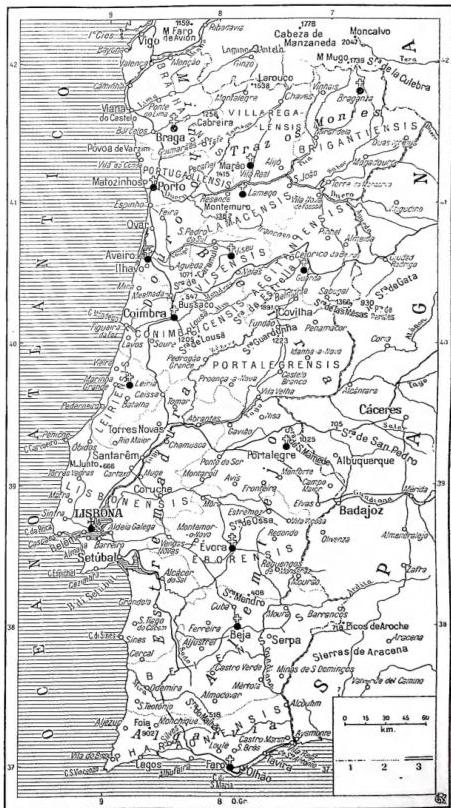
Portuguese territory constitutes the western margin of the Iberian plateau, which declines toward the coast in plains and terraces, interspersed, in the N. (Minho), in the centre (Beira), and in the S. (Algawe), with the final offshoots of the Spanish mountains.The temperate-oceanic climate is considerably more humid than in the rest of the peninsula, except in the extreme southern regions. Of the State’s 91,700 sq. km., 3,100 belong to the Azores and Madeira, which constitute 4 of the 15 provinces into which the territory of P. is divided. The population (8.5 million inhabitants, 90 per sq. km.), of coolatin origin, is highly homogeneous (only 0.4% foreigners) and almost entirely (94%) Catholic. Settlement density generally decreases from the sea inland and from N. to S.
P. is essentially an agricultural country; nevertheless, arable land covers less than 1/3 of the total area, as against 1/5 woodland and 2/5 unproductive land. Cereals, which yield very low returns per unit, are insufficient for domestic consumption. The economically most important crop is the vine, which provides a modest but high-quality product, largely destined for export (England, Brazil). The olive also produces a good harvest, and fruit-growing yields considerable revenue. Cork (half the world production), essences, and resins are obtained from the forests. Livestock farming is of little importance (sheep and goats; cattle are numerous in the N.); fishing (tuna and sardines) is much more significant. Mineral resources are varied (copper, tin, lead, silver, manganese, nickel, gold, chromite, etc.), but coal is scarce, and only pyrites and tungsten are exploited on a considerable scale. Industry is modest overall and concentrated in the principal cities.
The capital of the State is Lisbon (710,000 inhabitants), with a very busy port (it lies on the Tagus); Oporto (265,000 inhabitants) is the outlet for northern P. (Douro).
P. is a unitary republic with a corporative structure. Alongside the elective Asamblea Nacional, with limited suffrage, operates the Corporative Chamber, composed of representatives of economic interests and vested with legislative functions. The president, elected by direct suffrage, holds office for 7 years.
S. Tomé and Principe, volcanic islands in the Gulf of Guinea discovered by the Portuguese in 1471, form a Portuguese colony governed by a governor. The fertility of the soil and abundant precipitation promote luxuriant vegetation on the two islands (tropical forests); plantations introduced by the colonists permit exceptional production of cocoa, coffee, oil palm, peanuts, sugar cane, and cotton, most of which is exported. The population (57,000 inhabitants) consists mainly of Blacks, with a few mulattoes and about a thousand whites. The capital is S. Tomé (8,000 inhabitants), on the island of the same name, and residence of the governor.
II. CIVIL AND ECCLESIASTICAL HISTORY
I. The Middle Ages, civil history
The history of the western Iberian territory, up to the 11th century, cannot be distinguished from the historyof Spain. However, antecedent historical-political events and geographical and anthropological conditions constitute the basis of the autonomy of that portion of the Peninsula. Before the time of Fernando Magno and Alfonso VI, however, the region of present-day P. shared in the political vicissitudes of the entire Iberian Peninsula (v. SPAGNA).
(propr. *Bac. Col.)
PORTUGAL — 1) State boundary; 2) boundary of an ecclesiastical jurisdiction; 3) railways.
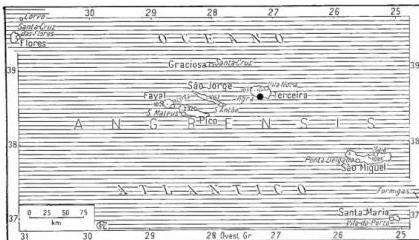
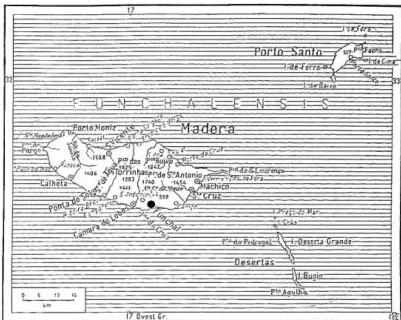
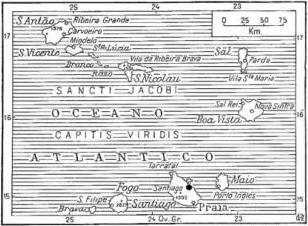
PORTOGALLO – Map of the Azores.
When Prince Dionigi assumed the government of the country in 1279, P. had achieved territorial unity and economic and administrative stability. He was able to found the Order of Christ, in place of the abolished Order of the Templars; to devote himself to the settlement and reclamation of the land (hence his title of Lavrador); and to promote commerce and the navy. He summoned the Genoese admiral Manuel Pessagna to provide instruction in navigation and seamanship. An illustrious poet, Dionigi founded the University of Lisbon in 1290, which was transferred to Coimbra in 1308. His marriage to Isabella of Aragon, proclaimed a saint by the Church, earned him immense prestige among the people, because the most virtuous woman devoted herself tirelessly to works of charity and benevolence.
But the prosperity of the Kingdom was put to the test by the resurgent Arab danger; in 1340, the combined forces of Alfonso XI of Castile and Alfonso IV, Dionigi’s son, won the great battle of Salado. The sad episode of Ines de Castro belongs to the time of Alfonso IV; Camões immortalized it in the Lusíadi, presenting the great love with which Prince Pedro loved her. He would become the quintessential “justiciar” King. The brief years of his reign were marked by perfect administrative stability and great serenity for the nation. Fernando was the last King of this first period of Portuguese history. His defects, weakness, and fickleness—he was called the Inconstant—brought invasions, wars, and struggles with the Castilians to P. On 16 June 1373 he signed the celebrated alliance with Edward III of England, still valid today. He nevertheless knew how to attend to agriculture through the Sesmarias law (1375) and to develop the merchant and military navy. Having died without descendants, he left the threat of Castile and the first great crisis of national autonomy.
For ecclesiastical history, from the Portuguese point of view, only Braga and Merida are of interest, and above all the former. As early as the 3rd century, the diocese of Braga was flourishing, and the bishop Paterno is known from this period. In the 4th century, at Evora, where pagan temples still existed, Christianity flourished under Bishop Quinciano, and likewise at Lisbon under Potamio. The invasion of the barbarians, between the 5th and 8th centuries, marked a dangerous crisis for Iberian Christianity, especially in the province of which Braga was the metropolitan see. The conversion of the Suebi was a significant event. Around the middle of the 6th century, St. Martino Dumiense, or Bracarense, was raised to the episcopal dignity, and two or three years later the First Council of Braga was held, followed by a second around 572, of which St. Martino, by then metropolitan, was the principal driving force. Until the conversion of the Visigoths under King Reccared, and thereafter also under Arab rule, the majority of Christians maintained their faith; only certain contaminations of doctrine and morals occurred, the logical consequence of contact with Jews and Muslims. The Church, however, endured very bitter times, because the problem of ecclesiastical organization under the Arab Empire presented ever greater difficulties. The Christian reconquest marked a magnificent revival in every field, religious, monastic, and apostolic alike. It can safely be affirmed that a new life in Lusitania began with the beginnings of the Christian reconquest, in every diocese—in Braga, Porto, Lamego, Beja, Evora, Lisbon, Coimbra, and so forth. The conquests of Alfonso Henriques took place with the help of the Crusaders, especially the Templars; the Crusades offered excellent opportunities to strike at Muslim power in its European stronghold, and P. benefited from them: Silves was reconquered during the Third Crusade through the efforts of Sancio I, and Alcacer in 1217 during the Fifth Crusade. This means that P. was rebuilt, stone by stone, with the collaboration of the defenders of Christendom.
The struggles of Alfonso Henriques’s successors with the clergy were merely episodes involving discipline and interest rather than religious matters, since the Portuguese leaders always maintained the loyalty sworn by the first king to the Church of Rome. In the time of Dionigi, Pope Nicholas IV, with the bull Cum olim of 7 March 1289, gave his “placet” to the Concordat of 40 articles, by which the rights of the king were defined without prejudice to the Church or the clergy. The same royal beneplacit, the first mention of which dates from 1361, cannot and must not be regarded as detrimental to ecclesiastical rights. The monastic Orders constituted, in medieval P., centers of civil, cultural, and political progress. The Cistercian Order, for example, followed by the Franciscan and Dominican Orders and others, worked to disseminate and defend culture, promoted the settlement of the territory, and contributed to its administration. As regards the military Orders, their contribution, as has been said, was fundamental to the conquest of the territory. The Order of Christ, founded by Dionigi and juridically established by Pope John XXIII with the bull Ad ea ex quibus of 15 March 1313, in place of the now-suppressed Order of the Templars, was, from the Portuguese point of view, a truly providential development, because the greatest contribution to the work of discovery came precisely from the Order of Christ. The celebrated Pope John XXI, Pedro Julião, author of many fundamental works, such as the Thesaurus Pouperum, was born in Lisbon between 1210 and 1220.
2. Modern Age. — a) Civil history. — King Fernando’s legitimate heir is Beatrice, wife of the King of Castile. The King’s widow, Leonor Teles, assumes the regency and then has Beatrice proclaimed queen.
This solution is unpopular, and a conspiracy is organized in which the future constable of the Kingdom, Nuno Alvares, today blessed of the Church, also takes part. The Master of the military Order of Aviz, Giovanni, son of Pietro and father of Fernando, wins the consent and sympathies of the people and is proclaimed king by the Cortes of Coimbra in March 1385, after the eloquent defense delivered by João das Regras. The forces of Castile, which had invaded the Kingdom, are destroyed that same year near Aljubarrota; other battles are won by the Portuguese, led by b. Nuno Alvares. The crisis is overcome. From the King’s marriage to Filippa of Lancaster was born the so-called «illustrious generation», which played an important part in the discoveries: Duarte, learned and cultured; Pietro, humanist and traveler; Enrico, called the Navigator because of the great impetus he gave to the discoveries, with the founding of the nautical school at Sagres. On 25 July 1415, the expedition led by the King and by the «high infants», as Camões called them, set out to conquer Ceuta. It was the first great blow dealt to Muslim power; in the Muslim temple of Ceuta, converted into a Christian church, the three princes Duarte, Pietro, and Enrico were knighted. Duarte’s reign witnessed the disaster of Tangier and the captivity of the infante Ferdinando, who voluntarily sacrificed himself so that Ceuta might remain Christian. From 1438 Pietro was appointed regent, until Alfonso V came of age to wear the crown. During his regency, the African policy continued with the conquest of Alcacer, Seguer, Arzila, and Tangier in 1471.
Atlantic policy was a constitutional necessity for the development of the Portuguese nation, which, closed off to the east by Spain, had no outlet except toward the sea. The scientific and methodical character of the Portuguese discoveries is demonstrated not only by the infante’s nautical school, but also by the works of Portuguese, Jewish, and later Italian geographers, cartographers, and scientists in general. Gil Eanes, according to the testimony of the historian Gomes de Azurara, reached the Canaries around 1433. The African coast as far as Cape Bon had been known to the Portuguese since 1415. In 1434 Gil Eanes himself reached Cape Bojador, according to Azurara. In the same year, the same navigator, together with Alfonso Gonsalves Baldaia, reached Angra dos Ruivos; in 1435 and 1436 they reached Angra dos Cavaleiros and Porto da Gale, on the Rio de Oro. From 1440 to
In 1487 Pero da Covilhã and Alfonso de Paiva set out for the lands of Prester John, Ethiopia, demonstrating the possibility of reaching India; while he was preparing the new expedition, King John died, and his successor, Emanuele I, entrusted the expedition to Vasco de Gama, who, having departed from Lisbon on 8 July 1497, arrived at Calcutta on 17 May of the following year. In 1500 Pietro Alvares Cabral discovered Brazil. In 1494, in view of the fact of the Spanish discoveries, the two powers of the Peninsula had reached the Treaty of Tordesillas, according to which all lands discovered or yet to be discovered situated east of a line drawn from pole to pole, 370 leagues west of the Cape Verde Islands, were to belong to Portugal; Spain was to receive the lands lying west of that demarcation. This treaty, although confirmed by Pope Julius II, did not, however, put an end to the disputes. During the reign of John III, the Portuguese advanced ever farther eastward, as far as Japan, China, and Oceania. The consequences of their discoveries were profound, especially for science and geography; they were even more so for civilization and the interests of the Church. In Brazil, for example, and in India and Asia, the activity of the missionaries, especially the Jesuits, was fundamental, both from the point of view of the faith and from that of the organization of civil life. During that period the Church was suffering from the crisis of the Lutheran schism. The tribunal of the Inquisition was established in Portugal on 23 May 1536, by the bull of Paul III, Cum ad nihil magis. This tribunal, which, once placed in the hands of the civil power, later committed abuses, at that time preserved Portugal from the terrible wars of religion. After the death of John III, the young King Sebastian ascended the throne. Having obtained the consent of the Holy See, which granted the expedition a Crusade bull, he engaged the Muslims at Alcacer Quebir, in North Africa. In the terrible defeat the young King disappeared in the fighting: thus was born the myth of «sebastianism».
This disaster brought Portugal into its second great crisis
(propr. Enc. Catt.)
Maria I ascends the throne, having married her uncle Peter III. At the turn of the 18th century, grave events unsettle Portugal. It had allied with Spain against France in 1793, but in 1796 Spain allies with France, forcing Portugal to abandon its alliance with England, and then in 1801 moves against Portugal to partition it with France. After the Continental Blockade against England is proclaimed, in 1807 the three French invasions begin, forcing the dynasty to take refuge in Brazil, while English troops participate in the defence of the country. New ideas ferment in Portugal and lead in 1820 to the revolution of Oporto with the demand for a constitution. King John VI (1816-26) leaves Brazil in 1821 and the following year grants the constitution, but by then Brazil has proclaimed its independence, leaving Portugal with only its African and Asian colonies. An absolutist reaction, begun in 1823, becomes entangled with dynastic disputes and keeps the country in turmoil for many years. The ambitious policies of King Louis I lead to an ultimatum from England (11 January 1890) regarding the African colonies, just at the beginning of the reign of Charles I; this causes grave public unrest and damage to the country's internal life. The King calls Giovanni Franco to government with broad powers (1906), who dissolves Parliament (10 May 1907). But such a sound and authoritarian government sharpens the spirit of revolt, and on 1 February 1908 the King and the crown prince are assassinated; then on 5 October 1910 the Republic is proclaimed, and the young King Manuel is sent into exile in England, where he died.
Ecclesiastical History. - Immediately after the conquest of Ceuta, Tangier, and other African cities, missionary work began in those lands. In 1462, Pope Pius II entrusted Friar Alfonso di Bolano with the conversion of the pagans of Guinea. In 1482, the King of Congo sent an embassy to John II requesting the light of Christian civilisation. The natives welcomed the missionaries favourably, and on Easter Sunday, 3 April 1491, the first Mass was celebrated in the territory of Soyo. Dominicans, Franciscans, and Jesuits all worked in the new Empire (v. ANGOLA). The conversion of Ethiopia was not achieved, but the Jesuits had begun a marvellous work of apostolate with the consent of the Ethiopians themselves (v. ETIOPIA).
In Asia, Friar Pero da Covilhã arrived in 1498 as a companion of Vasco da Gama, and it is believed he fell victim to the pagans. In 1500, the first priests, Franciscans, arrived in India with Cabral's fleet, the discoverer of Brazil. Until 1542, the missions were run by Franciscans, who by then had eleven convents, three orphanages, and eighty missionary residences from East Africa to the China Sea. Francis Xavier (v.) arrived in India on 6 May of that year, with special powers from the Pope and a mission from John III, and began the magnificent series of his apostolic journeys throughout the East. But the greatest glory of the Society of Jesus was the formation and Christianisation of Brazil. With the advent of enlightened despotism, the Society of Jesus received a severe blow in Portugal, as in all of Europe. The consequences were not long in coming, especially in the colonies. The secular and liberal spirit contaminated the structure of the nation's purest forces (though before then the work of a martyr of the Society of Jesus, St. John de Brito, had once again flourished). However, secularism soon nullified the fruits of so much centuries-long labour. At the beginning of the new century, with the advent of liberalism, religious Orders, monasteries, convents, and ecclesiastical hospitals in continental Portugal were extinguished following the law of 30 May 1834. The Church's assets were largely absorbed into the state's patrimony. The liberal work was completed by the anti-religious measures of the new Republic.
3. Contemporary Portugal
The first fifteen years of the new Republic have a very sad history: revolutions at every turn, disorders, party struggles, attacks, assassinations, persecutions against representatives of the Church, ministries succeeding one another in the impotence to administer justice, maintain public order, and balance the finances. "The Fatherland is sick," declares the public prosecutor himself, General Carmona, during the trial of the revolutionaries of 18 April 1925. On 28 May 1926, a movement led by General Gomes da Costa arises in Braga, initiating a recovery of national political life in order, legality, respect for the Church, and the sound ideas of tradition. On 25 March 1928, General Óscar Carmona is elected President of the Republic. On 27 April of the same year, Professor Oliveira Salazar of the University of Coimbra becomes Minister of Finance and later Prime Minister. The Constitution and the Portuguese Colonial Act, the new "magna carta" of the Lusitanian Empire, reflect certain principles defended in the papal encyclicals of Leo XIII, Pius X, and Pius XI. While maintaining the separation between Church and State proclaimed by the Republic, a climate of great respect toward the Church is created; the Concordat and the Missionary Agreement, signed...on 7 May 1940 with the Holy See, mark a new step forward in the defense of the spiritual heritage inherited from the ancestors. One of the most interesting measures of the agreement concerns marriage, which the Republic had considered a purely civil contract; now the Portuguese government once again recognizes legal effects in the civil sphere for religious marriage. From the perspective of international politics, Salazar's government maintained a policy of neutrality during the last war, preserved the alliance with England, and made a non-aggression and friendship pact with Spain. In the cultural field, under the ministry of Prof. Cordeiro Ramos, the last secular institutions created against the ecclesiastical organization by the Republic were abolished, and a reform of education was undertaken in which the moral and spiritual tradition of the Church was respected. Portugal thus managed to find and reclaim, as Pius XII said in his message of 31 October 1942, The lost path of its most beautiful traditions as a Most Faithful Nation.
Giuseppe Vittorino de Pina Martins
III. ECCLESIASTICAL ORGANIZATION
Portugal currently comprises one patriarchate and two metropolitan sees with 14 suffragan dioceses. 1) Patriarchate: LISBONA, with the suffragan dioceses: ANGRA, FUNCHAL, GUARDA, LEIRIA, PORTALEGRE; SANTIAGO DI CAPO VERDE (in the Cape Verde Islands); 2) Metropolitan see: BRAGA, with the suffragan dioceses: AVEIRO, BRAGANZA, COIMBRA, LAMEGO, PORTO, VILLA REALE, VISCU; 3) Metropolitan see: EVORA, with the suffragan dioceses: BEJA, FARO.IV. LEGAL STATUS OF THE CHURCH
This is regulated by the Concordat signed on 7 May 1940. In it, the juridical personality of the Catholic Church is recognized (Art. 1), and the free exercise of its power of order and jurisdiction is guaranteed, as well as full freedom of direct communication with the Portuguese clergy and Catholics (Art. 2).Clerics are exempt from the obligation to assume offices incompatible, by canon law, with the ecclesiastical state (Art. 13).
Ecclesiastical associations and organizations, which (Art. 3 and 4) may obtain recognition of juridical personality and acquire property, are free (Art. 20) to establish and maintain private schools, subsidized and equalized, parallel to state schools. The foundation of seminaries and any other institute of ecclesiastical formation or higher learning is free. In public elementary, complementary, and secondary schools, as well as in asylums, orphanages, official educational establishments, etc., Catholic religious instruction shall be imparted, using texts approved by the ecclesiastical authority (Art. 21).
The Portuguese State recognizes the civil effects of marriages celebrated in conformity with canon law and transcribed in the competent civil registry offices, as well as the exclusive competence of ecclesiastical tribunals regarding these marriages in matters of nullity and rato non consumato (Art. 22, 23, and 25). Art. 24 expressly declares that «in harmony with the essential properties of Catholic marriage, it is understood that, by the very fact of the celebration of the canonical marriage, the spouses renounce the civil faculty to request divorce, which therefore cannot be applied by civil tribunals to Catholic marriages».
The Concordat, which confirms the validity of the provisions not incompatible or modified by the agreements of 21 February 1857, 23 June 1886, 15 April 1928, and 11 April 1929, is supplemented by a missionary agreement concluded on the same date and jointly ratified on 1 June 1940; for the Indian dioceses V. PATRONATO.
Diplomatic relations between Portugal and the Holy See are maintained through the apostolic nuncio and the ambassador accredited to the Vatican.
V. LITERATURE
The Portuguese language, born in the territories of the extreme north-west of the Iberian Peninsula, precisely in those straddling the Minho River, which today marks the political border between Spain and Portugal, gradually extended southward along the western strip of the Peninsula, following the Christian reconquest that drove the Arabs back toward Africa. From the regions where it was first used, it was called Galician-Portuguese, until, mainly due to the absorption of Galicia by the Kingdom of León and its subsequent incorporation into the Spanish state (at the end of the 15th century), it eventually split into two distinct languages: Galician and Portuguese proper. However, from the time of the first linguistic traces (9th-10th centuries) until the end of the 12th century, the Portuguese language concerns philology, not literature. Literature begins toward the end of the 12th century, with poetry notably preceding prose, and is customarily divided into three periods: medieval, classical, and modern, each with distinct phases.1. Medieval Period (1189-1503). — It begins with a love poem by the troubadour Pai Soares de Taveirós, called the «Ribeirinha» after the pet name of the lady celebrated in it, and ends with the performance of the first auto by Gil Vicente, the Monólogo do Vaqueiro. The two phases generally recognized within it are named the Galician-Portuguese lyric phase (12th-14th centuries) and the palace lyric phase (15th century). The first, known through three of the surviving Cancioneiros among the many—perhaps fourteen—in which it must have been collected at the time (those of Ajuda, the Vatican, and Colocci-Brancuti or the National Library), and through the poetic compositions of King Alfonso the Wise of Castile, constitutes one of the most interesting and evocative manifestations of medieval Neo-Latin poetry. Without denying the influence exerted on it by Provençal lyric, it must be admitted that, beyond their local character and thus peculiar and original nature, the cantigas de amigo (songs of the beloved) offer an absolute poetic value, alongside the cantigas de amor (love songs) and the gentilezas (courtesies), forming one of the two themes treated in this lyric, according to the classification given by the 16th-century humanist and poet Garcia de Resende (the other theme is that of coisas de folgar o cantigas de escárnio ou de mal dizer: «things to amuse, or songs of mockery or slander», of lesser artistic importance due to their very nature as occasional works).
While the «love songs» pay an evident tribute to the troubadour fashion, echoing its themes and forms, the «songs of the beloved» reveal an unexpected poetic maturity. Their protagonist is the enamored woman, donna virgo or donna d'algo, who loves with sincerity of heart and expresses her anxieties by addressing her beloved (amigo) directly, or more often by speaking of him with her mother or a friend. The figure of the beloved, as she portrays him, animates the many types of songs in which the woman recalls where and when she met him, the dawns, the ballads, the zerramilhas, the pastorals, the pilgrimage songs, the barcaroles: among the elements of nature, due to the circumstances of place and time, the sea is the most frequent; the sentiment of love and the emotion of the sea merge, giving rise to the state of mind that Portuguese tradition underscores as typical of its people and its poetry—a complex of regret-expectation-hope and many other nuances, which that people collectively calls, with a word untranslatable into other languages, saudade. Of the more than two hundred authors of the cancioneiros (with approximately two thousand compositions), of 163 of whom some biographical information has survived, only a few names will be cited here, among those who composed primarily or exclusively «songs of the beloved»: Nuno Fernandes de Torneol (first half of the 13th century), author of delicate lyrics; João Zorro, minstrel-soldier-sailor (end of the 13th century), author of barcaroles; Martim Codax, author, in the first half of the 13th century, of the most famous barcarole, Cantas do mar de Vigo, the only lyric from the cancioneiros that has reached us accompanied by music; João Soares Coelho (ca. 1210-80), a cultured poet in contact with foreigners, probably also with Sordello; João Aires de Santiago, the most prolific composer after King Dinis. This great king (1261-1325) is indeed the most prolific and foremost representative of Galician-Portuguese lyric: in him converge and merge poetry of traditional, learned motifs and that of fresh popular origin.
The rapid maturity reached by the Galician-Portuguese language in lyric poetry, along with many other factors, extended its use to poets from other regions of the Peninsula. The first among them, in terms of human and poetic importance, was the grandfather of King Dinis, Alfonso the Wise (1221?-84), whose work in verse, the Livro das cantigas de Santa Maria (430 compositions), enriched that primitive poetry with a new theme, the religious one (in which the miracles of the Virgin are recounted and exalted), and also placed narrative expression alongside the strictly lyrical one: this brought about a decisive expansion in the framework of the first Iberian poetic manifestation (musical accompaniments by Alfonso the Wise have also survived). The palace lyric, transmitted through the Cancioneiro Geral, also called de Resende (1516), named after the aforementioned Garcia de Resende, who collected a thousand compositions by 286 authors from the second half of the 15th century, is artistically mediocre as a whole and monotonous, as it draws inspiration solely from the aristocratic class from which its composers come. It reveals the subsequent reversal of the cultural situation and the first signs of Castilian influence on Portuguese literature (a sixth of this cancioneiro is written in Castilian). Here too, the most frequent theme is love, but it is often treated with cerebral games: meanwhile, knowledge of the Italian Trecento poets emerges, at least in the external aspects of their inspiration, and almost always through the first Spanish Italianists (such as the Marquis of Santillana). Yet more than one poet stands out: Diogo Brandão (?-1530), melancholic and musical; D. João Manuel (1460-99), who suggestively adapts Petrarchan attitudes to the Portuguese temperament and, in the trovas in Castilian Sobre os sete pecados mortais, draws inspiration from Dante’s motif of the otherworldly journey. The reflection of Dante is more evident in the Trovas das cousas que vin by one of the least conventional and most interesting poets of the cancioneiro, Duarte de Brito. Duarte de Resende, on the other hand, introduces realistic touches into love poetry, unknown to the primitive lyric; while other composers adopt distinctly satirical attitudes.
The refinement of prose was slow but continuous. The Cistercians of the Alcobaça monastery were responsible for the first activity, translating from Latin or elaborating religious works (lives of saints, rules of Orders, etc.), chronicles, and «books of lineage» (these latter being attempts at universal history or encyclopedic treatises, such as the Nobiliário do Conde d. Pedro). However, the most significant genres concern chivalric life, didactics, and history. Above all, the atmosphere of the Round Table captivates Portuguese interest in those centuries and produces, with the História dos Cavaleiros da Mesa Redonda e da Demanda do Santo Graal (between the 13th and 14th centuries), the most notable work of literary prose preceding that of the historians, while the Amadis de Gaula (the oldest surviving written version of which dates from—
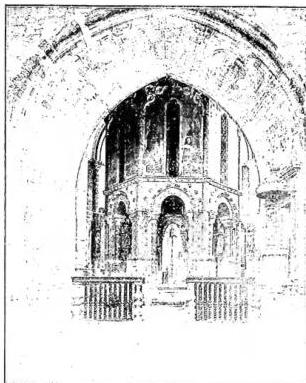
PORTUGAL - Interior of the Templars' Church (15th century) - Tomar.
1. Medieval Period (until 1502). – Alongside the Galician-Portuguese lyric poetry, which flourished from the 12th to the 14th century (v. POESIA PORTOGHESE), prose literature also developed, though more slowly. It produced, with the História dos Cavaleiros da Mesa Redonda e da Demanda do Santo Graal (between the 13th and 14th centuries), the most notable work of literary prose preceding that of the historians, while the Amadis de Gaula (whose oldest surviving written version, from the early 16th century, is in Spanish, but whose spirit is unmistakably Portuguese) inaugurated the series of great chivalric narratives of the Iberian Peninsula. In didactic prose, the activity of kings and princes, or that stimulated by them, stands out; foremost are: the Livro da Montaria by King João I (1365-1433); the Livro da Ensinança do Bem Cavalgar Toda Sela and the Leal Conselheiro by his son King Duarte (1391-1438); and the Tractado da Virtuosa Bemfeituria, the most balanced and mature work of the genre, by Pedro (1392-1449), brother of Duarte. But the great figure of medieval prose is the chronicler Fernão Lopes (1380?-1460), with the three surviving biographies of Kings Pedro I, Fernando I, and João I: his successors, such as Azurara and Rui de Pina, are inferior to him.
The ideal synthesis of the multifaceted 16th century was Luís de Camões ([v.] 1524-80), in whom the most significant elements of literary tradition and national consciousness converged. The poet fused them, in a felicitous union of culture and life, in the epic poem Os Lusíadas (1572), deservedly elevated to the symbol of his people. But Camões also spoke the highest word in lyric poetry, in which, wisely and skillfully adopting the Petrarchan atmosphere according to the Renaissance aesthetic canon of perfect imitation—perfect poetry—he expressed with admirable balance his inner exuberance.
The 17th-century or Spanish-influenced phase (1580-1700) is the weakest: the depression caused by foreign domination, first, and the inevitable restlessness during the consolidation of regained freedom (1640), later, along with the well-known phenomena of Baroque literature, at least in its traditional negative connotations, seriously compromised literary achievement. In poetry, an interminable series of mediocre epic poems vainly attempted to emulate Os Lusíadas, while an equally inexhaustible chain of lyrics delighted in playing with conceptism, in the atmosphere of Spanish fashion, as seen in the two main anthological collections, the Fénix Renascida (1716-28) and the Postilhão de Apolo (1761-62). Yet these works do not lack moments of freshness and spontaneity, foremost among them the religious-mystical inspiration, particularly evident in three nuns: Violante do Céu, Maria do Céu, and Maria Madalena da Glória. An exception to the mediocrity of the era is Francisco Rodrigues Lobo (1580-1622), who treated with originality not only various poetic genres—lyric, bucolic, epic—but also many prose genres, such as the pastoral novel and courtly themes, as in the latter case in Córte na Aldeia e Noites de Inverno (1619), his version of Castiglione’s Il Cortegiano. But the most notable writer of the 17th century is Francisco Manuel de Melo, son of a Portuguese father and a Spanish mother (1608-66), a classic author in both Portuguese and Spanish, addressing the most varied themes: from marriage (Carta de guía de casados, 1661) to history (História de los movimientos y separación de Cataluña, 1645), to sententious and humorous moralism (Apólogos Dialogais, posthumous, 1721, among which the fourth, Hospital das Letras, is famous for its acute critique of ancient and modern literary worlds), in prose; and in poetry, from theatre (Auto do Fidalgo Aprendiz, 1665) to lyric (almost entirely in Castilian: Las tres musas del Melodino, 1644, etc.). Meanwhile, 17th-century prose, wandering in conceptism in historical works and delighting in stylistic audacity in biographical and mystical genres, nonetheless displayed a suggestive effectiveness in sacred oratory, in which the Jesuit António Vieira (1608-1697) distinguished himself, preaching his Sermões in Portugal, Italy (also in Italian), and Brazil.
The 18th-century phase, also called the French-influenced period (1700-1825, the year of publication of Garrett’s poem Camões), is marked, in the first half of the century, by the emergence or reformation of academies, which sought to revive Portugal’s contacts with the outside world. Meanwhile, among the
(da Lio van Puyvelde, Les primitifs portugais et sa pénurie demande, Lisbona (II), t.n. tra pp. 8-7)
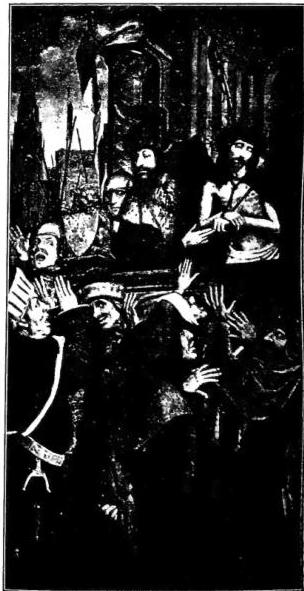
PORTUGAL - Ecce homo. Painting by Nuño Gonçalves - Lisbon, National Museum of Ancient Art.
Among the personalities oriented toward spiritual and intellectual renewal, that of Fr. Luis Antonio Verney (1713-92) stands out. Trained in Italy on the works of Muratori and Genovesi, he revolutionized the life of thought, particularly in pedagogy, in his country with the Verdadeiro Método de Estudar (1746). Meanwhile, the Arcadia Lusitana (or Ulisiponense, 1756) arose in Lisbon, echoing French spirits through Italian forms, recalling poetry to the paths of the national and foreign Renaissance and freeing the terrain from secentismo. Particularly notable in those decades were the theater (with the clamorous popularity, on Portuguese stages, of Goldoni and Metastasio, adapted to Portuguese taste), satire (among others, with a mock-heroic poem, Hissopo, by one of the two founders of the Arcadia, António Diniz da Cruz e Silva, 1731-99, which recalls the poems of Tassoni and Parini), lyric poetry (in which the other founder of the Arcadia, Pedro António Correia Garção, 1724-72, distinguished himself among many), and the epic (restored to honor by José Basilio da Gama, 1740-95, and José de Santa Rita Durão, 1722-84, both of Brazilian origin). However, toward the end of the century, many so-called Arcadians were such only in part, or no longer at all: poetry regained vitality (and warmth returned even in culture and in the fashionable versification of scientific themes), especially by returning to the sources of sentiment, primarily with Manuel Barbosa Bocage (1765-1805), who restored the sonnet to the human intensity and artistic balance lost after the sixteenth century. Romanticism was now imminent.
4. Modern Era (1825-1952)
The Romantic period is precisely the first of its three phases, extending until 1871, the year of the so-called "Democratic Conferences of the Lisbon Casino." Violently set in motion by the French invasion and liberation, and later by the civil struggles between absolutists and liberals, two writers who had experienced exile, João Batista de Almeida Garrett (1799-1854) and Alexandre Herculano (1810-77), infused their literature with new ideas, adapting them to local and patriotic circumstances and temperament. Garrett, with his restless, socially and politically fortunate, and emotionally inexhaustible existence, revived his lyrical (especially in the collection Fólias Caídas, 1853), theatrical (especially in the drama Fr. Luis de Sousa, 1844), and narrative (especially in the novel Viagens na minha terra, 1846) works with fine sensitivity and acute psychological intuition. Garrett also merits recognition for having drawn attention to ancient poetic traditions with his collection Romanceiro. However, the cultural integration of Portugal into the rest of Europe Herculano (v.). Beyond his artistically mediocre poetry, he cultivated narrative and history, gradually shifting from historical novels to history proper, revealing therein the scrupulousness of a researcher of what the author considered the truth of facts and men. While Herculano's narrative masterpiece is the novel Eurico o Presbítero (1844) — which addresses a theme dear to Iberian literatures, the conflict between sentiment and duty in the Catholic priest — his most important historical work is the História de Portugal (1846-53), alongside the collection Portugaliae Monumenta Historica. Far inferior to the fame attributed by tradition in the Romantic movement is the poet António Feliciano de Castilho (1800-75), more interesting as a translator than as an original author. Romantic literature evolved, producing in lyric poetry two movements sliding toward sentimentalism (those of the Coimbra newspapers O Trovador, 1844, centered around João de Lemos, 1818-90; and O Novo Trovador, 1851, centered around António Augusto Soares de Passos, 1826-60); in narrative and history, works laboriously following in Herculano's wake; but defining itself with new, increasingly visible values in the psychological novel, where the transition to the new phase primarily occurred, with the so-called rural novel of Júlio Dinis (1839-71), an author of fine psychology in the study of rural environments (particularly in As pupilas do Senhor Reitor-Crónica de aldeia, 1866, and A Morgadinha dos Canaviais, 1868) — viewed with benevolence but without distortion —and with the passionate novel of the highly prolific Camilo Castelo Branco (1826-90), whose work oscillated between disordered and belated Romanticism and the pitiless, acutely modern observation of the times and customs. Among his works, Amor de Perdição (1862) is famous and widely popular in Portuguese tradition for its Romantic and passionate atmosphere, but Novelas do Minho (1875) and A Brasileira de Prazius (1882) are certainly more notable, and along with his many other minor works of the genre, they can be considered the introduction to realism. Meanwhile, between Romanticism and realism, apart from poetic schools, the suggestive lyrical work of a solitary singer of love, João de Deus (1830-96), flourished with Flos do Campo (1868) and Campo de Flores (1893).
BIBL.:
For the 18th century: A. J. Saraiva, História da cultura em Portugal, vol. III, Lisbon 1955; J. Pereira Tavares, A Arcádia Lusitana, Lisbon 1937; A. Ferreira de Brito, O Verdadeiro Método de Estudar de Luís António Verney, Coimbra 1949; for the 19th century: A. J. Saraiva - Ó. Lopes, História da literatura portuguesa, Porto 1955; A. Ferreira de Brito, Garrett e Herculano, Lisbon 1941; A. Ferreira de Brito, O romance histórico em Portugal, Lisbon 1942; A. Ferreira de Brito, Camilo Castelo Branco, Lisbon 1945; A. Ferreira de Brito, Júlio Dinis, Lisbon 1946; A. Ferreira de Brito, João de Deus, Lisbon 1947.
G. GETTO
The Realist, or post-Romantic, phase is precisely what the second period of the modern era (1871-1900, the death of Eça de Queiroz) is called. It begins with the violent rebellion of a group of young students from Coimbra against the dictatorship of the elderly Castilho, a rebellion that started with what was known as the "Questione di Coimbra" (1865) and took shape with the aforementioned "Conferências Democráticas do Casino de Lisboa" (1871), held by those young men, which, though soon suspended by the authorities, set in motion the course of new ideas. The revolution brought by this generation is the ideal sum of three distinct manifestations: around Antero de Quental (v. QUENTAL; 1842-91), who initiated the "Questione" and prepared the "Conferências," the surge of social ideas that, for simplicity, can be called socialism (politically, it later dissolved when Antero de Quental withdrew into his human drama and poetic world); around Teófilo Braga (1843-1924), the school of positivism in science and republicanism in politics; around Eça de Queiroz (1845-1900), the world of writers with seemingly more conciliatory ideas and more composed attitudes but with vast horizons and a simultaneously destructive and constructive critique: this is the group defined, by one of its members, Oliveira Martins, as the "Vencidos da Vida" (Defeated by Life). Antero de Quental produces the poetically highest work of the modern Portuguese world, especially in Sonetos completos. The restless and inexhaustible cultural and literary research of Teófilo Braga, aimed at gathering Materiais para a história da civilização portuguesa, prepares the documents that will make a calmer and more objective interpretation of the literary fact possible for the next generation. And the complex of thought and art realized by the "Vencidos da Vida" significantly shortens the distance separating Portugal of the time from other countries. João Pedro de Oliveira Martins (1845-94) bursts into the national historical tradition with decisive violence, obeying the formula—enunciated by himself—that "history must always be a resurrection, and the artistic or synthetic process will always be the one suited to it." Thus, from his works (the fundamental ones being História da República Romana, 1885; História da civilização ibérica, 1879; História de Portugal, 1879), emerges a Portugal seen and felt in a way different from traditionalism, suggestively inserted into a pathetically evoked world. Eça de Queiroz makes the novel complete the full path of realism (O crime do Padre Amaro, 1875; O primo Basílio, 1878; Os Maias, 1880), deeply scrutinizing the Portuguese soul and, in the works of his later years (A ilustre Casa de Ramires, 1897; A cidade e as serras, 1901; and the 16 letters of Correspondência de Fradique Mendes, 1891), covering with a veil of restrained yet moving poetry the man at the center of his literary creation. Ramalho Ortigão (1836-1915) in prose and Guerra Junqueiro (1850-1923) in poetry ideally close the group of the "Vencidos da Vida"; and while narrative prose expands—and also gets lost—in the imitation of Eça de Queiroz, journalistic prose refines (and travel writing increases, which also concerns Italy, but produces its best pages with the books of Wenceslau de Morais, 1854-1929, on Japan), historiographical prose regains seriousness of study, and an increasingly confident awareness of erudition emerges (as, in the field of philology, with Francisco Adolfo Coelho, 1847-1919, and José Leite de Vasconcelos).
For Antero de Quental: T. Braga, Antero de Quental. Estudo de psicologia e de crítica, Porto 1896; A. Casais Monteiro, Antero de Quental, Lisboa 1945; for Teófilo Braga: A. Sérgio, Teófilo Braga e o positivismo, Lisboa 1913; for Eça de Queiroz: A. Casais Monteiro, Eça de Queiroz e a questão social, Lisboa 1945; J. Pereira de Sampaio (Bruno), Eça de Queiroz, Lisboa 1927; for Oliveira Martins: A. Sérgio, Oliveira Martins, Lisboa 1924; for the "Vencidos da Vida": J. Pereira de Sampaio (Bruno), Os vencidos da vida, Lisboa 1924; for the general literary history of the period: A. J. Saraiva - Ó. Lopes, História da literatura portuguesa, Porto 1955; T. Braga, História da literatura portuguesa, Porto 1870-73; A. F. de Castilho, Noções elementares de literatura nacional, Lisboa 1865.
A. V.