
ARCADIA, ACCADEMIA della. — Literary academy, founded in Rome in 1690 by 14 men of letters and rapidly rising to great prominence and extremely wide diffusion. To the programmatic originality and hence the extravagances of seventeenth-century culture, it wished to oppose a return to simplicity of feeling and to an unaffected pastoral quality of the imagination. Its members, on joining it, assumed Greek names and called themselves “shepherds”; its many sections in all the Italian cities were called “reservoirs”; as protector, or Great Shepherd of the shepherds, the Child Jesus was chosen, born in a stable and among shepherds; as its emblem it adopted the Greek syrinx wreathed with laurel and pine. The first and principal seat in Rome (the “central reservoir”) was inaugurated on 15 October 1690 with a gathering held in the garden of the Reformed Friars Minor at S. Pietro in Montorio. The A. received the high protection of Innocent XII the following year; nor did it lack the favor of Christina of Sweden, a great patron of artists and men of letters in Rome. Its laws were drawn up in Latin by the man of letters and jurist Gian-
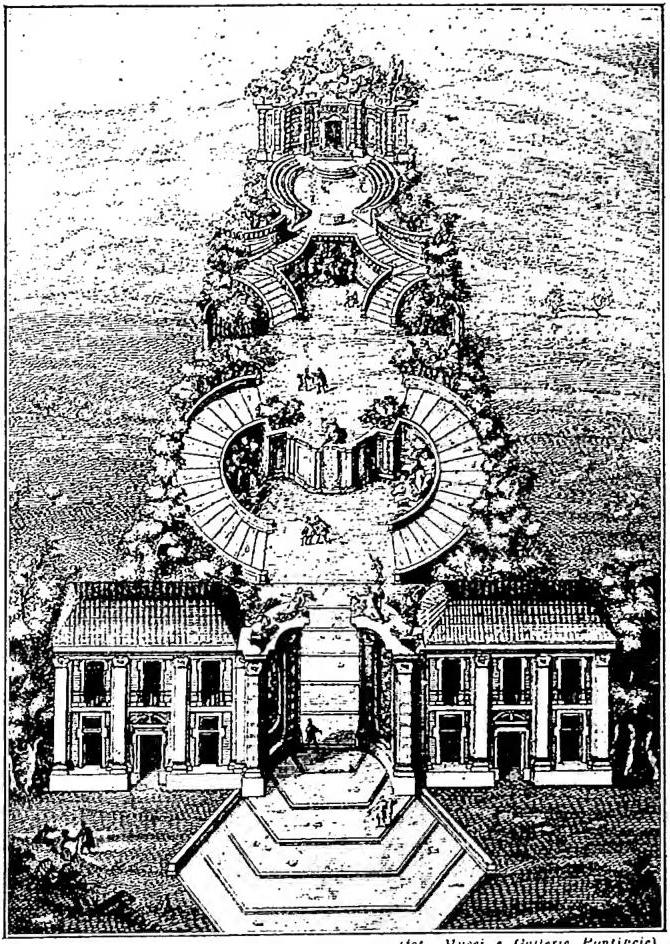
vincenzo Gravina; its head, with the title of General Custodian, was Giammario Crescimbeni, author of Bellezze della volgar poesia (1700), in which the Platonic aesthetics of the Arcadians are formulated, and of Memorie istoriche dell'Accademia. In keeping with its character, it held its gatherings in the open air, in the Bosco Parrasio; then, in 1725, through the munificence of John V of Portugal, it settled on the Janiculum. During the first thirty years of the eighteenth century there was scarcely an Italian city in which the A. had not established one of its colonies, as they put it in Latin. Protected and favored by the leading figures of the age (the Roman Arcadians often enjoyed the lavish hospitality of Cardinal Ottoboni in the gardens
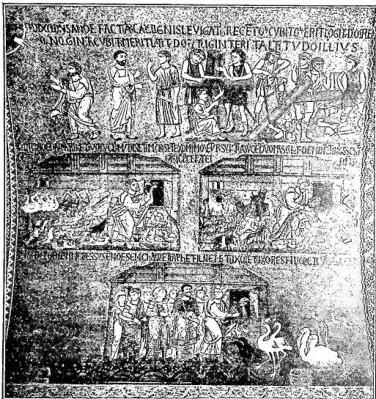
ARK of NOAH — Construction of the ark, introduction of the birds and quadrupeds, departure from the ark. Mosaic (13th century). Venice, Basilica of S. Marco, atrium.
Among the more notable Arcadians one may also recall: Monsignor Sardini, from Lucca; Monsignor N. Forteguerri; Canon G. Crocchiante; and, among the poets, G. B. Zappi, C. I. Frugoni, A. Bertola, I. Vittorelli, P. Rolli, E. Manfredi, and Metastasio. The A. also welcomed the most famous improvisers, such as the cavalier Bernardino Perfetti and Maria Maddalena Morelli (among the Arcadians, Corilla Olimpica).
It may in fact be said that, at least during the first half of the eighteenth century, all Italian poetic production unfolded within the sphere of the A., which came to dominate completely the literary fashion of the peninsula, imposing uniformity of aesthetic and artistic canons. It was precisely in these aesthetic canons, and not in any profound vital movement, that the reaction it opposed to seventeenth-century culture consisted. G. B. Marino and his school had indicated wonder as the end of poetry, and their Baroque style was the result of a search for the new at any cost, with wonder and novelty taking the place of other spiritual values that were lacking; thus, in the imaginism of the seventeenth-century writers, one must see the expression of mere sensualism. The A. sought to fill this inner void by other means, but did not abolish II. Against originality as an end in itself, the Arcadians restored imitation to honor, placing it before inspiration, and asserted the rule of rules. This position already contained in germ the mannerism and dilettantism that remain the limitation of all Arcadian poetry. Apart from its established Tassoian origin, the A. also took its pastoral world from Marino, whom it sought to oppose. Of the three tendencies that may be distinguished in Arcadian poetry, the Petrarchan tendency and the classicizing tendency, which drew, in a broader or narrower sense, on Platonism, and especially on the Renaissance Platonism of M. Ficino, were undoubtedly the most artificial; whereas the pastoral and Anacreontic tendency produced the finest “canzonette” that have survived (by Rolli and certain others) and the happiest moments of Metastasio. Even in these livelier expressions, feeling rarely rises above sentimentality and proves to be little more than a pretext for the melody of the verses and the refined elegance of expression, thereby indicating that sensualism, if it had been a constitutive element of Marinist imaginism, remained so for the Arcadians as well. This deficiency of feeling in its most genuine and vital form makes Italian Arcadian poetry a literary phenomenon parallel to the sensationalism of French philosophy. In this respect, the poetic praises bestowed by Frugoni on Condillac remain significant.
The A. began to decline in the second half of the eighteenth century; its decline became increasingly marked as the times changed and brought new demands. After a long period of colorless and difficult existence, the academy was reorganized in 1925, with the addition of Accademia letteraria italiana. Its seat was transferred from the Bosco Parrasio, which remains the property of the Institute, to the Angelica Library of Rome. The Academy has published 13 vols. of Rime and three periodicals: L'Arcadia (1889–1896), Giornale arcadico (1898–1916), Atti dell'Accademia e scritti dei soci (from 1917).
Salvatore Rosati
ARCADIO (Imperator Flavius Arcadius Pius Felix),
ROMAN EMPEROR. - Son of Emperor Theodosius
was represented by Alaric, king of the Visigoths, who repeatedly invaded Illyricum, provoking the intervention of Stilicho, minister of the Western Empire; Arcadius ended by granting him the title of magister militum, making him a federate.
Famous are the struggles waged in Arcadius' time by his wife Eudoxia against the bishop of Constantinople John Chrysostom, already disliked by Gainas, who was an Arian. Arcadius died on May 1, 408, and was succeeded by his young son Theodosius II under the guidance of Anthemius.