
TORQUATO TASSO. - Born to Bernardo and Porzia de' Rossi in Sorrento on 11 March 1544, he spent his early childhood in Naples with his mother and sister, whom he left (the former never to see again, and the latter only to meet again in 1577 in a romantically adventurous and elegiac encounter) around 1554 to join his father in Rome, an exile since 1552. After a brief stay in Bergamo with his paternal family, he rejoined his father in Pesaro and Urbino, where, in the refined court of Guidubaldo II della Rovere and in the company of the highly learned Bernardo, he began his experience of courts and letters. In 1559 he was in Venice with Bernardo (who had moved there to oversee the printing of Amadigi): and there he almost certainly began composing Gierusalemme, the first draft of what was to become his greatest poem. Having moved to Padua in 1560-61 to study law, he did not abandon what was now revealed as an irresistible poetic vocation; thus, while writing the first verses inspired by his love for Lucrezia Bendidio and Laura Peperara, he undertook and completed Il Rinaldo, a poem in twelve cantos in ottava rima, published in Venice in 1562 with his father’s permission.
In Padua, his literary education benefited from the conversation and lessons of Sperone Speroni, Francesco Piccolomini, Carlo Sigonio, and the environment of the Eterei, the Academy founded by Scipione Gonzaga, with whom the poet formed an affectionate friendship. And among the Rime degli Accademici Eterei, in 1567, T. published the first notable group of lyrics. Toward the end of 1565, having entered the service of Cardinal Luigi d’Este, he had meanwhile moved to Ferrara. There, at the Este court, whose lavish life he participated in with brilliant success, and in the Ferrarese Academy, where he was to deliver an oration and read the Discorsi dell’arte poetica and present the fifty Conclusioni d’amore, he developed those two fundamental themes of his life that revolve around the Court and the Academy, understood as complex meeting places of culture and civilization. In the retinue of the cardinal, in 1570-71 he traveled to Paris, from where he addressed to Ercole de’ Contrari a letter-treatise, thoroughly imbued with a savory geographical taste, on the affairs of France. In 1572 he was back in Ferrara, now in the service of Duke Alfonso II. This was a happy season of poetry for T.; he continued his lyric production, of sonnets, canzoni, and madrigals, of love (for Laura Peperara and Eleonora Sanvitale) and of encomium (for Lucrezia and Eleonora, the Duke’s sisters); in the spring of 1573 he composed Aminta, a pastoral fable in five acts; then he began Galealto re di Norvegia, the first attempt at a tragedy which, under the changed title Re Torrismondo, he would complete in 1586-87; and finally, in April 1575, “the poem of Goffredo,” to which he had dedicated himself for several years with enthusiasm of imagination and assiduity of labor, was finished. But already by the end of that year, the first symptoms of imbalance began to disturb the integrity of his body, worn out by fatigue, and of his mind, subjected to excessive tension. The long creative struggle was followed by the exhausting work of revising the poem, a labor poisoned both by the frenzy that gripped the poet anxious for success and by the disappointment over the criticisms of the poem that reached him from all sides—from Scipione Gonzaga, Sperone Speroni, Silvio Antoniano, Flaminio de’ Nobili, Pier Angelo Bargeo—whose judgment he himself had entrusted with his work. Artistic doubts, complicated by religious scruples and vague fears that were taking the form of persecution mania, made the dialogue with these revisers increasingly tormented. The suggestive and sorrowful testimony remains in a thick sheaf of letters and in the Allegoria della Liberata (1576), in which the poet strives to devise a hidden moral meaning for the poem. The examination, to which he voluntarily submitted, by the inquisitor (in Bologna in 1575 and two years later in Ferrara), with the subsequent absolution, did not free him from his morbid restlessness. But the most clamorous manifestation of the illness occurred one evening in June 1577, when, believing himself spied upon during a conversation with Princess Lucrezia, he hurled a knife at a servant. Confined for his dangerous frenzy, he escaped in romantic circumstances and began that painful wandering which introduced such a restless, tormented, and hallucinatory note into his biography: from Ferrara to Sorrento, to Rome, and back to Ferrara for a few months, with a new departure for Mantua, Padua, Venice, Pesaro, Urbino; and then again to Ferrara, Mantua, Vercelli, Turin. In February 1579 he returned to Ferrara, while at court everyone was busy with preparations for the Duke’s third marriage to Margherita Gonzaga; thus neglected and disappointed, in an access of his illness, on the evening of 11 March he burst into violent invectives against his former protector. Confined and chained as a madman in the hospital of S. Anna, he would spend seven long years there, treated, as the medical customs of the time dictated, more as a prisoner than as a patient, although later the initial severity was much mitigated. In S. Anna, the poet, during long intervals of lucidity, resumed his literary occupations and conversations with friends, and meanwhile sought to defend himself against the accusation of madness and to regain his freedom: of the sorrowful and anxious, fervent and feverish existence of this period, the letters are documents, some of them profoundly human, certainly among the most suggestive of his correspondence. To these years belong, along with many letters, a good number of lyrics, the Dialoghi, and the Apologia della Liberata. And it was during these years of imprisonment that the editorial vicissitudes of the Tassian masterpiece began. Published without the author’s knowledge and to his detriment by Celio Malespini in 1580 in Venice under the title Goffredo in a most incorrect and incomplete edition, republished complete the following year by Angelo Ingegneri in Padua and Casalmaggiore under the title destined to endure, Gerusalemme Liberata, it finally appeared in the same
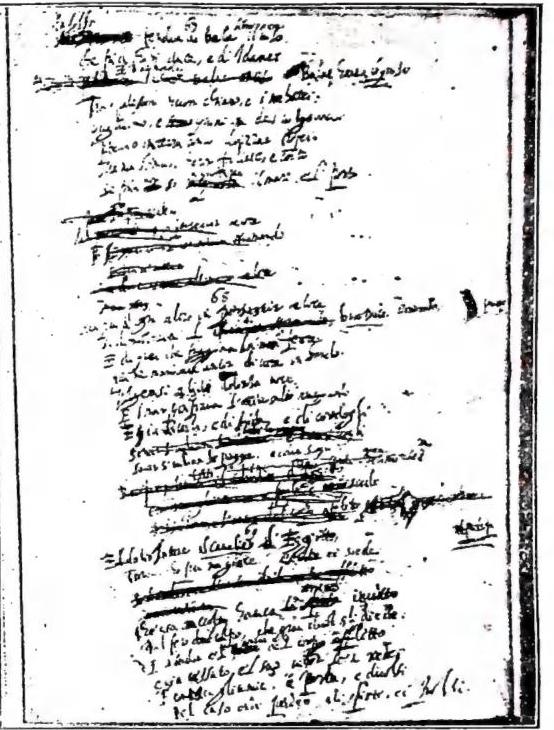
Tasso left a dense record of his external vicissitudes and a vivid portrait of his inner life in his Lettere (approximately seventeen hundred), which must, however, be read with great discernment, avoiding the confusion of their ideal truth with historical-archival fact. Beneath their consistently dignified and highly controlled literary seal, the poet conveyed, through a series of direct and indirect psychological details, the suggestive voices of his soul stirred by inner and outer events. This is the voice that resonates and takes shape in the court—a physical and moral, aesthetic and cultural reality that governs and adorns his writing, justifies his concettismo, and sustains and directs his persistent, painful pleas. Yet these very pleas, alluding to the poet’s enduring state of need and restless seeking, are among the most frequent and painful notes. Often, the sentiments of sorrow, melancholy, and death brush against these pages, while sighs and anxious gusts of desire for pleasure and well-being occasionally mingle and alternate. Frequently, the poet’s own physical presence emerges in some spontaneous gesture, or in the most singular hours of his day, or in the wholly exceptional experience of a new sensation, fermenting in zones of hallucination and mystery. Linked to the themes of sorrow and death is that of religious experience, which Tasso confesses with undeniable sincerity, though, it must be acknowledged, with little contemplative genius and devoid of ascetic fervor. More vivid and original are the themes engaging his intelligence in worldly matters, as seen in certain letters of objective dissertation, notably in the one on French affairs and another to Ercole Tasso on marriage. But the most intense notes touch upon the poet’s and scholar’s critical conscience, which exercises itself with vigilant and meticulous scrutiny, compelling relentless revision of the poem—a process documented in the extensive correspondence accompanying the transition from Liberata to Conquistata.
An expression of Tasso’s deep engagement with the critical problems of poetry, in both technical and rhetorical terms, are the early Discorsi dell’arte poetica in three books and the mature Discorsi del poema eroico in six books, around which a series of other writings revolve (from the Allegoria della Gerusalemme Liberata to the Apologia in difesa della Gerusalemme Liberata, to the Giudizio sovra la sua Gerusalemme da lui medesimo riformata; from the Considerazioni sopra tre canzoni di M. Giov. Battista Pigna intitolate le Tre Sorelle to the Lezione sopra un sonetto di Mons. Della Casa, and other minor works). Within the frameworks of contemporary literary Aristotelianism and along the trajectory from an aesthetics of hedonistic inclination to one of ethical-pedagogical tone, Tasso articulated his aspiration for an exceptional literature, a taste both solemn and academically refined, a «parlar grande e magnifico». The true value of the Discorsi lies in their programmatic and justificatory character regarding a taste and a poetics. Moreover, for those who can look beyond the tedium of their doctrinal scaffolding and the abstract schemata of Aristotelianism and the rhetoric of the time (which nonetheless served an indispensable didactic function), it is still possible to capture fresh impressions and witness the celebration of a genuine literary sensibility. Thus, the Discorsi, while extensively documenting Tasso’s poetic culture and often offering the key to understanding certain tonalities of his poetry, testify to his exquisite ability to comprehend and recall the poetry of great authors, from Virgil to Dante to Petrarch.
The twenty-eight Dialoghi are neither a work of philosophy nor a mere stylistic exercise, and even less the synthesis of philosophical and poetic form that the author may have envisioned. Instead, they occupy a space between these possibilities, reflecting Tasso’s intellectual and literary preoccupations without fully realizing any single ambition.
The Dialogues should rather be considered a work of literature, the result of a synthesis that operates not between different forms and distinct spiritual moments, but between contents (or forms reduced to contents) and diverse motifs and references. Here, it is not even excluded that one often remains at a mere stitching together of fragments or at the condition of scattered isolated fragments within an arbitrary framework. On this terrain of varied literature, alongside the need for orderly and captious dissertations, flourishes the pleasure of colorful descriptive pauses; alongside the love for sententious maxims, the exploratory curiosity about certain rare and precious matters; and the abandonment to autobiographical recollection or to affectionate personal confidences; and at times, the same vague smile of poetic contemplation. In the framework and subject matter of the Dialogues, in their development and tonal rhythm, one perceives the vivid echo of exemplary courtly conversations. And in reality, they perpetually oscillate between the moralistic and the dilettantish character, between the literary and the worldly accent. An indication of this are the very topics: games, honest pleasure, masks, Tuscan poetry, precedence, nobility, the court, enterprises, virtues, love, beauty, etc. Thus, reasoning, in its most strictly logical intent, remains in a zone of aridity devoid of inventive joy, while the more animated attention gathers on the framework of the dialogue, on the serene and luminous or nocturnal and stormy landscape backdrops, on certain intimate and luxurious interiors, on some beautiful female portraits or, by contrast, on some restless and witchlike visions. Of great interest are the frequent hints that establish a relationship with the events of the poet’s life and with the cultural motifs of the Counter-Reformation and the imminent Baroque. Among the Dialogues, it is possible to find the most accomplished and loftiest examples of Tasso’s prose, which are precisely offered by the Messaggero and the Padre di famiglia.
The Rinaldo, which narrates in twelve cantos in ottava rima the feats of arms and love of the young paladin, marks the true beginning (gathered around a vast, accomplished, and demanding trial) of Tasso’s poetic career. In this youthful poem, composed with the declared intention of imitating "partly the ancients and partly the moderns," the poet himself does not yet truly make his appearance, but rather the man of letters who tests his craft and imagination, and, with him, the adolescent who loves to translate into images his taste for action, glory, and love. The Rinaldo is the expression of an autobiographical dream: it amounts to the confession of a youthful fantasy. In the eponymous hero, Tasso delights in mirroring himself, secretly enjoying the thought of imagining that beautiful optimistic fable as valid for himself. The word does not develop with ease; it remains foreign to an authentic psychological motivation, to a justified thematic development, to a clear figurative process, to a living sense of time and space. Nevertheless, the Rinaldo holds a non-negligible significance in the history of Tasso’s poetic experience. In it, some fundamental themes and tones make their first appearance. Thus, the warrior motif: which, in its best moments, gives rise to a characteristic spectacular taste, often accompanied by an affective reaction that presents itself as a most suggestive elegy of death. Thus, and these are the most intense anticipations of Tasso’s great poetry, the restless and languid representation of love, the sorrowful expression of the doubtful and restless wandering of the mind, the contemplative pleasure in the rapid alternation of idyllic and luminous landscapes and backdrops of darkness and storm. In the youthful poem, then, Tasso is still seeking his style, and an absolute center of interest is still lacking; therefore, the value of the Rinaldo seems to gather in some generic situations, or in isolated motifs, in single verses, or in detached words, which are like the initial symbols of the future Tassian poetry.
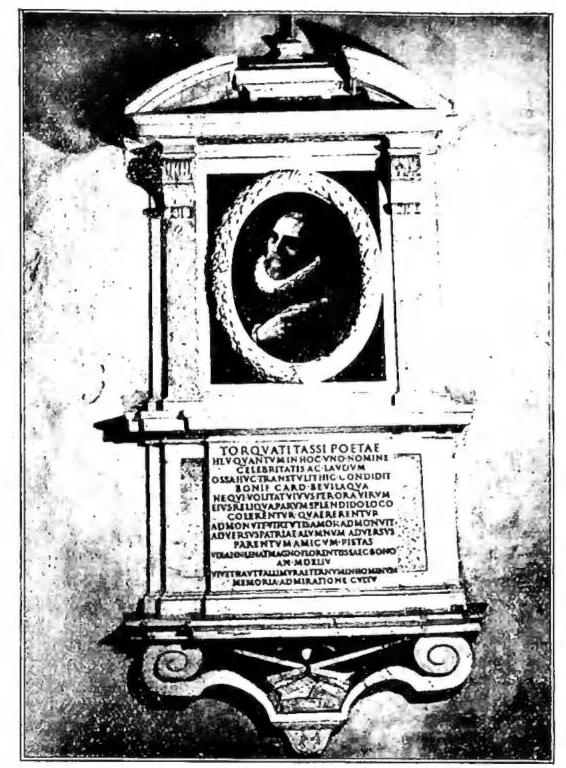
(Int. Sestini)
TASSO, TORQUATO - Tomb erected by the Ferrarese cardinal Bonifacio Bevilacqua (d. 7 Apr. 1627) - Rome, church of S. Onofrio.
The influence on Tasso’s imagination is exerted by the critical suggestion of recent and ancient models, of original structure and exquisite craftsmanship, belonging to the "pastoral" genre, along with the taste for masquerade and the perpetual winking allusion to courtiers and courtly affairs, and further by the desire to escape courtly life and the curiosity for a chimerical world of simple existence lived close to nature and in harmony with II. From this intricate fabric of cultural, civil, and technical stimuli, and from the skilful balance of the multiple tones that emerge from it, the Aminta derives its exquisitely literary framework and its highly decorative character. In this composition, in which multiple expressive vectors operate, harmonised by a vigilant literary consciousness, there flows a vein of poetry that can be identified in the intuition of love captured in its most germinal and shadowy forms, in its first unconscious blossoming, in its hidden rooting and naive development, in its timid and shy manner. A fertile nucleus of this poetry acts in the figure of Aminta, upon whom converges the suggestion derived from the lyrical analysis of the first unconscious effects of love. But this poetry is expressed more intensely in the figure of Silvia, in whom are explored the reasons and the progress that secretly and slowly lead to the explosion of love in a soul reluctant to II. This figure can be said to obey no other calls than those of the discovery, lyrically felicitous, of an emerging sensibility, fixed in its slow process of formation. For this reason, Silvia is also the only true character who has a history and a development. Indeed, it is solely upon this development that the dramatic movement of Aminta is sustained and justified, a movement that has sometimes been denied by critics.
Tasso remained faithful to the theatre in undertaking Galealto re di Norvegia, soon interrupted and later resumed as Re Torrismondo. Two impulses presided over the composition of this tragedy: one, fully conscious, of a technical-critical nature, aimed at applying Aristotle’s principles and imitating Oedipus Rex by Sophocles; and another, more obscure, of a psychological and imaginative nature, intent on evoking a turbulent and disturbed pathetic material, which, while gathering the suggestions of Seneca’s theatre, responded to the secret inclination of Tasso’s sensibility. In these five acts, the theme of incest is developed: an incest, in intention, of the Oedipal type (that is, understood as a fatal misfortune that arrives unwanted, unforeseen, and irreparable) but in effect, through unconscious suggestion, unfolded according to the type of Phaedra’s incest, that incest which is temptation and sinful reality, consciously present in the soul that does not know or does not wish to reject II. In this work, more than the characters—among whom, however, Alvida is particularly felicitous—it is the relationships between them that seem to be felt, relationships entangled in instinctive attractions and fatal divisions. Among the characters who pass bewildered across the stage, there is a continuous opening of abysses. The tragedy seems to culminate in a ruinous collapse of sweet hopes and settled illusions, which projects and refracts itself into a dark and stormy sky, present in almost all the images and words of these five acts. If Aminta represented the flowering of the sweet illusion of love, preserved within a frame of spring-like nature, Torrismondo represents the collapse of this illusion, reflected against a nocturnal backdrop of clouds and lightning, so that between the two works the inspiration seems to unify and compose itself in the fundamental rhythm of the birth of illusion and its fatal fading. And if in the smiling pastoral fable the language flowed harmoniously in a rare balance of recitative shading into song, here a syncopated language prevails, full of interjections and interrogations, whose most significant and poetically responsible documentation is found in the magnificent final chorus.
The concern for a meticulous formal revision, which becomes quite evident and indicative in the transition from the first draft of the tragedy (Galealto) to the definitive version (Torrismondo), assumes a character of particular breadth and intensity within the Rime, which present an extraordinarily intricate system of variants. Tasso’s care for the Rime (whose chronology initially refers to a period preceding the Gerusalemme and the Rinaldo) ranges from the youthful episode of the collection published among the Rime degli Eterei (1567) to the editions of the Prima parte in Mantua (1591) and the Seconda parte in Brescia (1593), containing respectively the "Amori" and the "Laudi" and "Encomi", to be followed by a Terza parte of "Cose sacre" and probably a Quarta of "Rime irregolari". The Rime, which establish a perpetual, declared or implicit, reference to the tradition stemming from Petrarch, represent the most extensive and authoritative recapitulation of preceding lyric poetry, and at the same time, due to the broad imitation they inspired in Marino and the poets of the seventeenth century, the starting point of subsequent lyric poetry. What Petrarch had represented for Tasso, and for the other poets up to him, Tasso would represent for the poets of the Baroque age and the Arcadia. The interest arising from the Rime is particularly nourished by the evaluation of the exquisite literature that informs and sustains them. Poetry, in reality, develops in them only episodically and fragmentarily. The variants of the successive drafts, in their overall movement and dense ramification, indicate the assiduous and restless attempt to attain poetry through a laborious and tormented maceration of literature on the part of the author. They also bear witness to the modification of a stylistic and ethical taste, to the action exerted on the Rime by a dual moralistic and literary stimulus, by a dual search for spiritualisation of content and refinement of form. On the lexical foundation of Petrarchan origin, distilled and selected, Tasso attempts a language that, with its melodious musicality and rich metaphorical sense, with its laboured ingenuities and refined rhetoric, might translate his world of indefinite emotional perplexity, of sighing and inconsistent experiences that fleetingly brush the surface of the soul and touch the tip of the senses, stirring them to—
BIBL.:
G. Getto, Immagini e problemi di Torquato Tasso, Milano 1957; B. Croce, La letteratura italiana per saggi storicamente disposti, Bari 1942; L. Caretti, Tasso e la poesia del Rinascimento, Firenze 1953; C. Calcaterra, Il Parnaso in rivolta, Milano 1940; F. Flora, Storia della letteratura italiana, Milano 1940-1942; E. Donadoni, Torquato Tasso, Milano 1952; A. Solerti, Vita di Torquato Tasso, Torino 1895; G. Ferretti, I due tempi della tecnica tassiana, Bari 1934; L. Tonelli, Torquato Tasso, Torino 1935; V. anche AMINTA; GERUSALEMME LIBERATA; RINALDO; RIME.
their evanescence. The lyrical moments in which a more persuasive synthesis of humanity and style is achieved are those in which, through a language poised between painting and music, opalescent moonlit nights and tremulous dawn enchantments, unsettling shadows and luminous plenitudes are evoked, along with the most delicate nuances of the landscape and the most varied forms and colors of nature. Above all, however, those feminine images that tend to resolve into profiles of fresh nature (while nature, in turn, seems to assume feminine traits and movements). This delicacy of tone generally fades when passing from love lyric to encomiastic verse. With the shift in intentions and literary models, expressive tones also change. Yet, just as it is not always possible, on a vertical line of development—from youth to later years—to rigidly distinguish the variations over time in new interventions of sentiment and taste, so too is it impossible, on a horizontal plane, to establish absolute distinctions among the various parts, from love lyric to encomiastic to religious. This is especially true when one considers that encomium, for Tasso, is something more than a fashion imposed by contemporary society or a literary suggestion. Encomium is a category of his spirit, an essential form of his sensibility. Thus, one might say that even love lyric tends toward encomium, just as religious lyric does. The poetry of the Encomi unfolds in solemn tableaux, adorned with illustrious names, embellished with a regal array of scepters and crowns, decorated with motifs from a pompous mythology, and harmonized in a majestic language. This aligns with Tasso’s vision of life (he is the least democratic poet in our literary history), open to the dazzling prospects of courtly environments, crowded with princes and gentlemen, and oblivious to the more modest classes and humbler settings. Moreover, Tasso entrusts to the structure of encomiastic poetry the deepest accents of his soul: the sentiment of death, the fleetingness of time, the nullity of the space in which men act with their passions, and sorrow (this last perceived not so much as an inner experience resolved in a wholly interior drama, but rather as a regret projected onto certain external realities, starkly emphasized and dripping with tears). Conversely, sacred lyric does not seem to engage Tasso’s soul deeply. His religious emotivity, as documented in his lyrics, oscillates between a lavish ornamentation that reflects the modes and schemes of contemporary iconography and liturgy, and a sorrowful awareness—more ethical than properly mystical or ascetic—turned inward upon the weary anxieties of his spirit, his fears of sin and death, and his consciousness of the vain forms that pass and fade away.
Likewise, Monte Oliveto (to which one could add the seven octaves Della vita di s. Benedetto) develops an ascetic theme—the flight from the world and claustral solitude—but this solitude bears the name of asceticism only in its illusory resonance, not in its actual reality. For it not only seems to transform, as it did for Petrarch in the De vita solitaria and the De ocio religiosorum, into a humanistic otium, but even to present itself as the propitious refuge, hedonistically cherished, of absolute repose, as the longed-for haven of a prolonged weariness, in which even books no longer speak to the heart and only the sweetness of beautiful nature remains, to which the senses surrender in a final avidity for joy. Thus, the two short poems on the Lagrime di Maria Vergine and the Lagrime di Gesù Cristo touch upon the theme of "weeping" without inner participation or poetry, a motif suggested on one hand by the literary tradition extending from Petrarch to Tansillo, and on the other by the religious tradition, which, beginning with the Psalms, reaches St. Augustine and continues down to Bellarmine (who, in his De gemitu columbae, will once again invoke the technical-ascetic necessity of tears).
A far more complex work, responding to the demands of a literary and theological culture of broader scope, is the Mondo creato, published posthumously in 1607. The Hexaemerons of St. Basil, St. Gregory of Nyssa, and St. Ambrose constitute its most important "sources," but countless echoes and suggestions are drawn from the Bible and the classics, either directly or through more recent and contemporary works. At the foundation of the poem lies an explicit religious intention: the epic celebration of creation. However, it is not God the Creator who stirs the poet’s imagination, but rather the created world, as the title symbolically suggests. In fact, the most open poetic charm in this book derives from the physical spectacle of "created things," contemplated in their infinite range of colors and forms, in their mobile and flowing life. The nature present in these pages is far from idyllic immobility: it is instead captured in its becoming and in its most unstable aspects, and the very words that depict it acquire a dynamic value. The sole religious suggestion, in the memory that recomposes the notes of the poem, is the echo of melancholy and death that envelops the fleeting illusions of life: the theme that lies at the heart of all Tasso’s poetic meditation.
The Gerusalemme Liberata represents the point of convergence of the poet’s vast activity, the felicitous culmination of an assiduous elaboration, the supreme realization of an effort aimed at creating a masterpiece—an effort that engages and occupies the poet’s entire life, from the first adolescent attempts with the Gerusalemme to the eve of death preoccupied with the final labors on the Conquistata. The subject matter of the initial draft is strictly epic-religious, centered on the First Crusade (a theme that was "in the air": one need only consider, on the plane of cultural history, the chronicles and histories of the Crusades by Guglielmo di Tiro, Roberto Monaco, and Benedetto Accolti, printed, reprinted, and translated into the vernacular precisely in those decades around the mid-century; and on the plane of civilizational history, the struggles waged by the Catholic world against the Turks. It is in this historical concreteness, in this harmony with contemporary sensibility, that the truest reason for the merit Foscolo recognized in the epic theme of the Gerusalemme lies, when he wrote that "the choice of subject is one of the principal merits of the poem"). In the Liberata, this epic-religious material of the Gerusalemme expands, through spontaneous structural amplification and irresistible lyrical impulse, into a broader and more complex human horizon, whose content, however, organizes itself under the stimulus exerted by the suggestion of a specific civilization and a precise culture—those of the court and the academy. The Liberata is, in effect, before being a testimony of authentic poetry, the eloquent document of a widespread affability of courtier and academician. From the will to celebrate the world of the court and the academy arises the entire structure upon which the poem rests. This vast structural zone is initially established in the simple act of selecting precise figurative contents, which sometimes remain in a raw state of superficial versification; while at other times (and this is a second ideal expressive moment) they take shape based on that taste for rule and technique which is among the greatest characteristics of this civilization, and which confers upon Tasso’s language an ordered rhythm of clarifying intelligence. But the structure reaches its highest degree of elaboration where the court and the academy act by developing a pronounced choreographic sense of spectacle and decorum. Now the structure of the poem merges with the lyrical precisely along this line of aesthetic emotions, of celebrations of beautiful appearances and spectacular realities, of elegant profiles and sumptuous perspectives, where, on the one hand, the sense of a civilization is summarized, and where, on the other, a faint illusion of life and a human aspiration—Torquato’s most intimate, dreamy, and evasive one—pallidly emerges. And it is the intervention of a faint and mournful note, which, sudden and unexpected, spreads over these images of life, that grants the possibility of a poetic landing to Tasso’s expression. In the elegiac music that comments on a fleeting dream of life at the moment it vanishes, Tassian poetry is realized. Tasso’s poetry, in reality, should not be sought in a dominant sentiment, or in a list of fundamental sentiments, but rather in a sentimental rhythm and an interior atmosphere: the rhythm of life’s perennial illusion and disillusionment, the atmosphere of the restless solitude of the soul absorbed in a dream and immediately disappointed by its fading. All the characters, lands, and situations of the poem find, in the sentimental condition suggested by this critical proposal, the unitary and propitious visual angle for the understanding of the poetry that touches and exalts them. The validity of this interpretation appears easily in the great love stories, which represent the most notable poetic nuclei of the Liberata—that of Tancredi and Clorinda, of Erminia and Tancredi, of Armida and Rinaldo, of Olindo and Sofronia: all based on a sense of fatal incommunicability, of painful separations, of nostalgic distances, and all resolved in a pathetic chiaroscuro of luminous desires and sorrowful disillusionments. In this spiritual climate, the figure of Goffredo is also sustained, the poetry of his absorbed mystical solitude and his lonely destiny as a leader. And even the epic of Argante and Solimano is not that of war, but the more intimate and tragic one of their solitude: a solitude, mind you, not generic, which cannot be confused with a vague and romantic melancholy (as some interpreters have understood), but which receives its full meaning, its cosmic resonance, from that essential rhythm of images of life that are perpetually born and die, which constitutes the dynamic center of Tasso’s human and stylistic intuition. And, just as the creatures of the Gerusalemme and its situations, so too its poetic backdrops and skies always refer back to that fundamental motif, to that eternal flow of illusions and disillusions, to that incessant fluctuation of beautiful forms that dawn and immediately set, in which consists the authentic nucleus of Tasso’s lyrical gnoseology. They are solitary landscapes, of nocturnal shadows, of deserted ruins, of boundless sands, of unknown oceanic immensities, of desolate and stagnant aridity, of tempestuous rain: always unsettling aspects of the landscape, which immerse man in a mute anguish, leave him alone, without possibility of refuge in nature, and call him back to thoughts of sadness and symbols of transience. An atmosphere, this, sometimes evoked by imperceptible traits, scattered in barely perceptible hints and cues, in single words and isolated cadences; in minimal quantities, in distant resonances and echoes, yet capable, though scattered, of giving life to the poetry of the Gerusalemme; a poetry that, in the end, seems to leave in memory a vague religious suggestion: illusions and disillusions always, because the truth of this life is the other life.
The transition from the Liberata to the Conquistata presents itself as highly complex due to the vanity and variety of its outcomes. The twenty cantos of the Liberata become twenty-four; some parts of the "fable" are modified, expanded, or suppressed under the urgency of ethical and poetic concerns; but these retouchings, rather than arising from a new vast lyrical nucleus capable of deeply engaging the poet’s soul, remain on an extremely episodic and fragmentary plane (the most serious negative variations consist in the suppression of Erminia’s pastoral in canto VII and the elimination of the episode of Olindo and Sofronia in canto II). The fantastical contents, expressive tones, and language undergo a revision fundamentally oriented toward forms of greater solemnity, as dictated by that poetics of "magnificence" theorized in the Discorsi del poema eroico. In general, overly subdued and narrative modes appear elevated; and the verses are more finely hammered. Yet the poet loses the sense of tender tones, of the most delicate nuances, of ineffable sentiments. To the poetics of magnificence, a stylistic inclination toward certain monumental and gloomy forms, or cruel and funereal ones, sometimes corresponds. In particular, the voices of night, solitude, and the vanity of earthly illusions find more persuasive and transparent modulations. But these are fragmentary results. The Conquistata is a high exercise in style, the indicative document of a changing taste, now decisively oriented—more than the Rime and the Liberata might have suggested (and apart from the Mondo creato, which in this regard is perhaps even more significant)—toward the formal schemes and content preferences of the Baroque. Yet the poetic reality that remains in everyone’s memory is still destined to be, despite Tasso’s intentions, that of the Liberata.