
GODFREY OF BOUILLON (BOUILLON), Duke of LOWER LORRAINE. — Son of Eustace II, Count of Boulogne, and of Ida, sister of Godfrey III, Duke of Lower Lorraine. At the death of his uncle in 1076 he received the county of Verdun and the march of Antwerp; in 1089, the duchy. As an imperial vassal he had fought alongside Henry IV against Rudolf of Swabia and later in Italy in the struggles against Gregory VII and Countess Matilda.
When and why he took a vow to participate in the Crusade is not known. It is legendary that he had already been a pilgrim in the Holy Land before the First Crusade. He set out for the East in the summer of 1096 with his brothers Eustace, Baldwin, and other relatives. He intended to reach Constantinople, the rendezvous of the Crusaders, by land, following the Danube and crossing the Balkans. He encountered serious difficulties in entering Hungary, where the plundering of Peter the Hermit’s bands had aroused the population’s resentment. Godfrey had to give hostages. Even in Constantinople the Crusaders aroused ill-feeling because their leaders refused to comply with Emperor Alexios Komnenos’ demands to swear fealty and to restore any territories taken from the Turks. The dispute escalated into armed conflict, the extent and duration of which the sources contradict; Godfrey ultimately submitted to Byzantine demands.
Godfrey crossed into Asia in May 1097 and took part in the siege of Nicaea and later in that of Antioch, though in a position subordinate to the other French crusader princes. Only in the summer of 1098, after his brother Baldwin had become Count of Edessa, did the Duke of Lorraine gain greater influence in the conflict between Bohemond of Altavilla and Raymond of Toulouse, and he joined the group of princes who were to adjudicate the dispute. The Count of Saint-Gilles even offered to hire him for money; Godfrey refused. As the crusader forces dispersed, Godfrey remained with the Count of Flanders, and together they left Antioch on 1 November 1098 intending to besiege Gibelet. They then hastened to Irka to assist the Count of Saint-Gilles. With Raymond’s prestige irreparably damaged over the issue of the Holy Lance, and Bohemond being absent, the Duke of Lorraine now took a leading role. He hired Tancred and directed the march on Jerusalem. At the capture of the Holy City on 15 July 1099, Godfrey took an active part, attacking at the Jaffa Gate. After the conquest, in the dispute over governance with Raymond of Saint-Gilles, who was opposed by the princes, Godfrey was supported by the Duke of Normandy and the Count of Flanders. He agreed to remain in the Holy Land and assume the governance of Jerusalem, but not with the title of king, only as “Advocate of the Holy Sepulchre.” It was only from this moment that Godfrey became the dominant figure of the crusading movement and the representative of European Christendom. In following the Duke of Lorraine in his crusader activity, one may discern in him a certain calm and measured prudence, a fidelity to the expedition’s original purpose that set him apart from nearly all the other princes, who were eager to acquire lands. Modern criticism has wrongly branded him as mediocre; later tradition, identifying the Crusade itself with him, perhaps felt him more deeply than did criticism. He was fully aware of the weight of his office; certainly he had no ambition to carve out a kingdom for himself and felt the importance of the commitments he had undertaken to the Byzantine emperor. He was compelled to accept governance because it was necessary to remove the restless and perhaps inept Count of Provence.
Immediately after the occupation of Jerusalem, Godfrey had to repel an Egyptian attack: the victorious battle of Ascalon secured possession of the Holy City and consecrated the prestige of the “Advocate of the Holy Sepulchre” (12 August 1099). But within a few months, the arrival of the papal legate Daimbert of Pisa, Archbishop of Pisa, cast doubt on Godfrey’s position. Daimbert forced Godfrey to depose Arnulf of Rohes, who had been elected patriarch, and installed himself as the patriarch of Jerusalem. A staunch partisan of Gregorian theocratic ideas, he compelled Godfrey and Bohemond to recognize themselves as his vassals and to receive investiture from him:
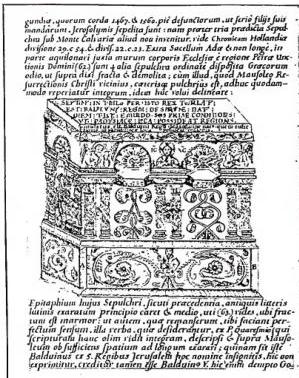
Then, claiming that the patriarchate should recover all rights and possessions it had held before the Turkish occupation, he demanded from Godfrey the cession of Jerusalem itself and the city of Jaffa. Godfrey sought to placate Daimbert in part, but faced with the patriarch’s threats he had to yield: on Holy Saturday, 1 April 1100, Godfrey recognized the patriarchate’s possession of Jerusalem and its territory, reserving its enjoyment until he had captured another city. He renewed the same concession shortly before his death. He died on 18 July 1100 and was buried in the basilica of the Holy Sepulchre.