
ADVOCATE. –
I. CANON LAW
Assistance in litigation undertaken in Rome by patrons on behalf of their clients was initially an aristocratic and unpaid office (oratores), which often opened the way to the highest offices of the State (cf. Cicero, De divinatione, 4, 11). Later, the parties, especially in criminal cases, began to summon patrons to be defended by them (advocati), and thus the patronage of the oratores and the advocati merged into a single office which, at first unpaid, became remunerated; nor did the lex Cincia de numeribus (in the year 550 of Rome) succeed in restoring the ancient gratuitousness of forensic service. According to this understanding, advocacy was considered a public office and acquired increasing importance in the juridical order with the establishment of Orders (consortia advocatorum or corpora togatorum), which were particularly regulated by Justinian.The office of the a., which was already defined by Ulpian as « desiderium suum vel amici sui apud eum qui iurisdictioni praest exponere vel alterius desiderio contradicere » (D. 3, 1, 1), consists in providing assistance to the plaintiff or the defendant.
In the Church, from ancient times, we find the defensores ecclesiarum (the Novels 56–59 already speak of the defensores clericorum). It is known that Innocent I (402–17) established in Rome seven defensores of the city, whose office was to plead before the Consistorium. The seven consistorial a. probably originated from these, and were given a particular organization by Benedict XII (Constit. Decens et necessarium, 1340). Alongside the consistorial a., we find, from a very early period, the procurators of the Sacred Apostolic Palaces, who pleaded before the Auditorium Sacri Palazzi. But when cases were no longer heard in the Consistorium, and the S. Roman Rota succeeded the Auditorium, the consistorial a. retained as their exclusive right that of requesting the pallium for archbishops in consistory and of presenting petitions in beatification and canonization cases, while the procurators of the Sacred Palaces retained the right to exercise their office in those same cases; nevertheless, the consistorial a. were received as proper and native members of the S. Roman Rota, and the procurators of the Sacred Palaces were likewise recognized as having the right to plead before the same tribunal (cf. Normae S. R. Rotae, art. 54). Today, others have been added to these in the Rota, as simple « rotal a. ».
De Luca writes that the a. of the Roman Curia are professors of both laws, civil and canon. Both in writing and orally, they defend cases solely from the standpoint of law, indicating to the judges what has been more precisely established in law, whether it is correctly applied to the case, and in what manner.
Over the years, the aforementioned colleges of a. came to be established in the Roman Curia, the most distinguished of which was that of the consistorial a., followed in importance by the college of procurators of the Sacred Apostolic Palaces, and finally by that of the rotal a. In addition to the a. belonging to these distinguished forensic colleges, there were many others who carried out their activities before the civil and criminal tribunals of the city. Some of these held permanent posts with the authorities of Rome; others, on the contrary, lived from the profits of their profession, often receiving annual pensions and gifts from their clients.
The Roman Pontiffs assiduously protected the dignity of the legal profession, regulated the activities and fees of the a., and at the same time sought to eliminate abuses and culpable delays to the detriment of clients.
At solemn ceremonies, the consistorial a. wear a cassock with a black velvet robe over it, having wide sleeves and ornamental fastenings; at the Pope’s pontifical Mass they wear over the cassock the cope fastened on the right shoulder. As regards a. in general, Clement XI, renewing the prescriptions of Urban VIII, prohibited a. from wearing the garment known as the abbot’s habit, proper to ecclesiastics, as well as the clerical collar. This prohibition was later renewed by Leo XII.
Mons. Luigi Gazzoli (1803), as Auditor General of the Reverenda Camera Apostolica (ordinary judge of Rome), prescribed that a. should dress decently in a long black garment, that is, a cassock and ferraiolone, as had immemorially been the custom in public hearings, and imposed penalties on offenders.
In speaking of a., it is not out of place to mention the advocate of the poor, who was a consistorial a. expressly appointed for the cases of poor persons, prisoners, or persons brought before justice in any manner.
The a. were not always worthy of their profession, which often declined through their own actions. For example, a. Bernard severely censured the forensic class of his time in the De Consideratione, which he addressed to Pope Eugenius III (1145–53), formerly his disciple. On the other hand, it would be lengthy to give a complete account of the most celebrated a. of the Roman Curia, especially those who were raised to the cardinalate (it is enough to recall the most famous, Giambattista De Luca, v.), or those who were elevated to the pontificate, such as Benedict XIV.
According to the CIC, litigating parties have the right to appoint one or more a. (can. 1656, § 3), and the same a. may also be constituted procurator (can. 1656, § 4); but the assistance of an a. is always necessary for the accused in criminal proceedings, and for all parties in proceedings involving the public interest or whenever the judge requires it (can. 1655).
The a. is appointed by the party or by the judge in a written act (can. 1661); his mandate may terminate by revocation (can. 1757, § 3, n. 1).
The agreements which, since Roman law, have been prohibited to a. are: the litis redemptio, the pactum de palmario, and the pactum de quota litis (can. 1665; cf. similarly in Italian law: Cod. civ., arts. 1261 and 2233).
The conditions under canon law for being an a. are as follows: to be Catholic (non-Catholics may be admitted only by way of exception, can. 1657, § 1; women, although there is no specific prohibition, are excluded on the basis of the general principles of canon law), of legal age, and of unimpeachable reputation (can. 1657, § 1); to hold a degree in canon law or at least to be well versed in it (can. 1657, § 2). To practice law before pontifical tribunals, it is necessary to possess at least a degree in canon law, to have completed a three-year apprenticeship at the S. R. Rota (Normae S. R. Rotae, art. 54, § 2; this apprenticeship is now required of all a. in cases of matrimonial nullity), and to have passed a special examination at the S. R. Rota. The a. thus approved (rotal a.) may practice before all ecclesiastical tribunals.
BIBL. G. B. Piazza, Eucologia Romana, Roma 1698; G. B. De Luca, Relatio Romanae Curiae, Disc. 46; G. Moroni, Curia romana, in Dizionario, XIX, Venezia 1843, p. 28 and 29.
Giacomo Violardo-Guglielmo Felici
II. PROFESSIONAL MORALITY
In order to exercise his profession worthily, the a. must possess the following qualities: competence, wisdom, diligence, justice, and humanity.The a. is required to have sufficient knowledge of the legal system in general and of those particular legislative norms directly pertaining to the cases for which his services are requested.
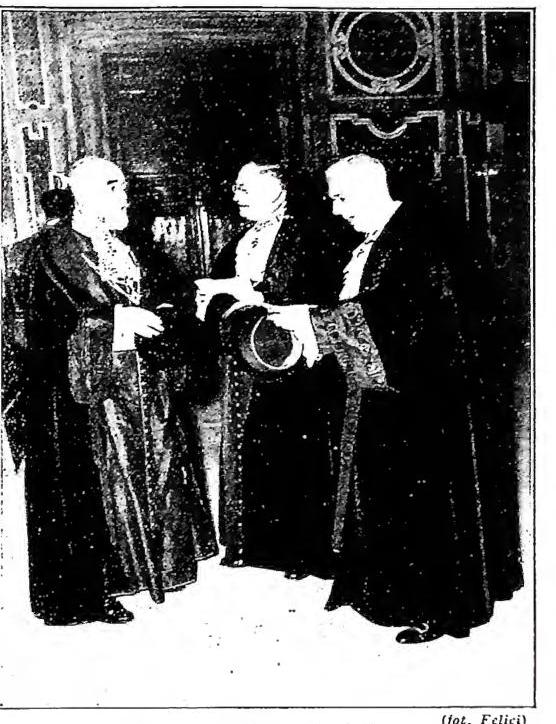
AVVOCATO - A. concistoriali.
(fot. Felici)
assisted by others. And he may resume the profession only once he has acquired the requisite competence and experience; should he proceed otherwise, he is liable for any damages consequently suffered by those who have recourse to his services.
Generally, one has no right to demand that a lawyer undertake the defense of a particular case; however, if the lawyer undertakes it, he must follow the proceedings with diligence proportionate both to the importance of the case and to his contractual obligations: otherwise, he is liable for the damages caused to the interested parties by his culpable negligence.
The lawyer must be just both in relation to the moral juridical order and toward his clients. With regard to the moral juridical order, it may generally be affirmed that everything is lawful for the lawyer that is lawful for the defendant or the plaintiff. Thus, in criminal cases, he may undertake the defense of the accused even if he knows with certainty that the latter committed the crime attributed to him. One who has committed a crime is, on the one hand, not obliged to reveal it spontaneously; on the other hand, he cannot be convicted unless it is proved in accordance with the law that he is truly guilty. Therefore, the lawyer may always conduct a defense in order duly to highlight the insufficiency of the evidence brought against the accused. In civil proceedings, the lawyer may not undertake the defense of a certainly unjust case; if he did so, he would incur responsibility for effectively cooperating in inflicting an unjust harm upon the opposing party. He may, however, support a probably just case. In that event, he is obliged to make the client aware of the objective situation; and he is likewise obliged to desist from his action should the case, in the course of the proceedings, prove to be certainly unjust. This is the common view. Yet there are those who distinguish between the lawyer’s service and the case, and maintain that the former is always lawful when it conforms to an objectively upright positive juridical order, even if in fact it redounds to the benefit of an unjust case. Others observe that in such a hypothesis one would be acting against the very reason for the existence of the positive juridical order, which was elaborated and exists to implement justice, and not to be turned into a means that makes its pursuit difficult or impossible. Conversely, there is unanimity in affirming that the lawyer may never resort to illicit means to defend a just case, even if he should otherwise find himself unable to assert it, since it is never lawful to attain good through evil. The lawyer must also be just toward his clients, demanding remuneration in accordance with the law (if a law exists on the matter), custom, or the common judgment of competent and honest persons, with due regard to his special expertise and the concrete work undertaken.
There are always persons in need of legal protection and lacking the means to obtain II. If the lawyer is in a position to do so, he has the duty of charity to place his services at their disposal, even free of charge. It is obvious that, once he has undertaken the commitment, he is bound in justice to follow the principles indicated above.