
PELLEGRINAGGIO. — From the Latin peregrinatio, “journey in a foreign land,” it is a devotional practice consisting in going, collectively or individually, to a sanctuary or to some other sacred place and there performing special acts of religion, whether for purposes of piety, or of fulfilling a vow, or of penance. The practice of p., in both its forms, is found in all religions, because it is natural for human beings to visit places sanctified by the presence of the divinity or by the relics of a distinguished deceased person, hero, or saint, from which divine power radiates more directly and effectively.
I. IN NON-CHRISTIAN RELIGIONS
Pilgrimage is one of the practices most dear to human groups: 1) because it engages all the individual’s faculties—visual, auditory, motor, and emotional—intensifying them through association; 2) because it exalts the collective bond, which is an exceptionally powerful factor in religious emotion; 3) because it enhances the value and prolongs the memory of the sacred destination and of the religious memories connected with it; 4) because, by making the sacrifice felt and almost measurable, it enables its effects to be foreseen and calculated with greater certainty. If, moreover, the religion is universal, the meeting of different peoples at the same religious center is exceedingly effective in imposing a sense of the social unity of that religion, above the barriers of race and nation.Pilgrimage, especially when undertaken to sanctuaries along a long route, offers the possibility of establishing fairs at stopping places for small or large-scale commercial exchanges, where poets and singers display their genius, and where the custodians of minor sanctuaries situated along the way exalt the hero or saint entrusted to their care.
This material and spiritual traffic, which is periodic in character, not only increases geographical and ethnographic knowledge, but also serves to lend prominence to the city that is the destination of the pilgrimage and to those scattered along the road; these latter, in fact, often end by becoming obscure and even disappearing altogether as soon as the attraction exercised by the former ceases. All religions know the practice of pilgrimage.
Japan. — The principal pilgrimage is the one made to the temple of Isè, dedicated to Amaterasu, the solar goddess. Among the most popular is the pilgrimage to the 33 sanctuaries of Kwannon, the goddess benevolent toward human suffering. Also famous is the pilgrimage to Fusi-jama, Japan’s highest volcanic mountain, as well as those to Mount Kimpu-sen in Yamato and Ontake in Shinano.
India. — India is pre-eminently the land of pilgrimages, especially in the region of the Himalayas and Kashmir. There are more than 60 pilgrimage sites. Siva is the deity most frequently visited; next come Kali, Vishnu, and Kṛṣṇa. Pilgrimages to the sacred rivers are also well attended: the Ganges, the Jumna, and the Narbada (or Godavari), especially at their confluences. Bathing in these rivers removes impurities of body and soul; the time for the bath is fixed by the priests to coincide with astronomical phenomena. A tattoo on the body is a sign that a pilgrimage has been completed.
Egypt. — For Egypt, Herodotus recalls the pilgrimage made by boat on the Nile to Bubastis, to the sanctuary of the goddess Seket, with dances, ritual insults, and a magnificent illumination; the pilgrimage to the sanctuary of Ammon was also famous.
Babylonia. — In Babylonia, where the procession was held in great cultic honor, pilgrimage is much less well documented. But it is known that Shalmaneser II undertook one in 851 to Babylon and Borsippa in order to secure the favor of the gods.
Israel. — Above all, one must recall the great pilgrimage which, especially after the Exile, brought all the Israelites to the temple of Jerusalem for Passover. The pilgrims proceeded in groups, singing the Psalms of Ascent (Graduals) along the way; on the 15th of nīśān they held the ritual supper and visited the temple. Two other feasts that drew the Israelites to Jerusalem were Pentecost, 50 days after Passover, and the Feast of Tabernacles, in September, when the harvest and grape gathering had ended.
Greece. — Devotees seeking healing continually made their way to the sanctuaries of Asclepius at Cos and Epidaurus. But the great religious-national gatherings at Olympia, Delphi, and Eleusis must also be regarded as pilgrimages, because they possess all their essential elements: the periodic assembly,
the contests and games, and the religious sacrifice to the patron deity of the sanctuary. In the plain of Olympia, for example, dominated by the sacred grove (altis) and the temple of Zeus, numerous sanctuaries were distributed along the sacred way; devotees came to them from all over Greece every four years (the Olympiads), at the end of summer, both to sacrifice to the gods and heroes and to participate in the contests and games, either as performers or as spectators.
Rome. — The sanctuaries of Jupiter Latiaris, Diana Nemorensis, and Juno Lanuvina were destinations of pilgrimage not only officially, for the cities represented at the festivals or for magistrates required to attend them, but also because of the throngs of devout and festive people who frequented them.
Buddhism. — That inclination toward pilgrimage so deeply rooted in Hindu India is also found in Buddhism. It is true that in the oldest Buddhism (Hīnayāna, or the Lesser Vehicle), pilgrimage is not expressly recommended; nevertheless, it was implicit to some extent in the obligation of the itinerant life imposed on monks by the rule (with the rainy season excluded), and it was encouraged by the desire to venerate the places sanctified by the life and death of the Buddha and by the presence of his precious relics. These had been distributed in eight parts among the peoples who had gathered for his funeral and were honored by King Asoka through the construction of sumptuous stupas. The principal pilgrimage sites among these are: Kapilavastu, where the Buddha was born; Budh Gayā, where he received enlightenment; Benares, where he delivered his first sermon on the four holy truths; and Kusinagara, where he died.
Outside India, other famous pilgrimage sites are: on the island of Ceylon, the Temple of the Buddha’s Tooth and Adam’s Peak, where the impressions of his feet are venerated and admired also by Muslims, Hindus, and Jains; in Rangoon, Burma, the Shwe Dagon pagoda, with its hundred images of the Buddha and the relic of eight of his hairs, toward which pilgrims come not only from China and Siam but also from Japan and Korea. In China, Buddhist pilgrimage sites have been superimposed upon old Taoist sanctuaries situated in the mountains, and there are chiefly four: Omishan (Szechwan province), Pictoshan (Chusan Archipelago), Wutarshan (Shensi province), and Chinhushan (central China, on the Yangtze). In Tibet and Mongolia, the three Lamaist capitals—Lhasa, Tashlumpo, and Urga—are visited by monks and the faithful, who venerate in the three great lamas the incarnation of as many bodhisattvas.
Islam. — For Muslims, pilgrimage is one of the five fundamental obligations. It must be undertaken to Mecca at least once in a lifetime. The practices date back to the pre-Islamic period and have remained unchanged. Having entered the sacred enclosure, the pilgrim circles the kaʿbah seven times, kisses the Black Stone, drinks the water of the Zamzam well, ascends Mount ʿArafat, and then descends into the Valley of Minā, where, as in the days of idolatry, a great sacrifice of animals takes place. Everything concludes with a second visit to the kaʿbah, after which the pilgrim removes the special garment he put on at the beginning and assumes the title of pilgrim (al-ḥāǧǧ). Shiite Muslims, who are forbidden to enter Mecca, make the pilgrimage to the tomb of ʿAli. Nicola Turchi
II. IN CHRISTIANITY
In the history of Christianity, two kinds of pilgrimage may be distinguished: pilgrimages of devotion and pilgrimages of a judicial nature.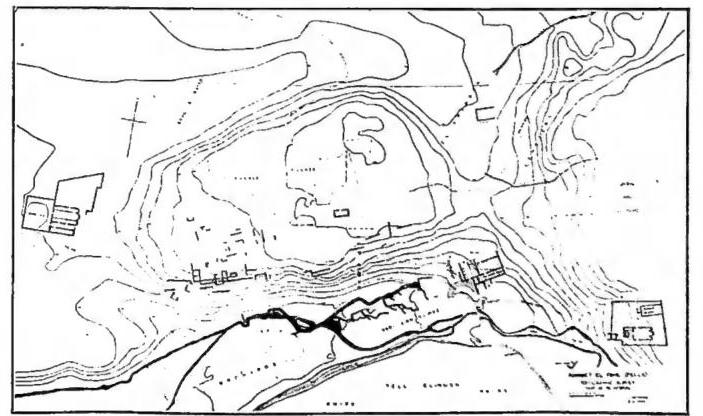
1. Pilgrimages of devotion
The construction of the basilicas erected by Constantine over the Holy Sepulchre and on Calvary, and by the empress Helena on the Mount of Olives and at Bethlehem, as well as the discovery of the Holy Cross, encouraged Catholics to visit and venerate the Holy Places. Hospices were also built for pilgrims in Jerusalem and in Egypt, because many longed to know the country where the Holy Fa-(from Palestine Exploration Quarterly, 1931, pl. 3)
PELLA — Plan of the excavations carried out at Jirbet el-Fabil, ancient P.

The sojourn of s. Girolamo in Palestine further increased the influx of pilgrims; and the descriptions of journeys made by learned Roman patrician women—Paola, Eustochio, Melania—are still preserved (PL 22, 482-92; T. Tobler-A. Molinier, Itinera latina bellis sacris anteriora, I, Geneva 1877, pp. 43-47; II, ibid. 1880, pp. 133-42).
As early as 333, a bishop of Gaul outlined the itinerary to be followed from Bordeaux to Jerusalem, passing through Constantinople (CSEL, 39); more detailed is the description by Egeria (v. ibid., pp. 37-101). Certain ecclesiastics guided the pilgrims, and armed men protected their journey through unsafe regions. In the 6th and 7th centuries the p. retained the same renown (ca. 670; CSEL, 39, pp. 137-50, 159-218, 221-97).
In the 11th century pilgrims could not enter Jerusalem unless they had first paid a tribute to the Muslims; but despite the dangers of the road, they travelled alone or accompanied by a servant or a guide (MGH, Scriptores, XI, p. 136; XII, pp. 249-67). The Danube route brought considerable advantages after the conversion of the Hungarians, and various hospices arose along the way. Two innovations soon appeared: individual p. were replaced by pilgrims travelling in groups, sometimes quite large ones; for example, the abbot of St-Vanne brought as many as 700 companions with him, and knights also took part, who, if necessary, would have used the sword against attackers. In 1065 the group led by Günther, bishop of Bamberg, comprised approximately 12,000 people. Attacked by the Bedouins, it owed its salvation to the intervention of the emir of Ramleh (L. Bréhier, L'Eglise et l'Orient au moyen âge. Les Croisades, 2nd ed., Paris 1928, pp. 42-50).
The occupation of Syria and Palestine by the Seljuk Turks obstructed, toward the end of the 11th century,
access to the Holy Places. The few pilgrims who returned safe and sound from their journey spread throughout the West accounts of the dangers they had encountered and of the vexations, insults, and affronts they had endured, thus contributing to the launching of the Crusade. When the kingdom of Jerusalem was subsequently founded by the Latins, the era of the p. once again began to flourish, all the more because the “Hospitallers” provided armed escorts. The Mongol invasions and the loss of St. John of Acre (29 May 1291) were disastrous; nevertheless, there were always courageous Christians who visited the Holy Land, as attested by a guide compiled in the 14th century (H. Omont, Une guide du pèlerin en Terre Sainte au XIVe siècle, in Mélanges G. Schlumberger, Paris 1924, pp. 436-51; for subsequent periods cf. Recueil de voyages et de documents pour servir à l'histoire de la géographie, depuis le XIIe siècle jusqu'à la fin du XVIe, ibid. 1892). Periodic journeys, at least from the 14th century onward, could be undertaken by sea from Venice.
In addition to the Holy Places par excellence, namely those of Palestine, the burial places of the apostles, martyrs, and deceased persons considered holy, as well as churches, monasteries, and chapels possessing distinguished relics, and sanctuaries dedicated to the Virgin, became destinations for p., all the more so because the Holy Places were difficult to reach and too distant (the list in L. de Sivry and de Champagnac, Dict. géogr. et hist. des pèlerinages anciens et modernes, 2 vols., Paris 1851; but today the list could be greatly extended).
Among these devotional p., two kinds were distinguished in the Middle Ages: the major p., namely Rome, St. James of Compostela, St. Thomas of Canterbury, and the Three Magi of Cologne; and the minor p., which included all the others. The tomb of the apostle Peter was especially favored by pilgrims: visitors cast their coins through the fenestrella, and an altar attendant collected them. The Holy See had also attached numerous indulgences to visits to the Roman churches, which the faithful were very eager to obtain.
Wherever he went on his visit, the pilgrim, before departing, had his belt blessed; he travelled dressed in a simple cloak, with a broad hat on his head, a satchel slung over his shoulder, and a staff in his hand, called a bourdon, from which an empty gourd for water was sometimes suspended. One who went to Rome was called Romipeta. During the journey, pilgrims found shelter in monasteries or in the innumerable religious houses that covered the soil of Christendom. At the end of their p., they were received in hospices specially intended for this purpose. No city, at least from the 14th century onward, was better organized to receive them than Rome, where there were guilds of innkeepers provided with detailed regulations. Certain confraternities, such as that of the Holy Trinity of the Pilgrims (16th century), provided food and lodging in particular. In the modern period, hospices reserved for subjects of one nation or another were built, and some still survive: for example, S. Ivo dei Bretoni, S. Niccolò dei Lorenesi, S. Luigi de' Francesi (v. J. Lacroux, Les institutions de la France à Rome, 2nd ed., Rome 1892; M. Romani, Pellegrini e viaggiatori nell'economia di Roma dal XIV al XVII sec., Milan 1948).
2. P. giudiziari. - Very often confessors imposed p. upon great sinners, so that they might serve as expiation for the grave sins committed. Thus Gregory VII did with that Cencio who had attacked him, and Clement V with Guglielmo di Nogaret, guilty of violence against Boniface VIII, in order to obtain absolution from the excommunication incurred through the performance of certain specified p. (cf. Regestum Clementis Papae V, Rome 1884-92, no. 7051).
III. MODERN WORKS FOR PILGRIMAGE
Whereas in antiquity pilgrimage was preferably undertaken individually, with the pilgrim relying on his own means and on the charity of the faithful, in the present age, by contrast, the practice has arisen—imposed by new needs and customs and by the increase in the number of destinations (Loreto, Lourdes, Pompei, Oropa, Fatima, etc.)—of entrusting oneself to committees and specialized organizations.2. Committee for Palestine and Lourdes
In Italy, mention should be made of committees established for the celebrations of the centenary of St Peter (1868) in Rome, and especially on the occasion of the priestly jubilee of Pope Leone XIII; as well as of the initiatives for the Holy Years of 1900, 1925, 1933, and especially 1950, which reached figures and totals never before seen.Toward the end of the last century, a committee for pilgrimage to Lourdes arose in Italy, established by Msgr. G. Radini Tedeschi, later bishop of Bergamo; it was subsequently joined by the Committee for Palestine (Committee for Palestine and Lourdes), with the extensive participation of pilgrims from every part of Italy.
2. U.N.I.T.A.L.S.I. — During the Italian national pilgrimage to Lourdes in 1903, the idea arose of the Italian National Union for the Transport of the Sick to Lourdes (U.N.I.T.A.L.), which later became U.N.I.T.A.L.S.I., with the addition of an organization for transporting the sick themselves to Italian shrines (S.I.). The idea of the organization arose in the mind of the young Roman G. B. Tommasi, who had gone to Lourdes with the intention of obtaining a cure or committing suicide, and returned with the precious gift of faith. In agreement with Msgr. Radini Tedeschi and with the blessing of the b. Pio X, in 1904 he established U.N.I.T.A.L. in Rome and became its first director. In 1908 regional sections began to arise: first of all the Piedmontese, followed by the Ligurian, Venetian, Emilian, Lombard, Sicilian, Neapolitan, Tuscan, Apulian, Marchigian, Umbrian, etc. In 1905, together with the National Committee for Palestine and Lourdes, the first ten sick persons were taken to Lourdes; by 1929 (the first twenty-fifth anniversary) their number had risen to approximately 2,000. In 1908 the first “white train” took place, together with the first popular pilgrimage.
3. Various initiatives
The new conditions of life and the easier means of communication subsequently led to the creation of new committees, both diocesan and national, all guided by prelates, bishops, and religious. Particularly deserving of recognition among these initiatives was the Opera card. Ferrari, with the Compagnia S. Paolo (v. PIA SOCIETÀ SAN PAOLO) and the Pro Civitate christiana of Assisi. In Rome itself, at the offices of the Vicariate, there arose (2 Dec. 1933) a Roman committee for pilgrimage, of a national character, which periodically takes groups of the devout to the principal shrines of Italy and abroad, using the most modern means and equipment.4. Peregrinatio ad Petri Sedem
It originated with the extraordinary Holy Year of 1933 (the centenary of the Redemption), through a letter from the cardinal secretary of(Ist. Felici)
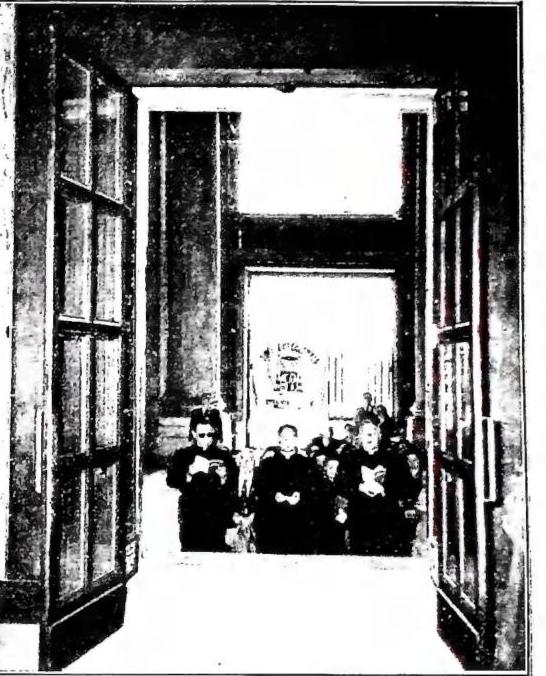
PELLEGRINAGGIO — Pilgrims from Columbus (U.S.A.) enter St Peter’s through the Holy Door (8 May 1950).
Cardinal Secretary of State Eugenio Pacelli to the president of the Central Committee, in which “the advisability of transforming the central organization into a permanent body whose principal purpose would be to direct the movement of pilgrims toward Rome and assist them” is elucidated. On 27 January 1942, its Statutes were approved, and in the following April its internal regulations as well, with the following tasks: a) to coordinate and assist the movement of individual pilgrims or groups arriving from the dioceses of Italy and from abroad, destined to visit the Sedes Petri or the principal sanctuaries of Italy; b) to place itself at the disposal of diocesan Ordinaries and foreign committees promoting pilgrimages in Italy; c) to coordinate and assist pilgrims also destined for foreign sanctuaries, and likewise to extend its hospitality to collective religious events, national and international. The Peregrinatio began its more regular activity after the war (1945). — Vedi tav. LXXVI.