
TAOISM. — This designation refers to the philosophical and mystical doctrines set forth in the works of Lao Tzu, Chuang Tzu, and Lieh Tzu (whose compilation is commonly assigned to the 4th–3rd centuries B.C.), and to the Taoist religion, regarded as a later degeneration of the former, whose establishment as an organized Church is ordinarily attributed to Chang Tao-ling
(b. in A.D. 34 — d. circa A.D. 156). In Chinese, the thinkers are designated as Tao Chia and the religion as Tao Chiao (the doctrine of the Tao), but the two terms are often confused with one another, and ordinarily it is the second that prevails. In truth, some regard the Taoist religion as contemporary with, or even preceding, the three “philosophers,” who probably represented a more learned current within the sphere of religious beliefs. Tao, moreover, is a very vague term: it means “road, way, principle, method, etc...,” and so numerous are the translations proposed by Western authors that it may seem appropriate to regard it as untranslatable, all the more since the Taoists themselves define it as “nameless.”
The point of departure of Taoist thought is the aim of preserving life and avoiding every injury to one’s person: it is therefore an individualistic and egoistic conception which, from the earliest periods, manifested itself in the form of “flight from the world” by individuals who sought peace and health in the eremitic life. Toward the second half of the 4th century B.C., the Tao Te Ching was perhaps compiled, a work ordinarily attributed to Lao Tzu, a figure about whom very little is known.
It seems that his personal name was Erh, his byname Tan, and his surname Li: Lao Tzu literally means “old philosopher.” Tradition says that he was keeper of the royal archives of Chou and that, in this capacity, he received a visit from Confucius, who was younger than he and is said to have been astonished by his wisdom. In all probability, however, this episode should be assigned to those numerous inventions of the Taoists who sought to elevate their religion, above all at the expense of Confucianism.
In the Tao Te Ching, the principles of prudence, humility, and contentment with little are expounded in the form of brief paragraphs, often exceedingly obscure in interpretation. The book appears to be a golden exposition of the principle of “living hidden,” of inaction, understood in the sense of doing little, of not overdoing things (sui-sui). Man should carry out his activities in a natural and spontaneous manner and restrict his desires to what is strictly necessary, reducing them as far as possible. Only in this way will he be able to avoid failure. The simplicity and innocence of the child (who has little education and few desires) are characteristics that every man should possess: whereas, for the child or the humble people, this simplicity is a gift of nature, for the sage it is a conquest of the spirit, the consequence of a conscious process of self-education.
(for curtain by G. Bertucciati)
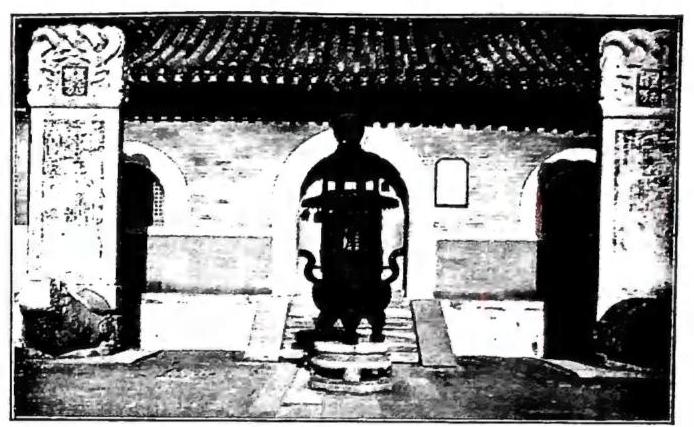
TAOISMO — Great censer between two stelae at the entrance to the Taoist monastery of Pai-yün Kuan — Beijing.
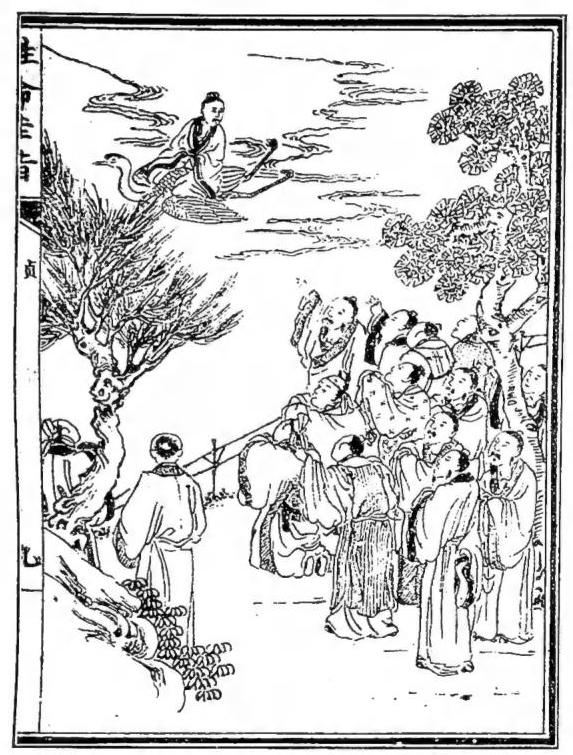
These concepts of Lao Tzu are set forth in magnificent literary form in the works attributed to Chuang Tzu and Lieh Tzu. Yet in these texts, alongside the exposition of this practical morality and of passages of a philosophical character, there are numerous passages in which the broader substratum of religious beliefs comes to the surface. The development of t. and the progressive drying-up of the marvelous creative capacities of the early writers led, over time, to the increasing predominance of the religious element, at the expense of the literary and philosophical value of the texts. It was especially during the Han dynasty (206 B.C.–A.D. 220) that the Taoist religion appears to us in its fullest development. Its purpose is to lead the faithful to eternal life. Since, however, it regards man as composed of matter, it follows that this eternal life is not understood as the spiritual immortality of the soul, but as the material immortality of the body, to be attained in this life through practices intended progressively to replace mortal organs with immortal organs, so that at a certain point the entire mortal body is replaced by an immortal body whose bones and flesh are of gold and jade. At this point the believer, having become immortal, ascends to heaven, ordinarily in broad daylight and from the summit of a mountain, or else—and this is the more frequent case—he dies. But his is a false death, called “liberation of the corpse”: what is buried is a sword or a staff that has temporarily assumed the form of a corpse, while the immortal body has already departed to live with the other immortals. Naturally, the believer had to observe certain practices in order to transform the mortal body into an immortal one. These practices could be bodily or spiritual. The former consisted of respiratory, gymnastic, sexual, dietary, and alchemical practices. The last of these, the most complicated and destined in time to fall into disuse, were directed toward preparing a pill called the pill of immortality, based on cinnabar; only this could make one immortal by the most direct route or, as the texts put it, a “flying immortal.” In reality, whoever took it sometimes fell dead from the poison, unless he had previously accustomed his organism to it by taking small doses. The other practices were much more interdependent: the respiratory practices consisted of difficult exercises of inhalation and exhalation, during which the believer had to try to retain the inhaled air for as long as possible and cause it to circulate through all parts of the body. Special gymnastic exercises served to loosen the joints more effectively and to facilitate the passage of the inhaled air through the body. The dietary practices, finally, consisted in eliminating cereals and also meat from one’s diet: the ideal was to manage to nourish oneself solely on
(courtesy of G. Bertuccioli)
TAOISMO - A Taoist immortal ascends to heaven. Illustration from the Hsing Ming Kuei Chih, a popular Taoist work of the eighteenth century, facsimile edition, Shanghai 1915.
air, pine resin, or some medicinal herb or plant. The spiritual practices consisted in leading a pure, virtuous, and charitable life (and in this they appear as a deviation from the principles set out above), as well as devoting oneself to exercises of meditation intended to bring about a kind of mystical union of the believer with the divinities or with the Tao. There is, however, no systematic organization in the texts that discuss the practices for attaining immortality, and this means that some prescriptions conflict with others. Thus, regarding sexual practices, some texts seem to praise chastity, whereas in others the exact opposite is found. For obvious reasons, however, knowledge of the latter practices was transmitted chiefly orally and was not entrusted to writing. In such a religious system, illness seems to have been conceived as punishment for sins committed: by confessing them, often in the course of collective ceremonies, the believer could hope to be cured, provided that he performed certain good works.
Around the second century of our era, Chang Tao-ling began preaching in the province of Szechwan a doctrine (according to some, perhaps influenced by religious ideas originating in Persia) that he and his followers skillfully integrated into the religious current of t. Legend has it that, having obtained the formula for becoming immortal, he ascended to heaven at the age of more than one hundred and twenty. Since his priests demanded an annual tithe-tax of 5 tou (a unit of capacity) of rice, his cult came to be called “the religion of the five tou of rice.” From a religious standpoint, the movement concealed a substratum of socialist and revolutionary ideas and culminated in a great rebellion that threatened to spread throughout China and overthrow the Empire, but it was subsequently contained and quelled.
Under the influence of Buddhism, t. began to organize itself as a monastic religion. The scholars of the Tao, called Tao-shih, gathered in common dwellings called Kuan (a term that still designates Taoist monasteries), at first with their women, and later, as Buddhist influence grew stronger, alone, until celibacy became the rule, even if it was not always observed in practice. Even today Taoist monks are called Tao-shih. Communities of women were also established, but over time they were suppressed. Ordinarily, monasteries arose in the great cities and on mountaintops; in the latter, ancient traditions were preserved for a longer period.
In this transformation, t. was favored by the rulers themselves, who wished to set it, as an “indigenous” religion, against foreign Buddhism. There were Taoist emperors especially during the T'ang dynasty (618–907). In imitation of Buddhism, t. created a pantheon in which the deities were stars, planets, ancient heroes, spirits assigned to various human activities, animals, and plants. Above all presided a supreme triad composed of the Jade Emperor (Yü Huang Shang Ti), Lao Tzu, and Tao Chih. Again in imitation of the Buddhists, the Taoists undertook to gather all their writings into the monumental collection known as the Tao-tsang, while religious doctrine gradually became concentrated around the principle of recording the rewards for every good deed performed and the punishments for every sin committed—a record kept by a divinity during a person’s lifetime in order to determine, after death, whether he should be sent to paradise or to hell. This distortion of the ancient nature of t., and, on the other hand, its tendency to adopt from a foreign religion whatever elements might prove most useful, did not prevent religious conflicts and rivalries between t. and Buddhism; these rivalries gradually waned in the centuries closer to our own.
Alongside the monastic religious personnel are Taoists who live alone and constitute the lowest part of the Taoist clergy. They may have families and practice the occupations of fortune-tellers, enchanters, exorcists, teachers Feng Shui (v.), healers, and so forth. Above all, they were dependent, albeit in a rather vague manner, on the T'ien-shih (Master of Heaven), whom certain Western authors have called, quite improperly, the “pope” or “supreme pontiff of t.” He resided on Mount Lung-hu in the province of Kiangsi and devoted himself to practices of low magic, to the sale of incantations and amulets, and to granting, for payment, certificates of initiation. The dignity of T'ien-shih was conferred around A.D. 424 on the Taoist K'ou Ch'ien-chih. Subsequently, during the T'ang dynasty, official recognition of the title was granted in 748, and it was assigned to the descendants of Chang Tao-ling. The emperor T'ai Tsu (1368–98) of the Ming dynasty is said to have abolished this title, considering it disrespectful toward Heaven, and replaced it with that of Chen-jen (true man). The ancient title nevertheless remained, even though it was not officially recognized. The position of the T'ien-shih steadily declined: in the nineteenth century he lost the right to be summoned to an audience at Court, and this was one of the most serious blows to his prestige. By then, however, all of t. was in decline. The Republic recognized no privilege for the T'ien-shih and indeed confiscated his property, expelling in 1927 from his possessions in Kiangsi the man who regarded himself as the sixty-third successor of Chang Tao-ling. From then on, this hardly worthy person lived in a modest Taoist temple in Shanghai.
With regard to the Taoist religion, regarded as superstitious and corrupt, the republican government from 1911 onward did not adopt an especially favorable official attitude. Taoist temples, especially in the cities, following the fate of many Buddhist temples, were very often requisitioned for use as schools and barracks. The great monasteries on the “sacred” mountains, destinations of pilgrimages—such as Mao Shan in the province of Kiangsu, T'ai Shan in the province of Shantung, and Hua Shan in the province of Shensi—were able to survive both because they were far from populated centers and because they possessed extensive tracts of land. In recent years, no serious attempt at renewal has occurred among the various numerous Taoist sects. Inferior to Buddhism in the number of its monks, t. has also been inferior in its attempts at reform and in its works of propaganda and proselytism. Although the temples at the summits of the mountains have still been able to serve as a source of religious appeal for some cultivated minds, the t. of the cities has been reduced to representing the superstition of the lowest and most ignorant classes of the population. The present Communist government has finally accelerated this process of decline by confiscating the landed properties still remaining to the monasteries in mainland China.