
SHANGHAI, diocesi di. - In central-eastern China, on the coast of the civil province of Kiangsu: it takes its name from the famous city that lies at the mouth of the Fiume Azzurro and is one of the most important commercial emporiums in the world.
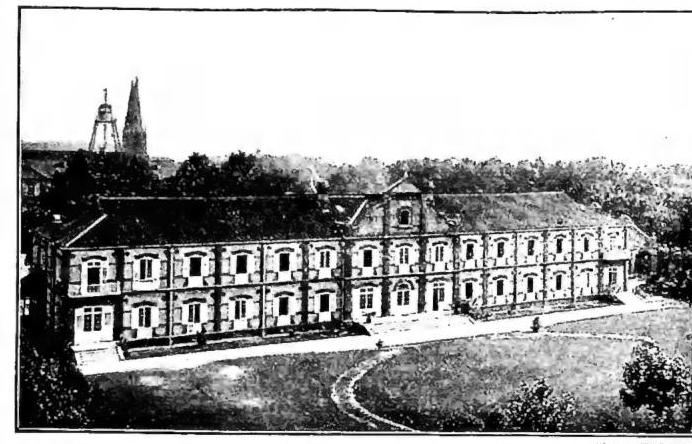
(photo Fides)
Thus reduced to an area of approx. 5,500 sq. km and a total population of approx. 7,000,000 inhabitants, on June 30, 1949, the mission of S. counted 108,935 Catholics and 1,594 catechumens. The bishop and the 80 Chinese priests were assisted by numerous religious men and women, the latter numbering over 600, more than half of whom were Chinese. Thus the Jesuits directed the Catholic University « Aurora » and several parishes in S., and at Zikawei, near S., where the residence of the Ordinary is also located, they had their house of probation and their residence, the well-known meteorological Observatory, the scholasticate with the theological faculty, the Collegio S. Ignazio, the minor seminary and the regional seminary for Kiangsu, and the orphanage; the Salesians, in addition to a parish, had an orphanage and an industrial school, a primary and a middle school, workshops, and an agricultural station; the Little Brothers of Mary directed the colleges of S. Francesco Saverio and S. Giovanna d'Arco and the Franco-Chinese municipal school; the Brothers of Charity ran a men's hospital for the mentally ill; the 18 women's Congregations maintained numerous works corresponding to the purposes of their respective Congregations; likewise, the Lazarists, the Society of Foreign Missions of Paris, the Congregation of the Immaculate Heart of Mary (Scheut), the Hermits of S. Agostino, the Recollects, the Society of the Divine Word, the Friars Minor, and the Society of S. Colombano each had their respective procuracy with at least three religious. The city of S. had 14 parishes, while the remainder of the territory was divided into 39 districts, equipped with numerous churches or chapels.
The preaching of the Gospel in the region of S. dates back to the time of Fr. Matteo Ricci, who was in China from 1583 to 1610, and the history of that Christian community merges with that of Nanchino, of which it formed part until recent times. On July 12, 1842, Fathers Gotteland and Estève arrived in S., the first Jesuits requested from Gregorio XVI by the faithful who survived the great persecutions of the 18th century; during the Taiping persecution (1850-64), only the Christian community of S. was able to survive in the European concessions. The first Chinese Council was held in S. in 1924. - Vedi tav. XXVIII.