
RICCI, MATTEO. — Jesuit, pioneer of the Catholic missions in China, born in Macerata on 6 October 1552, died in Beijing on 11 May 1610.
Having attended the Jesuit College in his native city, he studied law in Rome for two years, after which he entered the Society of Jesus on 15 August 1571. During his philosophy courses at the Roman College, he attended the mathematics lectures—understood in the considerably broader sense of those times—of the celebrated Fr. Clavio. Having embarked at Lisbon on 5 March 1577, he reached Goa in 1578, where he completed his studies and was ordained a priest, and in 1582 Macao in China, where he devoted himself to the study of the Chinese language and literature, since he had been assigned, together with Fr. M. Ruggieri, to break through the barrier of that great Empire, which barred entry to missionaries and the faith, and to reach as his final destination Beijing, the Court, and the Emperor himself. Such was the goal assigned to the two missionaries by the far-sighted visitor, Fr. A. Valignano; but achieving it required 18 years of work and waiting. R. in fact entered China in 1583 and was able to establish his residence at Sciaochin, where he soon entered into relations with, and gained great renown among, the learned men of the locality. To them he displayed the various objects brought from Europe, including a globe and a statue of the Virgin with the Child in her arms, which he placed at the entrance to the house, and he made the first conversions.
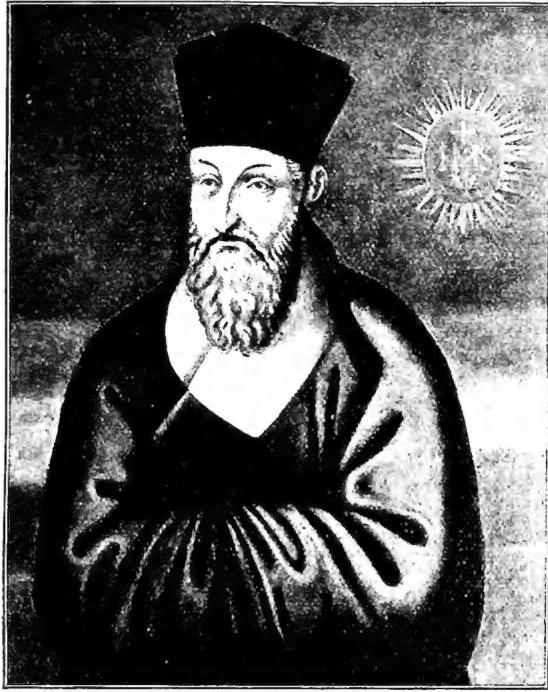
(courtesy of the Superior of the Residence of the Gesù)
RICCI, MATTEO — Portrait executed immediately after his death by Fr. Emanuele Jennebhoci or Pereira, S. I., and brought to Rome in 1614 by Fr. Nicola Trigault, S. I. — Rome, Residenza del Gesù.
to Sciaoceu; then in 1595 to Nanchino and subsequently to Nanciam; in 1598 once again to Nanchino, then to Pechino, and thereafter he returned to Sciaoceu. In 1601 he settled permanently in Pechino. In 1597 he had been elected superior of the mission, where he won the favor and esteem of the Court and of the Emperor Wanli.
The principles on which R. based his extraordinary work were simple, in conformity with the spirit of the directives left by s. Ignazio and the instructions given by Fr. A. Valignano: the greatest possible sympathy for and respect of the spiritual and intellectual values of the Chinese; the most perfect possible knowledge of the language; the use of science for an apologetic purpose; the apostolate of writing and conversation; attention to the educated classes, on which the government of the people depended; and primacy accorded to supernatural virtues (cf. P. D'Elia, L'uomo più strano della Cina, in Ecclesia, 11 [1952], pp. 477–81). Clear testimony to this is found in his literary activity; besides numerous letters and memoirs, he composed more than 20 works in Chinese on apologetics, mathematics, and astronomy (cf. the list in P. D'Elia, Fonti Ricciane, III [index], pp. 239–43), of which the principal ones may be mentioned: Dell'amicizia, Conversazioni catechistiche, Solido trattato di Dio, Dottrina cristiana, Dieci paradossi, Trattato dei quattro elementi, Trattato sul cielo e sulla terra, etc.; above all, the various increasingly perfected editions of world maps should be recalled (cf. P. D'Elia, Il mappamondo cinese del p. M. R., tradotto e annotato, Roma 1938), as well as his history of the Chinese mission, which remained unpublished until our own time and was published by P. Tacchi Venturi under the title: Opere storiche del p. M. R. (2 vols., I, Commentari della Cina, Macerata 1911; II, Lettere, ivi 1913), and by P. D'Elia under the title: Fonti Ricciane: Storia della introd. del Cristianesimo in Cina (3 vols., Roma 1942–49), with extensive use of Chinese sources, an updated bibliography, appendices, and indexes; further volumes on the letters and other works are to follow.
Regarding the legend that R. was a pious conciliator of beliefs, in the sense that he sponsored a kind of syncretism to the detriment of dogma, cf. P. D'Elia, Il dommo cattolico integralmente presentato da M. R. ai letterati della Cina, in Civ. Catt., 1935, II, pp. 35–53. For the question of the name of God and of the rites,