
I. THE SACRAMENT OF HOLY ORDERS
### SUMMARY:
I. Institution of the Priesthood of the New Testament
II. The Three Degrees of the Priesthood
III. Transmission of the Three Degrees
IV. Matter and Form of the Sacrament of Holy Orders
V. The Effects of the Sacrament of Holy Orders
VI. Conclusion.The Sacrament of Holy Orders is that sacrament, instituted by Jesus Christ, through which the ministers of Christian worship are constituted.
I. INSTITUTION OF THE PRIESTHOOD OF THE NEW TESTAMENT
Jesus, by right of nature and divine vocation the High Priest of the New Covenant (Hebr. 4, 14), having to withdraw His sensible presence (Io. 16, 6-7) and simultaneously render the economy of salvation perpetual and visible (Lc. 24, 45-48), from the beginning of His public life chose certain disciples, whom He educated with every care. At the culmination of this didactic formation, at the moment when He instituted the Sacrifice of the Mass (v. MASS), through a supernatural investiture, which He expressed in the words: «Do this in memory of me» (Lc. 22, 19; I Cor. 11, 24), He transmitted to them the power to renew the unbloody offering, a perpetual memorial of the immolation of Calvary. On the day of the Resurrection and the Ascension, by conferring upon the same Apostles the power to remit sins (Io. 20, 21-23) and the triple authority to instruct, sanctify, and govern all nations (Mt. 28, 19-20), He established them as representatives of God among men (descending mediation), while at the Last Supper He had constituted them as representatives of men before God (ascending mediation).True priests of the New Testament, in whom the promises of the Prophets were fulfilled (cf. Is. 66, 20-23; Mal. 1, 10-11), the Apostles felt with pride the honor of the divine investiture: «Let every man take us as ministers of Christ and stewards (οἰκόνουσα) of the mysteries of God» (I Cor. 4, 1); God «hath made us fit ministers of the New Testament» (II Cor. 3, 6) «giving to us the ministry of reconciliation» (ibid. 5, 18) «so that we are ambassadors for Christ» (ibid. 5, 20).
II. THE THREE GRADES OF THE PRIESTHOOD
The Apostles transmitted the priestly power, of which they possessed the fullness, to a threefold class of persons subordinate to one another, thus forming a hierarchy (hierarchia Ordinis). Indeed, in the nascent Church, bishops, presbyters, and deacons appear always and everywhere.In Jerusalem, following the dispersion of the Apostles (ca. 44) caused by the persecution of Herod Agrippa (Act. 12, 3), James, the brother of the Lord (Gal. 1, 19), became the recognized head of the local Church (Act. 12, 17; 15, 13; 21, 18-19; Gal. 2, 9, 12; cf. Hegesippus, in Eusebius, Hist. eccl., II, 23; PG 20, 195), with all the prerogatives of the bishop (cf. J. Colson, L'évêque dans les communautés primitives, Paris 1951, pp. 21-26). He stood out not only as the president but above all as the bond of unity for the college of presbyters, who gathered around him (Act. 21, 18-19), just as they had previously around the Apostles (ibid. 15, 6-29). In the same community, from its earliest days, the seven ministers of the tables had been appointed (ibid. 6, 1-7), commonly regarded as deacons (cf. S. Bihel, De septem diaconis, in Antonianum, 3 [1928], pp. 129-50). In the Churches founded by St. Paul, deacons are mentioned (Phil. 1, 1; I Tim. 3, 8), as well as presbyters (Act. 14, 22; 20, 17; I Tim. 5, 17, 19; Tit. 1, 5), to whom the title of bishop is promiscuously given (Act. 20, 28; Tit. 1, 7). Even considering the heated controversy over the existence or absence of true bishops in the Pauline Churches during the Apostle’s lifetime (cf. A. M. Vellico, De Ecclesia Christi, Roma 1940, pp. 329-42), it is undeniable that around Paul, the supreme head and spiritual bond of all the communities he founded, a college of presbyters gathered, assisted by deacons: the threefold hierarchy emerges here as well. The same is true for the communities of Asia Minor, established at the end of the 1st century under the influence of the Apostle St. John. Precise testimonies are provided by the letters of St. Ignatius for the churches of Ephesus (2, 2; 4, 1; 20, 2), Magnesia (3, 1-2; 4; 6, 1; 13, 1-2), Tralles (2, 1-3; 3, 1), Philippi (4; 7, 1-2), and Smyrna (8, 1-2; 9, 1; cf. A. Casamassa, I Padri Apostolici, Roma 1938, pp. 185-89). From the very beginning, this tripartite hierarchy exercised, in varying degrees and ways, true priestly functions concerning the Sacrifice (e.g., the bishop performs the Eucharistic rite: a fact explicitly attested by St. Ignatius [Phil. 4, 1], St. Irenaeus [in Eusebius, Hist. eccl., V, 24, 16-17; PG 20, 507], St. Polycarp, bishop of Smyrna, who celebrates the Eucharistic Sacrifice in the presence of Pope Anicetus in Rome), and by St. Justin [I Apol., 65 and 67; PG 6, 427, 430]) and the Sacraments (e.g., St. Peter and St. John lay hands on the baptized for Confirmation [Act. 8, 17], St. Paul, as bishop, ordains through the imposition of hands [I Tim. 4, 14; II Tim. 1, 6], presbyters administer Extreme Unction [Jac. 5, 12-15], deacons baptize [Act. 8, 26-40]).
This hierarchy has been considered from the beginning to be of divine origin: «Omnes episcopum sequimini, ut Jesus Christi patrem, et presbyterium ut Apostolos, diaconos autem revereamini ut Dei mandatum: οὐ Θεοῦ ἐντολήν» (St. Ignatius M., Smirn., 8, 1; cf. id., Ad Eph., 6, 1; Magn. 6, 1; Ad Trall., 3, 1; Phil., 7, 1-2). Therefore, Jesus, before ascending into heaven, during the forty days in which He conversed with the Apostles about the constitution of the Church (Act. 1, 3), must have imparted precise norms regarding the hierarchy of Orders, which He
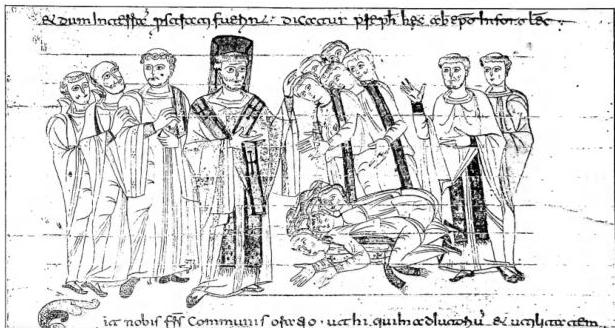
ORDER AND ORDINATION – Priestly Ordination. Miniature from the Pontifical of Landolfo I (957-84) – Rome, Biblioteca Casanatense, 724 B I. 13.
III. TRANSMISSION OF THE THREE DEGREES
From the very beginning, only the Apostles, in whom resided the fullness of priestly powers, conferred Ordination upon deacons (Act. 6:6), presbyters (Act. 14:23), and bishops (I Tim. 4:14; II Tim. 1:6). Timothy and Titus were probably the first disciples of Paul to whom the Apostle conferred the episcopate, assigning them to a specific community (Timothy to Ephesus and Titus to Crete), though he reserved for himself the high direction of the Churches he had founded.This initial practice became explicit teaching in the earliest liturgical documents, for example, in the Ἀποστολικὴ παράδοσις of Hippolytus of Rome (early 3rd century). «Presbyter... non habet potestatem dandi clerum, ideo non poterit constituere clericos» (8, 7-8, ed. A. Casamassa, Rome 1947, p. 19 [for private use]) and in the Didascalia Syriaca (3rd century) (3,20). By the 4th century, the Fathers provided a clearer formulation: «What does the bishop do that the presbyter does not, except Ordination (excepta Ordinatione)?» (St. Jerome, Ep., 146, 1: PL 22, 1194); «Bishops are superior to priests solely by the power to ordain» (St. John Chrysostom, Hom. II in Tim., n. 1: PG 62, 553); likewise St. Epiphanius (Haer., 75, 4: PG 42, 507), who did not hesitate to call Aerius mad for being the first (c. 375) to attribute to priests the power to ordain (ibid.). Against this doctrine, tested by constant and universal practice, two pontifical documents have recently been opposed, by which it would seem that simple priests, though invested with the title of abbots, were granted the faculty to ordain priests and deacons. In 1924, F. Fofi published for the third time (the first edition was in 1911 [F. Beck], the second in 1921 [F. Gilmann]) the bull Sacrae religioni, with which Boniface IX in 1400 granted the abbot of the Canons Regular of St. Osith (diocese of London) the faculty to «confer freely and lawfully» upon his subjects «all minor orders as well as the orders of subdiaconate, diaconate, and presbyterate, at the times established by law.» The discovery caused a stir, but a careful examination of the terminology and the circumstances in which the bull was promulgated—and shortly thereafter (1403) revoked—allows one to conclude that the expression «libere et licite ordinare,» according to the style of the time, should be understood as the faculty to grant dimissorial letters for Ordination, which could be done by a bishop freely chosen by the abbot, independently of the bishop of London (cf. J. Puig de la Bellacasa, La bulla «Sacrae religioni» de Bonifacio IX, in Estudios eclesiásticos, 4 [1925], pp. 3-19, 113-37; F. Cappello, De Sacra Ordinatione, Rome 1935, pp. 249-59; Ch. Journet, L'Église du Verbe Incarné, I, Paris 1941, p. 112, n. 2).
In 1489, Innocent VIII issued the bull Exposcit in favor of Giovanni de Cirey, abbot of Cîteaux, and the abbots of La Ferté, Pontigny, Clairvaux, and Morimond, granting them the privilege of conferring the subdiaconate and diaconate upon their own monks «ne extra claustrum hinc inde discurrere cogantur.» The bull was published in the Collectanea Cisterciensium privilegiorum (Dijon 1491, Paris 1713), and its validity was widely debated (cf. Pie de Langogne, De bulla innocentiana, Rome 1902). Today, not a few doubt its authenticity, since after extensive research neither the authentic copy among the Cistercians nor the draft in the Vatican Archives has been found; some therefore believe the document was fabricated by the notorious forgers of papal bulls, one of whom was hanged in 1489, especially since it contains an unusual privilege granted in such a straightforward manner, as if it were a normal matter; de Cirey, a simple man, may have been deceived. There are, however, defenders of its authenticity (e.g., C. Baisi, Il ministro straordinario degli O. sacramentali, Rome 1937, pp. 13-28; Y. Congar, Faits, problèmes et réflexions à propos du pouvoir d'Ordre et des rapports entre le presbyterat et l'épiscopat, in La Maison Dieu, 14 [1947], pp. 107-128). Since the question remains sub iudice, nothing certain can be deduced against the common teaching. Recent discussion has focused on a bull of Martin V: La bulle «Gerentes ad vos» de Martin V, in Collect. Ord. Cist. Reformatorum, 1951, pp. 1-7, 197-205.
BIBL.:
F. Fofi, Un singolare privilegio riguardante il ministro dell'O. sacro, in La scuola cattolica, 52 (1924), pp. 177-88; J. Puig de la Bellacasa, La bulla «Sacrae religioni» de Bonifacio IX, in Estudios eclesiásticos, 4 (1925), pp. 3-19, 113-37; F. Cappello, De Sacra Ordinatione, Roma 1935; Ch. Journet, L'Église du Verbe Incarné, I, Parigi 1941; Pie de Langogne, De bulla innocentiana, Roma 1902; C. Baisi, Il ministro straordinario degli O. sacramentali, Roma 1937; Y. Congar, Faits, problèmes et réflexions à propos du pouvoir d'Ordre et des rapports entre le presbyterat et l'épiscopat, in La Maison Dieu, 14 (1947), pp. 107-128; La bulle «Gerentes ad vos» de Martin V, in Collect. Ord. Cist. Reformatorum, 1951, pp. 1-7, 197-205.
A. Piolanti
IV. MATTER AND FORM OF THE SACRAMENT OF ORDERS
All Church documents show that Ordination has consistently been conferred through the imposition of hands accompanied by a prayer that specifies and determines its meaning according to the various degrees of the hierarchy.Scripture opens the series of testimonies: Acts 6:6: «Hos (septem) statuerunt ante conspectum Apostolorum et orantes imposuerunt eis manus» (Ordination of deacons); Acts 14:23: «Et cum (Paulus et Barnabas) constituissent (χειροτονήσαντες) illis per singulas Ecclesias presbyteros et orassent (προσευξάμενοι) cum ieiunationibus, commendaverunt eos Domino in quem crediderunt» (presbyteral Ordination). Much debated, however, is the text of Acts 13:2-3 concerning the Ordination of Paul and Barnabas: «Tunc ieiunantes et orantes imponentesque eis manus (προσευξάμενοι καὶ ἐπιθέντες τὰς χεῖρας) dimiserunt illos»; Coppens (v. BIBLICA., pp. 131-133) considers the ceremony a true episcopal Ordination, with the now-fixed rite of the imposition of hands and the concomitant prayer, performed in this case by extraordinary ministers chosen directly by God. Two texts from the Pastoral Epistles seem to refer to a true episcopal Ordination: 1 Tim. 4:14 «Noli negligere Gratiam (χαρίσιματος), quae in te est, quae data est tibi per prophetiam cum imposizione manuum presbyterii». St. Paul alludes to Timothy’s assumption into the ministry, which occurred through two successive acts: the designation of the person by some prophet (per prophetiam) present in the community (a case analogous to the selection of Barnabas and Paul in Acts 13:2), and the imposition of hands performed by the Apostle and the local presbyteral college (Ephesus, according to many Catholic exegetes; Lystra in Pisidia, according to Protestant authors). The effect of this rite is a permanent gift (χάρισμα), upon which Timothy can rely to remain faithful to his ministry. Another text: 2 Tim. 1:6: «Propter quam causam admoneo te ut resuscites Gratiam Dei quae est in te per impositionem manuum mearum». St. Paul no longer recalls the presence of prophets or the intervention of presbyters—circumstances preceding or accompanying the Ordination—but refers to the principal minister and the essential rite (per impositionem manuum mearum), illustrating the nature of the Grace (χάρισμα) communicated to his disciple: a gift of the Spirit, «a gift of strength, charity, and sobriety» (ibid., 1:7). That this refers to a true episcopal Ordination was the opinion of St. Epiphanius, Theodore of Mopsuestia, and Theodoret, today confirmed by distinguished Catholic scholars (Michiels, Bruders, Coppens) and independent critics (Harnack, Knopf, Gore-Turner), moved by the fact that all functions proper to the bishop are attributed by St. Paul to his disciple: the duty to preach (2 Tim. 1:8), to preserve the deposit of Revelation (1:14 and 1 Tim. 6:20), to govern the Church (ibid., 5:1-23), and the power to impose hands (ibid., 5:22).
The rite of Ordination, clearly outlined in the New Testament, spread invariably throughout the Church, as evidenced by the unanimous testimony of the Fathers and Councils (particularly numerous are the texts collected and illustrated by Card. Van Rossum [V. BIBLICA.], pp. 74-111) and by liturgical documents. The Eastern liturgies (Greek, Syriac, Coptic-Ethiopian, Armenian [which only around the 12th century came under Latin influence]) have repeated the same gesture used by the Apostles for twenty centuries (cf. ibid., pp. 111-27). In the West, from the Ἀποστολικὴ παράδοσις of St. Hippolytus (ed. A. Casamassa, Rome 1947 [pro manuscripto]), pp. 4-7, 16-20—where the three splendid formulas for diaconal, presbyteral, and episcopal Ordination are found—to the Roman rite from the 5th to the 8th century (Sacramentaries of Leo and Gelasius, Ordo S. Amandi, Ordines Romani VIII and IX) and the Gallican rite of the same period (Statuta Ecclesiae antiqua, De officiis ecclesiasticis of St. Isidore, Missale Francorum, Liber Ordinum of the Mozarabic rite), up to their fusion in the 9th century (Alcuin, Amalarius, etc.), Ordination retained its original character (extensive documentation in Tixeront [V. BIBLICA.], pp. 106-43). Only around the 10th century was the ceremony of the traditio instrumentorum (the book of the Gospels to the deacon, the chalice with wine and the paten with the host to the priest) sporadically introduced, which gradually became universal (cf. Card. Van Rossum [V. BIBLICA.], pp. 149-72). This ceremony, likely introduced to better explain the object of the power conferred upon the priest (Eucharistic consecration) and also as a continuation of the Romano-Germanic custom of transmitting any juridical authority through an instrument or insignia (cf. B. Bartmann, Manuale di teologia dogmatica, trans. it., III, Alba 1949, p. 334), was considered by some theologians as the essential matter of the sacrament of Orders. St. Thomas, siding with this opinion (De articulis fidei et Ecclesiae Sacramentis; IV Sent. d. 24, q. 1, a. 2, sol. 2; Sum. Theol., Suppl. q. 35, a. 2), gave it great weight and diffusion (R. de Mediavilla, Durandus of St. Pourçain, Capreolus, St. Antoninus of Florence), until it received official sanction from the Church at the Council of Florence. Indeed, Eugene IV in the Decretum pro Armenis (22 Nov. 1439) included an Instructio de Sacramentis (substantially drawn from the aforementioned opuscule of Aquinas), which explicitly states: «Sextum Sacramentum est Ordinis cuius materia est illud, per cuius traditionem confertur Ordo, sicut presbyteratus traditur per calicis cum vino et patenae cum pane porrectionem... Forma sacerdotii talis est: Accipe potestatem offerendi sacrificium in Ecclesia pro vivis et mortuis, in nomine Patris et Filii et Spiritus Sancti» (Denz-U, 701).
To explain this shift in the theology of Orders, the idea was advanced that Christ could have instituted some sacraments (e.g., Confirmation [v.] and Orders) with a generic or mutable determination of the rite (cf. F. Carpino, De Sacramentis in communi, Rome 1950, pp. 231-33, 242 [ad uso privato]), leaving to the Church the faculty to better define the elements according to the circumstances and needs of its centuries-long existence. Thus, regarding Orders, the Apostles chose the imposition of hands (v.) under the influence of Old Testament rites; the Eastern Church remained faithful to this rite, while the Roman Church either added to it (through intrinsic evolution [Billot, De Guibert, van Noort, Tymzak], or extrinsic addition [Scotus, Toledo, Lessius, Frassen, Billuart], or mixed addition [Lugo, Gotti, Amori]) or substituted it (Biel, D. Soto, Gregory of Valencia, Hugon, Galtier) with the traditio instrumentorum. The change, made gradually with tacit approval, received its solemn confirmation at the Council of Florence (1439).
BIBL.:
J. Coppens, L’imposition des mains et les rites connexes dans le Nouveau Testament et dans l’Église ancienne, Paris 1925; W. Van Rossum, De essentia Sacramenti Ordinis, Roma 1914; J. Tixeront, Histoire des dogmes dans l’antiquité chrétienne, III, Paris 1912; F. Carpino, De Sacramentis in communi, Roma 1950; further bibl. in V. ORDINE e ORDINAZIONE, I-III. A. MICHEL.
This process of ideas, possible and perfectly orthodox, today gains greater theoretical probability from a clause included by Pius XII in the apostolic constitution Sacramentum Ordinis of November 30, 1947: «If this (the handing over of the instruments) was once necessary for validity by the will and prescription of the Church, all know that the Church can also change and abrogate what it has established» (AAS, 40 [1948], p. 6). With this theory, everything harmonizes in the historical and ideological development of the sacramental rite of Ordination, and the Decretum pro Armenis acquires a particular significance. However, this is not the only way to explain the facts and interpret the documents. It can also be held that the Western Church remained constantly faithful to the original rite without ever adding to it, not even as an extrinsic complement ad validitatem, another rite (e.g., the traditio instrumentorum). Instead, due to a complex of circumstances, the opinion of theologians varied, and this directly influenced the decree of Eugene IV, who nevertheless did not intend to give any definition in sacramental matters but to present to the Armenians (who had introduced the rite of the handing over of the instruments since the 12th century) the most common doctrine of Latin theologians regarding the seven Sacraments and, in particular, Orders. Therefore, Eugene IV in the Decretum pro Armenis, contrary to what Cardinal van Rossum believed, did not err in any way because he did not intend to pronounce definitively.
The apostolic constitution of Pius XII Sacramentum Ordinis (a document to be venerated as the act of the supreme jurisdictional power of the Roman Pontiff [cf. F. Hürth, La cost. Sacramentum Ordinis, in Civ. Catt., 1919, II, p. 627]), while appropriately using the hypothetical clause quatenus opus sit, out of respect for the other theological opinion and to cut off any doubt,
restores the practice and doctrine of the Latin Church to the channel of its most ancient tradition and shows the Eastern Churches the common concord in the unity of the rites of Ordination: «The sole matter of the sacred Orders of diaconate, presbyterate, and episcopate is the imposition of hands, and the sole form is the words that determine (verbo determinatio) the application of such matter, which univocally signify the sacramental effects, that is, the power of Orders and the Grace of the Holy Spirit, and as such are received and used by the Church. Consequently, to remove any doubt and anxiety, We declare and establish by Our apostolic authority that, if ever it was otherwise disposed, from now on (saltem in posterum) the handing over of the instruments shall no longer be necessary for the valid conferral of the Orders of diaconate, presbyterate, and episcopate». The Supreme Pontiff further precisely determines in which concrete rite of the Roman Pontifical the matter and form of the triple Ordination are contained: «In the Ordination of the deacon, the matter is the single imposition of hands that occurs in the ceremony; the form consists of the words: Emitte in eum, quæsumus, Domine, Spiritum Sanctum, quo in opus ministerii tui fideliter exequendi septiformis gratiæ tuæ munere roboretur». In the Ordination of the priest, the matter is the first imposition of hands by the bishop, which is done in silence; the form is the words: «Da, quæsumus, omnipotens Pater, in hunc famulum tuum presbyterii dignitatem, innova in visceribus eius spiritum sanctitatis, ut acceptum a te, Deus, secundi meriti munus obtineat censuramque morum exemplo suæ conversationis insinuet». In episcopal consecration, the matter is the imposition of hands by the consecrating bishop; the form is given by the words: «Comple in sacerdote tuo ministerii tui summam et ornamentis totius glorificationis instructum cœlestis unguenti rore sanctifica» (AAS, 40 [1948], pp. 6-7).
V. THE EFFECTS OF THE SACRAMENT OF HOLY ORDERS — The sources of Revelation are in agreement in attributing to the rite of Ordination a supernatural efficacy in relation to Grace: Χάρωμα (I Tim. 4:14; II Tim. 1:6): «Spiritus plenitudo... maxime in Ordinatione operatur» (St. Innocent I, Ep., 24, 4: PL 20, 530; ample documentation in Michel [V. BIBLICA.], cols. 1255-57).
As for the character (v.), a process of explication is noted: the priestly powers conferred in Holy Orders are considered, from the beginning, as immutable realities (cf. St. Clement of Rome, I Cor. 44-45: PG 1, 295-302), which transcend the plane of a mere extrinsic deputization. Already by the fourth century, it is held that priestly offices are connected with a profound transformation of the priest’s soul (cf. St. Gregory of Nyssa, In Bapt. Christi: PG 46, 582-83); by the fifth century, this transformation is regarded as an indelible consecration of the spirit, distinct and separable from Grace (cf. St. Augustine, Contra ep. Parmeniani, 2, 28: PL 43, 70).
Since all ancient documents, particularly the liturgical formulas, speak of infused Grace and of powers truly conferred in each of the three Ordinations, it is deduced that the diaconate, the presbyterate, and the episcopate, in varying degrees, are truly sacramental Orders.
The theological illustration of the intimate nature of the character and the Grace of Holy Orders, especially the presbyteral, is the foundation of what is today called «priestly spirituality».
1. The Character
The character of Holy Orders is the highest participation in the priesthood of Christ, for while the characters of Baptism and Confirmation associate the faithful with the consecration and the indirect (and very limited) exercise of certain priestly powers of Christ, this makes a Christian a priest in the full sense. Indeed, the character of Holy Orders is the most perfect ontological consecration of the faithful, transforming the soul almost as the Eucharistic consecration transubstantiates the bread and wine into the Body and Blood of Christ: the comparison is from St. Gregory of Nyssa (In Bapt. Christi: PG 46, 582-83). Through this consecration,the ordained becomes in the full sense the «medium ontologicum» between the two extremes to be reconciled: God and men.
Moreover, through the character, the priest obtains immediate power over the real Body of Christ, with the faculty of rendering Him present on the altar through the words of Transubstantiation and of offering Him in sacrifice acceptable to the Father (ascending mediation). This is the principal act of the priest, to which all else refers as preparation and prolongation, so that priestly activity is the center and the end of the entire hierarchy. He who acts upon the Head influences the whole body. As the consecrator of the real Body of Christ, the priest acquires a direct power over the Mystical Body. Jesus clearly indicated what was included in the sacrificial power conferred at the Last Supper, when, on the eve of the Ascension, He gave the Apostles the command to instruct, sanctify, and govern all nations (Mt. 28:18-19). This threefold power is in function of the first: to render the faithful worthy adorers of God in the supreme act of worship: the sacrifice of the Mass. By preaching, sanctifying, and governing, the priest diffuses the light, virtue, and Grace that dispose souls for the Eucharist, the center of the Christian religion.
The highest right to Grace, since in the present economy of salvation, coinciding in the same person the office of priest and the state of victim (for Christ was «sacerdos suae hostiae et hostia sui sacerdotii» [St. Paulinus of Nola, Ep. 9 ad Secerum]), the more one participates in the priestly office, the more perfectly must he reproduce in his spirit the sentiments of the Victim, immolating all tendencies that conflict with the law of the spirit. It confers a place of preeminence in ecclesiastical society. The Church, which is «a people, a clergy within the people, a primacy within the clergy» (v. FORNARI, VITO, Della vita di Gesù Cristo, book 3), builds and expands itself through the work of its hierarchy, which is like a sphere whose center is the Pope, whose radii are the bishops, who, though extending toward the surface, never cease to converge toward the center of unity. But what gives impulse to the movement of expansion and that of unification—the two movements of every living organism—is the priestly power that consecrates the Eucharist. According to the law of its institution, the hierarchy, from top to bottom, from the Supreme Pontiff to the doorkeeper, in all its branches and in all its degrees, converges toward the edification of the Mystical Body through the Eucharist, the fruit of the consecratory words of the priest.
2. Grace
The Grace of Holy Orders is like the final touch that assimilates the soul to Christ, communicating to it the divine features of the Eternal Priest.To sanctifying Grace is added sacramental Grace, which orients the entire supernatural organism toward the end of this Sacrament, perfecting the virtues and the «professional» gifts (religion for worship, prudence for governance, wisdom for teaching), of which sanctifying Grace had deposited the seeds in the soul.
To this cortege of virtues corresponds a right to special aids from actual Grace, which activates them at the opportune moment.
Through such strengthening of supernatural faculties, the priest is rendered capable of performing meritorious acts that increase the common patrimony of supernatural goods, making their circulation easier (cf. St. Albert the Great, De Eucharistia, dist. 3, cap. 4).
Michel, Caractère, in Dictionnaire de Théologie Catholique, II, coll. 1255-57; A. Piolanti, I Sacramenti, Roma 1951, pp. 253-265; G. Philips, La grâce sacramentelle, Louvain 1939; P. Galtier, De Sacramentis, Roma 1948, pp. 180-190. — A. Piolanti.
VI. CONCLUSION
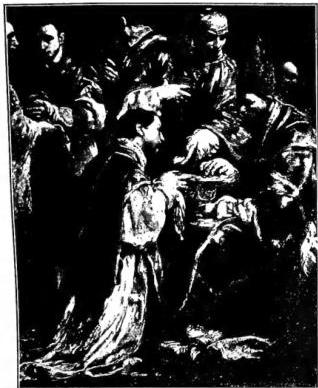
The positive documents of Scripture and Tradition demonstrate that ancient Protestantism (regarding the ideas of Luther, Calvin, and Zwingli, cf. A. Michel [V. BIBLICA.], cols. 1333-46 and L. Cristiani, Réforme, in DThC, XIII, II, cols. 2087-92) and modern Protestantism (regarding the theories of liberals and rationalists, cf. E. Ruffini [V. BIBLICA.], pp. 1-5; J. Coppena [V. BIBLICA.], pp. 110-20; Michel [V. BIBLICA.], cols. 1193-98) are entirely outside historical reality when they deny the divine origin of the sacrament of Orders, the foundation of the hierarchical structure of Christianity, which the Church, with full authority, defined at the Council of Trent (Sess. XXIII: 15 July 1563). The essential points ofORDER AND ORDINATION - Priestly Ordination, painting by G. M. Crespi (17th century) - Dresden, Picture Gallery.
The doctrine expounded is based on the following points: 1) the direct institution of a visible priesthood (ch. 1 and can. 1; Denz-U, 957 and 961), 2) by divine right arranged in hierarchical order: bishops, priests, ministers (ch. 2, can. 6: ibid., 958 and 966); 3) to be transmitted by bishops, who are superior to priests, having the exclusive power to ordain (ch. 4; can. 7: ibid., 960 and 967); 4) with a truly sacramental rite (ch. 3, cann. 3-5: ibid., 959 and 963-65); 5) which imprints the character and produces Grace (ch. 3, can. 4: ibid., 959-64). On this dogmatic foundation rest the pontifical documents on the priesthood: Pius X, exhortation Haerent animo (1908); Pius XI, encyc. Ad catholici sacerdotii (1935); Pius XII, exhortation Menti nostrae (1951).
II. SACRED ORDINATION.
It is the means by which the power of Order is conferred. This term, which properly applies only to the conferral of the major degrees of Order, sometimes refers (can. 950), in addition to episcopal consecration, to all degrees of Order and even to the first tonsure, which admits one to the clerical state (can. 108 § 1) and grants the privileges of the clergy (v. PRIVILEGI DEI CHIERICI), but does not confer any spiritual power.
SUMMARY:
I. Minister of Ordination
II. Subject of Ordination
III. Preparation for Orders
IV. Rite, Time, and Place of Ordination
V. Consecration of Bishops
VI. Nullity of Ordination
VII. Ordination as an Impediment.I. MINISTER OF ORDINATION
He is the one who has the power to confer Ordination validly. The ordinary minister is only the consecrated bishop; the extraordinary minister is the priest, who may have from the Holy See the faculty to confer only minor Orders or, by special personal indult or even by general disposition of law (can. 951). The tonsure and minor Orders may be validly conferred by cardinals (can. 239 § 1, n. 22), by apostolic vicars and prefects, by abbots and prelates nullius (can. 957 § 2), by regular abbots de regimine, who are priests and have received the abbatial blessing, provided that the ordinand is their proper subject by virtue of religious profession (can. 96, n. 1).For validity, the minister must first of all be himself validly consecrated (it is not sufficient that he be merely elected); validity remains, however, if the bishop is heretical, deposed, degraded, irregular, or simoniacal (but not Lutheran or Anglican: V. ANGLICANE ORDINAZIONI), because the validity of Ordination does not depend on the goodness or faith of the minister, but solely on the power of Order. Nevertheless, it is forbidden, under pain of suspension a divinis, to be consecrated by such bishops, and whoever has done so in good faith must abstain from the exercise of Order until authorized (can. 2372).
For a bishop to ordain lawfully, it is required that the ordinands be his subjects (can. 955). Among secular clerics, these are those who have in the diocesan territory their place of origin and current domicile; if the ordinand has no origin in the territory and is not incardinated in the diocese at least through tonsure, he must take an oath of intending to remain always in the diocese. The Ordinary may, however, ordain even non-subjects who are already legitimately destined for another diocese (can. 956), when they have the authorization of their own bishop (v. DIMISSORIE, LETTERE). If the ordinands are religious: a) those who by law or privilege are exempt from episcopal jurisdiction must present dimissorial letters from their own major Superior (general or provincial: can. 964, n. 2), addressed to the ordinary bishop in whose territory the convent to which the ordinand belongs is located (can. 965); only when this Ordinary does not hold ordination at the lawful time or is absent from the diocese, or is of a different rite, or due to the vacancy of the diocese, and provided these cases are not sought or expected fraudulently (can. 967), may the religious Superior address the dimissorial letters to any bishop of the same rite who is in communion with the Apostolic See, furnished with an authentic document from the competent episcopal Curia for the territory, attesting to the existence of one of the aforementioned conditions (can. 966). Acting knowingly and willingly against the aforesaid norms constitutes a crime punished with suspension from Mass (can. 2410). Non-exempt religious are equated for Ordinations to secular clerics (can. 964). Clerics ordained by the Roman Pontiff cannot be elevated to a higher Order without authorization from the Holy See (can. 952).
II. SUBJECT OF ORDINATION
This is the individual who may receive Orders. For validity, it is required that the ordinand be male (women, by divine law, are incapable of receiving sacred Orders; the offices entrusted to deaconesses [v.] did not entail any power of Orders); and that he be baptized, since only Baptism (of water) opens the door to the other Sacraments (can. 968 § 1). In adults, the intention, at least virtual, and a completely free will, that is, not imposed by others, are also required. The ordination of infants, absolutely speaking, is valid (cases occurred in past times); but with regard to the obligations of celibacy and other burdens, those who had been ordained as infants, upon reaching the age of sixteen, had to declare before the authority whether they intended to remain in the Order received (const. Ex quamvis of Benedict XIV, 4 March 1745). A cleric who had received sacred Orders under grave and unjust fear, once the cause of fear has ceased, may ratify the received Ordination, even only tacitly by the free exercise of Orders, intending to accept the obligations inherent to it; if he does not wish to do so, he must juridically prove the coercion suffered so that the ecclesiastical judge may restore him to the lay state without any obligation of celibacy or other burdens (can. 214 and Regulae servandae, S. Congr. de Sacram., 9 June 1931: AAS, 23 [1931], p. 457 ff.). It is illicit to compel a reluctant individual to receive sacred Orders, or to dissuade him from doing so if he is suitable (cann. 971, 972 § 2, 976, 2352).For the lawfulness of Ordination, the ordinand, besides the absence of any irregularity or impediment ([v.] cf. also cann. 968 § 2 and 2374), must demonstrate that he vocation (v.) (cann. 968 § 1, 1353), in the judgment of the bishop (who must form positive certainty of suitability: can. 973 § 3), and the will to ascend gradually to the successive Orders up to the presbyterate (can. 973). However, once ordained, the candidate cannot be compelled to receive the other Orders nor can he be impeded in their exercise (can. 973 § 2). The candidate must also have moral conduct that corresponds to the Order he intends to receive (can. 974 § 1, n. 2), especially with regard to chastity, so that one who was accustomed to committing sins contrary to this virtue could not be considered suitable for the priesthood unless after a long and serious period of probation. He must have the canonical age: 21 years for subdiaconate, 22 for diaconate, 24 for presbyterate (can. 975; cf. also can. 2374); competent knowledge (can. 974 § 1, n. 4); the tonsure cannot be conferred before the beginning of the theological course, the subdiaconate before the end of the third year, the diaconate not before the beginning of the fourth, the presbyterate only after the first half of the fourth year. Theological studies are not valid if completed privately, and if not preceded by a regular course of literary and philosophical studies (can. 976; cf. also can. 1565); the ordinand must undergo examinations (v.) before the diocesan bishop or examiners chosen by him. Orders are accessed by degrees, so that one who has not received the preceding Orders cannot receive a subsequent one (can. 977); and between the Orders themselves, interstices (v.) established in can. 978 must elapse. An Oriental who, by apostolic indult, were authorized to receive higher Orders in the Latin rite, must first receive the Orders that, according to the Oriental rite, he has not received (can. 1004).
It is necessary to approach ordination in a state of Grace; but under pain of grave sin and sacrilege only for those Orders that are certainly Sacrament, that is, diaconate, presbyterate, episcopate. It is also required that the ordinand be confirmed (can. 974 § 1, n. 1), though it is uncertain whether this entails a grave obligation. The bishop, moreover, should not ordain except those whom he deems necessary or useful for the diocese or destined for another diocese (can. 969 §§ 1-2). Regarding the canonical title required for ordination, V. TITOLO DELL'ORDINAZIONE; for the particularities required for Ordination and the burdens assumed with it, V. DIACONIA; PRESBITERATO; SUDDIACONATO; TONSURA; VESCOVO.
III. PREPARATION FOR ORDERS
This preparation is remote and proximate.a) Remote preparation consists in the proper spiritual and intellectual formation to gradually equip the future minister of the sanctuary with the virtues and knowledge necessary for the ecclesiastical state. For the secular clergy, residence in a seminary is required from a young age and at least for the entire course of theology (can. 972 § 1). Exceptions and dispensations, though possible (can. 972), are increasingly rare in practice. For religious, the novitiate (v. NOVIZIATO) is required, along with residence in houses of study and spiritual formation (cann. 542 ff.; 587-89), and, if they are to receive sacred Orders, perpetual profession (can. 964, n. 3).
b) Proximate preparation consists in preceding the ordination with a course of spiritual exercises. Religious undertake these in their own house or another; candidates of the secular clergy do so in a seminary or a religious house (can. 1001 § 3). The course must last at least three days for the tonsure and minor Orders, and at least six days for major Orders (can. 1001 § 1). This course must be repeated if the ordination is deferred by more than six months (can. 1001 § 2). Candidates, whether secular or non-exempt religious, must present or apply for ordination (can. 992). They must then submit several certificates: for the tonsure, certificates of Baptism and Confirmation (can. 993 n. 1); for each Order, the certificate of the previous ordination, of completed studies, and of good conduct issued by the rector of the seminary; testimonial letters from the bishop of the place where the candidate had resided for at least three months prior (can. 993, nn. 2-4; 994), and those from the major superior, if religious (can. 993, n. 5). Exempt religious cannot be ordained without dimissorial letters issued by the major superior (can. 964, n. 2). In these letters, religious must also attest to their membership in the religious family, the profession made, the studies completed, and the other requirements mentioned above (can. 995 § 1).
Current law prescribes that ordinations shall not proceed before the publication of the names of secular clerics (not regulars) to be promoted to Orders. These names are to be read in the parish church of the candidate’s birthplace on feast days during the solemn Mass, or when there is a greater gathering of the people, to allow anyone aware of any canonical impediment to confide it to the bishop or the parish priest. The bishop may modify the manner of publication or, at times, dispense with it entirely or in part (cann. 998-1000; V. INVESTIGAZIONE).
IV. RITE, TIME, AND PLACE OF ORDINATION
The ordaining bishop is bound to observe the prescriptions of the rites and ceremonies imposed for each Ordination in the Roman Pontifical and in other ritual books approved by the Church. The Mass of Ordination and that of episcopal consecration must always be celebrated by the minister or ordaining bishop (can. 1003). Those who are to receive sacred Orders must approach holy Communion in the same Mass of Ordination (can. 1005).Sacred or major Orders may not be conferred except in the solemn Mass of the Ember Saturdays, that preceding Passion Sunday, and Holy Saturday: for a grave reason, however, the bishop may confer them on any Sunday or holy day of obligation (for the episcopate, V. below). The first tonsure may be conferred at any day and hour: minor Orders only on Sundays and feasts of double rite, always in the morning. Contrary customs are approved by the CIC (can. 1006 § 3) and must therefore be corrected, even if immemorial. The prescriptions regarding the time of Ordination must be observed even if, by apostolic indult, a Latin bishop ordains a cleric of the Eastern rite or vice versa (can. 1006 § 5). If it is necessary to supply some forgotten rite, either absolutely or conditionally, the bishop may do so at any time and in secret (can. 1007 and declaration of the Commission for the Interpretation of the CIC, 15 May 1936). General Ordinations must be held in the cathedral church, in the presence of the canons: or, outside the episcopal city, in the most worthy church, in the presence of the local clergy (can. 1009 § 1): it is not unlawful, however, for just cause, to hold particular Ordinations in other churches, in the bishop’s private chapel, in that of the seminary, or of a religious community (can. 1009 § 2).
The first tonsure and minor Orders may also be conferred in private oratories (can. 1009 § 3) or in the vicinity of the church. It is not lawful for the bishop (it is, however, for cardinals, praemonito Ordinario if the church is the cathedral: can. 239 § 1 n. 15) to ordain outside his own territory when the rite of Ordination takes place with the pontifical Mass (can. 1008). The names of the individual ordinands, of the ordaining minister, the place and day of Ordination must be recorded in a special register (Liber ordinandorum); the documents presented by the ordinands must also be carefully preserved (can. 1010 § 1). Each of them must be given an authentic certificate of Ordination, which, in the case of Ordination by a foreign bishop, must be presented at the Ordination, so that it may be noted in the liber ordinandorum (can. 1010 § 2). The same annotation must be made in the Liber baptizatorum, if it concerns subdeacons; and therefore, if it concerns those belonging to the secular clergy, the major superior, if it concerns religious ordained with his dimissorial letters, must notify the parish priest of the Baptism of the ordained of the Ordination that has taken place (can. 1011).
V. CONSACRAZIONE DEI VESCOVI
Per sé è riservata al sommo pontefice (can. 953), il quale però suole dare ad altri la relativa licenza. Può essere eseguita legittimamente solo da quel vescovo che abbia avuto uno speciale mandato apostolico (can. 953) ed è comune dottrina che nemmeno il papa possa concedere facoltà ad un semplice sacerdote di conferire la consacrazione episcopale. Il vescovo consacrante deve essere assistito da due altri vescovi conconsacranti, salvo dispensa pontificia; senza di questa un solo vescovo consacrerebbe validamente, ma illecitamente. La consacrazione episcopale deve essere conferita in giorno di domenica o nelle feste natalizie degli Apostoli (can. 1006 § 1).VI. NULLITY OF ORDINATION
3. General Concepts
When any of the objective or subjective conditions required for the validity of Ordination (v. above) is lacking, its value is nullified: it is therefore invalid, and the duties or obligations inherent to it are likewise null. It must be borne in mind, however, that the validity of Ordination may well coexist with the nullity of its obligations, but not vice versa, as in the case of grave fear (can. 214) suffered by the subject at the time of ordination.The interest of the cleric or ecclesiastical authority in ascertaining the nullity of an Ordination may be twofold and divergent: either to provide for its convalidation and proceed to further Orders, avoiding a hiatus in their sequence; or to withdraw from the clerical state and return to the secular world with exemption from the obligations arising from the received Orders, as well as from the privileges and prerogatives attached thereto. However, while in the first case, to proceed to a new Ordination—at least conditionally—apodictic proof of its nullity is not required, but even a positive and prudent doubt thereof suffices, as ascertained by the diocesan Ordinary; in the second case, invalidity must be established with moral certainty, following a specific procedure.
4. Proof of the Nullity of Ordination and Its Obligations
In current legislation, the practical importance of proving the nullity of Ordination is almost exclusively confined to the presbyterate. Thus, except in exceptional cases, no interest is seen on anyone’s part to prove the nullity of the first tonsure or of minor Orders, since, even if the question of their validity remains unresolved, the return of a minor cleric to the lay state presents no difficulty, as this is, among other things, left to his simple will (can. 211 § 2): it is clear that he will thereby lose clerical offices, benefices, rights, and privileges, with the prohibition of wearing the ecclesiastical habit and bearing the tonsure. The same may be said of subdeacons and deacons. Even before the CIC, they could be reduced to the lay state by rescript of the Holy See with dispensation from all related obligations, including celibacy; and this must be affirmed all the more today, when a just and grave cause exists, following the issuance of two parallel Instructions on 27 December 1930 [AAS. 23 (1931), p. 120 ff.] and 1 December 1931 (ibid., 24 [1932], p. 74 ff.) by the Sacred Congregations of the Sacraments and of Religious, respectively for subdeacons and deacons under their competence: a specific clause, however, inserted in the rescript, prevents their readmission to the original state.The secularization of a priest may be regulated by a twofold canonical provision, depending on whether it is incomplete or complete. When a priest fails in the loftiest duties of his office without hope of amendment, and the continuation in the exercise of the sacred ministry would cause more harm than edification and profit to the faithful; or when, due to invincible repugnance, he is found unfit for the fruitful practice of the ministry, he must or may be reduced to the lay state with dispensation from the obligations, except for celibacy; in addition to the case of degradation, a penalty common to priests and, in general, to clerics in sacris (can. 211 § 1) who have committed a grave fault (in this case, the obligation of celibacy always remains). To obtain, however, complete secularization with exemption from all obligations, including celibacy, it is necessary for the priest to demonstrate either the nullity of the received Ordination or the nullity of the obligations inherent to it: and this through the institution of a specific cause against the validity of the former or the latter. Ordinarily, such a process is initiated either for lack of intention (simulation) in the subject or for some mental defect affecting the consent given to the received Order. The validity of the obligations, on the other hand, may be impugned only ex metu gravi ab extrinseco incusso (can. 214), which rendered the reception of Orders coercive.
5. Canonical Procedure for the Declaration of Nullity
Before the CIC, the treatment of these causes was regulated by the constitution of Benedict XIV Si datam of 4 March 1748: the CIC determines the procedure in cann. 1993-98, which prescribe a twofold form, the strictly judicial, with a double conforming sentence and appeal regulated according to the processes of matrimonial nullity; and the economical form or ad disciplinae tramite. However, to make the treatment of such causes more expeditious and secure, the Sacred Congregation of the Sacraments issued on 9 June 1931 (AAS, 23 [1931], p. 457 ff.) the Regulae servandae in processes of this kind, in which the economical procedural form is ordinarily established; without, however, entirely excluding the judicial form, which may therefore in some cases be prescribed by the Congregation.The competent forum for these causes is established by can. 1993: namely, it pertains to the Sacred Congregation of the Sacraments to judge those in which the obligations contracted with Ordination or the validity of Ordination itself are impugned; those in which the validity of Ordination is impugned due to a substantial defect in the rite are reserved to the Holy Office: any inferior judge is incompetent to instruct such processes unless endowed with apostolic faculty. Moreover, by reason of the committed crime, causes pertaining to the Sacred Congregation of the Sacraments also fall within the competence of the Holy Office when the priest who promotes them has contracted the so-called civil marriage: although the Holy Office, having ascertained its competence, usually entrusts their instruction and decision to the Sacred Congregation of the Sacraments.
The procedural order of causes under the competence of this dicastery is as follows:
the nullity of Sacred Ordination may be impugned indifferently by the interested priest or by the Ordinary to whom he is subject, or in whose diocese he was ordained. The declaration of nullity of the obligations, however, may be invoked only by the priest who believes he has not validly contracted them.
The introductory libellus of the suit, addressed to the Holy Father but transmitted to the competent Congregation, must contain a complete and accurate statement of the facts and the reasons that may lead to the conclusion of nullity, with indication of the date, place of origin or residence of the petitioner, and must be signed by him. Normally, the libellus is transmitted to the Holy See through the Ordinary, who will be that of the diocese in which the petitioner is incardinated, or, if he is a dismissed religious, the Ordinary of the diocese of origin or domicile: it may, however, be forwarded directly to the Holy See by the petitioner.
Upon receiving the libellus, the Congregation instructs the Ordinary to conduct a prior, extrajudicial, and secret inquiry into what is stated therein, and, if the request appears not unfounded, sends the Ordinary the letter of delegation to instruct the cause based on the following doubts: 1) An constet de nullitate S. Ordinationis in casu; and, if the answer were negative, 2) An saltem constet de gravi metu et de ratibabitionis defectu ut, ad normam can. 214 CIC, actor redigendus sit ad statum laicalem sine ullis coelibatus et horarum canonicarum obligationibus.
Once the process is completed, the acts must be sent in copy to the Congregation with the pro rei veritate opinion of the Ordinary, when he has not acted as judge; the decision is reserved to the Sacred Congregation.
As a first precaution (can. 1997), as soon as the judicial action is instituted—even if it concerns only the nullity of the obligations—the plaintiff must be provisionally barred from the exercise of Orders. Another precaution, which the Congregation usually takes, is to require the plaintiff to commit, before the constitution of the trial and by sworn declaration, that in the event of a favorable outcome, he will no longer reside or go for any reason to places where his condition as a priest is known, and especially not to his native country, under pain of excommunication: compliance with this condition is a prerequisite for the execution of the apostolic rescript of dispensation or declaration of freedom from the obligations.
The Regulae set forth the norms for the constitution of the tribunal, specify the office of the judge, regulate the examination of the plaintiff and witnesses, the collection of documents, indications, and presumptions; the manner of proving the lack of ratification of Orders by the plaintiff; his physical examination, when necessary; and conclude with the closure of the trial and the order to send the acts to the Congregation. Special emphasis is placed on the fact that these cases are handled ex officio, both at the diocesan curia and at the Congregation, which usually proceeds through the votes of special consultors: the term ex officio excludes the intervention of lawyers and procurators in the case. If, from the acts received by the Congregation, it appears that either the procedure was not observed, or the trial is incomplete or presents difficulties that can be resolved through a supplementary investigation, steps will be taken to initiate it ex officio; if everything is in order, the acts will proceed further, and the consultors will write their opinions on them, both in defense of Holy Ordination or the obligations, and pro rei veritate, or under both aspects depending on the case.
The bodies responsible for the decision are either the plenary Congregation of the cardinals belonging to the Holy Dicastery or a special Commission of consultors constituted for this purpose. As is obvious, the decision is contained in the response given to the two aforementioned doubts: if the answer to the first is affirmative, the Ordination will be considered null, making the response to the second superfluous; if, however, the answer to the first is negative and to the second affirmative, only the obligations will be considered null.
Since, however, the grave fear referred to in the second doubt is ordinarily difficult to prove in the external forum, Gasparri already warned that the Sacred Congregation of the Council, competent in such cases before the CIC, used to respond for greater security esse locum adeundi Pontificem pro dispensatione; a procedure that is still followed today. Affirmative decisions, whether to the first or the second doubt, are always reported in audience to the Holy Father, and communication is made to the interested parties through their respective Ordinary with the apostolic rescript, which contains the conditions and clauses regulating its execution.
VII. ORDINATION AS AN IMPEDIMENT
1. General Notions. - Canon 1072 states: "Clerics in Sacred Orders invalidly attempt marriage." Therefore, the impediment of Ordination is a true inability to contract marriage, which does not cease, in itself, even with the penalty of deposition, degradation, or reduction to the lay state, and directly concerns the marriage to be contracted, indirectly the lawful use of marriage already contracted before Ordination.For the aforementioned impediment to occur, it is required that one has received Major Orders (minor clerics, by virtue of canon 132 § 2, in case of marriage, lose clerical status ipso iure); that Ordination was freely received (thus, any inability ceases in cases of coercion or lack of ratibabitio as per canon 214, if legitimately proven: canon 1998 § 1); that Ordination itself was received with knowledge of the grave obligation of celibacy.
2. Legal Foundation of the Impediment. - Since marriage is not natura sua incompatible with the clerical state, the impediment of Ordination does not arise from divine law but solely from ecclesiastical law, as clearly demonstrated by the tolerance of the early Church, the practice of the Eastern Church, and the fact that the Church can dispense from II. However, it remains controversial whether the obligation of celibacy arises immediately from ecclesiastical law or from a vow, or from both.
3. Historical Notes. a) For the Western Church. - Although at the time of the Gregorian reform many writers (cf. St. Peter Damian, De coelibatu sacerdotum: PL 145, 380; id., Secunda dissertatio contra clericos intemperantes: PL 145, 408, etc.) and, after the decrees of the Roman Council of 1049, the popes, especially Gregory VII, had considered the marriage of priests null (v. CELIBACY), celibacy in the Western Church officially and clearly appears as a diriment impediment at the beginning of the 12th century, in the Second Lateran Council (1123), which in canon 21 establishes: "We absolutely forbid priests, deacons, subdeacons... to have concubines or to contract marriage: and we decree that marriages already contracted by such persons be dissolved... according to the definition of the sacred canons, etc." (Mansi, XXI, col. 286). This is confirmed by the Third Lateran Council (1139), which some authors consider the first to legislate on the matter. In the aforementioned Council, while canon 6 punishes with the deprivation of ecclesiastical office and benefice the subdeacon who has taken a wife or keeps a concubine, as this is unworthy of those who are "the temple of God, vessels of the Lord, the sanctuary of the Holy Spirit" (Mansi, XXI, col. 528), canon 7 prohibits listening to Mass celebrated by married or concubinary priests and establishes: "We decree that bishops, priests, deacons, subdeacons... who presume to join themselves to wives be separated. For we judge that such a union, which is known to have been contracted against ecclesiastical rule, is not to be considered a marriage" (ibid.). And increasingly clearly, the invalidity of such marriages is denied in the Decretals of the Roman pontiffs from Alexander III (c. 4, III, 3) to Gregory IX.
This makes it clear how justly proposition 72 of Pius IX's Syllabus was condemned as historically false, which traced the origin of the impediment of Ordination only to Boniface VIII (Denz-U, 1772). Finally, the Council of Trent dogmatically defined: "If anyone says that clerics constituted in Sacred Orders can contract marriage and that the marriage contracted is valid notwithstanding ecclesiastical law... let him be anathema" (sess. XXIV, can. 9, Denz-U, 979).
b) For the Eastern Church. — It should first be noted that in the Eastern Church there is no law in force that applies equally to all; one must instead consider what the individual rites prescribe. Generally, however, it can be affirmed that even today the fundamental law of the Eastern Church is the Trullan Council (692), which, while permitting married men to be promoted to the subdiaconate, diaconate, and priesthood, prescribes "that subdeacons who handle the sacred mysteries, and deacons and priests, abstain from their wives according to their own limits" (can. 13: Mansi, XI, 948; cf. also ibid., cann. 6, 12, 48: Mansi, XI, 944 ff., 965). After Ordination, however, subdeacons, deacons, priests, and, a fortiori, bishops are no longer permitted to contract marriage (Benedict XIV, const. Anno vertente, 19 June 1750, § 13 and can. 6 of the Trullan Council: Mansi, XI, 944). The invalidity of such marriages, however, is not certain; indeed, contrary to what authors commonly think, Bobak (op. cit. in bibl., p. 147 ff.) has demonstrated that it is an error to cite the Trullan Council and Justinian legislation (Novella VI, 1) as irritant laws for the marriage of clerics in Sacred Orders in the Eastern Church. Moreover, even Benedict XIV, while admitting that such marriages are illicit by virtue of the Trullan Council, asserts that nowhere is their invalidity sanctioned. The invalidity of the marriages of Italo-Greeks, however, is explicitly sanctioned (Benedict XIV, const. Etsi pastoralis of 16 March 1742, § 8, n. 27).
6. Dispensation
That the impediment of Ordination is dispensable depends on the fact that it arises from ecclesiastical law. The power to dispense belongs — by ordinary power — solely to the Supreme Pontiff; who has never exercised it in the case of bishops; exceptionally, he has exercised it, for reasons of public order, in the case of priests; rarely in the case of deacons, and with somewhat greater frequency when it concerns subdeacons.Historically, two cases of general dispensations are certain: that which occurred for a reason of public order under Julius II in 1554 and concerned all English priests who had attempted marriage before the restoration of Queen Mary, so that the English might be more easily induced to return to the Catholic Church; and that which took place for the religious pacification of France, under the pontificate of Pius VII, on 15 August 1801, from which two thousand priests benefited (the same Pontiff, however, did not wish to validate the marriage of the Prince of Talleyrand, formerly Bishop of Autun). In danger of death, Ordinaries, confessors, and parish priests may also dispense, but only for the diaconate and subdiaconate, for the reasons provided in canons 1043-45 of the CIC (v. URGENT CASE; DANGER OF DEATH). Although a public cause is no longer required, as ancient authors held, a cause is always required, even if private, but proportionate to the gravity of the law from which dispensation is granted. Once the dispensation is granted, the cleric reduced to the lay state can no longer exercise Orders.
7. Penalties
Those who contravene the discipline of the Church in such a grave matter are subject to severe sanctions: 1) latae sententiae excommunication, simpliciter reserved to the Apostolic See, both for clerics in sacris and for the person with whom they might attempt marriage, even if only civil (can. 2388 § 1). However, since the cited canon requires the deliberate will to violate the law (praesumentes), can. 2229 § 2 applies, and thus any diminution of imputability, due to lack of awareness or consent, exempts from the latae sententiae penalty; 2) the ipso facto loss of all offices (can. 188 § 5); 3) irregularity ex delicto (can. 985 § 3); 4) degradation, if the offenders, having been warned, do not repent within a specified time; 5) furthermore, clerics are also suspected of heresy, because they in fact show that they consider their marriage valid. Absolution from the aforementioned excommunication is reserved to the Sacred Penitentiary, which on 4 May 1937 published a declaration stating that said excommunication does not fall under the urgent cases referred to in can. 2254 § 1 (AAS, 29 [1937], p. 283); this applies to every person, even if a cardinal, unless, of course, a particular faculty has been granted by the same Sacred Penitentiary. If absolution were given in danger of death, recourse must be made to the same Sacred Tribunal, as established for censures reserved in a most special manner to the Holy See, according to can. 2252 (AAS, 28 [1936], p. 242).6. The impediment of O. and civil legislation. — Modern civil codes, with few exceptions, completely ignore the impediment of O. (it is a diriment impediment in Austria and Spain). In Italy as well, after the Concordat of 1929, the Civil Code does not recognize either O. or the solemn vow of chastity as an impediment to civil marriage. Nevertheless, some Italian jurists and canonists hold that a cleric in sacris cannot, under the concordatory regime, contract a civil marriage unless he has first obtained a dispensation from the impediment from the Holy See.
III. THE LITURGICAL RITES OF ORDINATION.
1. For the rites of Ordination in the Latin liturgy, V. ACCOLITATO; DIACONO; ESORCISTA; ESORCISTATO; LETTORATO; OSTIARIATO; PRESBITERATO; SUDDIACONATO; VESCOVO. See also the entries: ORDINES ROMANI; PONTIFICALE; SACRAMENTARIO; TONSURA.
8. IN THE EASTERN LITURGIES
Theologically, a distinction is made between ecclesiastical promotion and dignity (e.g., archdeaconate, chorepiscopate) and sacred O., and, regarding the latter, between minor and major Orders. Liturgically, these distinctions are not always indicated by a different ritual gesture, although in general the imposition of hands is excluded for minor Orders (but in the Chaldean rite it takes place for the Ordination of the lector and subdeacon; in the Armenian rite for that of the subdeacon; in the Syriac, Maronite, and Coptic rites the bishop touches the temples during minor Ordinations); however, the formulas always indicate which O. is being conferred. The higher the hierarchical degree conferred, the more solemn the liturgical ceremony becomes. It is not uncommon for a proclamation to be made indicating that a certain deacon, priest, etc., is being ordained for a specific church located in a particular place. In antiquity, the only ritual gesture was the imposition of hands (cf. Act. 6, 6, I Tim. 4, 14 and 5, 22, and II Tim. 1, 6); in the Traditio Apostolica of St. Hippolytus, the consent of those present precedes the imposition of hands, which is accompanied by a single prayer and followed by the kiss of peace, which is also that of the Mass that continues immediately with the Offertory and the Preface (ed. B. Botte, Paris 1946, p. 27); in book VIII, 4, 2 of the Constitutiones Apostolicae (ed. F. Funk, p. 475), interrogations about the person of the bishop to be consecrated precede the imposition of hands, the Gospel is also imposed, the Mass follows, but the introduction and embrace take place the next day. Even today, in almost all Ordinations of every rite, a fundamental schema is found: a proclamation with the formula: Divina gratia quae semper supplet defectus nostris..., the imposition of hands (and for the bishop, of the Gospel) with the prayer, the vesting with the sacred vestments proper to the new O. received, and the fraternal embrace.This simplicity has been best preserved in the Byzantine rite, but instead of one prayer with the imposition of hands, there are two; it should be noted that this gesture also accompanies the proclamation: Divina gratia... in such a way that many, though perhaps wrongly, have considered this proclamation as the essential rite of the O. conferred. Among the Ruthenians, the traditio instrumentorum has been introduced. Hymns and sometimes a short office, with readings and psalms, accompany Armenian Ordinations; in these, the imposition of hands is repeated, and the traditio instrumentorum was also accepted by the dissidents. In the Syriac rite, a first office (hymn, sedro, incensations, readings) precedes a prayer of thanksgiving, and before imposing hands, the bishop passes his hands three times from the consecrated gifts placed on the altar (the O. is conferred during the Communion of the Holy Mass) to the head of the ordinand. The Maronites use various formularies, still in manuscript, and multiply prayers and impositions of hands. In the Chaldean rite, several prayers precede, including poetic compositions, but the ancient usage of a single prayer with a single imposition of hands has been preserved. Among the Malabarians, the Roman Pontifical in Latin is used. In the Coptic rite, as also in the Syriac and Maronite rites, the bishop places his fingers on the temples of those receiving minor Orders. In every rite, the prayers and chants are rich in doctrine, especially regarding the relations between Christ and the Church; the fundamental idea is that of an infusion of the Grace of the Holy Spirit to render the ordained fit for his sacred ministry. - Vedi tav. XI.