
VOCAZIONE. — From the Latin vocatio = calling. The divine V. implies, in the efficient order, the divine will or election of a human creature for a particular task and, in the formal order—as implied by the concept of calling—its manifestation: only the latter creates in the one called the responsibility to respond.
I. SACRED VOCATION
Every moment of human life, in its objective concreteness, lies before the gaze and will of God, to whom all things are subject, as well as before the graces proportionate to the fulfillment of that moment. Thus one may speak, for man, of the vocation of every instant. Nevertheless, when speaking of divine vocation, or simply of vocation, one generally means the priestly or religious vocation. It is to these alone that the celebrated passages of Sacred Scripture refer: “And no one takes this honor upon himself, but he who is called by God, as Aaron was” (Hebr. 5:4); “you have not chosen me, but I have chosen you and appointed you that you should go and bear fruit” (Io. 15:16); “not all understand this word, but only those to whom it is granted” (Mt. 19:11). The reason for this privileged designation as divine vocation lies in the special divine content of the priestly and religious state, called sacred precisely for this reason; this places that state on a level superior to the entire ordinary human supernatural order. In religious life, this higher level consists in the practice of the evangelical counsels, status perfectionis, which crucify the most intimate and, in themselves, legitimate human tendencies, in order to facilitate perfect union with God (Sum. Theol. 1°-2°², q. 108, a. 4; ibid., 2°-2°², q. 184). In the priesthood, it consists in the sublime and operative deformity of the priestly character, powers, and mission—official and hierarchical—which demand the proportionate interior transcendence of the ordinary human order.The manifestation of the divine will may be either miraculous or ordinary, according as it occurs through God’s immediate and infallible intervention, as in the case of s. Paolo, or through providential yet fallible secondary causes. The first case is extremely rare; here we shall always be concerned with the second.
II. SIGNS OF THE SACRED VOCATION
1. Manifestative indications of the divine choice. - Before divine Providence, which regulates secondary causes for the manifestation of sacred election, stands the chosen one, considered not in isolation and abstractly, but within the complete and concrete framework of reality—that is, considered not only in his personal elements, but also in the environment of his origin and of his sacred destination. Only from the favorable maturation of all these elements will a sure indication of the calling emerge. Providence, that is: a) will make favorable (or enable him to overcome and compensate for) the original, family, and other environment, and then the formative environment, including material, economic, and other aspects; b) will instill and nourish in the young man the suitable physical, intellectual, and moral qualities; c) will inspire in his will the desire for religious or priestly life, having the spiritual director weigh and judge the aforementioned elements; d) will enlighten the responsible superiors of the religious institute or diocese, rendering their judgment favorable and inducing them to accept him. It is important to note in what sense, when priestly vocation is concerned, the judgment and acceptance of the bishop have pre-eminent value. Not because they disregard or replace the other elements, but because the judgment of the hierarchical superior is the only one capable of juridically authenticating their favorable character, conferring upon the chosen one the right to ordination: «vocari autem a Deo dicuntur, qui a legitimis Ecclesiae ministris vocantur» (Catech. Rom., part 2, chapter 7; Ench. Cler., no. 104); «no one has ever had any right to ordination before the bishop’s free election» (ibid., no. 860). The bishop, however, must also judge another element, extrinsic to the young man, yet likewise decisive: the number of priests required by the diocese and the possibility of incorporating the new recruit into the hierarchical ranks of effective priestly work (whereas the number of those called to their own sanctification in religious life may theoretically be without limit): «Nemo ex saecularibus ordinetur, qui iudicio proprii Episcopi non sit necessarius vel utilis ecclesiis diocesi» (CIC, can. 969 § 1). Alternatively, employment for him in another diocese must be envisaged (can. 969 § 2).2. Signs in the young man. - a) Moral suitability: of the three aforementioned personal aptitudes, this is the most problematic; 1) it must naturally be judged with a view to the higher level of the sacred vocation. Substantial chastity, for example, since it is obligatory even for a lay young man, constitutes a necessary sign, but not properly a distinctive one. 2) Priestly vocation is not an intermediate step or a compromise with respect to the level of religious vocation; rather, although it does not in itself imply the status perfectionis (except in the case of bishops: cf. 2ᵃ-2ᵃᶜ, q. 184, a. 6), it corresponds to the highest demand for holiness, though by means and on grounds different from those of religious vocation. For religious, the extrinsic but explicit title requiring holiness is the superior status perfectionis embraced for their own sanctification; for priests, the intrinsic but implicit title is the sublimity of their character, powers, and mission. 3) The practical necessities of the ministry, which deprive the secular priest of the precious protection of the religious rule, impose upon him the most solid deepening of his interior virtues. 4) Suitability must mature progressively; but since sacred service is the title requiring special priestly holiness, this holiness must have been substantially attained at the moment of s. Ordination (cf. the exhortation Menti nostrae, no. 100): therein lies another difference from religious vocation (cf. Sum. Theol., 2ᵃ-2ᵃᶜ, q. 189, 1 c.). 5) Although all the virtues are mutually supportive, the most characteristic sign of religious vocation is obedience (of the religious kind), because chastity and actual poverty are also found in other states; that of priestly vocation is devotion to the Eucharistic Sacrifice, because power over the real Body of Jesus is the greatest, most demanding, and incommunicable grandeur of the priest (cf. Menti nostrae, no. 101).
b) Will: it is not necessary for the interior motion of the Holy Spirit to have an emotional, much less a mystical, character (Ench. Cler., 860); it is enough that it invite one to the «yes» of right intention (cf. Pius XI, Ad Catholici Sacerdotii [1935]: in Ench. Cler., no. 1387; Menti nostrae, no. 76).
Here is the theory clearly expressed in the following diagram:
III. PARTICULAR QUESTIONS
1. Doubtful V
Once miraculous manifestation is excluded, God may permit secondary causes to fail. The statement: “if God calls, all difficulties will fall away” confuses God’s absolute and miraculous power with his ordered and ordinary power. There may be a case of lack of clarity, and therefore of doubtful V. One must then proceed—especially in the case of the priesthood—as though it were lacking. Indeed, since this concerns such a difficult exceptional state, the presumption must, with prudent tutiorism, be in favor of no. It is not necessary to prove that the V. is absent, but, with moral certainty, that it is present (cf. CIC, can. 973 § 3; Ad Cath. Sac.; Ench. Cler., 1388). This would also apply if the doubt arose after the first two major Orders (Istruz. S. C. Sacr., 27 Dec. 1930; Ench. Cler., 1224-95).2. Error
There may also be a case of irreparable error. What matters is that it not culpably depend upon the young man. Post factum, in the state mistakenly but inculpably embraced by him, he may likewise expect from divine goodness graces proportionate to it and will become a “called one” to that state.3. Loss of the V
Just as, by resisting Grace, anyone can reject the general V. to eternal salvation and be lost, so the chosen person, restricting the observation to his responsibilities, can reject the interior invitations of Grace to say yes, or, after embracing the priesthood, can reject the graces needed to live it worthily. In both cases he then becomes one no longer desired by God: this is the lost V.4. Scarcity of V
The divine, but non-miraculous, conception of the sacred V. Providence, which cannot allow the necessary priests to be lacking, with disregard for the initiatives that are likewise necessary for their recruitment (cf. Pius XI’s epistle Officiorum omnium, 1 Aug. 1922; Ench. Cler., 1152; Menti nostrae, n. 74-77).5. Freedom and responsibility
Given a certain v., the question arises whether there is an obligation under pain of sin to respond to II. The arguments of the affirmative, “obligationist,” position are weighty: a) the ascetical tradition inclines in this direction; b) assuming a mere invitation, in rejecting it there would indeed be no direct sin, but there would be the indirect sin of the offense inflicted by the refusal upon the divine inviter; c) such refusal would conflict with the obligation of charity to love God above all; d) it would constitute a culpable waste of the precious graces associated with it; e) it would violate the precept of charity toward oneself by unreasonably renouncing one’s own “better,” concretely proposed by God; f) by placing the soul outside the divine program and the preordained graces, it could compromise its eternal salvation; g) in the case of the priesthood it would constitute a betrayal of its social mission; h) it would imply sin, at least per accidens, arising from the culpable motives for the refusal; i) finally, once the obligation were excluded, the greatness and responsibility of the V. would be diminished. Nevertheless, the negative, “libertarian,” position seems more convincing, for the following reasons: a) although it is not absurd that God should impose, under pain of sin, on a person the obligation of living permanently on a plane superior to the normal supernatural level of his nature, this is not to be presumed; b) given the supreme importance of the sacred v., the presumed sinfulness of refusal would have to be grave: which, besides creating enormous anguish of conscience, conflicts with the most common opinion even among the “obligationists”; c) while the liturgy of Ordination shows concern for the suitability and freedom of the Ordinands, it omits any reference to the possible guilt—grave or light—of one who might reject the divine call. Pius XII likewise, in his closing address at the General Congress of Religious, on 8 Dec. 1950, while inculcating the duty of counselors not to obstruct the V. of those called, omitted any mention of a reciprocal obligation on the part of those called to follow it; d) in any event, in practice, sin must certainly be excluded on the authority of the “libertarians,” which renders the obligation, at the very least, doubtful and therefore juridically and morally nonexistent.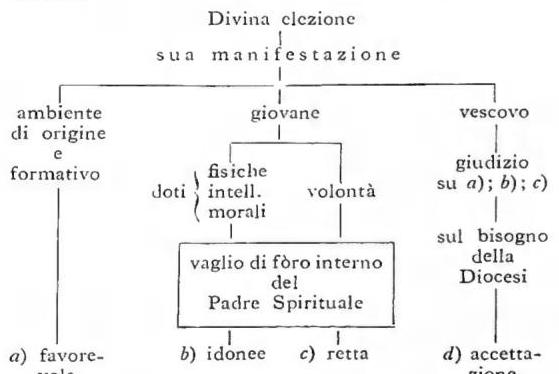
IV. PONTIFICAL WORK FOR VOCATIONS
Established by His Holiness Pius XII motu proprio through the apostolic letter Cum nobis of 4 November 1941, to safeguard, encourage, and assist priestly V. S. Congregation of Seminaries and Universities of Studies, which issued its statutes and regulations by rescript of 30 January 1942. By a rescript of the same date, the S. Penitentiary granted the Work numerous indulgences.To attain its proposed end, the Pontifical Work: 1) first of all fosters the dissemination of exact and clear ideas concerning the nature, necessity, and excellence of the priesthood; 2) promotes the offering of SS. Masses, Communions, prayers, works of penance and charity, in order to obtain from God many excellent priestly v.; 3) encourages the development of the Work, established in the various dioceses, and takes an interest in seeing that it is established where it does not yet exist.
The bodies that may be affiliated with the Pontifical Work are numerous and are divided into: a) branches: diocesan works for priestly v.; b) associate members: religious houses, general and provincial; institutes and centres of Catholic associations, and similar bodies, which extend beyond the sphere of individual dioceses. In order to affiliate a diocesan Work with the Pontifical Centre, the application must be signed by the Ordinary.
The Work has as its president the cardinal prefect of the S. Congregation of Seminaries and grants complete autonomy and freedom of action to the diocesan Works, which are organized and function according to their own regulations.
In order to make the dignity and necessity of the Catholic priesthood ever better known and more adequately appreciated, the Work: 1) invites priests to take advantage of every favourable circumstance to address the subject (e.g.: Lenten preaching, spiritual exercises, novenas, catechisms for adults); 2) urges the faithful to study both the documents issued by the S. See and what the Fathers of the Church and the most distinguished writers have written concerning the priesthood; it exhorts them to cultivate in children and adolescents esteem for the priesthood and to nourish in them the desire for Christian perfection.
In order to obtain from the Lord excellent V. state, together with the aids necessary for their successful fulfilment, the Work recommends the following practices: 1) the Ember Days, instituted by the Church from the earliest centuries also to assist, through prayer and fasting, those aspiring to the priesthood; 2) the « priestly day », a practice approved by decree of the S. Congregation of Rites (12 April 1937) and enriched with special indulgences by the Apostolic S. Penitentiary (cf. Eucharidion clericorum, p. 861, n. 1534); 3) prayers raised to God in turn by religious families; 4) the « day of suffering », on which a treasury of sufferings is gathered from among the sick. For several years this « day » has traditionally been celebrated on Holy Thursday, and its success is aided by radio broadcasts made in various languages for many countries.
The Work also promotes the implementation of various initiatives to interest the different categories of people in the problem of v.: parents, teachers, children, the sick and nurses, students, graduates and professionals, workers, farmers, sailors... An annual « Communion of Children » is requested of those who receive the Sacrament of the Eucharist for the first time.
It provides for the printing of suitable publications in the principal languages: Latin, Italian, French, Spanish, Portuguese, English, and German. The Poglio di comunicazioni, published since 1945, maintains relations between the Pontifical Centre and the diocesan Works; promotes meetings and congresses; supports, and sometimes actively participates in, diocesan, regional, and especially national congresses of priestly v.; and arouses the interest and cooperation of international and national Catholic Organizations.
The Work is consecrated to Jesus Christ, the supreme and eternal Priest; it is placed under the maternal protection of Mary Most Holy, Queen of the Apostles, and under the patronage of St. Joseph, patron of the universal Church; and it venerates in a special way the princes of the Apostles, Peter and Paul. Its principal feast is Holy Thursday, on which the anniversary of the institution of the priesthood occurs.