
SPIRITUAL EXERCISES. – An expression which, in a general sense, applies to the whole of those spiritual practices that tend toward personal sanctification, and, in a more particular sense—the only one considered here—to the retreat practised over several days in order to devote oneself to matters of the spirit.
The example of Jesus in the desert and of the Apostles in the upper room (Act. 1, 13) led, in antiquity, selected groups of Christians to withdraw during Lent to deserted places. Especially after s. Euthymius (d. in 473), one of the most ardent promoters of these retreats, their use spread so widely that Fr. Viller thinks it was general throughout the sixth to eighth centuries. In the Middle Ages many monasteries had special rooms, and sometimes even “hermitages,” for these guests. The decline of monastic life also brought with it the gradual disappearance of these spiritual vacations.
As a reaction to the religious upheaval of the fifteenth century, one sees men eager for reform approaching, for several weeks, the newly kindled fires of regeneration (the classic example is that of Gerardo Groot), especially in the milieu of the «Modern Devotion». S. Ignatius of Loyola providentially succeeded in systematizing this practice, assigning it a precisely determined purpose, organizing a gradual and methodical process, and placing the entire ascetical work under the guidance of a director.
Here, in summary, is the development of s. Ignatius’s «tactics». In a first study, that is, in the so-called first week, after showing through the «principle y fundamento» the norm and criterion according to which all actions must be ordered, he arouses in the exercitant a profound aversion to sin and to all the disorders and attachments that impede the service of God. Having effected this «purification» of the soul, s. Ignatius presents Jesus Christ as the model of divine service and as calling one to follow him, while simultaneously preparing the soul so that, in imitation of Him, it may order all its powers and its own life. In the third and fourth weeks the author of the s. e. seeks to induce a more intimate assimilation and transformation of the soul with the
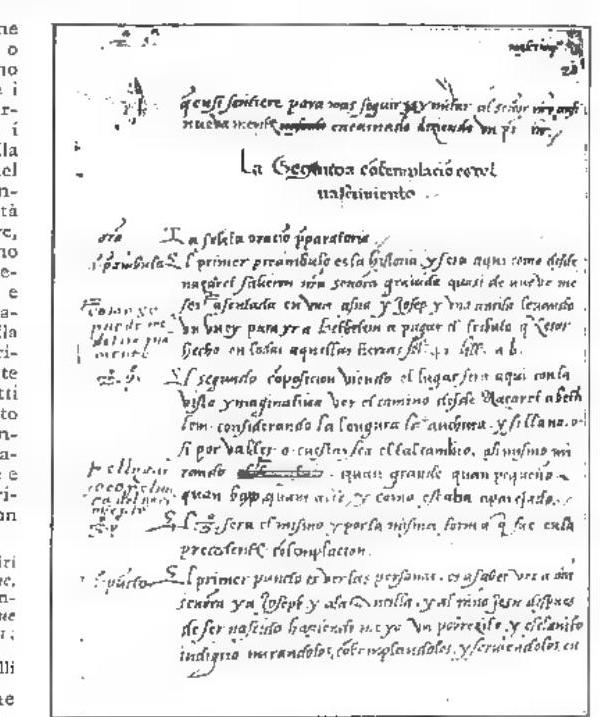
(courtesy of Fr. Spaniaguire S. I.) ESERCIZI SPIRITUALI - Page of the manuscript of the Exercises of s. Ignatius with authorial additions - Rome, Historical Institute of the Society of Jesus.
On 31 July 1548 the Ignatian book was solemnly approved by Paul III, with the brief Pastoralis officii, the first link in more than 600 testimonies made in favor of the book by 35 Supreme Pontiffs, over four centuries up to the present day. Pius XI published the specific encyclical Mens nostra (20 Dec. 1929), and already earlier, in the apostolic constitution Summorum Pontificum (25 July 1922), responding
to the requests of 672 cardinals, archbishops, and bishops, had constituted s. Ignatius of Loyola the heavenly patron of all the e. s. and of the institutions that promote them, in terms, according to Cardinal Enrico Pla y Daniel, analogous to those used by Leo XIII when he declared s. Thomas Aquinas patron of Catholic schools, so that one might deduce from this a preference for s. Ignatius in the spiritual sphere similar to that given by the Church to the «common and universal doctor» in the field of ecclesiastical sciences. This also explains Pius XI’s exceptional affirmation when, in the encyclical Mens nostra, he calls the Ignatian e. s. «the wisest and most universal code for the spiritual governance of souls... a most sure guide to conversion and to the highest spirituality», as well as Pius XII’s statement that «the e. of s. Ignatius will always be one of the most effective means for the spiritual regeneration of the world», because of their proper ordering, but on condition that «they continue to be authentically Ignatian» (24 Oct. 1948).
The original Spanish of the e. s. has been lost. A copy used and corrected by the Saint in his own hand is nevertheless preserved; it is called the «autograph». The editions of the book made in 22 languages number approximately 300. To these must be added those included in the various commentaries on the e., produced by more than 800 authors. Thus, according to approximate calculations, one reaches an average of one edition per month over four centuries, «with a minimum of 4 or 5 million copies.
At the beginning, the e. s. were given individually. In the seventeenth century the Jesuit colleges had special rooms for those making the Exercises. But there were also houses established exclusively for e. s. The first of all, which lasted only a few months, was a villa rented at Siena in 1538. In 1555 a proper house of e. was built at Alcalá. Others followed at Cologne (1561), Louvain (1569), and Val de Rosal (1570). Famous, and expressly established for women, was the «Asccerium» founded at Milan through the work of s. Carlo Borromeo (1579), who made the Ignatian method the soul of his reform. Already in the seventeenth century the e. s. had spread to many nations of Europe, America, India, and Japan. Among those making the Exercises were cardinals, bishops, diplomats, university professors, and influential men, but above all many priests and religious, including members of the older Orders such as Benedictines, Dominicans, Franciscans, Camaldolese, and Augustinians.
The e. s. given to groups, begun in the seventeenth century with religious and priests, underwent a remarkable development in the eighteenth century, promoted by the great apostles of the priesthood: Pietro de Bérulle, s. Francesco di Sales, J. J. Olier, and s. Vincenzo de’ Paoli, who personally gave them to more than 20,000 people. The beginning of the large-scale movement of the e. s. for the laity was constituted by the foundation of the house at Vannes (1659), thanks to the generosity of the bishop, Mons. Kerlivio. Fr. V. Huby, the driving force behind the work, gave e. s. each year to approximately 2,500 men. Alongside it, Caterina de Francheville founded another house for women with 350 rooms.
Other great apostles of the e. s. were, again in France, Frs. Maunoir (d. 1683), Jégou (d. 1701), Renauldt (d. 1743), Mayet (d. 1761), and Claudia Teresa de Kermoto; in Italy, Frs. Pavone (d. 1637), Segneri (d. 1694), Cattaneo (d. 1705), de Mattheis (d. 1779), Lentini (d. 1795), together with Frs. Manulio (d. 1742) and Vassallo (d. 1775), founders of the houses of e. s. at Naples and Cagliari; in Spain, Frs. Peguera (d. 1769) and Bertran (d. 1774), founders of the houses at Gerona and Barcelona, and Fr. Calatayud (d. 1773); in Brazil and Portugal, Fr. Malagrida (d. 1761); in America, Frs. Serra (d. 1697), Márquez (d. 1768), and Moncada (d. 1768);
in China, Frs. de Chavagnac (d. 1717) and Benoist (d. 1774); in India, Fr. Lavernhe (d. 1735), Bertoldi (d. 1740), and Beschi (d. 1747). In the Germanic and Slavic regions, organized centers such as Cologne, Olmütz, Prague, Dillingen, Freiburg, etc., stood out more than individuals.
In the eighteenth century the practice of retreats became one of the most common among spiritual persons, thanks above all to the fervent recommendations of the Popes, chiefly Clement XI, Clement XII, and Benedict XIV. The suppression of the Society of Jesus (1773) was a very serious blow to retreats. Nevertheless, isolated centers remained, such as that at Buenos Aires, where Maria Antonia de la Pas (d. 1799) succeeded in organizing e. s. for 250,000 people; in Italy, through the work of s. Alfonso M. de Liguori and the Redemptorists; at Regensburg, with the assistance of Mons. Sailor; and in France, with Victoria de S. Luc (d. 1794) and Maria Charlotte de Marigoo (d. 1819).
In the nineteenth century Fr. Roothaan (d. 1833) was the true restorer of the theory and practice. In France, Fr. de Ravignan (d. 1858) and especially Fr. H. Watrigant (d. 1826) also distinguished themselves: the latter first, until 1887, as founder and director of the house at Château-Blane, and afterward through his library of e. s. established at Enghien (Belgium) and his numerous studies for guidance and popularization.
Today the e. s. have attained a development never previously known in history. They have become obligatory for priests (at least once every three years) and for religious (at least once a year: CIC, cann. 126, 595), and for those about to receive the first tonsure or Orders (can. 1001 § 1); and very many others make them. According to statistical calculations, at least two million people undertake closed e. s. each year. The Jesuits alone, in 1948, gave them to approximately 850,000 people.
The influence of the e. s. is also exerted through many other means: «open» exercises, popular missions, literature and spiritual direction based on Ignatian principles, and above all through the infiltration of many elements of its spirituality not only into the CIC, but also into the Church’s spiritual bodies, institutions, and practices.
BIBLI: Sources: F. Cervin, Exercitia et directoria, Madrid 1919;
C. Marin, *Spiritualia exercitia secundum Romanorum Pontificum do-
cunanta, Barcelona 1941. On the e. in general: Collection de la
bibliothèque des exercices*, Enghien 1926–26 (100 booklets, under
the direction of Fr. H. Watrigant); E. Böninghaus, *Die Aussee
der Ignatianischen Exerzisten*, Freiburg im Br. 1927. On the genesis
of the e.: A. Codina, Los orígenes de los ejercicios, Barcelona
1926; P. de Latorre, Génesis de los ejercicios, in Archiv. hist. S. I.,
10 (1941), pp. 16–29; H. Picard de la Boullaye, *Les étapes de
rédaction des exercices, Paris 1945; H. Rahner, Ignatius von
Loyola und das geschichtliche Werden seiner Frömmigkeit*, Graz
1947. On the theory of the e. among the older authors, the principal ones are
V. GAGLIARDI, CARLO, L. La Palma, F. Suárez (De Religione, Tract. X,
lib. IX, capp. 5–7); among the moderns, V. MERCIER, DÉSIRÉ, F. Hummelauer,
E. Prayvora, G. Calveras, H. Picard de la Boullaye, L. Ambruzzi,
A. Valensin. The Italian authors who develop the e. are: G. Buceroni,
F. Calcagno, O. Marchetti, P. Orsini, L. Rosa, G. Porta. Other
authors: I. Casanova, A. Denis, H. Gabriel, H. Longhaye, M. Me-
schler, A. Orsi, G. Ovecka, F. Rickaby, W. Sierp. History of the
e.: H. Bernard, Essai Matrique sur les exercices, Louvain 1926;
I. Iparraguirre, Historia de la práctica de los ejercicios, I. Bil-
bac-Rona 1946. Bibli: E. Raito von Frantz, *Exercitiou-Biblio-
graphie, Freiburg 1940. The journal Manereta* (Barcelona) pub-
lishes systematically a bibliographical bulletin of the articles
and works on the e. that have appeared during the year.