
VANNES, DIOCESI DI. — Diocese and city, capital of the prefecture in the department of Morbihan, France. Its name in Breton is Gwened. It has an area of 6,798 sq. km and a population of 506,884, of whom 505,000 are Catholics distributed among 295 parishes, served by 933 diocesan priests and 125 religious priests; it has a major and a minor seminary, 66 male and 362 female religious communities (Ann. Pont. 1953, p. 443). It is suffragan to Rennes; the patron of the diocese is St. Patern; the patron of the city of V. is St. Vincent Ferrer.
The name of the city derives from the people of the Veneti, of whom it was the capital; the Veneti led the confederation that opposed Caesar, who destroyed their fleet in 56 B.C. The Romans laid out roads leading to Corseul, Locmariaquer, Hennebont, Rennes, Nantes, and Angers. By the middle of the sixth century, V. already had its counts. It endured harsh sieges in 1342. Duke Jean V had the Château de l'Hermine built and summoned St. Vincent Ferrer to V.; he died there in 1419 and was buried in the Cathedral. Brittany was united to the French crown in 1532.
The list of the bishops of V. is found in the Cartulaire of Quimperlé. Between 461 and 490, a council was held at V. on the occasion of Patern’s episcopal consecration; Modestus took part in the Council of Orléans in 511; Macliavus was bishop around the middle of the sixth century and is mentioned by Gregory of Tours (Hist. Francorum, IV, 4), as is Ennius (ibid., V, 26, 29, 40); then Regalis, around 590 (ibid., X, 2); Ago lived in the time of Charlemagne, as did Isaac (cf. J. La Martinière, Les origines chrétiennes et les premières églises de V., in Mémoires de la Société polymathique du Morbihan, 1913); Auriscandus appears in documents from 971 and 990; Iudicael from June 992 to 1032. In more recent times, P. de Foix, Cardinals L. Pucci (1514–1531) and A. Pucci (1531–44), and C. De Marillac (1550–60) may be mentioned. Councils were held at V. in the years 461 or 465, 818, and 846.
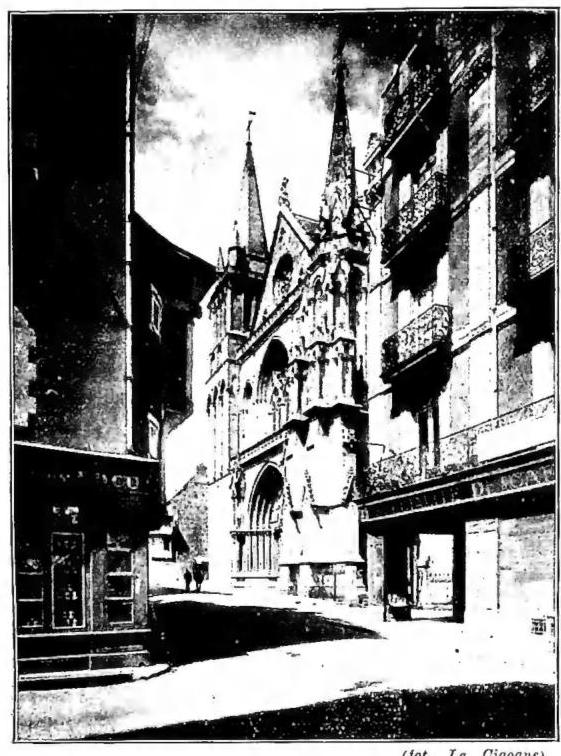
The Cathedral, dedicated to St. Peter, still preserves the bell tower from the beginning of the thirteenth century to the north of the façade, while the rest dates largely from the fifteenth and sixteenth centuries; the round chapel of the Blessed Sacrament is from 1537; the vaults and the choir are from the second half of the eighteenth century; the main portal was rebuilt in 1873. The interior (44 × 25 m) consists of a single nave with five chapels on each side, above which runs a gallery; in the third chapel on the right is the tomb of Mgr. De Bertin (d. 1774); in the fourth, beneath the altar, lies Blessed P. R. Rogue, born at V. in 1758, martyred on 3 March 1796, and beatified by Pope Pius XI on 10 May 1926; Mgr. Tréhion (d. 1941) is buried in the same chapel; in the second chapel on the left is the tomb of Mgr. Laticule (d. 1903). In the crossing are the altars of the apostles Peter and Paul; there are also the tomb and reliquaries of St. Vincent Ferrer, whose canonization and miracles are represented in several tapestries offered in 1615 by Bishop Mgr. J. De Martin. At the back of the choir is the chapel of Notre-Dame (1536–46), with the tombs of Bishops Mgr. S. De Rosmade (d. 1646) and Mgr. F. D’Argouges (d. 1716).
The church of St. Patern, originally Romanesque, began to be rebuilt in 1727. St. Francis Xavier College preserves the chapel dating from 1690.
The episcopal palace is the work of the architect R. De Colte; it was commissioned by Bishop Mgr. Ch. Fr. d’Allancourt (1723–54). The Municipal Museum occupies the former Hôtel de la Princerie, or of the Primicerius, rebuilt in 1525 by the Musson brothers, canons of V. Brittany, also called Château Gaillard, erected in the first half of the fifteenth century, now houses the Archaeological Museum, rich in prehistoric, Gallo-Roman, and medieval antiquities, as well as Renaissance objects; it also preserves an Aubusson tapestry from 1671. The Municipal Library contains more than 50,000 volumes, 122 incunabula, and more than 800 manuscripts, largely originating from the suppressed abbeys in the territory of V. Among the others, mention may be made of the illu-
minated Breviary of Bishop Hugues de Bar, from 1352. Of the former abbey of St-Vannes, only a tower of its church remains, incorporated into the walls of the citadel, while capitals and tombstones are in the Municipal Museum.
The principal sanctuaries venerated in the diocese are: St. Anne d’Auray (where the image of St. Anne, burned in 1793, was replaced by a new statue on 30 September 1868); Notre-Dame de Larmor; Notre-Dame de Quelven at Guern; Notre-Dame du Roncier at Josselin; Notre-Dame du Vœu at Hennebont. The Carthusian monastery of St. Michael at Auray was founded in 1480 by Duke François II on the site of the collegiate church established in 1382 by Jean IV de Montfort, after the victory of 1364; the Carthusian monastery was suppressed by the Revolution, and now houses a hospice for the deaf and mute run by the Sisters of Wisdom. Near the church, a mausoleum was erected in 1829 in memory of the 900 emigrés of Quiberon who were shot in 1795 (A. Le Mené, Chartreux d'Auray, in Bulletin de la Société polymath. du Morbihan, 47 [1905], p. 274 ff.).