
VANINI, GIULIO CESARE (TALORA LUCILIO)

VANINI, Giulio Cesare (sometimes Lucilio). – A turbid and restless figure, a pseudo-philosopher of Aristotelian leanings, born at Taurisano in Lecce in 1585, died at Toulouse on 9 February 1619.

Graduated in law at Naples on 6 June 1606, he may already have entered the Carmelite Order under the name of Fra Gabriele. Later, after 1608, he went to study at Padua in the company of his confrere Bonaventura (in secular life Gian Battista) Ginocchi. From Padua, it seems, the two friars crossed the Alps, wandering through Protestant lands, until they reached France, where the Order’s general, Enrico Silvio, compelled them to apostatize. In 1612 they went to Venice, obtained from the English ambassador a letter of commendation to the heads of the Anglican Church, and on 28 June of that year in London they formally renounced Catholicism. Suspected by the Anglicans on account of their libertine reputation, and soon in dire straits, they asked and obtained permission to return to the Catholic Church; but while Ginocchi made his way back to Italy, Vanini remained in France, where a fierce campaign was under way against libertines and atheists. In June–July 1615 he secured from the ecclesiastical authorities permission to print at Lyons his *Amphitheatrum Aeternae Providentiae divino-magicum christiano-physicum, necnon astrologo-catholicum, adversus veteres philosophos, atheos, epicureos, peripateticos et stoicos*, and the following year in Paris his dialogues *De admirandis Naturae reginae deaeque mortalium arcanis*. Revisions to the manuscript of the latter work and its printing by a non-Catholic publisher aroused strong suspicions about the true aim pursued by Vanini in these writings; accordingly, to avoid the worst, he thought it prudent to leave Paris and settle at Toulouse under the assumed name of Pompeo Usciglio. His intemperate language in disputes with the leading theologians of Toulouse led the city’s Parliament to have him arrested (August 1618). Tried as a blasphemer and atheist, he was condemned to have his tongue cut out and to be burned at the stake. The following year the *Amphitheatrum* and the *De arcanis* were disavowed and prohibited as fostering “perilous atheism” and serving as “champions of a more hidden and abominable libertinism” (16 July 1620; cf. E. Nemer [V. BIBLICA.], pp. 186–98).
Vanini’s thought represents no advance in the history of philosophy. At a time of profound

Article illustration
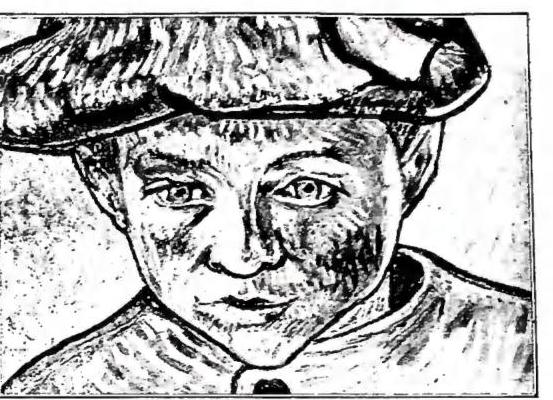
VAN GOGH, Vincent. – A Dutch painter, born at Groot-Zundert on 30 March 1853, who died by suicide at Auvers-sur-Oise on 29 July 1890.

His painting encapsulates the diverse artistic currents of half a century. In his Dutch period (1880–85) it was inspired by the realistic-social motifs of Millet and Israëls (*The Potato Eaters*). In his brief Parisian period (1886–88) it opened to the purely pictorial influences of Impressionism (*La Guinguette*, *View of Montmartre*), Pointillism (*Interior of a Restaurant*), and Japanese prints, but it found its most striking originality in the Provençal period (1888–90). With Van Gogh, Expressionism announces and asserts itself through the emotional power of colour and the deforming impetus of line. Released from earthly bonds, he sought to interpret the sense of being (*The Cornfield*, *The Harvest*, *The Sower*), the cosmic infinite (*Starry Night*), the vital impulse and the elements (*Field with Poppies*, *Cypresses*, *Sunflowers*), and human sorrow (*A Ward in the Hospital at Arles*, *The Reapers*, *Café at Night*; and in many portraits). His vision often turned dark and hallucinatory (*The Cottage*), yet in the face of the formal excesses of later Expressionists he remains a classic. Famous are his letters to his brother Théo (Amsterdam 1914–25) and to Bernard (Paris 1911).

BIBL.: G. B. de la Faille, *L'oeuvre de V. V. G.*, Paris 1939; J. Leymarie, *V. G.*, ibid. 1951; M. Valsecchi, *V. G.*, Milan 1952; Giuseppe Faggin.

VANINI, Giulio Cesare (sometimes Lucilio). – A turbid and restless figure, a pseudo-philosopher of Aristotelian leanings, born at Taurisano in Lecce in 1585, died at Toulouse on 9 February 1619.

Graduated in law at Naples on 6 June 1606, he may already have entered the Carmelite Order under the name of Fra Gabriele. Later, after 1608, he went to study at Padua in the company of his confrere Bonaventura (in secular life Gian Battista) Ginocchi. From Padua, it seems, the two friars crossed the Alps, wandering through Protestant lands, until they reached France, where the Order’s general, Enrico Silvio, compelled them to apostatize. In 1612 they went to Venice, obtained from the English ambassador a letter of commendation to the heads of the Anglican Church, and on 28 June of that year in London they formally renounced Catholicism. Suspected by the Anglicans on account of their libertine reputation, and soon in dire straits, they asked and obtained permission to return to the Catholic Church; but while Ginocchi made his way back to Italy, Vanini remained in France, where a fierce campaign was under way against libertines and atheists. In June–July 1615 he secured from the ecclesiastical authorities permission to print at Lyons his *Amphitheatrum Aeternae Providentiae divino-magicum christiano-physicum, necnon astrologo-catholicum, adversus veteres philosophos, atheos, epicureos, peripateticos et stoicos*, and the following year in Paris his dialogues *De admirandis Naturae reginae deaeque mortalium arcanis*. Revisions to the manuscript of the latter work and its printing by a non-Catholic publisher aroused strong suspicions about the true aim pursued by Vanini in these writings; accordingly, to avoid the worst, he thought it prudent to leave Paris and settle at Toulouse under the assumed name of Pompeo Usciglio. His intemperate language in disputes with the leading theologians of Toulouse led the city’s Parliament to have him arrested (August 1618). Tried as a blasphemer and atheist, he was condemned to have his tongue cut out and to be burned at the stake. The following year the *Amphitheatrum* and the *De arcanis* were disavowed and prohibited as fostering “perilous atheism” and serving as “champions of a more hidden and abominable libertinism” (16 July 1620; cf. E. Nemer [V. BIBLICA.], pp. 186–98).

Vanini’s thought represents no advance in the history of philosophy. At a time of profound

VANNES, DIOCESE OF

Facade of the cathedral of St Peter (15th–16th c.).

The cathedral, dedicated to St Peter, still preserves the bell tower from the early 13th century on the north side of the façade, while the rest largely dates from the 15th and 16th centuries; the round chapel of the Blessed Sacrament is from 1537; the vaults and the choir are from the second half of the 18th century; the main portal was rebuilt in 1873. The interior (44 m × 25 m) is a single nave with five chapels on each side above which runs a gallery; in the third chapel on the right is the tomb of Monsignor di Bertin (d. 1774); in the fourth, beneath the altar, lie the remains of Blessed P. R. Rogue, born at Vannes in 1758, martyred on 3 March 1796 and beatified by Pope Pius XI on 10 May 1926; in the same chapel is buried Monsignor Tréhino (d. 1941); in the second chapel on the left is the tomb of Monsignor Laticule (d. 1903). In the crossing are the altars of the Apostles Peter and Paul; the reliquary contains relics of St Vincent Ferrer, for whom several tapestries, donated in 1615 by Bishop Monsignor J. De Martin, depict his canonization and miracles. At the far end of the choir is the chapel of Our Lady (1536–46) containing the tombs of Bishops Monsignor S. De Rosmade (d. 1646) and Monsignor F. D’Argouges (d. 1716).

The church of St Paterne, originally Romanesque, was rebuilt beginning in 1727. The College of St Francis Xavier preserves its chapel of 1690.

The episcopal palace is the work of the architect R. De Colte; it was commissioned by Bishop Mons. Ch. Fr. d'Allancourt (1723-54). The municipal museum occupies the former Hôtel de la Princierie or del Primicerio, rebuilt in 1525 by the Musson brothers, canons of V. In the Palace of the former Parliament of Brittany, also known as the Château Galle, the hall, erected in the first half of the 15th century, now houses the archaeological museum rich in prehistoric, Gallo-Roman, medieval antiquities, and Renaissance objects; it also preserves an Aubusson tapestry from 1671. The municipal library contains over 50,000 volumes, 122 incunabula, and over 800 manuscripts, most of which come from the suppressed abbeys of the territory of V. Among these is the Breviary of Bishop Hugh de Bar from 1352.

Of the ancient abbey of St-Vannes, only a tower of its church remains, incorporated into the walls of the citadel, while capitals and tombstones are in the municipal museum.

The principal shrines venerated in the diocese are: St. Anne of Auray (where the image of St. Anne, burned in 1793, was replaced by a new statue on 30 September 1868); Notre-Dame de Larmor; Notre-Dame de Quelven in Guern; Notre-Dame du Roncier in Josselin; Notre-Dame du Voeu in Hennebont. The charterhouse of St. Michael in Auray was founded in 1480 by Duke Francis II on the site of the collegiate church established in 1382 by John IV of Montfort, following the victory of 1364; the charterhouse was suppressed during the Revolution, and now houses a hospice for the deaf and mute run by the Sisters of Wisdom. Near the church, a mausoleum was erected in 1829 to commemorate the 900 emigrants of Quiberon who were shot in 1795 (A. Le Mené, *Chartreux d'Auray*, in *Bulletin de la Société polymathique du Morbihan*, 47 [1905], pp. 274 ff.).

BIBL.: Eubel, I, p. 520; II, p. 290; III, p. 349; IV, p. 362; V, p. 408; L. Duchesne, *Fastes épiscopaux de l'ancienne Gaule*, II, 2nd ed., Paris 1910, pp. 375-76; R. Grand, *V.*, in *Congrès archéologique de France*, Brest et Vannes 1914, Paris 1914, pp. 401-37; Cottineau, I, col. 207 (for Auray), II, cols. 3294-95; *Guide de la France chrétienne et missionnaire*, 1938-49, Paris 1948, pp. 416, 791-794; 1115-19; P. Grosjean, *St Paterne d'Auray* and *St Paterne de V.* in the Martyrologies, in *Analecta Bollandiana*, 67 (1949), pp. 384-400.