
FRANCE. - Region and State of Western Europe, the only one to enjoy the benefit of a triple maritime façade (Mediterranean, Atlantic, North Sea) and the possession of the shortest and most convenient land routes between the Mediterranean and the Atlantic (Aquitanian Gate) and between Central and Western Europe (Burgundian Gate).
CONTENTS:
I. Geography
II. Civil and Ecclesiastical History
III. Literature
IV. Art
V. Current Relations between Church and State
VI. Educational System.### I. GEOGRAPHY.
Spanning the most populous part of the continent, it occupies a central position within it, with a border that is more maritime (3,120 km of coastline) than terrestrial (2,300 km) and a character more Atlantic (1,385 km of coastline) than Mediterranean. By its surface area (551,696 km² after territorial acquisitions at the expense of Italy along the Alpine border), it is the largest state in Europe (excluding the U.S.S.R.), but it is surpassed (besides the U.S.S.R.) by Germany, the United Kingdom, and Italy in population, and by many other states in population density. The territory over which it exercises dominion is, in extent, the third largest in the world: 12.4 million km² with 115 million inhabitants.
A line drawn from Bayonne to Metz separates in France the domain of lowlands (below 1,200 m) from that of highlands (only 1/10 of the total, however, exceeding 800 m). To the north and northwest extend plains (Paris Basin, Aquitaine Basin), plateaus, and hills, with reliefs of ancient origin and modest elevation (Armorican Massif, Ardennes); to the south and southeast lie imposing mountain ranges of recent emergence (Alps, Pyrenees, Jura), whose possession France shares with neighboring countries (Italy, Spain, Switzerland). The two domains are joined in the center of the country by the vast Massif Central (1/7 of the territory), which in some ways participates in the peculiar characteristics of both types of relief. The result, overall, is a fairly varied morphology, corresponding to an equal richness of landscape, natural resources, and economic aptitudes, and a harmonious arrangement of basins and passes, always favorable to trade.
The climate reflects, by region, oceanic influences (Brittany, Aquitaine, Flanders: uniform, mild, humid), Mediterranean influences (Provence, Languedoc: mild winters, hot and dry summers, rainy autumns), and continental influences (Central Plateau and eastern regions: strong seasonal contrasts, snowy winters, and summer rains), but it is everywhere temperate, with precipitation generally not less than 600 mm annually and well distributed throughout the year.
According to the recent (24 December 1946) constitution, the French Republic, which is part of the Union Française together with the associated states (Protectorates of Morocco and Tunisia, Republic of Vietnam), comprises, in addition to the metropolitan territory, 4 overseas departments (Martinique, Guadeloupe, Réunion, Guinea) and 8 overseas territories (A.O.F., A.E.F., Madagascar and Comoros, Somalia, Indian Establishments, New Caledonia, Oceanic Establishments, Saint-Pierre and Miquelon); in total, 11.1 million km² with 75-80 million inhabitants. (Togo and Cameroon are under trusteeship administration, and the New Hebrides under condominium.) The Union Française is presided over by the President of the Republic: its expression is an Assembly composed half of representatives from metropolitan France. The French Republic, in turn, exercises its sovereignty through a bicameral Parliament (National Assembly of 619 deputies, and Council of the Republic of 250-320 councilors), which is responsible for the election of the president, who remains in office for no more than 7 years. The French Republic is defined, in the new Constitution, as "indivisible, secular, democratic, and social." Administratively, the metropolitan territory is divided into 37,989 communes, grouped into 3,028 cantons, 311 arrondissements, and 90 departments.
France remains essentially an agricultural country: nearly half of its inhabitants are engaged in agriculture.
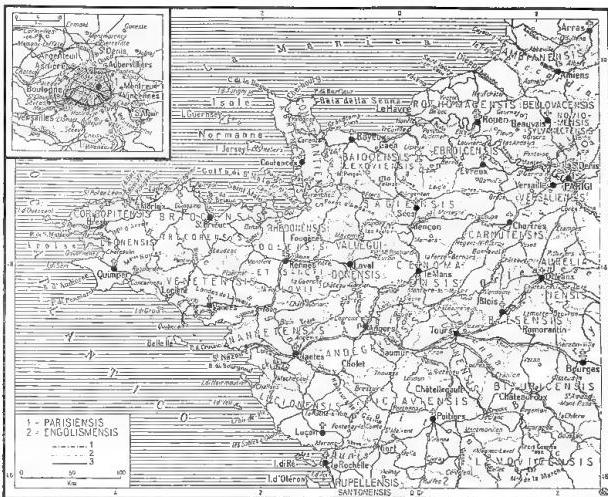
FRANCE - N.W. France. Ecclesiastical circumscription. 1) State borders; 2) Ecclesiastical circumscription borders; 3) Railways. The inverted diocese symbol in the four maps of France indicates that the diocese is suppressed, though its curia name still remains, combined with that of the current diocese. At the top left, the archbishop's seat in Paris.
most of its inhabitants, many of whom are small landowners. Various crops are cultivated, but among these cereal crops prevail (plains of the North, West, and Aquitaine), with wheat (33 million quintals in 1947: 87 in 1913) and oats (30 and 52 million quintals, respectively) dominating, as well as potatoes (60 and 130 million quintals at the same dates), to which various industrial crops (sugar beet, tobacco, hops, etc.) have been added in our century; however, all remain insufficient for domestic consumption. France is, instead, a major exporter of wine, which grants it a recognized world primacy (44 million hectoliters in 1947: 63, on average, in 1934-38). Livestock farming is also flourishing, in relation to the substantial production of hay and fodder: France ranks first in Europe (excluding the U.S.S.R.) in the number of cattle (15 million head) and horses (2.4 million), second in pigs (after Germany), and third in sheep, etc. Consequently, the revenue derived from animal products (butter, cheeses, eggs) is considerable. Fishing is also well developed, especially in the northwest sector (Brittany).
The exceptional wealth of its iron ore reserves (Lorraine; France extracts about 1/4 of the world total of these minerals) contrasts with the relative poverty France laments in fossil fuels (Flanders, Cavenne; barely 5% of the world total). France does not even produce 2/3 (45 million tons in 1947) of the coal it consumes; moreover, it is almost entirely devoid of oil (51 thousand tons in 1948), while it can rely on substantial hydroelectric reserves (8 million HP, of which 6 installed). Despite these imbalances, large-scale industry is represented in France in all its branches, led by textiles (Northern and Eastern France), where, as in other fields (furniture, goldsmithing, perfumery, crystalware, etc.), the tendency to prefer quality, taste, and elegance stands out. After the wartime hiatus, France has now resumed, and sometimes surpassed (artificial textiles), its 1938 positions. The major industrial districts are located in Flanders (machinery, textiles, glassworks, sugar refineries), around Paris (luxury goods, publishing), and near the major ports, as well as around Lyon (silk) and St-Etienne.
Internal communications benefit from the favorable altimetric conditions of the terrain and the arrangement of the major river basins, radiating like spokes from the Massif Central. France has about 640,000 km of roads, 9,000 km of navigable waterways, and 62,500 km of railways, of which 20,000 are local and 3,500 electrified. Characteristic is the convergence of all these communications toward Paris. As for foreign trade, predominantly maritime, it is favored by the good equipment of the major ports (Marseille, Rouen, Bordeaux, Le Havre, Cherbourg, Dunkerque) and by a merchant fleet that includes over 500 ships (of which 30 transatlantic) with a total tonnage of 2.1 million tons.
Foreign trade consists mainly of raw materials and foodstuffs in imports, and agricultural products and quality manufactures in exports. Since 1944, the trade balance has always been in deficit (223.4 billion francs in 1948).
| Historical Provinces (and constituent departments) | Area in km² | Resident Population (census of 10 March 1946) | Density per km² | Capital (and its population in thousands in 1946) |
|---|---|---|---|---|
| Flanders (Nord) | 5,774 | 2,022,167 | 350 | Lille (189) |
| Artois (Pas-de-Calais) | 6,752 | 1,170,467 | 175 | Arras (33) |
| Picardy (Somme) | 6,227 | 467,479 | 75 | Amiens (85) |
| Brittany (Finistère, Côtes-du Nord, Morbihan, Ille-et-Vilaine, Loire-Inférieure) | 35,312 | 3,074,683 | 104 | Rennes (114) |
| Normandy (Manche, Calvados, Orne, Eure, Seine-Inférieure) | 30,728 | 2,332,228 | 76 | Rouen (108) |
| Maine (Mayenne, Sarthe) | 11,457 | 630,867 | 56 | Le Mans (100) |
| Anjou (Maine-et-Loire) | 7,218 | 477,600 | 66 | Angers (97) |
| Orléanais (Eure-et-Loir, Loir-et-Cher, Loiret) | 19,171 | 827,463 | 44 | Orléans (70) |
| Île-de-France (Oise, Aisne, Seine-et-Oise, Seine-et-Marne) | 25,385 | 7,671,878 | 302 | Paris (3,725) |
| Champagne (Ardennes, Marne, Aube, Haute-Marne) | 26,741 | 1,126,904 | 42 | Troyes (59) |
| Lorraine (Meuse, Meurthe-et-Moselle, Vosges) | 23,633 | 1,866,147 | 79 | Nancy (113) |
| Alsace (Bas-Rhin, Haut-Rhin, Belfort) | 8,902 | 1,318,838 | 149 | Strasbourg (176) |
| Poitou (Vendée, Deux-Sèvres, Vienne) | 20,114 | 1,004,872 | 50 | Poitiers (49) |
| Touraine (Indre-et-Loire) | 6,158 | 343,276 | 56 | Tours (80) |
| Berry (Indre, Cher) | 14,210 | 534,317 | 38 | Bourges (51) |
| Bourbonnais (Allier) | 7,383 | 368,778 | 50 | Moulins (23) |
| Nivernais (Nièvre) | 6,888 | 246,673 | 276 | Nevers (34) |
| Burgundy (Yonne, Côte-d'Or, Saône-et-Loire, Ain) | 30,701 | 1,448,457 | 47 | Dijon (101) |
| Franche-Comté (Haute-Saône, Jura, Doubs) | 15,590 | 738,438 | 47 | Besançon (64) |
| Aunis and Saintonge (Charente-Inférieure) | 7,232 | 419,021 | 58 | La Rochelle (40) |
| Angoumois (Charente) | 5,972 | 309,279 | 52 | Angoulême (44) |
| Limousin (Haute-Vienne, Corrèze) | 11,443 | 569,359 | 53 | Limoges (108) |
| Marche (Creuse) | 5,506 | 201,844 | 36 | Guéret (10) |
| Auvergne (Puy-de-Dôme, Cantal) | 13,793 | 676,991 | 49 | Clermont-Ferrand (108) |
| Lyonnais (Loire, Rhône) | 7,658 | 1,678,605 | 22 | Lyon (461) |
| Guyenne and Gascony (Gironde, Dordogne, Lot, Aveyron, Lot-et-Garonne, Tarn-et-Garonne, Landes, Gers, Hautes-Pyrénées) | 63,232 | 2,764,605 | 44 | Bordeaux (254) |
| Béarn and Navarre (Basses-Pyrénées) | 7,712 | 413,411 | 54 | Pau (46) |
| County of Foix (Ariège) | 4,903 | 155,134 | 32 | Foix (7) |
| Roussillon (Pyrénées-Orientales) | 4,145 | 233,347 | 56 | Perpignan (75) |
| Languedoc (Haute-Garonne, Aude, Tarn, Hérault, Haute-Loire, Lozère, Ardèche, Gard) | 46,331 | 2,555,424 | 55 | Toulouse (264) |
| Savoy (Haute-Savoie, Savoie) | 10,786 | 498,971 | 46 | Chambéry (10) |
| Dauphiné (Isère, Drôme, Hautes-Alpes) | 20,441 | 928,233 | 45 | Grenoble (102) |
| Comtat Venaissin (Vaucluse) | 3,578 | 245,508 | 69 | Avignon (60) |
| Provence (Basses-Alpes, Bouches-du-Rhône, Var) | 18,268 | 1,708,554 | 94 | Aix |
| County of Nice (Alpes-Maritimes) | 3,736 | 513,714 | 138 | Nice (211) |
| Corsica | 8,722 | 322,854 | 37 | Ajaccio (31) |
| 550,986 | 41,905,968 | 76 |
II. CIVIL AND ECCLESIASTICAL HISTORY.
SUMMARY:
I. In the Middle Ages
II. In the Modern Age
III. The Revolution
IV. Contemporary France.I. IN THE MIDDLE AGES
1. Civil History
From the end of the 6th century, the essential characteristics of France manifest themselves in Merovingian Gaul. From the north, it had reached the Pyrenees and the Mediterranean; victorious wars extended the authority of Clovis’s descendants over the Germans beyond the Rhine. Fused in the Catholic religion, Franks (v. FRANCHI) and Gallo-Romans had suppressed Arianism and formed a single people. Yet peace remained precarious: the Merovingians set the worst examples of discord and brutality; the name of Queen Brunehild (end of the 6th century) is tied to the most infamous memories. The peaceful reign of Dagobert (629-39) was but a brief episode before the decline of the rois fainéants, whose degeneration rapidly led them to the grave after preventing them from resisting the ambition of the maîtres de palais. The kingdom was not a state but rather a patrimony divided at every succession (Neustria, Austrasia, Burgundy, Aquitaine).Chaos produced salvation: this is one of the characteristics of French history. The unity of barbaric Gaul was achieved by a barbarian, Clovis. Merovingian France was saved from anarchy by one of those maîtres de palais who had torn it apart. Later, it would be one of the least fortunate lords, the Capetian, who saved the monarchy from feudal dismemberment. Various favorable circumstances contributed to the fortune of the Carolingians. The energy of the maîtres de palais of Austrasia resolved the incapacity of the fainéants. They rose to the rank of saviors: Charles Martel halted the Muslim advance at Poitiers (732), which sought to infiltrate the West; his son, Pepin the Short, saved the Holy See, threatened by Agilulf, king of the Lombards. Stephen II, grateful, declared that "he should be king who governed" (Chronique de St-Denis, V, 82) and came to France to consecrate the new dynasty (754).
Under Charlemagne, Pepin’s son (768-814), it seemed that the nation and the reality of the imperial state, lost in the West after Odoacer’s coup in 476, had been restored. The Frankish Kingdom covered, and at times surpassed, the ancient Roman territory: Italy, where Charlemagne took the iron crown of the Lombard Desiderius (773); the Spanish March, conquered despite the Battle of Roncevaux (778); Bavaria, taken from Duke Tassilo; Pannonia, pacified after the conquest (796) of the nomadic capital of the Avars (the Ring); Germany, wrested from the Saxons fanaticized by Widukind. A capital with a Latin name, Aix-la-Chapelle (Aachen), was established, following Roman tradition, near the ancient limen of the Rhine; a sacred palace, other dignitaries, general laws (capitularia), a centralized administration (counts, missi dominici): all power was concentrated in the hands of the prince. The illusion was even greater after the imperial coronation at St. Peter’s on Christmas Day 800 by Leo III.
In reality, the edifice was but a façade: incomplete, it showed cracks. Weak, incapable, or divided, the Emperor’s descendants could not restrain centrifugal forces, face external assaults, or even consolidate the structure. Due to a lack of finances, imperial assets were squandered to remunerate military services; no bond other than the fragile one of personal loyalty still tied the sovereign’s servants to him: vassalage took shape. The practice of divisions persisted, and already during his reign, Louis the Pious (814-40) witnessed, powerless or as a victim, the quarrels of his sons over his inheritance. The Empire disintegrated; Europe was emerging. France turned inward, now mutilated. The Serment de Strasbourg (842), bilingual, distinguished the Romance dialect from the Germanic one; the Treaty of Verdun (843) placed, as a point of discord, Lotharingia (Lothar’s Kingdom) between the two Frances of the East and West: that of Louis the German and that of Charles the Bald. Only the latter retained the name. Regionalism appeared in Aquitaine. The crown made a final flourish when Charles the Bald reformed imperial unity (Christmas 876); but it was the last gesture: his successor, Charles the Fat, discredited himself by abandoning Burgundy to the Normans.
Three waves brought the Normans into France after Charlemagne’s death. Until 860, their ships ascended the rivers for raids as devastating as they were fleeting. From 860 to 911, their attacks intensified; they besieged Paris in 885. In 911, Charles the Simple ceded them the present-day province of Normandy. At the same time, the Saracens in the 9th century and the Hungarians in the 10th plundered the southern coasts and the east and center of the Kingdom, respectively. Faced with invasion, monarchical power remained impotent; only local defense proved effective. Counts, hereditary in fact, became independent; they reserved tax revenues for themselves, as it was their duty to maintain castles and lead their men into battle. The great fiefs took shape (duchies of Normandy and Burgundy, counties of Flanders, Auvergne, Poitiers, Toulouse, and Barcelona). Authority dissolved, and the monarchy was now nothing more than a dignity, contested in the 10th century among the great lords.
Hugh Capet had already exercised the tutelage of Kings Lothair and Louis V, and two of his ancestors had occupied the throne when, in 978, he was elected king. A weak king with powerful vassals. The first four Capetians (Hugh, Robert the Pious, Henry I, Philip I) could at least derive from their sovereign rights and the Church’s support, which had consecrated them, the possibility of expanding their domains and securing the crown in their lineage.
In the 12th century, with two active kings, Louis the Fat (1108-1137) and Louis VII the Younger (1137-80), the monarchy reawakened. The name of king became synonymous with peace. Louis VII expelled the adventurous lords from his land; the people trusted in his justice, and under his protection, the Communes freed themselves from their lords. However, the struggle against the great feudal lords became more difficult when Henry II Plantagenet, king of England, added to his domains of Maine and Anjou all of Aquitaine, brought to him as the dowry of Eleanor, his wife, whose previous marriage to Louis VII had been annulled.
The monarchy’s support grew under the reigns of Philip Augustus (1180-1223), Louis IX (1226-70), and Philip the Fair (1285-1314). In the Kingdom, enlarged with Artois, Picardy, and other regions confiscated from John Lackland (Normandy, Poitou, Saintonge), and whose strength was demonstrated at the Battle of Bouvines (27 July 1214), the virile equity of St. Louis brought tranquility and order. War gave way to peaceful works: the land and trades nourished a more numerous people; the fairs of Champagne attracted foreigners; gold coinage, forgotten since Charlemagne’s time, was minted anew; the French language, the University of Paris, and Gothic art shone throughout Christendom. The administration of the baillis, the justice of the royal inquisitors and the Parliament, were perfected under Philip the Fair, while the king seized Lyon, Champagne, and Flanders.
With the death of Filippo il Bello, fortune abandons the Capetians. In 14 years (1314-28), amid feudal unrest, the three sons of the king (Luigi X il Protervo, Filippo V il Lungo, Carlo IV il Bello) break with the tradition, never before challenged, of male succession. The inheritance is not transmitted through women, and thus Carlo il Malvagio, future king of Navarra, and the king of England, Edoardo III, are excluded in favor of a minor, Filippo di Valois, since he is "native to the Kingdom." From this arises the Hundred Years' War. Calamities accumulate. The unpreparedness of Filippo VI and the reckless valor of Giovanni II il Buono are paid for with the disasters of Crécy (1346), Calais (1347), and Poitiers (1350); the king of F. dies a prisoner in London. The territories abandoned in the Peace of Brétigny (1360) are never compensated by the acquisition of Montpellier and the Dauphiné. Economic and social disaster brings further scourges: famine, monetary devaluation, inflation, plague, depopulation with their train of disorders (Jacquerie), and the bourgeoisie, led by Étienne Marcel, attempts, through the Estates General, to control royal finances.
Carlo V il Saggio (1364-80) manages to put an end to the pillaging of the grandes compagnies and restore authority, and, with the help of Bertrand du Guesclin, to retake from the English part of the lost territories. The reign of his son, Carlo VI (1380-1422), begins well, but he goes mad, and the 14th century closes amid disorder; indeed, to the rivalries of the princes is added the confusion of the Schism. The future of F. is then uncertain.
2. Ecclesiastical History. - Medieval F. owed almost all its features to the Church; and the Church, in return, found in its "eldest daughter" a land of election. After baptizing F. at Reims in the person of Clodoveo, the Church educates Frankish society. Episcopal schools and monasteries save from the disaster of Merovingian ignorance what still remains of ancient letters and arts. The unbridled immorality of the laity is counterbalanced by the great austerity of St. Colombano and his disciples. Brutality finds barriers in the right of asylum and the immunity of Church lands, and restraint in the energetic remonstrances of bishops (Gregorio di Tours, Fortunato). The monarchy bows before them; it endows great abbeys (St-Denis, St-Wandrille, Jumièges, St-Riquier, St-Croix-de-Poitiers). In reciprocal exchange of services, it is from civil authority, represented by the heirs of Carlomagno, that Bonifacio receives the necessary aid for the reform of a clergy too tied to secular life and for the expansion of the faith in Germany. The double consecration of Pipino il Breve by Bonifacio and the Pope gives the French monarchy a religious character.
Just as it oversaw the birth and early education of the French nation, the Church, united with the Carolingian state, gives the new Empire its raison d'être. The Catholic creed founds the unity of the populus christianus; the Latin language expresses it; bishops are the auxiliaries of counts; conquests aim at the Crusade; the "Carolingian renaissance" is the work of the clergy; finally, legend will canonize the "new Constantine." His son Luigi, educated by bishops, will be "the Pious"; he humbles his power before the Pope, and the heads of abbeys (Wala) govern the country. Under the following generations, the episcopate still supports the deficiencies of the monarchy: Incmaro first, then Adalberone, are holders of the bishopric of Reims, the most renowned.
Analogy of situations, analogy of solution. The Baptism of Rollone transforms the Normans from bar-
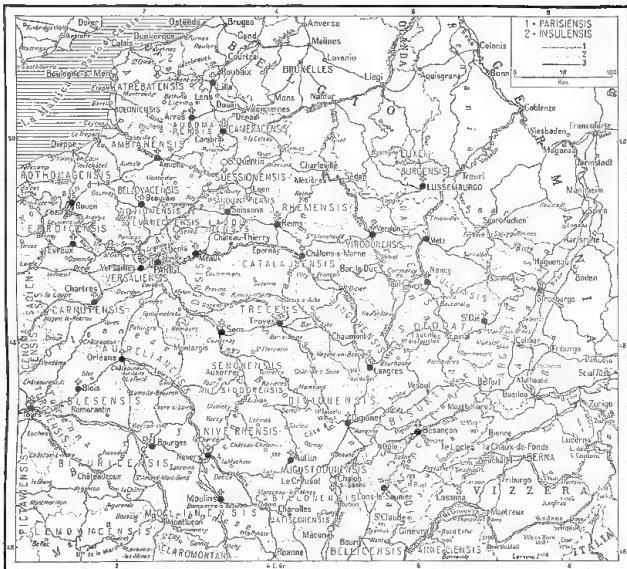
FRANCE - NORTHEASTERN FRANCE. Ecclesiastical Circumscriptions. 1) State borders; 2) Ecclesiastical circumscription borders; 3) Railways.
As the Merovingian bishop had done before, it is especially the monk who, from the 10th century onward, defends Christian virtues and faith against the contamination of the world. And here is Cluny, founded in 910, whose branches, everywhere, oppose the spirit of religion and peace to the slow materialism of the early feudal age. The end of the first millennium sees France clothed in a "white robe of new churches." Across France, Cluniac sanctuaries (Tours, Vézelay, Saint-Gilles, Toulouse) line the pilgrimage routes. Burgundy and Aquitaine are the privileged lands of Cluniac influence. There, the institutions of peace (Peace and Truce of God, peace associations) sprout, while knights "ordained" according to almost sacramental rites make it a point of honor to protect the weak. The abbeys add to the benefit of peace that of daily bread assured by the labor of their fields to a multiplying population. Then the people put their expansive force and the barons their honor at the service of the Faith; the Crusade, conceived in Burgundy and the South during the 11th century, makes its first campaign in Spain, and is organized, under the direction of a French pope, Urban II, at the Council of Clermont (1095). From then on, the majority of the forces in every Crusade come from France, and in the East, all Westerners are called Franks.
For the Church, problems renew as rapidly as it does. The spread of ancient rationalism (the "new Aristotle") under the influence of Arab science, and that of Cathar Manichaeism, source of the Albigensian heresy, create new serious problems for the Faith. The great momentum taken by cities and commerce increases the love of wealth, which ends up insinuating itself even into the Cistercian Order. In the effort toward a solution, the chaff grows with the wheat; but it will be the 13th century that brings the triumphant answers. Rivals in austerity, the monks of the abbey of Fontevrault, founded by Robert of Arbrissel, and the Carthusians of St. Bruno, the Premonstratensians of St. Norbert, and, above all, the Cistercians reformed by St. Robert of Molesme and St. Bernard of Clairvaux; while a Peter Waldo, in Lyon, is only the shadow of a St. Francis, lacking humility.
The name of St. Bernard dominates the entire era. He is counselor to popes, bishops, and kings. Civil power, moreover, finds its best support in the Church; chancellors are men of the Church, e.g., Suger, abbot of St-Denis, friend of Louis VII. More than the proud rationalism of an Abelard, St. Bernard brings to the crowd the consoling devotion of the Feast of Corpus Christi: it will be a response to the Albigensian condemnation of matter, with the worship of a God hidden under the species of bread. And, to put an end to the Albigensian heresy that tears apart Languedoc, the long crusade of the northern barons led by Simon de Montfort against Raymond VI of Toulouse in 1209 is not enough. Even the Inquisition, established in 1229, is only a brutal and negative means. Only preaching will bring souls back to the Faith. Founded on French soil, in Toulouse, by a Spaniard, St. Dominic, and not without relation to the ideal of the Poor Man of Assisi, the Order of Preachers finally achieves the synthesis between study and poverty, reason and Faith, speculation and prayer.
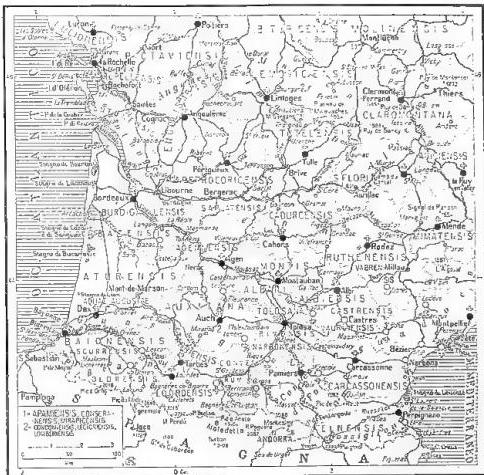
FRANCE - SOUTHWESTERN FRANCE - Ecclesiastical Circumscriptions. 1) State borders; 2) Ecclesiastical circumscription borders; 3) Railways.
to the round arch, spread by the Cistercians, the ogival style is born in the Île-de-France; at Notre-Dame and the Sainte-Chapelle in Paris, at Saint-Denis, the royal necropolis, at Chartres, Bourges, Laon, Reims, Amiens, and Rouen, it expresses the ascent of religious thought and sentiment.
In the Middle Ages, the temporal and the spiritual are united as soul and body. Philippe le Bel perhaps believed he could serve the Church as much as his crown by defending the financial and judicial immunities of his clergy against the Pope (the tithe affair, the trial of Bernard Saisset), and by condemning the Templars, reproved by public opinion. Neither party distinguished the domain of God from that of Caesar, and the misunderstanding reached its extremes: the Pope excommunicated the king and threatened to depose him (bull Unam Sanctam, 1302); the king allowed Guillaume de Nogaret to perpetrate the attack on the Pontiff at Anagni (1303), plotted by the Colonna. The French Church, with the exception of the Regulars, followed Philippe le Bel, and its docility foreshadowed religious "nationalisms." One should not, however, imagine that the French popes of Avignon, from Clement V to Gregory XI, were nothing more than docile servants of the king of France. The Hundred Years' War worsened the situation, and the papacy, apparently compromised, failed in its multiple mediation efforts. The Schism, from 1378 onward, placed France among the partisans of the Avignonese Clement VII. Thus arose "Gallicanism," strengthened by a temporary "subtraction of obedience" by the French Church toward the two rival Pontiffs. Yet once again, the university proposed solutions for Christendom: agreement and council. At the end of the 14th century, disorder reigned in France, both in the Church and in political life.
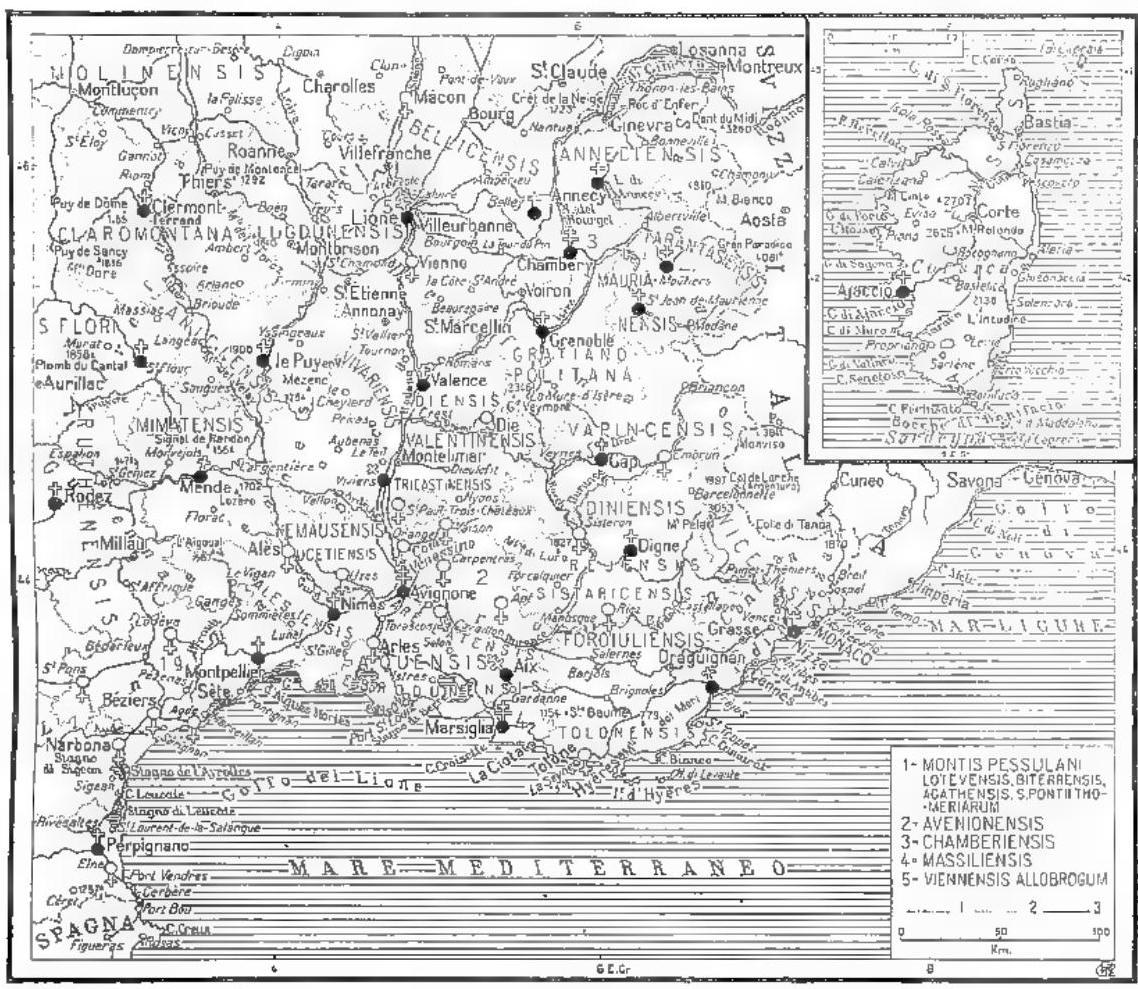
FRANCE - SOUTHEASTERN FRANCE - Ecclesiastical Circumscriptions. 1) State borders; 2) Ecclesiastical circumscription borders; 3) Railways. At the top, right, map of Corsica.
For religious history: N. Valois, La F. et le Grand Schisme d'Occident, 4 vols., Paris 1896-1902; G. Kurth, Clovis, 2 vols., 3rd ed., ibid. 1901; E. Vacandard, Vie de St Bernard, 2 vols., 3rd ed., ibid. 1902; E. Martin, St Colomban, ibid. 1905; E. Mâle, L'art religieux en France du XIIe s. au XIIIe et à la fin du moyen âge, 3 vols., ibid. 1908-23; E. Lesne, Histoire de la propriété ecclésiastique en France, 6 vols., Lille 1910-43; P. Mortier, Hist. abrégée de l'Ordre de St Dominique en France, Tours 1926; J. Rivière, Le problème de l'Eglise et de l'Etat au temps de Philippe le Bel, Louvain 1926; L. Bréhier, L'Eglise et l'Orient au moyen âge, Les Croisades, 5th ed., Paris 1928; G. Goyau, St Louis, ibid. 1928; A. Fliche, La chrétienté médiévale, ibid. 1929; J. Guiraud, Hist. de l'Inquisition au moyen âge, 2 vols., ibid. 1935-38; G. Digard, Philippe le Bel et le Saint-Siège de 1293 à 1302, 2 vols., ibid. 1937; Fliche-Martin-Franze, VI; A. Fliche-V. Martin, Hist. de l'Eglise, VII, Paris 1948; VIII, ibid. 1946; IX, ibid. 1948; P. Belperron, La Croisade des Albigois, ibid. 1942; E. Gilson, La philosophie au moyen-âge, ibid. 1944; A. Fliche, La querelle des Investitures, ibid. 1946; Ch. Poulet, Hist. de l'Eglise de F., moyen-âge, ibid. 1946; R. Grousset, Hist. des Croisades, 3 vols., 2nd ed., ibid. 1948-49; L. Halphen, P. Glorieux, G. Le Bras et al., Aspects de l'Université de Paris, ibid. 1949; G. Mollat, Les Papes d'Avignon, 9th ed., ibid. 1950. Guglielmo Mollat
II. IN THE MODERN AGE
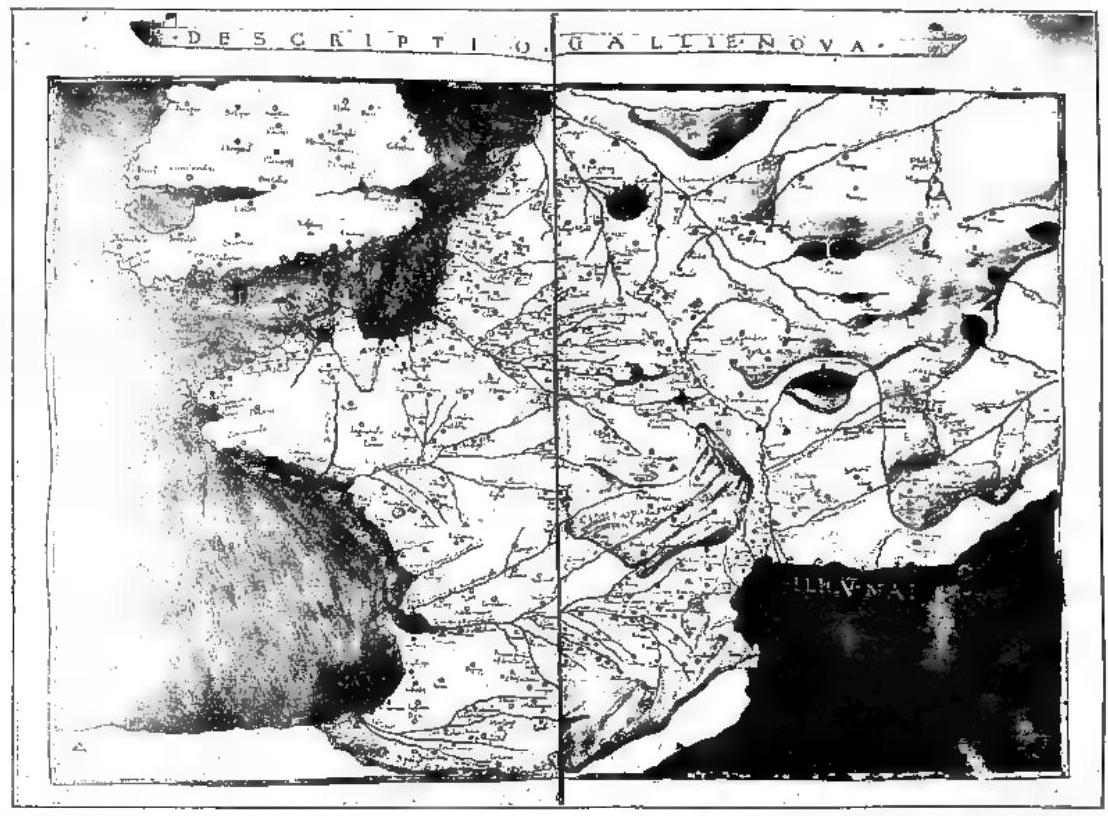
The intermittent madness of King Carlo VI, which began in 1392, prevented the French nation from seizing those advantages that the general situation of Europe—worsened by the Schism—would have allowed. Rivalries for the governance of the Kingdom immediately erupted among the king’s uncles and brothers, who sought their own personal gain; foremost among them was Filippo di Borgogna, whoFRANCIA - Map by Jacopo Angelo Fiorentino (1472) - Vatican Library, Urb. lat. 277, f. 123'-124.
The development of his Flemish state along the Lower Rhine was the aim of Philip of Burgundy. The history of 15th-century France is thereafter filled with disasters and upheavals; from 1415 to 1429, the Hundred Years' War resumes with a slow recovery until 1453, followed by a period of laborious reconstruction in which monarchical absolutism, the high feudal nobility, and the Estates General confront one another. This arduous and fruitful work for the future is abandoned at the end of the century in pursuit of the ambitious dreams of the Italian campaign and European primacy, which, after 66 years of war, will leave France defeated and the monarchy weakened and discredited.
Upon the death of Philip of Burgundy in 1404, uncle of the king and de facto regent, his son Giovanni was sidelined by Louis of Orléans, the king’s brother and husband of Valentina Visconti, himself a poor administrator. On 23 November 1407, he fell victim to an ambush by his Burgundian cousin, who took power, favoured Paris and its merchants, and provoked a reaction from the feudal nobility, which rallied around the sons of Orléans under the leadership of the Count of Armagnac, from whom the faction took its name. A long civil war ensued, while in Paris the arrogance of the populace and the Butchers' Guild, led by their chief Caboche, provoked a backlash that handed the city over to the Armagnacs.
Into this troubled and bloodied France descended the English invasion of Henry V, who sought a diversion from his difficult domestic situation through a popular and successful war. For fourteen years, French disasters followed one another: the fall of Harfleur, the defeat at Agincourt (1415), the fall of Rouen, the assassination of Giovanni, Duke of Burgundy, followed by the Treaty of Troyes (1420), by which the king disinherited the Dauphin Charles and recognised Henry V as his heir, betrothed to his daughter Catherine. The new Duke of Burgundy adhered to the treaty, so that all the land up to the Loire, including Paris, fell into English hands. In 1422, upon the death of both kings, the Dauphin (Charles VII) was proclaimed at Bourges, while the infant son of Henry V was proclaimed at Saint-Denis as King of France and England. By 1429, France’s decline had reached its nadir: the English were preparing to cross the Loire at Orléans when a girl not yet twenty years old, Giovanna D'Arco, convinced by her visions of her divine mission to save France, travelled to Bourges, roused the king and his court from their inertia, and was sent with an expedition to Orléans. She put the English to flight, led the king to Reims to be crowned, and, though she fell into English hands and was burned at the stake as a witch, truly initiated France’s recovery. By 1453, only Calais remained under English control.
From such ruins, the monarchy rose to new prestige and used it to establish a royal and absolute administration, free from the limitations of feudal rights, communal franchises, and the Estates General. It now had its own finance, its own army, its own justice superior to feudal justice, and control over local administrations. The Concordat of 1516, while satisfying the papal desire to see the Pragmatic Sanction of Bourges suppressed—along with its Gallican and Basilian principles—placed the Church of France in the hands of the monarchy, which presented candidates for bishoprics and abbeys for papal investiture. Thus, 94 bishoprics, 527 abbeys, and other priories allowed the king to reward ministers, favour younger sons of noble families, and even foreign diplomats with rich prebends. Furthermore, by incorporating younger nobles into the new militias that Charles VII created in 1445 to replace the old mercenary companies, the king tamed the restiveness of noble families, while the greater nobles were removed from the provinces to become courtiers at the king’s mercy, shielded from economic ruin. It would be the specific task of Louis XI (1461–83) to engineer the ruin of the high feudal nobility, to whom provinces had been distributed as appanages for royal cadets.
To the treacherous methods of his former companions, he responded with equally deceitful and cruel tactics to evade the commitments imposed on him and the promises extorted by their rebellious coalitions, even when called the League of Public Weal. Tragic was his duel with Charles the Bold, Duke of Burgundy, who dreamed of an independent kingdom between France and the Empire and who fell at Nancy (1477) under the pikes of the Swiss, secretly paid by Louis XI. Louis XI absorbed his French states and gradually reconstituted the territorial unity of France, reclaiming Maine and Anjou, wresting Normandy and Guyenne from his brother, exterminating the houses of Armagnac, Alençon, Nemours, and Saint-Pol, subduing the Duke of Brittany, and occupying Artois, Franche-Comté, Charolais (these last foolishly restored later by Charles VIII), Picardy, and the counties of Burgundy and Boulogne, these last already Burgundian domains. Having subdued the feudal nobility, he knew how to impose himself on the Estates General, convening them ever more rarely. Thus, when in 1484 his daughter Anne of Beaujeu, regent for the minor Charles VIII, ignored the proposal to limit the taille (which had become the monarchy’s primary source of revenue and was fixed at the king’s discretion), the monarchy, secure in its income, could truly be called absolute. Despite internal unrest and the Burgundian threat, Louis XI did not cease to intervene abroad; indeed, Charles’s aggression drove him to counter it by every means, in Switzerland, Lorraine, and Italy, reducing the Duchy of Savoy to a kind of vassalage, though his own sister Yolande, the regent duchess, resisted him. He also intervened between Florence and Naples and often made his influence felt in Rome, using both the Pragmatic Sanction and ecclesiastical ordinances. He occupied Cerdagne and Roussillon as a pledge for a loan and aspired to Catalonia. With the Bold’s disappearance, this policy became more oppressive and active, though without direct interventions. Death overtook him as the inheritance of Provence, which gave him the ports of Marseille and Toulon, confronted him with the Mediterranean problem. During her regency (1483–91), Anne of Beaujeu, forced to suppress new revolts by the high feudal nobility, still managed to secure the Duchy of Brittany for the Crown through the marriage of the young king to the duchess’s heiress. It would be the young and romantic Charles VIII (1483–98), however, who would cross the Alps in pursuit of the dream of conquering Naples (as heir to the rights of the Angevins) as a stepping stone to Jerusalem.
Constantinople. Having resolved the Breton crisis with the disastrous concessions mentioned, Charles VIII, from Senlis in May 1493, sends his embassies to the Italian states to request their cooperation. In Italy, no one believes in the expedition and responds evasively, except for Milan, which, due to the matter of Genoa, is almost a vassal: the king’s childish obstinacy overcomes internal opposition, and by July 1494, fighting already occurs at Rapallo, and Genoa becomes a French base. In October, the French army is in Piedmont, and by early November, in the Sforza-controlled Lunigiana, easily overcoming Florence’s opposition, as the city is traditionally pro-French, even if the inept Piero de’ Medici is allied with the Aragonese of Naples. Having extorted money from Florence, the march proceeds easily to Rome: on 22 February, the king is in Naples without ever having fought a real battle. The Italian states now realize their mistake in having revealed their political and military weakness and, urged by Venice and the Aragonese—who, as with Sicily, cannot tolerate a French Naples—form an Italian and European league; the king must return to France with the intention, lasting until his death, of returning to Italy. Unfortunately, the French monarchy has thus committed itself to a policy detrimental to its true interests, uniting all of Europe against it and persisting in it until 1559, because his successor, Louis XII (1498–1515), as grandson of Valentina Visconti, immediately organizes the conquest of Milan with the help of Venice and Alexander VI. Milan is soon occupied, and France thus holds the key to Italy, but Louis XII continues Charles VIII’s error and aspires to Naples. The southern kingdom is quickly occupied and divided with Aragon, but lost as soon as the first rivalries arise, and Louis XII thus convinces Spain that Naples cannot remain Spanish with a French Milan. Louis XII’s Italian policy continues against Venice with the League of Cambrai, but Venice’s resurgence leads to that anti-French coalition which was in Europe’s logic, to the expulsion of the French from Milan (1512), and to the invasion of France by the English and Imperial forces: in 1515, Louis XII dies having lost all his conquests. His cousin and successor, Francis I of Valois-Angoulême (1515–47), with the victory of Marignano (1515) retakes Milan, but only for six years, because the war with Spain, now an instrument of Charles V’s imperial ambitions, causes France to lose it forever. New expeditions fail, and the most serious defeat is that of Pavia (1525), for which Francis I, taken prisoner, renounces Italy and Burgundy in order to regain his freedom. Later, to save this province, he uses the League of Cognac (1526) with the Italian states as a scarecrow, ultimately abandoning his allies in the Peace of Cambrai (1529).
Italy is already lost, even if in 1536 Francis I occupies Piedmont under the pretext of his mother Louise of Savoy’s inheritance; the struggle against Charles V’s universal ambitions shifts from Italy to Flanders due to the resolute neutrality of Venice and Paul III despite French intrigues, and France, to seek balancing allies, must turn to the Ottomans, their corsair fleets in the Mediterranean, and the German reformed princes who curb Charles V’s imperial power. Thanks to a balance of forces, France is not affected by the Emperor’s invasions, but the last attempts of Francis I and his son Henry II (1547–59) yield no results; and at Cateau-Cambrésis in 1559, the agreements of thirty years earlier at Cambrai are confirmed, the Italian territories occupied in Corsica, Tuscany, and Piedmont are definitively evacuated; the only improvements are the recovery of Calais and the occupation of Metz, Toul, Verdun, and Saluzzo.
To the ruinous wars was added poor administration. Louis XII had sought to alleviate taxes and remove injustices, earning the title of father of the people; but with Francis I, the demands of war were compounded by those of a brilliant and lavish court that traveled continuously with a retinue of over ten thousand horses. The budget, despite the high taille, barely balanced in ordinary years, and because war was almost constant, loans were resorted to, especially with Italian merchants in Lyon, and to the disastrous sale of offices, multiplied for this purpose and later made transferable; while this provided capital at the moment, it permanently deprived the state of the corresponding revenue. Tax pressure, the devaluation of money which reduced the value of rents and wages, disrupted economic life; thus, by the end of the period, there was discontent due to economic hardship and the growing administrative centralization, which, though not always useful, in any case disrupted habits and interests.
Following the Italian war and the peace of 1559, France experienced forty years of unrest and civil wars, commonly called religious but in fact stemming from far more complex origins, such as the discredit of the defeated monarchy, the weakness of the government under three minor or nearly minor kings (Francis II [1559–60], Charles IX [1560–74], Henry III [1574–89], the three sons of Henry II). This weakness allows the feudal nobility to attempt a revanche against the monarchy, using the religious pretext, while the latter pursues a policy of tolerance and balance between the two factions. The French monarchy lacks the interest in the Reformation that German princes have in seizing large ecclesiastical estates, since the king can dispose of them in other ways, and there are no true ecclesiastical princes in France. Already Francis I, though allied with the German Protestants, initially took an uncertain stance, then revealed himself as severe and suspicious toward the reformers, many of whom, including John Calvin, had to go into exile.
The reformed party, initially spread among the discontented lower classes, changed its character when, in 1558–59, the Bourbons and the Condés, the last branch of the royal family besides the reigning one, joined it, having gained advantage from the marriage of Antoine of Bourbon (brother of Louis of Condé) with Jeanne d’Albret, heiress of French Navarre. From that adherence, the party took on a political character, as a resumption of the feudal struggle against the monarchy, demanding not only freedom of the new cult but also the recognition of the rights of the princes of the blood, especially in opposition to the dukes of Guise, of Lorrainian origin, who, due to the prowess of Marshal Francis, prevailed in the government and were the leaders of the Catholic party. During the minority of Charles IX, the regent Catherine de’ Medici (who ultimately became hated by both parties and whose Italian origin was reproached) published an Ordinance of Conciliation in the Estates General of 1561. But in 1562, a serious incident provoked by the Guise at Vassy sparks the civil war. The peaces of Amboise (1563) and Longjumeau (1568) are nothing but truces. After that of Saint-Germain (1570), the Huguenot leader Coligny seeks to win over Charles IX by outlin—
France, after briefly considering the conquest of Flanders, which was rebelling against Philip II, under the leadership of the Huguenot chief Coligny to win over Charles IX, saw this episode tragically interrupted by the massacre of St. Bartholomew’s Night (24 August 1572), during which, in Paris and with the king’s consent, numerous Huguenots were killed under the accusation of plotting against the king. This was followed by a new civil war, an anti-monarchical stance from Calvinism, and the futile Peace of 1576, as the vast majority of France and the Estates General opposed the edicts of tolerance. The civil war worsened when, upon the death of the king’s brother in 1584—who in turn had no children—the succession passed to the Huguenot Henry of Navarre. The Catholic League, led by Henry of Guise, accepted the declaration of Pope Sixtus V that Navarre, as a heretic, could not succeed to the throne. Paris adopted a hostile stance toward the king himself, who had Guise killed in his chambers at Blois on 23 December 1588, only to be assassinated in turn on 1 August 1589 while besieging Paris alongside Henry of Navarre.
Though designated by the dying king, Henry IV (1589–1610) was only partially recognized: Paris called for Philip II’s aid and received a Spanish garrison. Four years of confused warfare followed, but national sentiment gradually prevailed. Already convinced of the necessity of conversion, Henry IV abjured in 1593 and was crowned king in Paris the following year. The war then turned against Spain, which, in the Peace of Vervins (1598), reaffirmed the 1559 borders. Shortly before, the king had granted Protestants freedom of conscience and partial freedom of worship through the Edict of Nantes (30 April 1598), along with the possession of certain security strongholds, including La Rochelle—a political concession that Richelieu would later restrict as dangerous. Henry IV firmly set about restoring the decayed royal authority, remedying the damages of civil war, improving finances, reducing the taille, and promoting industries and colonization in America. By renouncing Saluzzo, he obtained Bresse and Bugey from Charles Emmanuel of Savoy (1601). With the major wounds healed, France returned to its old dream of European primacy; the resistance of German Protestants to Catholic advances offered an opportunity for revenge against the Habsburgs. But rumors of alliances with Protestants disturbed Catholics, and the king fell victim to a fanatic (14 May 1610), leaving as heir a nine-year-old child (Louis XIII [1610–43]) under the regency of Queen Marie de’ Medici.
With the disappearance of such a great personality, policy weakened toward the nobility and the resurgent Huguenots, the treasury was squandered to appease discontent, the Estates General (the monarchy’s ill-omened birds) were convened, and the queen’s Florentine favorites—chief among them Concini, husband of one of her ladies—dominated the government. In 1617, the young king rid himself of Concini by having him assassinated and exiled his mother, only to fall into the hands of the incapable and dishonest. Abroad, a close union with Spain was pursued, including the king’s marriage to Philip III’s daughter, while France passively witnessed the first phase of the Thirty Years’ War and imperial triumphs. Only with Richelieu’s rise in 1624 did France regain a government and a policy of its own, which Louis XIII, though weak, had the merit of supporting against the entire court. Richelieu resumed Henry IV’s methods, subduing the feudal lords, the Huguenots, and the Parlements, and ruthlessly crushing the intrigues of the queen mother and the king’s brother. In foreign policy, he gradually resumed the struggle against the House of Austria, first expelling it from the Valtellina, then installing a French prince (Gonzaga-Nevers) in Mantua and Casale, and securing Pinerolo from the Savoys to gain a foothold in Italy. Though a zealous bishop of Luçon and an effective polemicist against Protestants, he did not hesitate to use them politically to counter imperial absolutism, first aiding the Swedes, then intervening directly in Germany and Flanders. His policy was successfully concluded by Cardinal Mazarin, his successor after his death in 1642 and the king’s in 1643, during the regency of Anne of Austria. With the Peace of Westphalia in 1648, the Empire ceded Alsace (except Strasbourg) to France and recognized the semi-independence of the German princes. Having successfully ended the German war, Mazarin still had to defeat Spain and the opposition of the Paris Parlement to new taxes, which had degenerated into a true popular revolt, and later the opposition of the princes when he arrested Condé, who claimed to be the arbiter of government (the Parliamentary and Fronde of the Princes). Mazarin was forced into exile (1651–53) and returned only when the divisions among his enemies and the queen mother’s steadfast trust allowed II. He then sought to repair the grave losses caused by the Fronde and, with Cromwell’s England as an ally, compelled Spain to the Peace of the Pyrenees (7 November 1659), which granted France Cerdagne, Roussillon, much of Artois, and cities in Flanders, while the marriage of Louis XIV to the Spanish Infanta Maria Theresa laid a virtual mortgage on the Spanish inheritance. He died two years later (1661), leaving France in first place in a Europe half-destroyed by war.
With Louis XIV (1643–1715), the Grand Siècle began, the golden age of France: not only did Louis XIV’s power dominate Europe, but the splendor of Versailles became the model for European courts, French fashions imposed themselves everywhere, and literature and culture were celebrated to the point of provoking envy in all learned circles of Europe. Louis XIV’s reign (a man of great intellect and marvelous activity), which began with great triumphs, ended disastrously due to continuous wars that provoked ever-larger coalitions against him. In the first war against Spain, he obtained cities in Flanders, including Lille; in the second, against Holland, he gained Franche-Comté in the Peace of Nijmegen (1678), and during the peace, through the Chambres de Réunion, he occupied new cities, including Strasbourg (1682). These and other acts of arrogance, including the bombardment of Genoa (1685), led to the League of Augsburg (1688–97), which forced Louis XIV to return much of what he had occupied. In the final war, the War of the Spanish Succession (c. 1700–13), by accepting the Spanish throne for his grandson Philip V, he found nearly all of Europe against him and was forced to seek peace, accepting the dismemberment of the Spanish dominion in favor of Austria (Utrecht, 1713). In 1715, the king died, leaving as heir a five-year-old great-grandson under the Regency (1715–1723) of the Duke of Orléans. Domestically, despite the early work of the great minister J. B. Colbert, France’s economy was in ruin. Royal despotism had suppressed all autonomy and freedom. In religious matters, not only was the Edict of Nantes (18 October 1685), which regulated relations with the Reformed, revoked, but forced conversions were imposed through military means.
The seventy-year period from the death of the "grand roi" to the Revolution is nothing but a continuous movement toward the final crisis.
The increasingly serious decline of the monarchy, with its unfortunate wars, the scandalous life of Louis XV (1715-74) and the customs of the court, and the disastrous financial policy—while public opinion grew ever more convinced of the need for a renewal of the political and social constitution—led France toward catastrophic collapse. Yet France remained the center of Europe for art, literature, philosophy, and fashion: its influence was immense in every field, despite the decline of its political prestige. The War of the Polish Succession, aimed at placing Stanislao Leszczyński, the queen's father, on the throne, failed in its purpose but gave France hope for Lorraine (Nancy), temporarily granted to Stanislao, while in Italy it forced Austria to relinquish Naples and Sicily. The second war, over the Austrian Succession, full of disasters, served only, as it was then said, the King of Prussia, who gained Silesia. In the third war, known as the Seven Years' War, there was a reversal of alliances attributed by public opinion to Madame de Pompadour: it cost France Canada, Senegal, and Louisiana. Shortly afterward, to counterbalance English predominance in the Mediterranean, Corsica was occupied (1768). Public opinion became increasingly hostile due to the scandals of the king's private life, the wastefulness they occasioned, and the weakness of foreign policy, in which, entangled in Austria's intrigues, he allowed the first partition of Poland to occur. Criticisms of the old constitution and the remnants of feudal privileges intensified in literature, while the Third Estate aspired to a share in government proportionate to its economic importance.
Great hopes were placed in Louis XVI (1774-92), but his good and honest nature was not matched by either intelligence or will, while the task of reforming such a disordered state was enough to daunt even an Henri IV. The queen, Marie Antoinette of Austria, aggravated the king's faults—not as guilty as the slanderous pamphlets portrayed her, but frivolous, fond of luxury, and inclined to meddle in politics to favor her friends or the interests of her House. Among the new ministers, Turgot was honest and capable, with high economic competence, but lacked the energy to fight against the court's intrigues, suspicious of his intentions of economy. The war for American Independence was a success (though burdensome for France's already shaken finances) in that it humiliated England, which lost Minorca and restored Senegal, but it further spread among the population those principles of liberty that were seen defended in America but not applied at home. The public sphere was overshadowed by financial disaster, especially after Necker's report in 1781 revealed the gravity of the court's expenditures: from Necker to Calonne, to Loménie de Brienne, wastefulness never ceased, so public opinion, the assemblies of notables, and the Parlements refused new taxes and instead demanded a national assembly. The discredited monarchy, reduced to bankruptcy and having suspended payments, resorted to the convocation of the Estates General, forgotten for 175 years, and to the recall of Necker to calm public opinion. It was believed that this would initiate the reform of the State, but instead, it opened the door to the Revolution.
III. THE REVOLUTION
The financial situation, the discredit against those who failed to remedy it, and the political-military setbacks would not have sufficed to create that complex of events which, from the last decade of the 18th century, reverberated from France throughout Europe, inaugurating modern history. Convictions and tendencies had evolved in the public spirit that aimed at a radical transformation of society, both in the spiritual and the political-economic spheres. Among the educated classes, that spirit which in France is known as "Encyclopedism" had taken root, so named because its particular exponent was the famous Encyclopédie, which, under the guise of philosophy, called minds to full independence from any revelation and to the total experience of human reason. All this was expressed through the enunciation of freedom of conscience, which polarized either toward a deism that, while not renouncing all spirituality, conceived it as independent of any confessionalism and any providential intervention, or toward a materialism—elegant, if one wishes, and refined, but nonetheless brutal in its consequences. Christianity was combated, more or less covertly, in the historical and philosophical fields, or tolerated only for the necessity of moderating popular instincts.
A thoroughly practical aspect, philosophism assumed thanks to the doctrines and pedagogy of Jean-Jacques Rousseau, which enjoyed wide diffusion and favor. From him originated what came to be called the return to the state of nature—that is, to that original natural goodness which would have been corrupted by absolutism, to the primitive equality and fraternity that were to destroy the regime of privilege created by the selfishness of usurping classes. Public education was thus to be radically reformed; constant recourse to popular consultation was to be established, both in proposing laws and in appointing their executors. Rotation in power, together with state education, was to offer guarantees against any return of tyranny. It was now believed that the principles and directives for creating a new society, in accordance with the conclusions of philosophy, were at hand. In particular, the Third Estate, compared to the nobility and clergy—considered the holders of privilege—intended to assert the force of its numbers and its demands.
The clergy found itself in a highly delicate situation. In its higher ranks, it was recruited from the highest nobility, and the richest benefices—bishoprics, abbeys, pensions—allowed it a life of splendor bordering on worldliness. The middle urban and rural nobility effectively reserved for itself the lesser benefices, especially in collegiate and cathedral chapters. Finally, the rural clergy, the most numerous, had but a small share in the distribution of ecclesiastical revenues. Forced into a very modest life, with the obligation to provide for popular education, it was in direct contact with the humblest part of the population from which it itself originated. It felt more closely the weight of social injustices and the legitimate right to remedy them. Thus, it readily embraced not only what seemed likely to improve the people’s conditions but also those proposals for ecclesiastical reform that would eliminate at least the most glaring abuses. No wonder, then, that it aligned itself with the Third Estate.
When the Estates General opened on May 5, 1789, public sentiment was divided between those who wished to preserve as much as possible of the ancien régime—and they were relatively few, for the need for renewal was felt—and those who wanted to undertake the broadest possible general reform in harmony with the new theories. How far it should go, by what means, and through what paths, all remained vaguely conceived, without any program. The program was gradually developed by the streets of Paris under the shouts of its demagogues, and Paris became the tyrant of all France, while the court and the ruling class proved incapable of any initiative. The representatives of the Third Estate, who constituted half of the total number of approximately 1,200, claimed for themselves the right to control elections, calling on the representatives of the other two estates to join them and clearly showing the intention to act as a National Assembly with the aim of modifying the traditional constitution of the State. Since 207 ecclesiastics also sat among them, they were joined by others who sat among the clergy’s representatives. Soon, some of the more reform-inclined representatives of the nobility also joined, so that the Third Estate could now consider itself the representative not of a single class but of the entire nation. The presence in Paris of so many deputies and their progressive alignment with the clamors of the city crowd, intoxicated by the speeches of demagogues who spoke of the abolition of tyranny, led to the storming and demolition of the Bastille, the fortress that dominated the city (July 14). Two days later, the deputies proclaimed themselves a Constituent Assembly, and as the foundation of the new constitution to be given to the nation, they published (August 24), in 17 articles, the Rights of Man and of the Citizen (v. RIGHTS OF MAN), which proclaimed, without further ado, the sovereignty of the people, freedom of religious belief and of the press, the right of resistance against oppression—that is, the right to revolution. The law was declared an expression of the general will, and before it, all men were equal. But this was not enough to restore order and concord. On the night of August 4, the nobility renounced its privileges, titles, and the most burdensome feudal rights for the people (hunting and fishing rights, feudal dues, reserved dovecotes), as well as its exemption from taxes and its own tribunals. For its part, the clergy renounced tithes, contenting itself with compensation, as well as stole fees and tax exemptions. To the contribution of 30 million already assumed to address the financial deficit, it added another 400 million—that is, a third of its real estate holdings—though it had previously contributed more than the other two estates to the nation’s welfare. Thus ended the particular constitutions of estates and corporations and inequalities in penal law; access to all civil offices was opened to all citizens.
The decision was more generous than enlightened and did not suffice to satisfy the spirit forming in the public. On October 10, at the proposal of Maurice de Talleyrand, Bishop of Autun, the Assembly declared that ecclesiastical property was national property. On November 2, it established the contributions that the nation was to pay for the maintenance of the clergy. Thus, the old glaring disparities removed, they were reduced to salaried employees. It also decreed that the alienation of these properties should begin immediately. In February 1790, the Assembly denied validity to solemn vows and permitted religious to return to their homes, with the provision of a pension drawn from convent properties. In September, it ordered all to lay aside the religious habit. Almost all nuns, however, remained faithful to their vows, as did the religious affiliated with the more observant Orders, while among the others, many were apostates.
The revolutionaries refused to recognize the Catholic religion as the state religion; instead, they sought to draft a Civil Constitution of the Clergy, and overbearing lawyers cobbled together a project that, brought before the Assembly, was approved on 27 November 1790 despite opposition from Catholics, and its implementation began at the start of 1791. France had been divided into departments and cantons, overriding all historical traditions without regard. This program of absolute equalization was also applied to ecclesiastical relations, and all institutions that did not fit into the pre-established framework were summarily sacrificed. Abbeys, chapters, priories, and chapels were abolished. Parishes, dioceses, and ecclesiastical metropolises remained: but the 18 archbishoprics and 108 bishoprics were replaced by 10 archbishoprics and 73 bishoprics corresponding to the 83 departments; parishes were to be established by agreement between the bishop and civil authority according to the same criterion; bishops were to be assisted by a council composed of parish priests and vicars. Bishops and parish priests were to be elected by the same electoral assemblies that, in each department, elected state officials; the metropolitan was to confirm the bishops, while the pope was merely informed of the election that had taken place to preserve unity. Parish priests were to seek confirmation of their election from their bishops; both were to swear before the departmental authority to fulfill their duties and observe the Civil Constitution of the Clergy. On 2 January 1791, the oath began to be demanded from members of the Assembly, then from others who were obliged to take II. Believing that this Constitution did not touch upon dogma, many thought it was not contrary to the spirit of the ancient Church; however, only four bishops took the oath; it is estimated that one-third of the priests swore it; these were called assermentés (sworn), many of whom later retracted their oath, while the rest lost all credibility even among the faithful; insermentés were those who refused to swear. Pius VI, on 13 April 1791, condemned the Constitution, suspended the assermentés from divine offices, and declared the new ecclesiastical elections and promotions null. In retaliation, Avignon and the Venaissin were occupied.
The Constituent Assembly was followed in October 1791 by the Legislative Assembly, which intensified the struggle against the Church: on 29 November, the oath was imposed on all ecclesiastics under penalty of being unable to exercise their ministry and losing their pension. In the spring of 1792, wearing ecclesiastical garb was forbidden, and the remaining religious congregations were suppressed; priests who had not taken the oath were exiled and deported, so that those who managed to remain were forced to exercise their sacred ministry in secret, at the risk of their lives. Special laws introduced civil marriage and divorce.
While legislation was being enacted, the most radical elements not only pressured the Assembly but also kept disorder alive in the city and countryside under the pretext of fighting aristocrats and traitors to the people. They rallied around Danton, who dominated with the club of the Cordeliers, Robespierre, leader of the club of the Mountain, and the ferocious Marat, and provoked the massacres of 2–6 September in Paris, accompanied by severe repercussions in the provinces, where the most unscrupulous revolutionaries were sent on mission. On 21 September, the new National Convention proclaimed the Republic, and on 21 January 1793, it had Louis XVI beheaded; Queen Marie Antoinette was also put to death. A Committee of Public Safety was established to suppress internal revolts and stem foreign invasion; thus, a new popular army was created, organized with those elements of the royal army who accepted the new service. Meanwhile, it was officially declared that all religious forms were suppressed, striking even the sworn priests, who were forced to contract marriage; the new republican calendar of 12 months and three decades per month was introduced, beginning on 21 September 1793; and on 10 November, in place of Christianity, the cult of reason and nature was introduced, represented by two harlots enthroned in the cathedral of Notre Dame.
With the assassination of Marat (13 July 1793), discord also penetrated among the men of the Terror. Robespierre, who soon grew weary of the ridiculous farces staged by Danton and Hébert, pure materialists, sent them to the guillotine (April 1794). Posing as a dictator, he had the Convention recognize the Supreme Being and the immortality of the soul; and in a solemn ceremony, he symbolically overthrew discord, atheism, and egoism to replace them with knowledge, justice, and love (7 May). But on 28 July, the Thermidorians sent him to the guillotine and seized power. It seemed there would be no respite for Christianity, as the Convention decreed on 27 August that churches still used for worship would pass into national possession; however, with the decrees of 21 February and 30 May 1795, the reopening of churches was permitted, and the constitutional bishops and priests took advantage of this to organize themselves under the guidance of Grégoire, the sworn bishop of Blois; while Catholics were divided over the oath required by the Convention, in which hatred for royal authority and anarchy was professed.
On 20 August 1795, France adopted a new constitution with two chambers and a committee of five directors (Directory) to which executive power belonged. Religious relations did not improve; while abbeys, including that of the Theophilanthropists, could freely organize, many priests were guillotined, and many others who had returned from exile were deported to Guiana or interned on the French islands of Ré and Oléron (1797).
The laws of the Revolution were immediately applied in the countries that the revolutionary armies managed to occupy. In Holland, as early as 1792, the Batavian Republic was established, and the Reformed Church lost its privileged position, so that oppressed Catholics gained some advantage. After the revolutionary victories at Jemappes (1792) and Fleurus (1794), Belgium, taken from Austria, was annexed to France, where French refugee priests were persecuted, the republican calendar was introduced, churches were seized and adapted for civil and military use, public worship and processions were prohibited, tithes were abolished, and communication with the Holy See was prevented. The republican oath was imposed on ecclesiastics; and because most did not comply, condemnations and deportations were also used against them.
Beginning in 1792, the territories that the Church possessed along the left bank of the Rhine gradually fell into the power of the Republic: the electoral principalities of Cologne, Trier, and Mainz, the prince-bishoprics of Speyer and Worms, and also the possessions held there by the Kingdom of Prussia and other minor principalities. In 1793, Prussia concluded a separate peace, and France organized all those territories into four new departments without introducing the Civil Constitution of the Clergy or the new calendar, but suppressing most monasteries and obliging the clergy to take the civic oath. Even in these lands, a political ecclesiastical order that had lasted for centuries was ruthlessly swept away.
In Italy, the Revolution was introduced by the army commanded by Bonaparte in 1796, which quickly overcame the Kingdom of Piedmont, occupied the Duchy of Milan, the Po Valley duchies, and the territories of the Venetian Republic, as far as beyond the Isonzo. The Pope was forced into the Peace of Tolentino (17 February 1797), losing the Legations and contributing a substantial war indemnity in money and art objects; until, following riots artfully stirred up in Rome itself, General Berthier inaugurated the Roman Republic (17 February 1798) and removed the Pope from Rome. By order of the Directory, Pius VI was taken prisoner to F. the following year, where he died on 29 August 1799. Meanwhile, Napoleon was engaged in the Egyptian campaign, and F. was driven out of Italy by an Austro-Russian coalition; in Venice, the new Pope Pius VII was elected (14 March 1800) and re-entered Rome on 3 July, now freed from the recent republican regime.
Meanwhile, Napoleon returned from Egypt and, with a coup d'état, suppressed the Directory (10 November = 19 Brumaire 1799); he replaced it with a government of three consuls, of whom he, as first consul, assumed full civil and military powers. To settle the fate of F., he undertook a new campaign in Italy and, with the victory of Marengo (14 June 1800), drove out the Austrians; at the same time, F. returned to the Rhine. If internal peace in F. was to be restored, it was necessary to regulate the religious relations disrupted by republican intolerance, and Napoleon considered a Concordat with the Pope to replace that of 1516. Negotiations concluded in Paris on 15 July 1801; it was recognised that the Catholic religion was that of the majority of the French, and thus the free and public exercise of worship was permitted. In place of the ancient dioceses, 60 episcopal sees were established, of which 10 were metropolitan; individual bishops were granted the right to establish a Chapter and a seminary and to create parishes; the Church renounced its former properties, while the government, in compensation, undertook to provide an allowance to bishops and parish priests; the appointment of bishops was reserved to the first consul, canonical institution to the Pope. F. thus maintained the privileges of the old Concordat; however, opposition was tenacious, and promulgation only occurred on 18 April 1802, accompanied by 77 "organic articles" for the application of the Concordat itself. These were inspired by old regalist traditions, imposed the government's placet on papal and foreign conciliar acts, prohibited the holding of synods and ecclesiastical assemblies without government consent, allowed the appeal ab abusu from Church decisions to public authorities, obliged acceptance of the four Gallican articles of 1682, and introduced a distinction between parish priests appointed for life (curés) and those removable (desservants). Despite the Pope's protests, the articles were promptly applied. Of lesser importance, due to far fewer disturbances, was the Concordat with the
Cisalpine Republic, which Napoleon ratified on 2 November 1803 and published in Milan on 26 January 1804, with an addition of articles analogous to the French ones.
Now victorious over the European coalitions against F., on 18 May 1804 Napoleon was proclaimed Emperor of the French by the Senate, and Pius VII agreed to travel to Paris to crown him (2 December); on this occasion, Francis II relinquished the title of Emperor of Germany for that of Emperor of Austria, and Napoleon also assumed that of King of Italy (26 May 1805). But he could not contain his ambition, provoking new European coalitions against himself. He wished the Pope to move to Paris, which was to become the brain of the civilised world; he gradually occupied the Papal States and, because Pius VII issued an excommunication against the violators of the Church's rights, had Rome occupied, dragged Pius VII prisoner to Savona (15 August 1809), convened a national Council of French and Italian bishops in Paris (June 1811), then took Pius VII to Fontainebleau (June 1812), to extort a new Concordat (25 January 1813); and for a moment, by force, he succeeded. After the disastrous Russian campaign, Napoleon was unable to resist the Europe allied against him, F. was invaded, and he fell into the hands of his enemies (1815). With the Treaty of Vienna concluded on 9 June 1815, the allies believed they had restored order in Europe. Louis XVIII ascended the throne of his unfortunate brother, and thus began the period of the Restoration.
IV. CONTEMPORARY FRANCE
With the Restoration, it was thought possible to completely stifle the revolutionary spirit and establish a form of government not too dissimilar from the ancien régime; but the years of the Revolution had not passed in vain over Europe, and particularly over France. An entirely new legislation had been introduced, along with a new economic and social order; with the great roads, new communications had opened; the abolition of ancient noble privileges and corporate protectionism had given rise to the new banking capitalism, with the introduction of large-scale industry and the emergence of the proletariat, the origin of new social movements, timid at first but increasingly threatening. Propaganda through the press and speech could no longer be halted by police measures, and political parties had no intention of abandoning their principles. Alongside the royalists, steadfast—especially in their relations with the Church—in the old ideas, stood the Bonapartists, the republicans, the remnants of the old revolutionaries, and those agitating for liberty, hence the label "liberals" willingly accepted by the opposition parties.A concordat that Louis XVIII wished to substitute for the Napoleonic one (1817) could not even be presented for a vote in the Chambers, and only in 1822 was a new ecclesiastical circumscription achieved. Nevertheless, the life of the Church began to flourish again: the number of priests, seminaries, and educational institutions grew; religious Orders and female monasteries were gradually rebuilt; new teaching and hospital Congregations organized themselves; missions among the infidels found new missionaries and new support; even ecclesiastical properties and pious foundations could resurface. A strong anticlerical resurgence was noted in August 1830 when Charles X, brother of Louis XVIII, was forced to abdicate the throne in favor of Louis Philippe of Orléans, the "bourgeois king." In 1848, the revolution also dethroned the latter, and new elections were called; a new republican constitution was then promulgated, and Charles Louis Bonaparte, nephew of Napoleon I, became its president; however, in 1852, with a new coup d'état, he had himself proclaimed emperor under the name Napoleon III. The "liberal Empire," as it was called, at first favored the activity that the Church carried out more freely, thanks to the popularity it had gained. Taking advantage of this freedom, it convened synods and provincial councils, expanded its institutions and schools, almost entirely removing the obstacles of old regalism, particularisms, and the more advanced Gallican conceptions. But although it showed zeal, for political interests, in defending the temporal power of the Pope, the Empire resumed the oppressive measures of the First Empire and manifested its ill will, especially on the occasion of the Vatican Council. The Franco-Prussian War of 1870 ended with the fall of Napoleon III, the invasion of France, and the loss of Alsace-Lorraine. After overcoming the Commune (v.) in May 1871, the Assembly, which had been elected to restore order in France, continued to govern the country. Its members were mostly monarchist in tendency but divided among themselves and lacking clear-sighted and resolute leadership; it was thus possible for the anticlerical and republican minority, led especially by Léon Gambetta and Jules Grévy with the influence of Freemasonry, to obtain a majority in the 1877 elections and pursue an anticlerical policy. Without touching the legislation that ensured the freedom of schools—a recent conquest of Catholics—it found ways to close the institutes run by the Jesuits and expel them from France; to prohibit priests and religious from teaching in public schools and to remove religious instruction from them (1866); divorce was introduced (1882), and clerics and religious were subjected to military service. Leo XIII repeatedly exhorted French Catholics to remain united, accepting the republican Constitution for the supreme good of the Church and the State, and condemning the concept of the separation of the two powers. A violent anticlerical struggle flared up again in 1899 on the occasion of the Dreyfus Affair (v.), until in 1901, under the ministry of Waldeck-Rousseau, the proscription of religious Congregations took place, though it failed to stifle free education. Through the efforts of Minister Combes, on Good Friday 1904, crucifixes were removed from schools and courts; and in that same year, diplomatic relations with the Holy See were broken. The final step was taken with the law of December 9, 1905, which, while declaring that "the Republic ensures freedom of conscience," added that "it recognizes nor subsidizes any religion" and thus "suppresses from the budget of the State, departments, and municipalities all expenses related to the exercise of worship." By 1906, citizens could form associations cultuelles to "provide for the expenses, maintenance, and public exercise of a religion," with the faculty to collect monetary contributions, constitute limited reserve funds, receive custody of places of worship with their furnishings and clergy residences. These associations could unite among themselves, forming central administration and direction, and dissolve at will; they were solely responsible for matters concerning worship and had legal personality, though the clergy was completely excluded from them. Special articles in the law regulated the exercise of worship.
With this, the Concordat of 1801 was suppressed; on February 11, 1906, Pius X pointed out the wrong done to the Church, condemned the law as contrary to its hierarchical constitution, and thus the cultuelles were not formed. Nevertheless, religious life was not interrupted, thanks to the courage and generosity of the French clergy and people, so much so that in 1907 the government had to leave churches for the use of the faithful and apply previous laws concerning the rights of citizens to assemble and practice the religion of their choice.
The World War of 1914-18 found French religious life under the dominion of these "secular laws." After the victory, they were not extended to Alsace-Lorraine, reunited with the Republic; diplomatic relations with the Holy See were resumed, and a modus vivendi was sought, found in giving the secular laws a broader interpretation, validated by a special opinion of jurists requested by the government. Thus, in each diocese, a "diocesan association" was formed under the presidency of the bishop and an administrative council operating "in conformity with canonical laws" (cf. the scheme in A. Ottaviani, Institutiones iuris publici ecclesiastici, II, Rome 1925, p. 411 ff.); matters pertaining to spiritual governance were excluded from its competence. The encyclical of January 18, 1924, sanctioned this state of affairs, which withstood the test of the great war of 1939-45.
### III. LITERATURE.
SUMMARY: I. Origins. Middle Ages. -
II. The Renaissance
III. The "Golden Century." -IV. The Eighteenth Century
V. The Nineteenth Century
VI. The Twentieth Century.Alongside these two idioms, rendered vital by a historical antagonism lasting three centuries, other minor dialects (bourguignon, picard, normand, français) dominated in the north, until, after the triumph of the Capetian dynasty, French, or the idiom of the Île-de-France, could prevail and compete literarily with the southern dialects (lauguédorien, gasson, limousin, provençal), giving rise to the national language of France.
Disregarding the earliest public acts written in the primitive langue d'oïl (such as the Oaths of Strasbourg of 842, sworn between Charles the Bald and his brother Louis the German against Lothair), the first literary documents are generally considered to be a Sequence of St. Eulalia (881), of which fourteen verses remain, the Vie de St Léger and a Passion du Christ, slightly later; the Vie de St Alexis, belonging to the same cycle of religious tales, dates to 1040. Between the end of the 11th century and the 13th—that is, during the most flourishing period of feudalism—the langue d'oïl saw the development and affirmation of the highly important French epic and chivalric literature, which divided into three great cycles of chansons and romans: the French cycle, dedicated to the deeds of Charlemagne and his paladins; the Breton cycle, of amorous and heroic character, featuring King Arthur and the knights of the "Round Table"; and finally, the classical cycle, also called the Alexander cycle, which gathered ancient Greco-Roman and Oriental legends. The poems of the French cycle, called Chansons de geste, are written in verse (decasyllables in the oldest and alexandrines in the more recent), grouped into stanzas and laisses of varying length and rhyme. Undoubtedly the most beautiful and important among them is the Chanson de Roland (11th century), which recounts the tragic end of Roland at Roncevaux, a great national epic in which religious enthusiasm, love of country, and chivalric loyalty are expressed with a human truth worthy of Homeric poems. The authorship of this masterpiece of French epic, whose authentic text was revealed only in 1837 by Francisque Michel, has been attributed to a certain Turoldus (or Théroulde), a Norman minstrel who lived at the end of the 11th century, who was probably no more than the compiler—albeit an inspired one, and certainly not devoid of classical literary influences—of the récit already known and sung with many variants by the middle of the same century in the southwestern regions of France. What is certain, however, is that these and other chansons de geste were grouped in the 13th century into three main clusters: those of King Charlemagne, his peers, and his vassals; those of Garin de Montglane and his descendants; and finally, those of Doon de Mayence; and thus divided, they have been handed down.
Romantic matter and adventurous, erotic spirit instead blend in the novels of the Breton cycle, among which the legend of Tristan and Iseult stands out, one of the most beautiful love epics ever conceived (G. Paris), which inspired Wagner’s well-known musical drama; and other poems of King Arthur (Lancelot, Yvain, Perceval, etc.) of great poetic and religious suggestiveness. Alongside the adventure novels and those, already mentioned, of ancient subject matter, this courtoise epic, flourishing in the courts, manifests—for the first time in the Middle Ages—the mystical and erotic aspirations of a society already inclined toward the most exquisite refinements of life and culture, and thus had great influence on all Western literature.
No less development had, in the langue d'oc, the troubadour poetry, also called the "gay science." The forms employed, from the canso to the sirventes, from the tenson to the pastorela, from the alba to the balada, destined to embrace—and not only in Provence—the most learned and refined expressions of love, reached in the verses of Guillaume de Poitiers (1073–1126), Jaufré Rudel, Bernard de Ventadorn, and especially Bertrand de Born (d. c. 1210) an undeniable elegance and musicality, but succumbed to the characteristics of the school, and thus to a certain monotony of themes, well before the Albigensian Crusade dispersed the last representatives of troubadour art.
Having established itself, as mentioned, in almost all parts of France as a literary language, after the chansons de geste and the romans courtois, the langue d'oïl was employed in every literary genre: in the didactic and satirical poetry of bestiaries, fabliaux, and allegorical poems; in dramatic poetry; and in the lyric poetry of songs, odes, and ballads; as well as, as will be seen, in the prose of chroniques and sermons. Undoubtedly, the gradual emancipation of the bourgeoisie led to the rise, alongside and almost in opposition to chivalric poetry, of the fabliaux (satirical tales), imprinted with an often brazen realism reflecting the daily aspects of the feudal world, and the great allegorical and didactic poems of the 13th and 14th centuries, foremost among them the Roman de Renart and the Roman de la Rose. Against the mystical idealism of the time, the anonymous authors of the Roman de Renart directed their barbs, a collection of twenty-six poems whose characters are animals, with the fox and the wolf as heroes: the former, a symbol of deceit and hypocrisy, now rampant in the world; the latter, of violence, always accompanying fraud. Amorous and didactic matter unfolds instead in the very long Roman de la Rose, considered the masterpiece of medieval allegorical poetry. It consists of two very different parts, both in the time of their composition and in the spirit that animated them. The first (4000 verses), published around 1230, the work of Guillaume de Lorris, presents itself as an ars amatoria, in which all the vicissitudes and perils of a thwarted love unfold around the essential symbol of the rose. Less rich in imagination and more laden with symbols is the second part, written more than forty years later by Jean de Meung, who transforms the love romance into a kind of encyclopedia and universal satire. The work, which enjoyed enormous success in its time, was imitated and utilized in a thousand ways, not only by satirical and didactic poets but also by Dante, Marot, and Spenser.
The oldest known drama in the French language is the Représentation d'Adam (12th century), followed in the next century by Jean Bodel’s Jeu de St Nicolas and Rutebeuf’s Miracle de Théophile; forty-three dramatic representations remain from the 14th century, all belonging to the genre of Miracles de Notre-Dame: the themes are drawn from the life of the Virgin and the saints, and while they exemplify a marvelous popular naivety, they too often lack artistic value. Undoubtedly more important are the mystères, religious dramas staged by the Confréries de la Passion, in which episodes from the Old and New Testaments, legends of saints, and moments of the Passion are recounted with great dramatic intensity. In the 15th century, alongside the miracles and mystères, moralités, farces, sotties, sermons poétiques, and monologues were added, blending the sacred and the profane: these mark the dawn of dramatic poetry and modern theater.
Around the mid-13th century, in Douai, Rouen, Arras, and other centers where public poetic competitions were held, bourgeois and popular lyric poetry flourished, in clear opposition to the courtly and aristocratic kind. The first and most celebrated author of songs was Rutebeuf (d. c. 1225), a poor, pious Parisian with an ardent heart, of whom numerous verses of religious, bacchic, and satirical character remain.
Notable as both a dramatic and lyric poet was also Adam de la Halle, who lived at the court of Roberto II d'Artois and authored a famous Congé. Among the other rhymers of the same period, Guillaume de Machaut, Philippe de Vitry (whom Petrarch deemed the greatest poet of the time), Jean Froissart, Eustache Deschamps—authors of numerous ballads, songs, and dits—Christine de Pisan (of Italian birth), who poured her gentle and melancholic soul into the Cent ballades d'amant et d'amie; Alain Chartier; and, lastly, the learned and refined Charles d'Orléans, whose tumultuous political life he never translated into original lyrical fervor, deserve mention. "One might say that, until the mid-14th century, a kind of contradiction existed between the poet's art and the intensity of his emotions. Villon would be the first to resolve this antinomy" (P. Van Tieghen).
Between the second half of the 14th century and the first half of the 15th, Villon unquestionably holds the palm of poetry. His turbulent and guilty existence (1431–70?), which unfolded first in Paris—where he earned his licence and maîtrise ès-arts—and later, after a death sentence for murder, in flights, robberies, Blois at the court of Orléans, and finally, it seems, in Burgundy, was devoted in its finest moments to poetry. Among the 2,500 verses he left, a Petit testament (1456), a Grand testament (1463), and a few isolated lyrics stand out: yet this suffices to compose the portrait of a soul condemned to suffer and to cause suffering, yet, before pure and sincere poetry, tormented and devout.
At the beginning of the 13th century, excellent historical chroniques already appear: Geoffroy de Villehardouin (d. 1213) dedicated one to the Fourth Crusade and the capture of Jerusalem, of whom one knows not whether to admire more the modernity of his thought or the simplicity of his style; while in the Histoire de saint Louis by Jean sire de Joinville (1224–1319), "the holy words and good deeds" of the great Saint are described with an amiable and penetrating candor. Chroniques multiplied in the 14th and 15th centuries, often coupling literary quality with historical and documentary value: interest in the Crusades and the Orient alternated with that in the great events of the time, as in the immense history of the Hundred Years' War written by Froissart or in the Mémoires of Commines (1445–1509), who served Louis XI and recounted his wars and political undertakings, offering the first truly modern example of historical and political analysis. Alongside history, political and religious eloquence also took their rightful place in the same era; while the former asserted itself after the convening of the Estates General (1302), the latter admirably interpreted—particularly in the sermons of great preachers like Bernard and Maurice de Sully—this age of transition from the pure religious values of the Middle Ages to the humanistic and scientific inquiries that characterized the Renaissance.
II. THE RENAISSANCE
As in Italy, the Renaissance in France was preceded by a fervor of erudite discoveries oriented toward Greco-Roman antiquity, by philological fanaticism, and, gradually, by a mature scientific awareness, the fruit of great geographical discoveries and the invention of printing. The era of the Renaissance in France assumed more reflective aspects, both in the field of culture and in that of art, where, following the wars in Italy and the influx of Italian artists and men of letters to the courts of Charles VIII, Louis XII, and Francis I, the Italian influence certainly asserted itself. For this reason, in sixteenth-century France, the break with medieval culture is less pronounced, as it extends into the works of the century’s principal writers.Linked to the spirit of Humanism but not yet freed from the didactic and allegorical bonds of the Middle Ages are the schools of poetry at the end of the fifteenth century, in which, alongside masters such as Marot and Scève, mediocre versifiers like Chastellain, Molinet, and Meschinot were admired. Clément Marot (1496-1544), born in Cahors and formed in the shadow of the school of the grands rhétoriqueurs, became a court poet under Marguerite of Navarre, the learned author of the Heptaméron, and later under Francis I. He traveled to Italy following turbulent political and religious events and died, still young, in Turin, leaving a large body of elegies, epistles, rondeaux, and epigrams of delicate craftsmanship, in which the imitation of Ovid and Martial is already a sign of refined Renaissance elegance. A representative of the école lyonnaise, Maurice Scève (1510-64) offered in his long poem Délie a different poetic sensibility, the fruit of a philosophical conception of Platonic and Petrarchan type, which continues, perhaps with greater sincerity, in the brief but intense work of Louise Labé (1525-63). Once the themes and modes of expression of the Middle Ages were exhausted, under the influence of ancient models and Italian poets, French lyric poetry gathered, in the second half of the sixteenth century, under the banner of the new school, the Pléiade: formed by a group of seven poets (Ronsard, Du Bellay, Belleau, Jodelle, Daurat, Baff, and Ponthus de Thiard), it aimed to transform the national poetic language, defending it from mediocre and courtly poets and elevating it, following the example of the ancients (Homer and Pindar were taken as guides), to sublime heights. The intentions, theoretically expressed in the Défense et illustration de la langue française by Du Bellay (1549), were met with energetic enthusiasm by the poets of the Pléiade, and principally by its master, Pierre de Ronsard (1524-85): imitating the ancients, with a copious and rich language, in all literary genres, from tragedy to comedy, from epic to ode. The epic was tackled with the Franciade by Ronsard, but with little success; the theater with Cléopâtre and Didon by Jodelle; more fortunate and inspired, among so many attempts at translation and adaptation, were the cultivators of lyric poetry, Ronsard himself and Du Bellay, who renewed the poetic language, varying rhythms and competing in nobility of expression with the ancients and the Italians. The odes, elegies, and eclogues of Ronsard, collected in Élégies, Mascarades, Bergeries (1565) and in the Recueil de nouvelles poésies (1569), more than the Petrarchan Amours, give a full measure of the grace and lightness of the poet’s art; just as Du Bellay’s Olive is certainly to be preferred to the collection of Regrets et antiquités de Rome, where the author sings, with an almost Romantic taste, the poetry of ruins.
A similar formal and thematic renewal occurred in sixteenth-century prose. The chivalric romance gave way to contes and nouvelles, where the influence of Boccaccio began to be felt; it became naturalistic with Rabelais; eloquence excelled in Michel de l'Hôpital and François de Sales; Montaigne stood out in philosophy and essay writing, followed by thinkers such as Étienne de la Boétie, Pierre Charron, and Jean Bodin; the great classical works were revived under the pens of magnificent translators like Amyot; and oratory, with the Satire Ménippée, moved toward the splendor of the following century. François Rabelais (born near Chinon between 1493 and 1494, died in 1553), a Benedictine, physician, professor of anatomy, and later curé of Meudon, was an erudite and curious spirit, full of zeal for science but insolent and coarse. He left behind the Vie inestimable de Gargantua and the Faits et dits héroïques du grand Pantagruel (1534), a satirical and pedagogical work of great human flavor and lively writing, which attacked every institution of the time, from the monarchy to the judiciary, from the clergy to religious Orders and schools, combining "in a monstrous way a fine and ingenious morality with filthy corruption" (La Bruyère). A serene and refined thinker was Michel Eyquem de Montaigne (1533-92), whose numerous travels abroad, especially in Italy, are noteworthy. The three books of the Essais, published in their definitive edition in 1588, reveal, in a methodical and unitary manner, his conception of benign skepticism; but they should be taken as an immense mine of partial observations, essays, and moral reflections, in which the humanity of the Renaissance is bitterly expressed in all its most sordid forms. Written in an effective language, endowed with a highly personal style, full of color, form, and movement, these essays fittingly open in French literature the series of great moral inquiries, escaping strict philosophical classification due to the unparalleled human and artistic accent with which the most disparate subjects are addressed.
With the work of St. François de Sales (1576-1622), which already extends into the seventeenth century, one may say that the Renaissance expressed its other spiritual and religious face, which would have nothing to fear from the disintegrating work of the "Reformation," represented in France by J. Calvin. Born near Annecy and later becoming bishop of Geneva, the Saint possessed a first-rate artistic personality, which asserted itself, among other things, in the splendid Introduction à la vie dévote (1608) and the Traité de l'amour de Dieu (1616), both of which remained famous for the breadth of their doctrine, poetic enthusiasm, and vivid, imaginative style.
III. THE "GOLDEN CENTURY." - In French literature, the seventeenth century is the classical era par excellence. Culture and the administration of the ancients had by then reached such a degree of refinement and balance as to allow the greatest minds of the time an equal mastery in action and thought, in erudition and art: on this plane, the values of the spirit acquired a concreteness and force that rendered them eminently rational and moral, even when questions of thought and morality were not at stake. The pursuit of order and clarity dominated the first half of the century, from the death of Henry IV (1610) to the personal reign of Louis XIV (1661) or, if one wishes to mark two more typical literary moments, from the reform of Malherbe to the appearance of the Provinciales (1590-1656): this rationalistic demand was accompanied, without being nullified, by a Christian spirit of moralization and truth, and by a worldly spirit of dialogue and exchange of thought. These are the aspects that would make the works of Descartes, Pascal, and Corneille a marvelous concert, in which the deepest and most interior notes of man would be heard.
At the beginning of the 17th century, weariness had set in with the overly erudite language and poetry of Ronsard and his disciples: François de Malherbe (1555-1628), born in Caen and having lived until the age of 50 in Aix as secretary to the Duke of Angoulême, then at the court of Henri IV and Marie de' Medici, was the rigorous and exacting reformer who imposed himself in the art of versification. Boileau said of him: «Enfin Malherbe vint...», signifying the necessity of his reform, based on clarity of thought, simplicity of form, and purity of language. The rational lyricist, with little imagination, Malherbe left, among many odes, stanzas, sonnets, and epigrams, some authentic masterpieces of poetry, such as the Stances à Du Perier (1601) and the famous Ode sur la mort de Henri IV.
This work of purification and clarification was continued by the Société polie, the Hôtel de Rambouillet, and finally, with greater scientific rigor, by the Académie Française, founded by Richelieu in 1635. While the Société polie had a worldly and aristocratic character, and the Hôtel de Rambouillet (opened by Catherine de Vivonne for her friends to gather and discuss) possessed a refined sense of literary criticism and manners, it fell to the Académie to undertake the singular task of guiding public opinion through letters and channeling it into the domain of literature. A truly historic mission, whose first milestone was the compilation of the French Dictionnaire, published in 1694. Outside the salons and the Académie, followers of various religious schools and doctrines pursued their own paths. Among these, the most fervent were the Jansenists, who gathered in the famous abbey of Port-Royal. It was during this time that Blaise Pascal, a precocious mathematical genius born in Clermont-Ferrand in 1623, to defend his friends at Port-Royal—where he had retreated to meditate on religious questions—published under a pseudonym the Lettres provinciales against the Jesuits, one of the most tormented works of Christian literature. He later meditated on an Apologie de la religion chrétienne, for which he gathered immense material; these notes, fragments, and meditations, known after his death as the Pensées, are an authentic masterpiece of French prose, in which, alongside the Augustinian spirit, one finds one of the greatest efforts made by a modern soul to seek within itself and in the universe the pacifying Truth.
Between the first and second halves of the century, the dramatic works of Pierre Corneille of Rouen (1608-84) stand out. To him is undoubtedly due the discovery and consecration of theater as a great literary and social genre. For nearly fifty years, with the clarity of his style and the power of his verse, he imposed a series of tragedies in which the passions depicted, through extraordinary poetic truth and precise moral consciousness, attain a sublimity of human accents. From Le Cid (1636), his masterpiece, to Horace and Cinna (1640), from Polyeucte martyr, which magnificently concludes this Roman and Christian cycle (1642), to Rodogune (1644) and Oedipe (1650), the drama of Corneille’s heroes—each subject to fate yet each master of his own will—inserts itself as an unforgettable moment in the history of universal theater. One should also recall Corneille’s great verse translation of the Imitation de Jésus-Christ, for which he spent six years of labor.
The second half of the century reaped the marvelous fruits of the first, surpassing it, in a sense, in formal perfection. Louis XIV attracted the greatest geniuses of the time to his court, protected them, and never ceased to provide them with occasions and pretexts for new masterpieces; while famous architects erected Versailles for him, and talented painters and sculptors adorned its halls and gardens. Boileau, Molière, and Racine celebrated his glory in literature. Before discussing them, it is fitting to mention the singular works of two writers distinct from them, though deeply tied to the spirit of the age: La Rochefoucauld and La Fontaine. Both led very turbulent lives, later finding solace in meditation and poetry. Of La Rochefoucauld (1613-80), the Réflexions or Sentences et maximes morales, published in 1685, remain famous—written in a highly tense style and dedicated to the most varied moral problems, «one of the works that most contributed to forming the national taste and giving it a character of perspicuity and precision» (Voltaire). La Fontaine (1621-95) created with his Fables, more than with his Contes et nouvelles, a rare and precious genre of poetry, both melancholic and smiling, in which, behind the words of animals (each retaining its true or traditional character), one discerns the voice of man, who at times mocks and at times wistfully laments the customs and situations of all times. Thus, the fable is no longer a mere diversion or harmless fiction but, as the author himself says, «a drama of a hundred different acts, whose stage is the universe.»
Facing a naive and cordial poet like La Fontaine stands a sharp and enlightened theorist like Boileau. Poet and critic, he outlined in the Art poétique (1674) the most felicitous legislation of the classical spirit. He is reproached for having misunderstood the old national poetry and disdained Malherbe’s predecessors; yet no one, in an era as vast and complex as his, was a finer judge of beauty, more severe in combating affectation or bombast, pedantic erudition, false poetry, and preciosity—in a word, all that distances itself from humanity and reason. The Art poétique reflects the purest values of the siècle d’or, and thus the poetry of Molière and Racine. Jean-Baptiste Poquelin (1622-73), known as Molière, a Parisian who lived from 1658 until his death at the court of the «Roi-Soleil», brought to the stage in the most unforgettable manner the men and customs of his century, sometimes indulging their follies, sometimes depicting them with bitter truth, yet always remaining faithful, even in comic abandon, to his artistic canons, his ideas, and his morality. Of the thirty comedies he left, some (Le bourgeois gentilhomme, Les fourberies de Scapin, Le malade imaginaire, etc.) are comedies of intrigue; others (Les précieuses ridicules, L'école des femmes, L'école des maris, Les femmes savantes, etc.) are comedies of manners; and still others, truly immortal (Le misanthrope, Le tartuffe, L'avare, etc.), must be considered comedies of character. Perfect in the technique of representation, most pure and varied in language, irresistible in caricature or buffoonery, Molière remains, as his contemporaries said—against whom he had to fight not a little to impose his art—a contemplator and painter of human nature; beyond his century, he is one of the most genuine and smiling of poets, and also an inimitable guide in our need to understand life. «Every man who can read is a reader of Molière» (Sainte-Beuve).
Molière established himself in comedy, just as Racine did in tragedy; but while the tradition and examples of comedy in France were scant, mediocre, or of foreign derivation, tragedy had recently produced a poet of Corneille’s stature. Racine’s effort was to secure, alongside Corneille, a worthy place in the understanding and admiration of the public. Coming from Port-Royal, Jean Racine (1639-99) brought to the theatre his passionate energy and the infallible taste of an art as tormented as it was human—whereas Corneille’s had been superhuman and heroic. He won his battle, just as, in Greek tragedy, Euripides ultimately stood beside Sophocles. Works such as Andromaque (1667), Britannicus (1669), Bajazet (1672), Mithridate (1673), Iphigénie (1674), and Phèdre (1677) provoked the most disparate comments; but Phèdre failed. For twelve years, Racine, grieved, fell silent; then, returning to the theatre, stronger after long religious meditations, he imposed, this time uncontested, the simplicity and grandeur of his final masterpieces (Esther and Athalie). After Racine, dramatic art seems to exhaust itself, and indeed it disappears from the French stage, only to return after the pause of the Enlightenment, in the Romantic era. The place of theatre is taken, as we shall see, by the novel. In the seventeenth century, this genre was cultivated, even in epistolary form, with varying success; it was Madame de La Fayette (1634-93) who first imposed it on the admiration of contemporaries and posterity with La Princesse de Clèves. This was followed by Perrault’s Histoires and Contes du temps passé, and many other novels, though none matched the stylistic and psychological excellence of La Princesse.
Close in spirit to the novel and the short story is the epistolary literature, which reached heights never again attained in the art of Madame de Sévigné (1626-96), author of a collection of Lettres that admirably reflect the education and culture of the time. Lesser in literary value are the Lettres, Mémoires, and Entretiens sur l'éducation des filles by Madame de Maintenon; but excellent are the Mémoires of Saint-Simon, despite their careless form, and those of Cardinal de Retz, felicitous examples of a genre halfway between history and documentation, which would see great developments in French literature. This era, of such vast literary and artistic proportions, could not fail to find in oratory its most fitting arena. Sacred orators triumphed, and among them all, Jacques Bénigne Bossuet (1627-1704), born in Dijon and living in Paris, not far from the court, where he was later called to educate the Dauphin. Preacher, historian, and ardent polemicist, the "eagle of Meaux," as he was called by the bishopric he obtained, was an unparalleled master, both for the beauty and sublimity of his style and for the depth of his thought and perfect knowledge of the human heart. His Oraisons funèbres (for Henriette de France, Anne de Gonzague, Louis de Bourbon, and the Prince de Condé) possess all the characteristics of great poetic works, for their emotional impetus and stylistic discipline. Like the Discours sur l'histoire universelle and the Traité de la connaissance de Dieu, they occupy a unique place not only in historiography and religious treatises but in French prose. Weaker, but endowed with a subtle and innovative intelligence, François de Salignac de la Mothe-Fénelon (1651-1715), from Cambrai, bishop, theologian, orator, and philosopher, may be considered as belonging to a different era, due to the practical character of his ideas and the restlessness of his spirit. His Fables, Dialogues des morts, and especially the famous Aventures de Télémaque (1699), which contain many allusions and critiques of the reign of Louis XIV, fully mark the development of his pedagogical theories, which shaped many generations of educators. But his religious writings, letters, and philosophical and literary dialogues reveal the complex aspects of his personality (his partial adherence to Quietism led to the condemnation of Explication des maximes des saints). To complete the vast picture of moralistic and literary activity in this half of the century, it suffices to mention the work of Jean de La Bruyère, from Paris (1645-1696), an incisive and penetrating writer who, in addition to translating The Characters of Theophrastus, painted the "characters" of his time in a varied, precise, and biting language that already heralds the eighteenth century. The "golden century" could not have had a more classical and typically French literary conclusion.
IV. THE EIGHTEENTH CENTURY
Heralded by the famous Querelle between the ancients and the moderns, in which Perrault, Lamotte-Houdar, and Fontenelle sided with the moderns, while Racine and Boileau defended the ancients, the "Age of Enlightenment"—as the eighteenth century was called—shifted literary taste and spirit away from the notions and experience of truth and beauty toward those of utility. Nearly all the writers of this period, who began to abandon the courts to gather in salons—by which they were almost overpowered—aimed to reform society through their works. Many of them, confident in reason and progress, pursued more or less practical ends in their writing. Consequently, the century's originality lies in historical, scientific, legal, and social polemical works; religion was neglected by the upper classes and became a subject of controversy among intellectuals. And if the Revolution erupted at the century's end, for the era's brilliant minds it had already been accomplished and settled twenty, thirty, or forty years earlier in a moral and cultural sense. In this atmosphere of inquiry and anticipation, the poet's first impulse was to serve a purpose; thus, lyric poetry declined, though it did not lose its traditional regard for form. It gained, however, a sense of nature and a certain bucolic grace and lightness, while the influence of the English spirit grew increasingly precise. The names of eighteenth-century poets are almost forgotten, save for Voltaire, who distinguished himself in epic, didactic, and satirical genres, and André Chénier (1762-1794), who towered at the century's close, solitary. His poetry's two aspects were briefly mentioned: classical inspiration and pre-Romantic sentiment. Later generations of French poets would look to this mature genius, cut down by the Revolution, admiring the new rhythms, the richness of symbols and images, and the restless sensitivity of the author of the Élégies and the Jaubes.With Chénier's name, we reach the chronological end of an era. Returning to its origins, we encounter the work of Montesquieu. His Lettres Persanes (1721) struck at the roots of the philosophical and encyclopedic spirit, the new breath of freedom that succeeded the classical ethos. Satire of institutions alternated with that of moral and religious principles; yet the originality of the undertaking and the lucidity of its ideas must not obscure the negative influence these theories exerted on the century's religious consciousness, encouraging the skepticism and materialism already poised to dominate every cultural sector. Montesquieu's historical and observational qualities are better revealed in his life (1698-1755), where he was a precise and scrupulous magistrate, in the Considérations sur les causes de la grandeur et de la décadence des Romains (1744), and especially in L'Esprit des lois (1748), where the principle of the separation of powers was first asserted. Montesquieu's revolutionary spirit was adopted, enriched, and in a sense magnified by the vast, bold, and curious work of François-Marie Arouet, known as Voltaire, undoubtedly the most eighteenth-century genius France ever produced. Born in Paris in 1691, after a contradictory education, he devoted himself to political satire and theater; he visited England and Prussia, where he was received by Frederick II, and finally settled at Ferney, near Geneva, at the height of his glory, never ceasing to write and engage with the most significant issues and events of his time. He died in Paris in 1758. There was no literary genre Voltaire did not cultivate: tragedy (Zaïre, Mérope), history (Histoire de Charles XII, Le siècle de Louis XIV), the novel and novella (Candide, Zadig, Micromégas, etc.), criticism (Le temple du goût), epic (La Henriade, Poème de Fontenoy), lyric poetry, and above all philosophy (Lettres philosophiques, Dictionnaire philosophique, Essai sur les mœurs, etc.), always infusing his writings with his proverbial irreligiosity alongside the most varied ideas and the most unexpected cultural and social appeals. Ambitious, vain, and superficial in three-quarters of his work, Voltaire's enduring legacy is the penetrating clarity of his style, unmatched in his time.
To amplify the influence of these new principles and popularize these theories, a collective work emerged: L'Encyclopédie ou Dictionnaire raisonné des sciences, des arts et des métiers (whose first volumes appeared in 1751). Its directors were D'Alembert and Diderot, assisted by Montesquieu, Voltaire, and Rousseau, as well as other renowned writers such as Buffon, Condorcet, Condillac, Helvétius, D'Holbach, Turgot, Necker, and Marmontel. A true war machine in the service of eighteenth-century philosophical doctrines, as it was defined, despite its excesses, materialistic fanaticism, and doctrinal errors, the Encyclopédie nonetheless brought significant benefits to scientific knowledge and cannot be overlooked in the history of human thought. During the same period, however, a monumental body of historical research conducted by the Benedictines of the Congregation of Saint Maur, known as the Histoire littéraire de la France, remained in the shadows and deserves to be brought to light today.
Alongside the Encyclopédie, Rousseau and Diderot have been mentioned. These are perhaps the century's most singular and genuine writers; they introduced new logical and imaginative dimensions to French literature, which must be acknowledged, even if one cannot overlook—particularly in Diderot's work—the skeptical and irreligious spirit underlying his literary endeavors. Of the two, Rousseau is certainly the more tormented. Born in Geneva (1712-78) with a fantastical and dreamy temperament, inclined toward utopias, Jean-Jacques Rousseau undoubtedly led a restless life; this unease translated into much of his work, in which he advocated, as is well known, a return to the state of nature and recognized in Nature the only deity to obey. His pedagogical works, Julie ou la Nouvelle Héloïse (1761) and Émile (1762), are often singled out; but beyond the originality of their ideas, the qualities of his art—equally and entirely dictated by sentiment—are more abundantly found in the Confessions and especially in the Rêveries d'un promeneur solitaire, written in the final years of his life, which later Romantics regarded as precursory to their own tastes. Of Denis Diderot, born in Langres (1713-84), his novels (Jacques le fataliste, La religieuse), some successful satires (Le neveu de Rameau), and his dramas (Le fils naturel, Le père de famille) will be recalled, where the taste for paradox, the elegance of ideas, and the acuity of analysis are admirable, even when self-serving. Yet it is perhaps in his vast Correspondance that this complex and simple man is fully revealed—passionate dreamer and cold realist, a critic to whom important discoveries in painting, music, and theater are owed.
On a plane of naivety and naturalistic abandon, any work by Voltaire, Rousseau, or Diderot is surpassed by the novel Paul et Virginie (1787) by Bernardin de Saint-Pierre (1737-1814), who was the first to introduce the exotic note into French narrative. Yet this is not the only masterpiece of the eighteenth-century French novel. When it does not devote itself—as too often happens—to the depiction of intrigues or frivolities, when it does not surrender to an ambiguous analysis of society (as in Les liaisons dangereuses by Laclos), or when it does not descend into sadism, as in the works of the infamous Marquis de Sade, the novel of the period sometimes expresses, with curious anticipation, certain states of mind that would later reappear in Romanticism and Naturalism of the nineteenth century. By way of example, one might mention Manon Lescaut by the Abbé Prévost, Obermann by Sénancour (though already beyond the eighteenth century), the tales of Marivaux, and Gil Blas by Le Sage (1712). Both Marivaux and Le Sage also hold a notable place in the dramatic production of this century. Marivaux (1688-1763), creator of many successful comedies (La surprise de l'amour, Le jeu de l'amour et du hasard, Les serments indirects, etc.), crafted with subtlety and delicate fervor, and Le Sage, who infused Turcaret with much of the Spanish spirit, foreshadow the lively art of a comic genius like Beaumarchais (1742-99). Le barbier de Séville and Le mariage de Figaro, comedies that are satirically yet poetically felicitous, brought their author immense success. They remain a key to understanding the spirit of the age and that reformist impulse which no French writer lacked before or during the Revolution.
The dramatic aspects of French life and society are found, however, more in oratory than in theater, an art which in this period occasionally reached the heights of great eloquence. It certainly did so with Mirabeau. Mirabeau’s oratory is vivid and vehement, drawing its color and force from the matters at hand, unlike that of his eccentric, humanistic, and bombastic predecessors. Even today, his pages on the Droit de paix et de guerre, the Sanction royale, and others are admired. Opposing Mirabeau in all things, sometimes with success, was the Abbé Maury, a great defender of the monarchy’s interests and the Church’s rights. Yet this era saw many famous orators: Vergniaud, Danton, Robespierre, Cazalès, Barnave, who moved men and crowds.
Confined to the silence of libraries, yet no less historically significant, are the thirty-six volumes of Buffon’s Histoire naturelle (1707-88), dedicated to the observation of facts and the analysis of natural phenomena. They undoubtedly represent the greatest effort made by a French writer, since the Humanist era, to restore to the arid matter of science the unity of thought and the vivifying enthusiasm of poetry. They are perhaps the loftiest and most majestic message of eighteenth-century thought.
THE NINETEENTH CENTURY
In the transition from the eighteenth to the nineteenth century, many historical conditions and states of mind must be considered, which influenced the thought and imagination of writers: the decline of eighteenth-century materialism and cosmopolitanism, the experience of social utopias and the Revolution, the attraction toward moral and religious problems, national spirit, and bourgeois individualism. Individualism, religiosity, and historicism characterize the new literature, even without accounting for the practical elements due to schools and the influence of great minds. When speaking of Romanticism, one touches upon the extremes of this inner renewal, which took place throughout Europe but essentially originated in France with the works of Chateaubriand and Madame de Staël. "Cease looking to Greece and Rome," the latter urged the writers of her time—"seek sources of inspiration in national history, in your traditions, in your legends. Draw from religion, so that your art may gain in depth and sensitivity." Well-versed in the development of German philosophy and art, Madame de Staël (1766-1817) popularized its spirit in the four books of De l'Allemagne (1820), concluding with the assertion of the supremacy of inspiration over rules, of sentiment over reason, of individualism and freedom over authority. An enemy of Napoleon, alongside Staël, was also François-René de Chateaubriand (1768-1848), born in Saint-Malo, who in his youth traveled as far as America, then lived in his homeland during the early years of the Revolution until, having emigrated to London and already in the grip of a spiritual crisis, he decided to devote himself entirely to the cause of the Restoration. He died in Paris after serving as ambassador and Minister of Foreign Affairs under the Bourbons. His work, passionate, imaginative, eloquent, endowed with descriptive power and musicality, was dedicated to the apology of Christianity (Le génie du christianisme, 1802), interpreted with rare literary efficacy, and to the romantic illustration (Atala, René) of certain passages from the book. The success of these works was enormous (René had as many admirers and imitators as Goethe’s Werther), but even more revealing of Chateaubriand’s religious consciousness are the volumes that followed: Les martyrs (1809), Itinéraire de Paris à Jérusalem, and finally the masterpiece, Mémoires d’outre-tombe, published posthumously, in which the soul of this restless and tenacious genius is revealed, a true renewer of aesthetic taste and of historical and religious sentiment.
Overlooking the defenders of authority—Louis de Bonald, Joseph de Maistre (vigorous and severe author of Soirées de Saint-Pétersbourg and Histoire de l'Église gallicane), and Xavier de Maistre (to whom we owe the brilliant Voyage autour de ma chambre and Le lépreux de la cité d'Aoste)—and turning to the Romantics, their movement can be divided into two circles: the first, known as the Arsenal, between 1823-24, and the second, around Hugo, in 1828. It was in the latter, however, that the battle against the Classicists was fought to the fullest, and after 1830, they disappeared from the literary scene. The Romantic spirit then spread throughout France with the works of Lamartine, Hugo, de Vigny, Musset, George Sand, Balzac, and Dumas père, while Stendhal remained isolated, his narrative works not being appreciated until much later. With Romanticism, restlessness entered French literature, and the initial impulse, though not exhausted, veered toward new aspects within just twenty years of its affirmation. By the mid-century, with Parnassianism and the realist novel, one already witnesses a retreat of Romanticism into its own motifs, and thus the liquidation of the movement.
It was, however, illustrated from its inception by Victor Hugo, born in Besançon (1802-85), who left unforgettable marks in lyric poetry, theater, and the novel. From Odes et ballades (1826) to the dramas Cromwell (1827), Hernani (1829), Le roi s'amuse (1832), and Ruy Blas (1838), to the novels Notre-Dame de Paris (1831) and Les misérables (1862), one can follow the continuous flow of Hugo’s imagination, now animated by legend, now by political ideas, now by stories, now by the author’s sentimental ferment. Yet, perhaps more than in his dramas and novels, to fully grasp it, one must turn to his finest lyric works: Les feuilles d'automne (1831), Les voix intérieures, Les châtiments (1833), La Légende des siècles (1859). Inspiration and richness of sentiment are also present in Alphonse Lamartine (1799-1869), born in Mâcon, a typical exponent of early Romanticism, who sang with profound and sweet melancholy of the raptures of ideal love, nature, and God in Premières méditations (1820) and Nouvelles méditations (1823); he analyzed himself with ardor in the novel Graziella (1851) and finally touched upon philosophical and religious themes in Jocelyn and La chute d'un ange, though with lesser artistic success. This moral and religious vein also guided the poetry of Alfred de Vigny (1797-1863), born in Loches to a noble family, whom criticism, which little understood him in his time, now regards as the most significant and complete poet of the first Romantic season. His is a poetry of ideas, rich, profound, and endowed with moral and religious impetus (see the posthumous collection Les Destinées, or even Poèmes antiques et modernes, 1825), which at times becomes desperate or resigned, so great is the solitude from which it departs and to which it returns. Another nature is that of Alfred de Musset (1810-57), a Parisian, author not only of verses famous in his time but also of exquisite theatrical compositions (Fantasia, On ne badine pas avec l'amour, etc.) and of the singular Confessions d'un enfant du siècle (1836), where the so-called mal du siècle is described through events of passion and dream. Among all, Musset is certainly the poet who approached love, melancholy, and death with the greatest passion, though not with the moral force that Hugo and Vigny sometimes conveyed. The poetry of this era has a wholly melancholic and intoxicating hue, and thus risks being confused within a single vague latitude. Some poets (such as Gérard de Nerval and Maurice de Guérin), however, though uncertainly, cast their gaze toward the future and would therefore be appreciated many years later.
The case of Stendhal is singular: having lived during the full Romantic era (1783-1842), he had few and not entirely successful contacts with the French literary movements, preferring his homeland, and especially his city (Grenoble), Italy, where, after various political and literary vicissitudes, he eventually settled. He is a writer rich in impulses and passions, concealed in a cold, bureaucratic style, as it was said; and thus his novels (Le Rouge et le Noir, La Chartreuse de Parme, etc.), though so rich in Romantic psychology, herald another age: realism. The most representative writer of the early nineteenth century remains Honoré de Balzac (1799-1850), an extremely prolific novelist (one recalls Eugénie Grandet, Le père Goriot, César Birotteau), whose vivid and powerful imagination and unparalleled caricature art always vibrate with a profound knowledge of life. Balzac can be considered both Romantic and realist: in any case, he belongs to the great family of character creators and thus holds a premier place in nineteenth-century French literature.
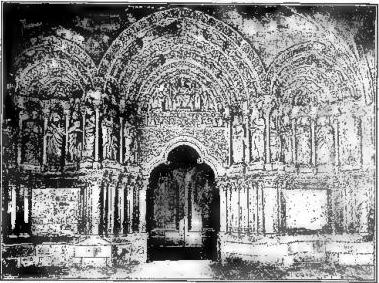
and decreed the impersonality and impassibility of the poet, and Charles Baudelaire, its originator (1841-67), there are many ties and affinities; yet Baudelaire’s genius (Fleurs du mal, 1857) transcended the school’s characteristics, situating itself in a highly personal realm: his poetry, essentially Christian even when it delves into evil and disorder, is perhaps the most plastic, the purest, and the most musical of the entire century. For Baudelaire, the problem of artistic creation is not merely one of tears, as for so many Romantics, nor of impassibility or literary technique, but of conscience and profound inner struggle. More consistent in absolving his own heart and describing its shifting palpitations, though at times artificial, is Paul Verlaine (1844-96), whose vast lyrical output (Poèmes saturniens, Fêtes galantes, La bonne chanson, Sagesse, etc.) is to his credit, and with whose name the birth of Symbolism—the second great movement in the poetry of this era—is associated. For a brief but intensely human and literary period, Verlaine was joined by Arthur Rimbaud (1857-91), whom many critics have recognized as possessing a seer’s soul. In Rimbaud, poetry becomes a burning expression of life and truth, rising to incredible heights; yet with resolve, the poet abandons it at just twenty years of age, fleeing to Africa and surrendering to his meteoric destiny. Finally, it is Mallarmé (1842-98) who reasserts the same impulse, coldly and hermetically, with a determination and fervor unmatched in our era. For him, Symbolism became more than a literary school: a way of conceiving poetry, from which the poets of our century, in France and elsewhere, would scarcely deviate.
The novel, following in the footsteps of Balzacian realism, encounters many dangers due to its prevailing tendency to describe reality without mastering it from within, but it is redeemed by the works of Flaubert and Maupassant, and partially by those of Zola, the Goncourt brothers, and Daudet. In these authors, the novel is not merely—even when it aspires to be—“a representation of nature and ourselves with a view to the physical and moral improvement of our species,” as Proudhon expressed it; in Flaubert (1821-80), as it had been before Naturalism in Mérimée, a sober, precise, and attentive writer, the art of narration becomes an inner quest according to a method of integral realism, no less artistic or effective for that. The serenity Flaubert achieved at the cost of so many stylistic sacrifices becomes impassibility in too many works by Émile Zola, a combative theorist of the Naturalist school (in the Rougon-Macquart series, defined by J. Lemaitre as “a pessimistic epoch of human animality,” his method borders on that dear to positivist science) and undoubtedly a better writer in his fantastical tales (cf. Le Rêve). In Daudet (1840-97), an impressionistic and comic vein prevails: it yields a masterpiece of humanity like Tartarin de Tarascon; in Maupassant (author of the famous Boule de Suif, Bel-Ami, and Pierre et Jean, etc.), a psychological and passionate vein, with results at times surprising in color and style. Also dear to the generations between 1880 and the early twentieth century were the novels of Pierre Loti and Paul Bourget, the former set in exotic environments, the latter rich in penetrating psychological analyses of an anti-materialist character. A tormented writer, ultimately liberated by faith, is Huysmans, in whom all the restlessness of this transitional era is found, moving from the last offshoots of Romanticism, through Naturalism and Positivism, toward the idealism of the early twentieth century.
Certainly, the narrative literature of the second half of the nineteenth century is the most hybrid and restless sector. Historians, philosophers, critics, and orators, and finally dramatists, who renew and deepen the schemas already sufficiently provided by the eighteenth century, benefit at times from the changing perspectives of customs and thought, often anticipating them with dazzling acuity. Among historians, we can distinguish a picturesque and descriptive school, led by Thierry (1795-1856) and Michelet (1798-1874), a philosophical school, represented by Guizot (1787-1874), Mignet, Taine (author of the famous Origines de la France contemporaine), and finally Renan, known for his studies on Judaism and Christianity. A true modern historian, meticulous in research and impartial in judgment, is Adolphe Thiers (1797-1877), whose name is linked to an excellent history of the French Revolution. Literary criticism was to receive the best of his activity from the sharpest, perhaps, of the Romantic-era men of letters: Charles-Augustin de Sainte-Beuve (1804-69), to whom we owe masterful and vivid portraits of writers and the most sagacious judgments on the literary production of his time. In this field, inaugurated by Chateaubriand and Madame de Staël, Girardin, Nisard, Taine, and later Paris, Claretie, Brunetière, Lemaitre, and Faguet also established themselves.
Still retaining the prestige, undiminished by time, of poetic truth and imagination, are certain dramatic authors who, in their day, aroused enthusiastic acclaim: here we refer to Eugène Scribe, author of vaudevilles and subtle comedies, to Émile Augier, to Dumas fils, to Victorien Sardou, and to Edmond Rostand, author of the celebrated Cyrano de Bergerac. With Henry Becque, toward the end of the century, the theater assumes its function as a critique of customs.
VI. THE TWENTIETH CENTURY
The first fifty years of this century witness, alongside the perpetuation of many models and the dilution of certain typically nineteenth-century states of mind, the proliferation of literary schools entirely different in spirit and form. France does not lose its role as a forge of novelty and new technical and spiritual experiments. And if it is too soon to offer an overall judgment on current literary production, some more typical figures already indicate, through the variety of expressions and the originality of creative work, the boundaries of an era consumed by a formal struggle unparalleled in any century, and at the same time intoxicated with clarification in every sense and direction of spiritual life. After the cold and secret difficulties to which the genius of Mallarmé had driven it, poetry takes on metaphysical impulses and colors in the work of Paul Valéry (1871-1945), enchants itself in the delicate and elegiac rhythms of Francis Jammes (1868-1938), bursts into Dionysian and mystical forms, of a vivid dramatic quality, in Paul Claudel (b. 1868), one of the greatest Catholic poets of the twentieth century, only to dissolve into the irrationality of the Surrealist movement, in which it remains entangled today. To the novel and prose of ideas, writers of diverse and in many ways contrasting personalities lend the charm of their rich individuality—yesterday Anatole France and Maurice Barrès, today or just yesterday, André Gide and Marcel Proust. Gide and Proust are perhaps the least ephemeral masters of this troubled and divided era, which has already seen wars, disorientations, and disillusions in every European soul, and above all in the sensitive French soul, so ready to reveal and question itself in depth. A fanatical seeker of truth, wherever it may be found, captious and biting, yet always tireless in his own attempts, Gide may be taken as a symbol of all contemporary literature, just as Proust may be considered the historian of poetry’s supreme illusions: the search through art for lost time. Alongside them, though not always close in spirit, must be considered the novelists Giraudoux and Mauriac (the latter singularly engaged with the religious problem), Daniel-Rops and Bernanos, the poets Apollinaire and Jacob, while gradually fading into the memory of literary chronicles are the proponents and disciples of the various movements and trends that continue to appear and disappear in our time. French literature, which has so admirably interpreted in the past the greatest demands of the spirit, including those of the religious spirit, is undeniably linked to many of our current hopes for a complete renewal of Western civilization.S. Atkinson, Les nouveaux horizons de la Renaissance française, 1935. - On the eighteenth century: P. Hazard, La crise de la conscience européenne, ibid. 1935; id., La pensée européenne au XVIIIe siècle, ibid. 1945. - On classicism and romanticism: W. Folkieriski, Entre le classicisme et le romantisme, ibid. 1925; M. Bray, Chronologie du romantisme, ibid. 1932; P. Martino, L'époque romantique en France, ibid. 1944. - On contemporary literature: H. Clousard, Histoire de la littérature française du symbolisme à nos jours, ibid. 1947; M. Raymond, De Baudelaire au surréalisme, Italian trans., Turin 1948. - For a religious profile of French literature, cf. especially: H. Bremond, L'hist. litt. du sentiment religieux en France, 11 vols., Paris 1915-33, and, for the contemporary period: J. Calvet, Le renouveau catholique dans la litt. contemporaine, ibid. 1927; Le manuel de la litt. catholique en France, with the collaboration of specialists, 2nd ed., ibid. 1930. - For religious theater: G. Cohen, Le théâtre en France au moyen âge, I, Le théâtre religieux, ibid. 1928. Giacinto Spagnoletti
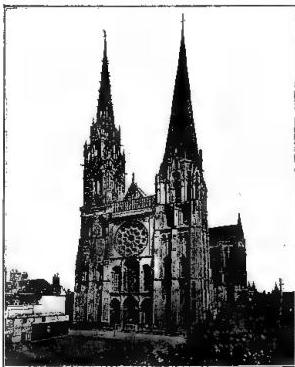
I. ROMANESQUE ART (ARCHITECTURE AND SCULPTURE)
The first manifestations of French art after the fall of Roman rule were not autonomous. The Visigoths (in the south), the Burgundians (in the east), and the Franks (in the north) did not give rise to a new monumental art, which also failed to emerge with the advent of Clovis (482) and the Merovingian dynasty and the consequent unification of the peoples of Gaul. Taste, however, found particular expression in goldsmithing, where motifs derived from the East were interpreted with an original spirit (v. BARBARICA ARTE). Even the architectures, of which only scant remains survive, declare a dependence on Byzantine monuments (e.g., St-Pierre in Vienne [Isère]). After the fall of the Merovingians, political upheaval was followed by the decline of art until Charlemagne reconnected with the artistic traditions transmitted from antiquity, seen through Byzantium and the Christian East. The first manifestations of a French architecture, in which the seeds of what would mature into Romanesque art were already contained, are encountered precisely in what was called the Carolingian Renaissance (v. ARTE). And this is not merely about the appearance of certain structural elements but the value assumed by the various formal elements of architecture. Thus, more than in the Palatine Chapel of Aachen (consecrated in 805), which echoes San Vitale in Ravenna, new elements appear in the small church of Germigny-des-Prés, in St-Philbert of Grandlieu (Loire), in Cravant (Indre-et-Loire), and in Jumièges (940): apses flanked by smaller apses, lantern towers, and pillars emerge. Of the frescoes and mosaics that decorated the walls, only scant remains have survived (e.g., the Martyrdom of St. Stephen, 9th century, in St-Pantaléon-les-Autun). Sculpture at the time was poor and crude; instead, illumination (v.), enamels (v.), goldsmithing (v.), and ivories (v.) flourished, in which one finds againFRANCE - Portal of the church of St-Seurin (1260) - Bordeaux.
It exhibits the classical taste in compositions and relief, executed with delicate and meticulous craftsmanship.
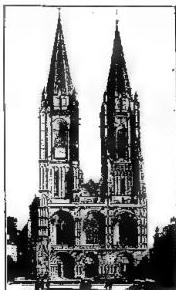
II. GOTHIC ART
The Middle Ages called "opus francigenum," thus unequivocally specifying its origin, that architecture which the Renaissance, with a misguided pejorative meaning, termed Gothic (v. GOTICA ARTE). The Romanesque conquest of the vault found its completion and conclusion in Gothic architecture. The first examples began in the mid-12th century in the Île-de-France, and its consequences extended until the mid-16th century. The pointed arch, the ribbed vault, and the flying buttress are the structural elements of the new architecture;(fot. Neurénia)
FRANCIA - Façade of the cathedral (13th-14th centuries) of Chartres.
From the coordination of these elements arises a new aesthetic language. Vaults no longer rest on walls but on pillars, which come to form the sole framework of the structure; the thrust is counterbalanced by flying buttresses, which discharge the entire weight of the vaults outward. Having found the technical formula, architects were able to unleash their imagination to the fullest: first and foremost, achieving the greatest heights, which it sufficed to balance with a corresponding ma-
Notre-Dame-de-St-Lô, diocese of Comiances (13th-16th centuries).
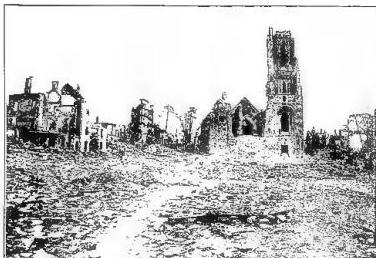
The first great building to inaugurate this new taste is St-Denis, for whose construction Abbot Suger summoned architects from all over France in 1132. Shortly afterward, a remarkable flourishing followed in all regions: Noyon, Senlis, St-Remi of Reims, and finally Notre-Dame of Paris (1163-82) concluded this first period of Gothic art, in which the essentiality of structure predominated. From the 13th to the 14th century, architects advanced toward greater lightness in construction and enrichment of ornamentation: spires, pinnacles, and cornices of immense portals multiplied, covered in sculptures, along with the marble lacework of rose windows and large windows (e.g., the rebuilt Notre-Dame of Chartres [1198-1260], the cathedrals of Reims, Amiens [1220-88], Beauvais, Strasbourg, Metz). The architects who imposed their style were J. de Chelles, author of the transept of Notre-Dame of Paris, and Pierre de Montreuil, architect of St-Germain-des-Prés, who completed the south crossing of Notre-Dame. Under their influence, the Ste-Chapelle (1240-48) was built, in which the liberation of the wall’s mass was taken to its extreme consequences. Also constructed were the cathedral of Troyes and the façade of that of Strasbourg. In the south, J. Dechamps dominated (cathedrals of Clermont-Ferrand, Narbonne, and Limoges). After these supreme achievements, the taste for excessive ornamentation led to the disintegration of structural compactness, giving way to trite and exuberant decorative virtuosity (façade of the cathedral of Rouen, St-Jacques of Dieppe, cathedrals of Evreux, Nantes).
### III. SCULPTURE.
The liberation from pictorialism and the achievement of a purely plastic organicism was the great innovation of Gothic-period sculptors. Iconographic sources were also renewed.
(Courtesy of Mont. G. Pollaux)
Notre-Dame-de-St-Lô, after the 1944 bombardment.
Composition took on a new character due to the need to adhere to the taste that shaped the new architectural forms, and to the agitated gestures of crowded Romanesque compositions succeeded, in the early manifestations of Gothic sculpture, a hieratic calm that in some ways seems to reconnect directly with the purity of Greek statuary.
The earliest testimonies of Gothic sculpture can be identified in the portal of St-Denis (c. 1140), with figures set against the columns and along the archivolts of the lunette. Shortly thereafter, Chartres became the school of French sculpture with the magnificent "Portal of the Kings" (c. 1150), followed by that of Ste-Anne at Notre-Dame in Paris, and then Étampes, Angers, Le Mans, Amiens, and Reims. However, simultaneously with the evolution of architecture, even the plastic simplicity, from the mid-13th century onward, gave way to the search for pictorial effects. From the south and north porches and portals of Chartres, with figures of a very soft modeling but still solemn, one arrives at more lively images in their attitudes, more animated, such as the Queen of Sheba, the famous Angel known as the "Smile" of Reims, and the Virgin with the Child of Notre-Dame in Paris. This refined grace eventually declined into affected mannerism, while from the intent of renewal arose a realistic search. This found its field especially in portraiture, of which notable examples remain (Charles V, Jeanne de Bourbon, at the Louvre). In the 15th century, the most prominent figure is Claus Sluter, who, with the tomb of Philip the Bold and John the Fearless (Dijon Museum), left the model of the realistic funerary monument. Simultaneously, through the work of Michel Colombe, a reaction emerged that did not, however, create a new language but evoked the delicacy of Gothic modeling without reviving its lyricism (sculptures of the cathedral of Nantes; bas-relief with St. George and the Dragon at the Louvre). G. Regnault and G. Chaleveu disseminated Colombe's manner and taste for large sacred groups.
While the cathedral was the greatest expression of medieval architecture, it must not be forgotten that simultaneously feudal society built its castles, most of which have survived only as ruins. The scheme, which remained substantially unchanged, consisted of a compact structure with an enclosing wall flanked by powerful towers. The first example was Château-Gaillard (Normandy), built by Richard the Lionheart; shortly afterward, Philip Augustus had the Louvre constructed. In the 13th century, that of Vincennes arose. In the 14th century, the Papal Palace of Avignon (v. AVIGNONE) gained particular importance, and the castles of Charles V and his brothers, the dukes of Berry, Burgundy, and Orléans, became famous. Meanwhile, the types of civil architecture were established (Palais de Cluny, in Paris; Palais de Justice of Rouen; Town Hall of St-Quentin), which were to endure for a long time. Indeed, the Gothic style did not completely fade even when, in the 15th-16th centuries, France encountered the Italian Renaissance, which influenced especially painting and sculpture. The Gothic taste, in its extreme expression of the "flamboyant," persisted above all in sacred architecture, where it often merged with Renaissance motifs (St-Pierre of Caen; St-Eustache and St-Étienne-du-Mont in Paris), and survived in castles: the Château de Chantilly, those of Plessis-lès-Tours, Perpignan, and Blois, repeated the type of the medieval castle modernized by the introduction of Italian decorative elements.
IV. PAINTING FROM THE ROMANESQUE PERIOD TO THE 15TH CENTURY
For painting as well, the abbey of Cluny was one of the most important centers of diffusion. One of the most interesting pictorial complexes of the Burgundian group is found in the chapel of Berzé-la-Ville (Martyrdom of St. Lawrence): the painting rivals mosaic in achieving precious decorative effects; the abstract and solemn figures in their sumptuous garments reveal a perfect adherence to Byzantine models. In the artistic environment that matured in Poitou and Berry, painting is lighter and more spontaneous; it retains a popular tradition derived from Carolingian art. Light tones predominate, and garments are draped in broad, flowing folds. Moses with the Tables of the Law (church of St-Savin-sur-Gartempe) and the Constantine of the baptistery of Poitiers can be considered early examples of a truly "French" art. Due to its humanity, the art of Poitou had a wide expansion: at St-Gilles-de-Montoire (Loire), St-Jacques-des-Guérets (Loire), Laget (Touraine), etc., and at Tavant (Indre-et-Loire), where the Descent of Christ into Limbo achieved highly dramatic effects; and again in Berry (church of Vicq), in Maine (Château-Gontier), where it flourished vigorously.Even in the Gothic era, when painting in churches was reduced to a secondary role, it found full development in castles, where it adapted to a particularly refined, aristocratic taste. It narrated the lives of illustrious figures (Stories of Caesar in the Castle of Vaudreuil), celebrated contemporary events (Expedition of the French to Sicily, at the Castle of Conflans), or allegories (suffice it to mention the oft-repeated Fountain of Youth); it drew subjects from literature, particularly chivalric poems (Castle of Étampes). Finally, the great vogue for tapestries (v.) began, whose illustrative and narrative character also influenced mural painting: a taste emerged for hunting or fishing scenes set against a backdrop of flowering greenery; enchanted gardens where slender, delicate figures move with grace, dressed in refined, heraldic elegance (Palace of the Popes in Avignon, Castle of Sorgues). Unfortunately, only a few fragmentary examples of this art remain, pervaded by an elegance and luxury that is not merely an element of taste but identifies with the artistic form itself.
In Gothic cathedrals, with walls opened by large windows, painting, confined to limited spaces, now had an essentially ornamental function. It ultimately shifted its interests to another technique: stained glass (v.). Stained glass, with its luminosity heightened by the juxtaposition of complementary colors, played a vital role in Gothic architecture; perhaps never before had architecture and decoration been so closely linked. Originating at St-Denis, stained glass developed at Chartres, which served as a model for other cathedrals in the first half of the 13th century. Around 1250, Paris became the center of this new artistic expression, reaching its highest achievements in the Sainte-Chapelle and Notre-Dame, in the cathedrals of Angers, St-Étienne of Auxerre, Poitiers, etc., and, in the 14th century, at St-Pierre in Chartres, the cathedrals of Évreux, Rouen, etc.
At the end of the 14th century, Paris took an important place in the history of French painting. In the city already famous for its ivories, its miniatures, and its tapestries—of which, together with Arras, it held the monopoly—a school emerged from which the first personalities stood out. Characteristics of the Parisian school are the nobility of drawing, the clarity of composition, and the elegant elongation of slender figures that stand out against a gold background with an ivory pallor. Even in sacred scenes, these figures often evoke the refined world of the court (e.g., the diptych of Richard II with the Virgin and Child among a Choir of Angels, attributed to André Beauneveu [ca. 1390, London, National Gallery]; the portrait of Jean le Bon, attributed to Gérard d'Orléans [ca. 1360, Paris, Petit Palais], painted with a freedom that, even through the crude realism of the sharp profile, achieves a subtle spiritual characterization).
The art of the Parisian school spread to the provinces. It took on a particular character in the Duchy of Burgundy, where contact with other artistic languages (Italian and Flemish) gave rise to the so-called Franco-Flemish art, characterized by a taste for architectural backgrounds and sometimes brutally realistic characterizations of figures. Malouel and Bellechose (Retable of St-Denis, Louvre), M. Broederlam (Episodes from the Life of the Virgin, in Dijon, 1394-99), and G. Beaumetz are the artists who disseminated this style. Another important center was Avignon, where the encounter between Italian art and that of Paris gave birth to a new taste (e.g., the Retable of Touzon; the triptych of the Museum of Angers), which also spread to Upper Piedmont (castles of Fénis and Manta).
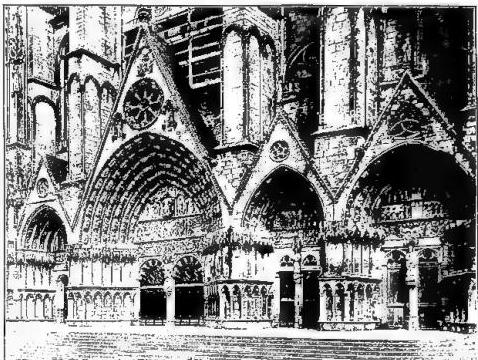
The Loire Valley assumed capital importance in the history of French art, where the most interesting personality of this period, J. Fouquet (ca. 1425-1480), emerged. After a brief stay in Italy (he painted the
(Int. Nuusieris)
FRANCIA - Western portal of the cathedral of Bourges (14th century).
portrait - lost - of Eugene IV), he settled in Tours, where before 1474 he became the painter of the court of Louis XI. His style, which rejected the motifs of the florid Gothic, was expressed with clarity and balance in composition and with powerful psychological characterization in portraits (Giovanni degli Orsini, Carlo VII, at the Petit Palais; Stefano Chevalier with St. Stephen, at the Berlin Museum). Fouquet expressed the same qualities in miniatures, to which he gave spatiality, monumentality, and the fluidity of large compositions. Those in Book I of Josephus' Jewish Antiquities, which Fouquet illustrated for the Duke of Nemours, are certainly his. Fouquet's sons François and Louis, along with various pupils, continued his work; but the elements that in the master's art were style became in his followers a mere cipher and a taste for the "genre." The Master of Moulins emerged, identified with J. Perréal, in whom the lessons of Fouquet, the Flemish Van der Goes, and the Italians bore fruit in motifs that were assimilated and recreated with a taste for plastic modeling and a realism of popular vein (Nativity at the Autun Museum, St. Maurice at the Glasgow Museum, the retablo of Moulins, various portraits).
V. THE RENAISSANCE AND ITALIAN INFLUENCE IN ARCHITECTURE AND SCULPTURE
The taste of the Italian Renaissance penetrated France through Italian works (the tomb of Louis XII and Anne of Brittany by Antonio and Giovanni del Giusto; the sepulchre of Robert Lannoy and Folleville by Antonio della Porta, etc.) or through the artists themselves (G. Mazzoni’s atelier in Paris was much frequented). Eventually, Francis I officially introduced Italian art by first summoning Leonardo and Andrea del Sarto, then Primaticcio and Rosso with their collaborators to the Château de Fontainebleau: from that moment, for over a century, French art was oriented toward Italian models. The monument that epitomizes the new architectural taste is the Louvre, whose reconstruction was begun by P. Lescaut (1547) after the demolition of the old building of Philip Augustus, transformed by Charles V. ■ Lescaut conceived an immense palace with four wings around a central courtyard. He completed only the western wing and the adjacent side of the southern wing, but his work was fundamental and had such a distinctive character that subsequent artists in the following century felt bound to II. From this point, the orders, pediments, and other elements that Lescaut derived from the Italian Renaissance became part of the French architectural language and stimulated new research: G. Bullant, in the Palace of Écouen, first adopted the single order; at the Tuileries and Fontainebleau, F. Delorme likewise pursued the purity of classicizing forms of Italian origin.Sculpture, in a secondary role, expressed the same ideals. Two personalities dominated that period: J. Gujon, a seeker of flowing rhythms and precious refinements in modeling (sculptures at the Louvre; the Fountain of the Innocents, 1549, in Paris; Diana and the bust of Henry III, at the Louvre); G. Pilon, with a more spontaneous and naturalistic manner (tomb of the Chancellor of Birague; sepulchre of Henry III, at the Louvre).
In this period, classical French art was born, reaching its greatest expression in the 17th century.
Architecture, in particular, was dominated by Italianism, which informed the vast building renewal of Henry IV’s Paris. Churches crowned with domes arose (the church of the Sorbonne, Val-de-Grâce, the Collège des Quatre-Nations); palaces with gardens populated by statues (Marie de’ Medici had the Luxembourg expanded and transformed in imitation of Palazzo Pitti by S. de Brosse); and the Italian taste for glorifying the lives of high-ranking figures through funerary statuary emerged (Chantilly: the tomb of Henry Condé by Sarrasin; at Moulins, the tomb of Montmorency by F. Anguier). The invitation to Bernini (1665) to continue the construction of the Louvre is an indication of the taste’s orientation toward Italian art; but simultaneously, Bernini’s failure is proof of it, as French classical art blossomed, using Italian elements only as reminiscences: F. Mansart (1598-1666), who imposed himself through his sense of proportion and sobriety (church of the Visitation; Hôtel Vrilliere; church of the Minims; project for Val-de-Grâce in Paris; Château de Blois; Château de Maisons); his great-nephew J. H. Mansart (1646-1708), who left his masterpiece in the Petit Trianon at Versailles; L. Le Vau (c. 1612-1670), who also traveled in Italy (Hôtel Lambert, Collège Mazarin in Paris; Château de Vaux); A. Le Nôtre (1613-1700), one of the principal garden architects (his masterpiece being the park of Versailles); Le Mercier; C. Perrault, who continued the construction of the Louvre, were the dominant figures of this period. All left their mark on the Louvre and on the monument that represented the highest expression of the art and taste of that era, Versailles, where architecture, statues, gardens, fountains, and abundance of water combine to create a sumptuous scenographic complex. The elements drawn from Italian art were by then experienced with an autonomous spirit that imprinted a particular character on French architecture: born from the encounter with the Italian Renaissance, it took from it grandeur but not its intimate grandiosity; nobility but not monumentality (e.g., Perrault’s colonnade at the Louvre). This character is also found in sculpture, which follows architecture, once again in a minor key. A. Coysevox (Duchess of Burgundy, 1712), Girardon (Bath of the Nymphs), J. B. Lemoyne, J. B. Pigalle gradually freed themselves from Italian motifs, up to E. Bouchardon, who foreshadowed Clodion.
VI. PAINTING IN THE 16TH CENTURY AND ITALIAN INFLUENCE
With the reign of Francesco I, the influence of Italian art also entered painting. The French masters of this period looked to Moroni and Bronzino for the composition of figures, understood in relation to characterization. The dominant personalities are Janet and François Clouet. Of Janet (1475-1540), the portrait of Francesco I (Paris, Petit Palais)—a true glorification of sovereign dignity—the portrait of the Dauphin Francesco (Antwerp Museum), and the Francesco I in the Uffizi are works that set a precedent; the same is true of some by François: the portrait of Jean Babou, the signed and dated portrait of Pierre Quet (1562, Louvre), those of Francesco di Lorena, of Claude de Baune (also in the Louvre), and of Elisabetta di Valois (Toledo). Yet it is from these very works that the decline of portraiture arises, as it came to be perceived as a "genre," and thus bound to a formula that quickly became fashionable and rhetorical.Alongside this official portraiture, a taste emerged that, though directly generated by the influence of Italian artists, asserted itself with original and independent characteristics: that of the School of Fontainebleau. This school was formed by French artists who collaborated with Rosso and Primaticcio, and later with Niccolò dell'Abate, in the decoration of Francesco I's castle. These Mannerists brought to the French milieu the theoretical principles of the Italian Renaissance: anatomy, drawing, perspective, Vitruvius's treatises, and, naturally, knowledge of the classical world. The School of Fontainebleau is characterized by decorative richness and an extreme, affected elegance. The heroes of the classical world became delicately gallant and precious courtly figures; from this environment arose that aristocratic Epicureanism which would later reappear in Boucher, Fragonard, and even Ingres. The leading figure of the School of Fontainebleau was Jean Cousin (1490-1561). Primaticcio died in 1570 and Niccolò dell'Abate the following year; yet the School of Fontainebleau continued to thrive and resonate until the early 17th century, and its work was carried on by the Second School of Fontainebleau with Dubreuil (1561-1602), M. Fréminet (1567-1619), J. Cousin the Younger (ca. 1522-92), and A. Dubois (1543-1614), who decorated the Gallery of Diana at Fontainebleau (destroyed under the Empire). By this time, however, the school, while retaining its taste for sumptuous decorations, had lost its delicate elegance and refinement, as well as all spontaneity (e.g., Last Judgment by J. Cousin the Younger, in the Louvre).
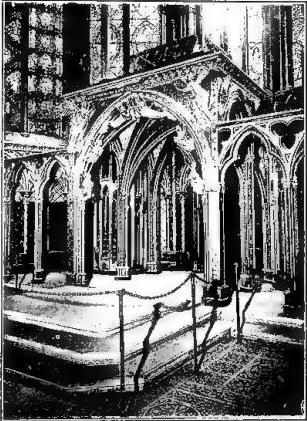
VII. THE SEVENTEENTH CENTURY ■ CLASSICAL PAINTING
The so-called classical age of French painting is that of the renewal brought about by great personalities through whom French painting acquires an autonomous physiognomy, independent of the triumphant Baroque taste prevailing in Italy and spreading across many European countries. The center where this profound renewal converges is Paris, where the patronage of Louis XIII first, and later the court of the Sun King, fosters artistic production. Yet at the beginning of the century, as the language of the School of Fontainebleau faded into a final weary echo, French painting was still dominated by Italian influence through the three most esteemed painters: Valentin, Vignon, and Vouet.Valentin (1591-1634) was Caravaggesque, having lived in Rome from 1614 until his death (Concerto, at the Petit Palais; Judith, at the Musée des Augustins in Toulouse; The Cheat, at the Dresden Museum, which was even attributed to Caravaggio). Paris was dominated during this period by S. Vouet (1590-1649). His output was vast; he executed large decorative works (at the Louvre, the Luxembourg Palace, the destroyed Hôtel de Bullion, etc.), many paintings for churches (Presentation at the Temple, at the Louvre; Martyrdom of St. Eustace, in the eponymous Parisian church; St. Charles Borromeo, at the Brussels Museum), and portraits (Louis XIII with the Symbolic Figures of France and Navarre, at the Louvre). He possessed narrative fluency, virtuosity in pictorial effects, and nobility of composition, but never freed himself from academic superficiality.
Isolated artists who left no school were the brothers Antoine (1588-1648), Louis (1593-1615), and Mathieu (1607-c. 1677) Le Nain, who ennobled and spiritualized the bambocciata, the small genre painting of popular and humorous subjects. Born in Lyon and thus in contact with Flemish art from childhood, the Le Nain likely worked in collaboration (their works are signed only with their surname). Nevertheless, criticism has distinguished their three personalities, identifying in Antoine a more Flemish-inflected taste for storytelling (Family Gathering, at the Petit Palais), in Louis a broader and more vigorous style (Peasant Family, at the Petit Palais), and in Mathieu a more conventional Mannerism (The Backgammon Players, at the Petit Palais). What is striking in the Le Nains' works is the absolute immobility of the figures, frozen—even in gestures of movement—in a calm, almost rarefied atmosphere.
The tradition of portraiture, reduced to the constraint of worn-out formal conventions, was renewed by P. de Champaigne (1602-74). Born and raised in Brussels until the age of 19, he learned from the Flemish the love of color; later, he studied the Italians. He recreated these elements with a personal, rigorous, and austere style, while the physical and spiritual truth of the subject was highlighted, and in function of this truth, costume and setting were also perceived. Champaigne, with his vast oeuvre (e.g., Louis XIII Crowned by Victory, the magnificent Richelieu, President de Mesme, the double portrait of Mother Superior Catherine Arnauld with Sister Catherine de Sainte-Suzanne, in which psychological penetration is so subtle that the real is transfigured into the ideal), marked the classical rebirth of French art. Classicism had another representative in Eustache Le Sueur (1617-55). After studying and copying Vouet, he began to study Raphael through prints and drawings; from this, he derived an academic manner, somewhat theatrical, an exteriority accentuated by the search for emotional effects, only rarely corrected by a certain restraint in drawing, perspective construction, and sobriety of color effects (Death of St. Bruno, Christ Carrying the Cross, Mass of St. Martin).
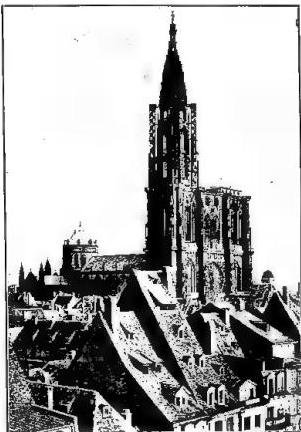
(courtesy of Dr. E. Oertini)
FRANCE — Cathedral of Strasbourg (13th century).
French painting was profoundly influenced by these two masters; their impact was felt not only by the artists of their own time (beyond those who worked within their sphere, such as Dughet and Patel), but also later, from David and Delacroix to Corot and Millet, as French painting presupposes the experience of these two great masters.
VIII. THE ACADEMY
The age of Louis XIV is dominated by Charles Le Brun (1619-90) with his vast production and the founding of the Royal Academy of Painting and Sculpture (1647). Initially, the Academy intended to be merely a gathering of artists eager to perfect themselves through discussion and the study of problems of common interest, but unfortunately, it ended up elaborating a doctrine—that of Le Brun—to which the others conformed. Le Brun, who had studied in Italy, drew from the works of Raphael and the Bolognese a strong influence that is fundamental to his taste (Maddalena, Adoration of the Shepherds, Hunt of Meleager at the Louvre; grand decorations at Versailles with allegories glorifying the reign of the Sun King; cartoons for tapestries). In portraits, where psychological inquiry restrains the artist’s facile exuberance, his style is more rigorous (Seguier, at the Louvre).Le Brun dominated French painting for thirty years and found in the Academy willing collaborators and followers. However, opposition to the taste he spread arose within the Academy itself. Significant was the long polemic (1668-90) on the preeminence of drawing or color, which pitted the followers of Le Brun against those of Rubens.
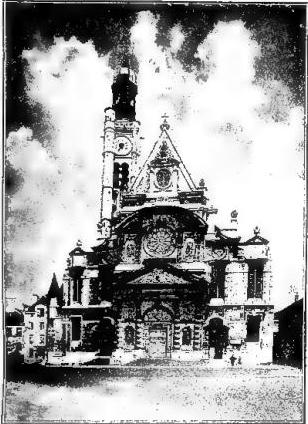
A renewer of French taste and palette was A. Watteau (1684-1721), who revived and revolutionized every lesson drawn from Rubens' school and from the study of Titian's works, forging a style entirely independent and personal.
Watteau's painting was of capital importance for the subsequent development of French art, but it did not have an immediate echo; rather than pupils, he had imitators who learned his lesson superficially. Lancret (1690-1743), the most gifted among them, possessed a delicate sense of color, but his Fêtes galantes adapt Watteau's lyricism into a precious realism. The artists of the Louis XV era were left with only the great resource of their craftsmanship: sure technique, correctness of drawing, and knowledge of color's possibilities. These traits are common to numerous artists who do not rise above mediocrity: even Nattier (1685-1766), with his worldly portraits of the court (Stockholm Museum: The Duchess of Chartres as Hebe), repeats with delicate chromatic virtuosity the same chilled formula, which nonetheless retains a tone of spontaneous freshness in the painting of F. Boucher (1703-70), who also exerted great influence on French taste. His only great pupil was J. H. Fragonard (1734-1806), who combined his master's teachings with those derived from his stay in Rome, where he deeply studied Pietro da Cortona.
The year 1737 is an important date in the history of French painting: it marks the establishment of the Salons. Figurative art came into direct contact with the public, among whom a taste for artworks spread; from the Salons emerged the fame of artists such as Chardin, Greuze, Fragonard himself, and Vernet. J. B. S. Chardin (1699-1769) holds particular interest for the modern spirit with which he drew inspiration from subjects of domestic intimacy: his world is the modest and simple one of his own home. The danger of falling into rhetoric or genre scenes is overcome by the purity of his style. The emotion evoked by his pictorial world is not so much expressed as suggested by his sober and acute drawing and by his pure color, modulated in delicate tones with a light touch. J. Vernet (1714-70) renders the sky and light of his landscapes with a delicacy of tone that foreshadows Corot. But before color's sensibility could mature into its highest solutions, French art had to undergo an experience that involved all of Europe: Neoclassicism.
IX. NEOCLASSICAL ARCHITECTURE AND SCULPTURE
In the mid-18th century, while the Baroque had Rococo (v.) even less—confined as it was to interior decorations and furnishings—the taste for ancient classical art (v. ART) matured. Architecture immediately embraced this new taste, yet precisely because of the ease of finding immediate models, it failed to derive from the grandiose purity of classical forms an expression of intimate monumentality. The Panthéon in Paris, by G. Soufflot (1705-80), obviously inspired by the Pantheon in Rome, marked the beginning of an entire series of monuments of this kind. It was especially the Napoleonic era that centralized, particularly in Paris, the triumph of Neoclassicism. The most notable figure was Chalgrin (1739-1811), who drew new ideas from the elaboration of classical monuments (Paris, Arc de l'Étoile). However, other architects such as Vignon (Church of La Madeleine), Brogniart (the Bourse), Bélanger, and even Percier and Fontaine, Napoleon’s official architects (Arc du Carrousel), produced works that were mere tired copies of classical motifs, devoid of autonomous vitality. The most significant phenomenon of the Neoclassical era was the emergence of urban planning problems, the first realization of which was the Place de la Concorde in Paris (1757) by J. Gabriel. He was also the architect of the Château de Compiègne and the theater of Versailles (1770). The Neoclassical infatuation scarcely touched religious architecture, which reverted to the imitation of basilical schemes.Sculpture, quickly dominated by the Italian influence of Canova, found its most notable figure in H. Houdon (1741-1828), whose numerous busts—inspired by Roman portraiture—and subject statues were enlivened by a refined sensibility (Petit Palais: Voltaire; The Flayed Man; Giordano Bruno; Rome, church of S. Maria degli Angeli: S. Bruno). Among the sculptors working within his orbit (A. Pajou: busts of Descartes, Bossuet, Pascal; F. Lecomte; David d’Angers: pediment of the Panthéon), Clodion (1738-1814) stood out, particularly in his small bronzes, terracottas, and vibrant bas-reliefs, surpassing conventionality with a lively freshness of modeling (Louvre: Cleopatra).
X. NEOCLASSICAL AND CLASSICAL PAINTING
French Neoclassicism found its most significant expression—also in terms of its influence on European art—in painting, dominated by J. L. David (v.). The influence exerted by David was enormous; from his school emerged A. Gros (exalter of the Napoleonic epic), Girodet, Gérard (typical representatives of the "Empire" taste), while the Neoclassical creed spread throughout Europe. The first opposition to David's predominance arose within his own studio, where J. A. INGRES, JEAN-AUGUSTE-DOMINIQUE (v.) asserted the freedom of painting against all programmatic constraints.XI. ROMANTICISM.
1. Painting. – The true reaction against Neoclassicism and, at the same time, against Classicism was that which asserted itself under the name of Romanticism. The Raft of the Medusa (Louvre), exhibited by J. L. A. Géricault (1791-1824) at the Salon of 1819, seemed to launch the program of the new movement. The subject, drawn from the dramatic episode of a shipwreck that moved public opinion, is rendered with a painting so rich in pure color effects and with a stylistic power that elevates realism from a human plane to a heroic significance. Yet it was a man of letters, Baudelaire, who first critically examined the work of the most significant personality of the Romantic movement, DELACROIX, EUGÈNE (v.), and in a celebrated essay (L'oeuvre et la vie d'Eugène Delacroix) synthesized Romantic aesthetics: the freedom of the artist’s imagination and the spirituality of art.
Outside the Romantic milieu, yet also distant in spirit from the so-called Realists, stands the work of H. Daumier (1808-79), who, turning his attention to daily life, highlights the sorrows, vices, or weaknesses of humanity, capturing the nuances of a gesture or an attitude. Reality is ironically transfigured, and every element is distorted to reveal the true meaning of his subjects.
2. Architecture and Sculpture. – Romanticism did not produce an original architectural expression. The taste for the Middle Ages, which had led to a critical revaluation of the Gothic (in 1823 the Société des antiquaires de Normandie was founded, and in 1837 the Commission des monuments gothiques), resulted in practice in the banal imitation of those monuments. A typically representative architect of this taste was Viollet-le-Duc (1814-79), who dedicated himself especially to the restoration of great cathedrals and castles. Unfortunately, these restorations often amounted to complete reconstructions that, by reducing architecture to formal schematics, destroyed its artistic truth (e.g., the Château de Pierrefonds). The imitation of Romanesque and Gothic was followed by that of Byzantine and Renaissance styles, and the elements of these different expressive languages were employed with continuous contamination. The result was an eclectic taste that, apart from local characteristics, was common throughout Europe for half a century. From this taste, Paris acquired a new face, the one that still characterizes it today, through the implementation of a complete and organic urban plan designed by G. E. Haussmann, prefect under Napoleon III. The architecture, pompous and ornate, nevertheless bore a particular stylistic imprint and had its major monuments in the Opéra by C. Garnier (1861) and the Nouveau Louvre by Lefuel (1852-57).
Sculpture followed painting in a minor key. The most significant personality in the Romantic milieu was F. Rude, whose most representative work is the great bas-relief on the Arc de Triomphe (Paris, 1833-56), The Departure of the Volunteers of 1792, executed with fresh enthusiasm that earned it the popular name of La Marseillaise. Barye, passionate about the painting of Géricault, ennobles his animal bronzes with profound emotionality. A deep influence of Rude was felt early on by J. B. Carpeaux (1827-75), who later turned to realistic investigations.
BIBL.:
For painting: C. Baudelaire, Curiosités esthétiques and L'art romantique; L. Rosenthal, Du romantisme au réalisme; J. Cassou, Panorama des arts plastiques contemporains; G. Bazin, Histoire de l'art de la Révolution à nos jours; for architecture: L. Hautecœur, Histoire de l'architecture classique en France; P. Lavedan, Histoire de l'urbanisme; for sculpture: S. Lami, Dictionnaire des sculpteurs de l'école française au XIXe siècle; L. Réau, Histoire de la sculpture française au XIXe siècle. – A. Venturi.
XII. FROM ROMANTICISM TO IMPRESSIONISM
Romanticism reached its exhaustion around the mid-19th century. The year 1848 is conventionally set as the boundary between Romanticism and the new taste: while such a division is arbitrary, it is undeniable that from that year of profound upheavals across Europe, life emerged transformed; new social ideologies attracted the attention of artists. Historical subjects, the exaltation of the Napoleonic era, and the rhetoric of literary inspiration gave way to the humanity of workers and peasants, to humble people; contemporary life replaced that of the past. Thus, Realism was born, taking its cue from G. Courbet (1819-77), who triumphed at the Salon of 1850 with A Burial at Ornans. Courbet's style, characterized by excellent drawing skills, a taste for beautiful pictorial matter, for color modulated in delicate tonal variations and brilliant light effects (Paris, Jeu-de-Paume: Young Ladies on the Banks of the Seine; The Stone Breakers; The Studio), created a following; but soon literary rhetoric was replaced by demagogic rhetoric. A distinct place within Realism belongs to J. F. Millet (1814-75): in his themes drawn from daily life, he brings a patient and meditative analysis that translates into monumental stillness (Paris, Jeu-de-Paume: The Reapers). Yet his minute examination and psychological inquiry sometimes lead to sentimental effects (The Angelus; The Shepherdess).Operating fully within Realism but with a Romantic spirit and reclaiming pictorial taste was a group of artists centered around Th. Rousseau (1812-67) in what was called the Barbizon School. These painters dedicated themselves exclusively to landscape, which they sought to renew from the formulas of the Anglo-Dutch tradition and French Neoclassicism.
Neither to Romanticism nor to Realism does the work of the great figure of C. Corot (v.) belong. His painting, through its subjective vision and rapid fixation of the mobility of things, foreshadows the movement that broke all ties with tradition and from which modern art was born: Impressionism (v.).
XIII. FROM IMPRESSIONISM TO CONTEMPORARY PAINTING
The movement, which initially included a small group of independent artists exhibiting outside the official Salons, derived its name from a painting by Monet, Impressions; but the work that clamorously proclaimed the new artistic creed was Manet’s Déjeuner sur l'herbe, exhibited at the Salon des refusés in 1865. A revolutionary work not only in its choice of subject but in its "painting," which no longer respected traditional canons: color separations are sharp, without intermediate transitions or chiaroscuro. Above the demands of perspective, modeling, and composition—above all conventional elements—FRANCIA - The Panthéon, begun by Soufflot in 1764 and completed by his pupil Rondelet in 1790 - Paris.
(courtesy of Dr. Degenhart)
FRANCIA - S. Giovanni Battista. North portal of Chartres Cathedral (late 13th century).
of reality, the sole law is that of color. Alongside Manet, and following the same principles, other painters emerge with their own independent personalities: Degas insists on the psychological examination of his subjects with meticulous and attentive care; Monet transforms light into pure pictorial essence; alongside him, Sisley and Pissarro carry luminism to those extreme consequences that would mature into divisionism; and Toulouse-Lautrec (1864-1901) achieves a synthesis between decoration and illustration. But already in those years (1883-90), the crisis of Impressionism was maturing: artists from the same Impressionist group distanced themselves from it, reaching results different from the initial premises: Renoir, who achieved astonishing effects of open air and solar luminosity, and restored the study of the figure to honor; and Cézanne, who used color to fix nature in a plastic, immobile, and geometric reality (The Card Players at the Jeu-de-Paume; numerous landscapes and still lifes). His volumetric world cubism (v.).
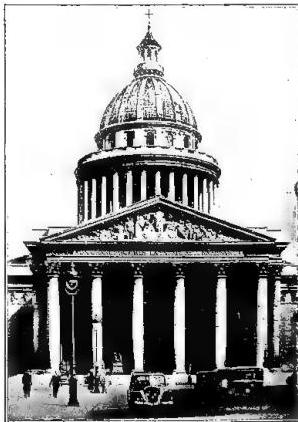
V. Van Gogh (1853-90), with his shattered form and harsh, dazzling brushstroke, opens the way to Expressionism.
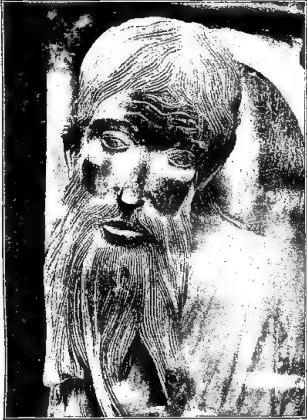
XIV. ARCHITECTURE AND SCULPTURE FROM THE MID-19TH CENTURY
Impressionism, which by its very nature was a pictorial movement, did not find a corresponding revolution in the field of architecture. What remains in the realm of engineering, and thus of pure technique rather than architecture (that is, art), are the attempts represented by the Halles of Paris (v. Baltard, 1851-59) and the Eiffel Tower (1889), where the renewal of construction materials—iron—was not followed by a renewal of artistic language. Nor did the later stripping away of ornamentation, derived from the use of concrete, achieve stylistic rigor. The new architectural solutions that matured
(from L. II, Labande, Les primitifs français, II, Marseille 1838) FRANCIA - St. Giovanni Evangelista at Ephesus. Provençal panel (15th century) - Marseilles, Bernard collection.
Sculpture adhered to Impressionist taste with A. Rodin (1840-1917). His style was already clearly expressed in the work with which he established himself: The Man with the Broken Nose (1864; Paris, Musée Rodin), where realism is surpassed by a sense of drama suggested by a pictorial chiaroscuro, which nonetheless does not sacrifice plastic energy.
The overcoming of Impressionism in sculpture was fundamentally achieved through the work of Renoir (who dedicated himself to it late, after 1890), who brought a sense of solidification to form. Soon after, his own students distanced themselves from that taste. Bourdelle (1861-1929) sought the beauty and monumentality of archaic art, but beneath this deliberate formal simplification, academism sometimes surfaces. A. Maillol achieved a more spontaneous monumentality, with broad masses balanced by a calm and composed rhythm. Contemporary French sculpture remains influenced by his style. So much so that current expressions adhering to painting—from Cubism to Expressionism to Abstraction (when not the same painters, like Matisse and Picasso, who model sculptures)—may appear sporadic: R. Duchamp-Villon, H. Laurens, and even Derain, for example, transpose Picasso’s language into sculpture. In reality, since Impressionism, French art has played a globally significant role, but it is through painting that it has fulfilled every demand of artistic evolution.
Elsa Gerlini
Without wishing to trace back to the Concordat of 1516 or discuss the revolutionary crisis of 1789, it is nonetheless necessary to briefly recall the official union established between Church and State with the Concordat of 1801, the Organic Articles, and imperial legislation. Despite numerous incidents, the Concordat provided the Church with relative peace for 80 years. However, as early as 1880, it gradually lost its advantages. Furthermore, with the law on associations of July 1, 1901, which dissolved the Congregations, the dispute over the formula for appointing bishops, the law of July 7, 1904, suppressing congregationalist teaching, and the recall of the French ambassador to the Holy See, despite the Concordat’s continued existence, separation was de facto accomplished.
It was legally decided with the law of December 9, 1905. Article 2 established the principle that "the Republic recognizes no religion." Yet, while the Republic did not recognize any religion, it nonetheless ensured freedom of conscience: the law declared it guaranteed the free exercise of worship. Ecclesiastical property was to be transferred to associations that would legally form in accordance with the general rules of worship organization. Such were the essential principles of the separation law. The Church was free but impoverished and threatened with total dispossession if it did not constitute the foreseen associations. However, these associations threatened the constitutional order of the Church.
The principles set forth by the 1905 law were also condemned by Rome. On February 11, 1906, the encyclical Vehementer Nos protested the rupture of the Concordat and demonstrated the incompatibility between "cultural associations" and the Church. On August 10, 1906, the encyclical Gravissimo Officii condemned any form of cultural association. Faced with the Church’s resistance, a new law, dated January 2, 1907, intervened, leaving sacred buildings at the disposal of Catholics and granting their free use not only to cultural associations but also to those of common law and to ministers of worship. New difficulties arose, and the Council of State, the supreme judge of administrative matters, had to resolve all issues. Under its influence, relations between Church and State, from declared hostility, gradually transformed into a tacit agreement. To summarize the entire period from 1801 to the present in a few words, one must adopt the formula of Prof. Le Bras: there was a transition from concordats to separation and from separation to concord.
The liberal evolution of the regime is characterized by a reconciliation between Church and State and an understanding between the two authorities. This reconciliation dates back to the resumption of diplomatic relations with the Vatican. An ambassador was appointed on May 21, 1921. French representatives in Rome sought to obtain the lifting of the interdict pronounced by Pius X against cultural associations. A commission of French jurists approved draft statutes for diocesan associations that were not contrary to French legislation and, at the same time, conformed to the constitution of the Catholic Church. The encyclical Maximum Gravissimumque of January 18, 1921, authorized their establishment. These were the main stages of reconciliation. But the understanding that was established is the fruit of decisions made by the Council of State, which can rightly be called "the regulator of parish life."
Whether concerning religious buildings, the situation of ministers of worship, or the organization of ceremonies, it is the Council of State that has enabled the liberal evolution of public spirit. To parish churches, which the law of January 2, 1907, had declared destined for the exercise of worship, the Council of State added chapels and religious monuments, which escape any influence of civil authority. No alienation of a building can occur without legislative decree; no demolition except in cases of imminent danger; no modification of the premises. The law of April 13, 1908, allows the State, departments, and municipalities to assume the necessary expenses for the maintenance and conservation of places of worship. In the very important decree "Canonico Vaucanu" of October 26, 1946, the Council of State imposes on municipalities the obligation to accept the participation of the faithful in church repairs. If the municipality refuses, it will bear the consequences of this refusal.
Regarding ministers of worship, the Council of State subordinates the faithful to the pastor. It recognizes as pastor only the one accredited by the bishop. In disputes between a priest sent by a cultural association and a priest in communion with Rome, it has always considered the latter as the only legitimate one. Thus, the organic unity of Catholicism is ensured. The Council of State has also permitted collections in churches. It has allowed municipalities to grant a salary to curates as guardians of the church.
As for the external manifestations of worship, and in particular processions, the Conseil d'État sought to reconcile respect for freedom of worship with the maintenance of public order. As early as 1926, the jurisprudence of the Conseil d'État became firm and consistent for both processions and small processions. It annulled any prohibition of traditional processions unless justified by public order. The Conseil d'État authorized priests to carry the Viaticum "under the conditions sanctioned by local customs and traditions." However, it was strict regarding prohibitions against public Masses. By decree of 5 March 1948, it ruled illegal a prohibition imposed by a prefect when neither public tranquility nor security was threatened. The 1905 law declared that the Republic did not recognize any religion, but also that the Republic ensured freedom of conscience. The Conseil d'État sought to apply this principle in the same way it accepted the scrupulous respect of canon law. Persons, things, sacred acts—it accepted all the definitions and prescriptions of the medieval Corpus and of the code that replaced it in 1918. This acceptance of canon law is exact at least for the exercise of freedom of conscience, which presupposes, for those who profess the Catholic religion, the adoption of all the rules of the Roman Church.
VI. SCHOOL SYSTEM.
Talleyrand proposed in 1790 the establishment of an elementary school in every municipality and a lycée in every district; Condorcet reorganized all schools in 1806-1808, adhering to the principle that only the State has the right to educate the people; Guizot established in 1833 a teachers' seminary in every department; Falloux recognized in 1850 that the Catholic Church also has the right to teach. This right was annulled in 1882 by Jules Ferry, who declared that education must be considered the foundation of the Republic and, as such, must be compulsory, free, secular, and non-denominational.
Secular morality was to replace religious instruction, which was thus moved to churches, where it was taught on Thursdays, declared holidays.
The Church established family councils, which were tasked with ensuring that the religious sentiments of their children were not offended in non-denominational schools, as the law of J. Ferry granted family councils the right to lodge complaints against offenses to religious sentiment.
Combes and Briand achieved in 1904-1905 the complete exclusion of the clergy from schools, the suspension of any form of state subsidies to private schools, including Catholic ones, and the prohibition of private schools, including Catholic ones, in the provinces of Alsace-Lorraine. The encyclical Maximum gravissimumque brought some relaxation in the school field, and 1920 marked a revival of Catholic schools. The ministerial decree of 15 April 1948 emphasized vocational education. The French school system comprises 2,869 écoles maternelles, 68,015 lower and upper primary schools, 198 secondary schools, divided into écoles and collèges, 195 écoles normales, practical schools of commerce and industry, and various normal and evening vocational schools. The universities are as follows: Montpellier (1125), Paris (1150), Angers (1220), Toulouse (1330), Gray (1287), Orléans (1260), Avignon (1303), Cahors (1332), Grenoble (1339), Orange (1365), Aix (1400), Dôle (1422), Poitiers (1431), Nantes (1460), Bourges (1464), Caen (1421-72), Perpignan (1349), Valence (1459), Bordeaux (1441), Besançon (1485), Douai (1530), Lille (1530), Nancy (1572), Pont-à-Mousson (1572), Reims (1550), Pau (1722), Rennes (1735), Dijon (1772), Lyon (1808), and Clermont-Ferrand (1808).
As for freedom of education, the Constituent Assembly, on 9 August 1946, refused to regulate it in the preamble of the Constitution. It is therefore no longer one of the principles of the new 1946 Constitution, and, while it cannot be said to be abolished, it remains only within the scope of ordinary laws. Naturally, the bishops protested and acted through committees and memorials. A decision of the Conseil d'État of 3 June 1949 and a decree issued following its deliberation (13 April 1950) allow for the distribution of financial aid to pupils of private schools as well; and that these pupils must be able to enjoy the same advantages as students in public schools. For the protection and defense of free education, the ecclesiastical hierarchy has given rise to various associations and auxiliary unions, e.g., the Fédération des amicales des nations élèves de l'enseignement catholique de France; the Alliance des nations d'éducation catholiques; the Syndicat des chefs d'établissements d'enseignement libre, etc.
Catholic French maintain at their own expense numerous schools of all levels and universities: the Institut catholique in Paris and the Universities of Angers (1875), Lille (1875), Lyon (1875), and Toulouse.
The education of the Catholic clergy takes place in 37 preparatory schools, 132 minor seminaries, 34 colleges, 96 major seminaries, and 3 seminaries called Seminaria plena. - Vedi tavv. CVII-CXI.