Machine translation of the 1948–1954 Italian original. The original text is authoritative.
IVO of CHARTRES, saint. - French canonist, b. at Beauvais in 1040, d. at Chartres on Dec. 23, 1115.
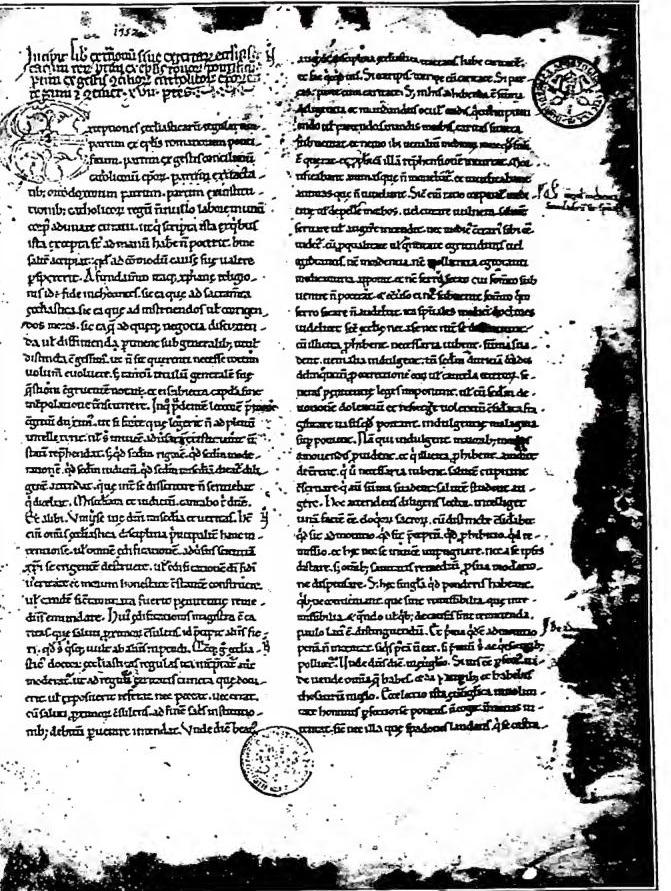
(phot. Enc. Catt.) IVO of CHARTRES, saint - Prologue in Decretum (12th cent.) - Vatican Library, cod. Vat. Lat. 1357, f. 1.He studied philosophy and theology in Paris, was a canon at Nesle in Picardy, and in 1090 was appointed bishop of Chartres by Urban II, hence the epithet Carnotensis by which he is remembered. Feast day, Dec. 23.
Three important collections of canon law are attributed to him, which represent, along with the works of Burchard of Worms, the major sources subsequently drawn upon by Gratian for his Decretum. These collections consist of the so-called Collectio tripertita, the Decretum, and the Pannormia or Panormia.
While these aforementioned elaborations by I. can be considered, from the material aspect of a collection of texts, as preparatory work for Gratian's Decretum, the method followed—common to that of his contemporary Bernold of Constance—can be considered a forerunner of what Gratian set as the primary purpose of his own work: namely, the resolution of contradictory texts.
Another characteristic, later followed by Gratian and already found in I., is that of gathering together both leges and canones. The Collectio tripertita is a non-original work, but a derivative one, since, according to Fournier's thesis (v. BIBLICA), its first two parts constitute a chronological collection of texts drawn from the Decree of
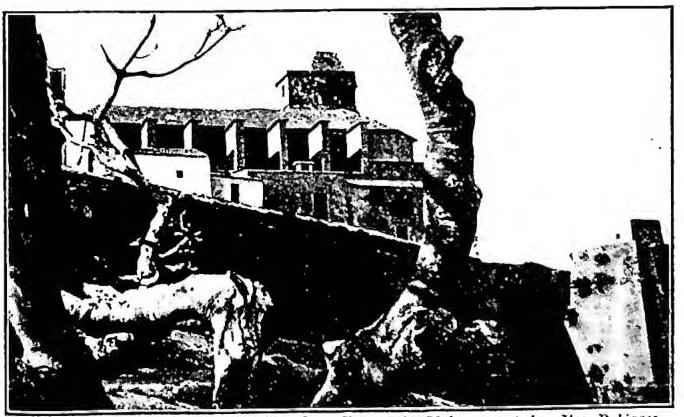
IVIZA, diocese of - Cathedral erected in 1235, given a Baroque style in the 18th cent. (from P. Lavedan, Palma de Majorque et les Iles Baléares, Paris 1936, pl. 53)Burchard of Worms and from other collections of Italian origin. On the other hand, it is not even known with certainty whether I. was the material author or merely the promoter of this first block of the Tripertita. The third part of the aforementioned Collectio would instead appear as a summary of I.'s Decree, a fact that would increase the suspicion that even the entire collection was not his direct work. As for the Decretum, Fournier believes it to be a disorganic collection compiled between 1090 and 1095, drawn from Burchard's Decree, the first two parts of the Collectio tripertita, a Collectio similar to the Collectio Britannica, and the Digest. Fournier doubts that the Decretum is a direct work of I.
The Pannormia, finally, still according to Fournier, would be more properly I.'s work, although the help of others in it cannot be excluded. It would be a systematic collection compiled around 1095, after the Decretum and using material from it, but with additions extraneous to II.
Contrary to this thesis, Bliemetzrieder ascribes the Decretum to I., inasmuch as I.'s prologue refers to that work and not to the Pannormia, as Fournier maintains. The same author, however, doubts whether the Pannormia can be by I. The Decretum, the Pannormia, and the Collectio tripertita were published in PL 161, 47-1423.
BIBL.: I. R. Menu, Recherches et nouvelles études critiques sur les recueils canoniques attribués à Yves de Chartres, Paris 1880; A. Sieber, Bischof I. von Chartres und seine Stellung zu den kirchenpolitischen Fragen seiner Zeit, Königsberg 1885; P. Fournier, Les Collections canoniques attribuées à Yves de Chartres, in Bibliothèque de l'École des Chartres, 57 (1896), pp. 645-58; 58 (1897), pp. 26-77, 293-326, 410-44, 624-76; P. L. Schmidt, Der h. J. Bischof von Chartres, Vienna 1911; F. Pl. Bliemetzrieder, Zu den Schriften I. von Chartres. Ein literengeschichtlicher Beitrag, in Sitzungsberichte der K. Akademie der Wissenschaften in Wien, Philos.-histor. Kl., Vienna, 185 (1918), p. 6 ff.; J. de Ghellinck, Le mouvement théologique du XIIe siècle, 2nd ed., Bruges 1948, pp. 445-59 and passim. Antonio Rota
Cite this article
“IVO DI CHARTRES, SANTO.” Enciclopedia Cattolica, vol. VII (1951), p. 347. Azione Romana digital edition, https://azioneromana.com/article/ivo-di-chartres-santo.