
JUDGMENT OF GOD. — This was the name given to those ordeals that made a presumed divine intervention, and the consequent presumed manifestation of God’s will, determine either a declaration of innocence or the resolution of a civil or criminal dispute. For primitive peoples V. ORDALIA.
Forms of the judgment of God are also found among the ancient primitive peoples; there, however, the divinity invoked or believed to intervene is not the true immaterial God, but any kind of pagan divinity (animals, plants, human beings, natural or artificial things), or even evil spirits themselves. Such forms of judgment are shrouded in the most superstitious rites and accompanied by propitiatory practices and incantations.
In the West, during the Middle Ages, the use of the judgment of God became particularly widespread through the influence of Germanic customs. It was then believed that the divine will manifested itself favorably toward the party that was in the right and in the truth, as though divine assistance would naturally be directed toward it in order to overcome the ordeal; whoever succumbed to the ordeal, on the other hand, was considered guilty, precisely because he was thought to have been abandoned by divine assistance and thereby indicated by the divinity itself as guilty. It has been thought that the first favorable attitude of the Christian milieu toward the judgments of God is attested in biblical accounts (recalled in the Ordines and by writers) concerning the three youths in the furnace, the bitter waters, the duel between Goliath and David, and, in the New Testament, the episode of St. Peter walking upon the waves.
As regards the duel in particular, the assistance of divine intervention seemed to be recalled in a letter from St. Augustine to Count Boniface; the relevant passage, cited in Ivo’s Panormia (VIII, 43, de pugna), reads: « Gravi de pugna conquereris. Arripe manibus arma; oratio aures pulset auctoris. Quia quando pugnatur Deus apertis coelia expectat, et partem quam inspicit iustam, defendit ». Nevertheless, it should be held that St. Augustine is speaking there of a genuine battle, and his admonition to those fighting for the just cause to remain confident of divine assistance is not in itself conclusive evidence. Judicial duels, in fact, take place between individuals in order to resolve disputes and are conducted as genuine judicial ordeals.
The material test to which recourse was had in the judgments of God in order to establish a right or innocence, and to reveal wrong or guilt, could consist, besides the duel, in material tests applied more directly to the person, such as the application of red-hot iron, walking through or immersion in icy or boiling water, or in boiling oil, and similar practices. There was also the so-called iudicium feretri, in which, when a corpse was displayed before the presumed murderer, he was held guilty by divine judgment if the wounds reopened or bled.
The judgments of God were also called “ordeals,” a term that corresponds simply to “sentences” (from the German Urtheil), because the divine decision was inferred from the more or less complete success in overcoming the test, and the human judge had only to record II. The term judgment of God was subsequently extended both to the ordeal itself, regarded as a particular means of proof, and to the decision derived from it, as well as to the entire procedure required by that decision.
In the Middle Ages, these judgments are also found among ecclesiastics, and it is not uncommon to encounter records of litigation in which a monk abandons the claim advanced, confessing the wrong committed by his monastery and refusing to submit to the ordeal lest he offend the divinity and become guilty of perjury. Recourse to the forms of the judgments of God also appears very frequent when there was uncertainty about the authenticity of documents presented in court or when other clear and conclusive evidence was lacking.
The judicial duel (pugna), in particular, was most often employed to resolve disputes. It could be fought either personally or through campiones, and not infrequently had an outcome that was anything but definitive. In view of these strange experiments, it is reasonable to believe that confidence in such forms gradually declined and that the idea of their uselessness for revealing truth and justice gradually gained ground. But their inherent moral defect must also have become apparent. Accordingly, conciliar decrees and papal letters—the former attested from the eighth century onward, the latter from the following century—began to oppose this barbarous custom, which presumed the continual intervention of God at the parties’ pleasure; meanwhile, the idea gained ground that failure in the ordeal might result from a lack of physical strength and material endurance, rather than from guilt.
Nevertheless, even in considerably later periods it is not uncommon to encounter acts of purgation from an accusation performed by high ecclesiastics through the reception of the Sacred Species, although here, according to some, the matter concerns purgatio canonica. It is noteworthy that, around the eighth century, synodal tribunals employed the judgments of God to establish the guilt of servants, whereas for free men recourse was had to the oath.
In the famous matter of Lothair’s divorce, it was admitted that God, in His mercy, might conceal the accused man’s guilt. During the tenth century, English and Bavarian synods established the formalities that were to accompany ordeals, and subsequently other German and Spanish synods prescribed the appropriate ordeals for the crimes of adultery and murder. The Roman Synod of 1098 is memorable for having authorized the famous ordeal of Pietro d’Abano. At the Council of Reims in 1119, the judgment of God was imposed upon an accused person who was not a miles.
Finally, the Fourth Lateran Council formally prohibited ecclesiastics from blessing boiling or cold water and red-hot iron, while reaffirming the prohibition of the duel. The anonymous contemporary author of the Chronicon Turonense reports those prohibitions as follows: « Quod iudicium aquae vel ferri vel duellum numquam fieri de coetero permittatur ». In the fourteenth century there followed conciliar provisions pronouncing excommunication upon anyone who resorted to ordeals “by which the Divinity is put to the test and the innocent are exposed to the danger of being condemned.”
The rationale for this grave measure now expresses with evident clarity how far progress had been made in withdrawing belief in the efficacy of those tests. Among the pontiffs, the first to express a more categorical judgment condemning the duel and ordeals was Niccolò I.
Stefano V and Alessandro II followed, but the provisions they issued seem to have been restricted to prohibiting these forms in ecclesiastical courts. Alluding to the judgments of God, Lucio III declares that the sacri canones prohibit the iudicia peregrina. An explicit condemnation of the duel goes back to Pope Celestino III, whereas Pope Innocenzo III seems tolerant, although he states that the duel occurs iuxta pravam quarundam consuetudinem regionum.
It was to Onorio III, his successor, that at least the condemnation of the red-hot-iron ordeal is owed, in the letter
Stefano V and Alessandro II followed, but the provisions they issued seem to have been restricted to prohibiting these forms in ecclesiastical courts. Alluding to the judgments of God, Lucio III declares that the sacri canones prohibit the iudicia peregrina. An explicit condemnation of the duel goes back to Pope Celestino III, whereas Pope Innocenzo III seems tolerant, although he states that the duel occurs iuxta pravam quarundam consuetudinem regionum.
It was to Onorio III, his successor, that at least the condemnation of the red-hot-iron ordeal is owed, in the letter
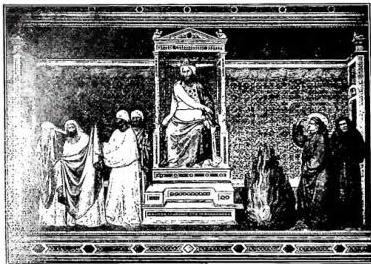
GIUDIZIO DI DIO - The sultan invites the Ottoman sages to the trial by fire. They refuse, while s. Francesco passes unharmed through the flames. Fresco by Giotto (after 1317) - Florence, church of S. Croce, Bardi Chapel.
Dilecte fili, inserted in the Decretals of Gregory IX (V, 35, 3). Nevertheless, Innocent VIII still had to take action to have the trial by red-hot iron abolished in the kingdom of Maximilian.
As for the duel, the bulls of Julius II (1509) and Leo X (1519) concern the chivalric duel and not the judicial one (v. DUELLO).
With regard in particular to the attitude of Christian writers toward ordeals, the invocation of the bishop of Lyon, Agobard (d. in 840), in the letter he addressed to the emperor Louis the Pious to request the prohibition of those judicial forms, deserves particular attention. The letter, without a title in the manuscripts, was entitled by Baluze (Agobardi episcopi Lugdunensis, Opera, I, Paris 1666, pp. 107–21) Liber adversus legem Gundobadi et impia certamina quae per eam geruntur. Subsequently, Christian writers aligned themselves even more strongly in support of the prohibition of the g. di Dio.