
DIVINE JUDGMENT. – It is the supernatural manifestation of divine justice, whereby, at the accounting of each person’s life, there will correspond the infallibly exact assignment of reward and punishment.
This manifestation is twofold: one at the end of each person’s life (particular judgment), the other, at the end of time, for humanity as a whole (universal judgment).
I. PARTICULAR DIVINE JUDGMENT
The doctrine defined by the Church indissolubly unites particular divine judgment, which follows each person’s death, with the immediate retribution of souls.1. Errors
According to the ancient Jewish conception, all the dead, Jews and pagans, good and evil, descend into Ie'di and lead there a diminished, “shadowy” existence, immersed in silence, darkness, and complete inactivity, as though overcome by profound slumber (cf. Iob. 10, 20-22; Eccle. 9, 10). This conception strongly influenced certain Christian writers from the very beginning. According to s. Giustino (Dial. cum Tryph., 5: PG 6, 487), souls would be kept in different places, according to their respective merits, iudicii tempus expectantes. S. Ireneo (Adv. Haer., 5, 31: PG 7, 1208) held that they abibunt in invisibile locum, where they would await the resurrection of the bodies. Tertulliano (De anima, 55 and 58: PL 2, 742, 750) was convinced that all souls remained penes inferos until the universal judgment; yet the damned would experience supplicia in advance, and the saved refrigeria; he held, however, that the martyrs were immediately granted the vision of God as a privilege (De resurr. cornis, 43: ibid., 856). According to Lattanzio (Institutiones, 7, 21: ibid., 6, 800), all souls would be gathered in a communique custodia awaiting the final judgment. Vigilanzio, vigorously opposed by s. Girolamo (Contra Vigil., 6 and 17: PL 43, 344, 352), held that they would remain drowsing (πεννογία: semi-wakefulness) or asleep (δηνος: sleep) until the second coming of JesusCristo. In substance, these writers admitted the postponement of particular divine judgment until the end of the world.
In the West, there was a brief and partial revival of this archaic theory in the controversy De visione beatifica, which arose between Franciscans and Dominicans under the pontificate of Giovanni XXII (d. 1334). It seems that the same Pontiff, as a private theologian, for some time embraced the opinion of those minorite theologians who, while granting to fully purified souls entry into Paradise and the vision of Christ’s humanity, held that the intuitive vision of the Divinity would be granted to them only after the resurrection of the flesh.
In the sixteenth century, the Protestants revived the old error: Lutero asserted omnes dormire insensibiles, exceptis paucis, usque ad diem iudicii (Ep. ad Amsdorf, 13 Jan. 1522, E. L. Enders, III, Erlangen 1925, pp. 269-70); Calvino, on the other hand, after opposing the theory of the sleep of souls, which was dear to the Anabaptists (De psychopannychia, Strasburgo 1542), maintained omnia teneri suspensa donec Christus appareat Redemptor (Institutio relig. Christ., III, 25). In the eighteenth century, the Anglican Tomaso Burnet gave a scientific form to the doctrine of the intermediate state of souls awaiting the final judgment, but he was effectively opposed by Muratori (De paradiso regnique caelestis gloria, Verona 1738). Today, hostility toward particular divine judgment is widespread among liberal Protestants. Also opposed to particular divine judgment are the tuetopsychites, who, like Taziano (Adv. Graecos, 13: PG 6, 833) and certain Arabs (cf. Eusebio, Hist. eccl., 6, 37: PG 20, 598), teach that the soul is annihilated at the moment of death, to be resurrected later, together with the body, before the universal judgment. Priestley (d. 1804) and the Adventists hold the same view. The Gnostics, Manichaeans, and Theosophists, metempsychosis (v.), necessarily reject particular divine judgment.
2. Catholic doctrine
From the thirteenth century onward, because of the many contacts they had with the East, the popes were led to clarify this point and repeatedly reaffirmed the same doctrine: that righteous and fully purified souls are immediately (mox) received into heaven, while those stained by mortal sin are immediately (mox) cast into hell. Thus taught the Council of Lyons (1274) in the profession of faith of Michele Paleologo (Denz-U, 464); Benedetto XII in the dogmatic constitution Benedictus Deus (1336), by which he brought to an end the controversy that had arisen under Giovanni XXII (ibid., 530-31); the Council of Florence (1439) in the decree of union with the Greeks (ibid., 693); and Gregorio XIII and Benedetto XIV in the professions of faith prescribed for dissidents returning to the unity of the Church (ibid., 1084, 1468). This doctrine implicitly affirms that all souls, immediately after(from Wilpert, Puttare, luv. 23)
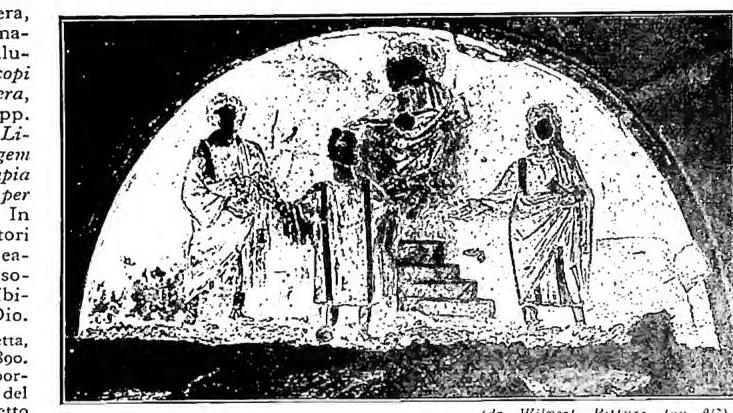
DIVINE JUDGMENT — Scene of the judgment: Christ the judge between two saintly protectors and the deceased. Fresco of the fourth century — Rome, cemetery of Bassilia.
[Non-Text]
•
[Non-Text]
death, undergo the particular divine judgment, by which the reward or punishment is assigned to them.
In the same way, in Sacred Scripture, while the immediate retribution of the good and the wicked is directly discussed, the particular divine judgment is indirectly affirmed. Immediate recompense is clearly indicated by Jesus both when he states that, at the moment of death, Lazarus is carried into Abraham’s bosom and that the rich man is buried in hell (Lk. 16:22), and when he replies to the good thief: «Hodie mecum eris in Paradiso» (ibid. 23:43). St. Paul teaches the same thing when he expresses the desire to die (pereginari a corpore) in order to dwell with the Lord (praesentes esse ad Dominum: ἐνδημῶς πρὸς τὸν Κύριον [II Cor. 5:8]), as well as when he affirms that Christ died for us, so that whether in life or in death simul cum illo visumus (I Thess. 5:9–10). The same idea underlies other texts: Mt. 26:24, II Cor. 5:10, Philip. 1:23, Hebr. 9:27, Apoc. 14:13.
The New Testament doctrine is reflected in the thought of the Apostolic Fathers: Ignatius (Rom. 4 and 7; Trall. 13), Clement of Rome (I Cor. 5:4; 5:7), Polycarp (Phil. 9), and receives particular clarification in St. Cyprian: «Let us accept death, which assigns to each person his dwelling and, tearing us away from the bonds of the world, restores us to Paradise and the Kingdom... There our loved ones await us, and a numerous host longs for us, now secure regarding its own salvation, but still anxious for ours (iam de sua incolumitate secura et adhuc de nostra salute sollicita)» (De mortuitate 26: PL. 4, 601). Origen himself, when reproducing the traditional thought, asserts that the soul at the moment of death (cum ex hoc mundo discesserit) will be treated according to its merits, attaining the joys of heaven or the eternal punishments of fire (De principiis, 1, praef. 5: PG 11, 118).
In the fourth and fifth centuries, the idea of judgment and retribution at the moment of death is widely attested by the great Doctors: St. Gregory Nazianzen (Gratio in landem Gorgoniae 23: PG 35, 815), St. Gregory of Nyssa (In funere s. Pulcheriae: ibid. 46, 870: tibi oculum ciassit, sed lumini aeterno aperuit... de regno ad regnum traducis est), St. John Chrysostom (In Mt. hom. 14, 4: ibid. 57, 222: cum hinc obierint; De beato Philogonio: ibid. 48, 749: hodie beatus ille ad tranquillam vitam translatus est... ad beatam sortem hodie transiit), St. Jerome (In Joel, 2: PL 25, 965: quod in die iudicii futurum est omnibus, hoc in singulis die mortis impletur). Some uncertainties are found in St. Hilary of Poitiers and St. Ambrose, but these are due to the influence of Jewish and Origenian eschatology. St. Augustine, who at times wavered, wrote in De anima et eius origine (2, 4, 8: ibid. 44, 499): recitissime et valde salubriter credit iudiciari animas, cum de corporibus exierint. Finally, the concise and clear formula of St. Gregory the Great (Dial. 4, 28: ibid. 77, 365) die exitus sui indicates the path that would be followed by the whole of scholasticism.
St. Thomas explains the appropriateness of the particular divine judgment: the attainment of the ultimate end of every being cannot be postponed (C. Gent. 4, 91); a person must be judged both as an individual (particular divine judgment) and as a member of human society (universal divine judgment), cf. Sum. Theol. 3, q. 59, a. 4, ad 1; Suppl. q. 69, a. 2; q. 88, a. 1, ad 1.
3. Nature of the particular divine judgment
The judge is Jesus Christ, not only as God but also as man (cf. Mt. 28:18; Io. 5:22; Act. 10:42). At the instant of judgment, the soul does not see the Divinity intuitively, for otherwise it would already be blessed, nor does it see the humanity of the Redeemer; rather, through an infused light, it apprehends that the God-Man is the supreme judge of the living and the dead.God knows the soul through an immediate intuition, and it, under the radiance of the divine light, has an adequate knowledge of itself, embracing all its actions down to the smallest details and evaluating them without the possibility of error. This inner reckoning, in the light of eternity, constitutes the sentence.
In the swift illumination of its entire being and its actions, the soul, in spontaneously formulating an infallible judgment upon itself, experiences and apprehends that it is being judged by God. This occurs in the same place and at the same moment in which it ceases to inform the body. At that very instant, the judgment receives its execution from divine omnipotence, to which the inner inclination of the judged soul spontaneously conforms, since, just as heavy bodies descend and light ones rise, so pondere suo the wicked will fall into torments, while the good will fly toward the place of delights (cf. Sum. Theol., suppl. q. 69, a. 2).
II. UNIVERSAL DIVINE JUDGMENT
1. The truth of universal divine judgment is formally contained in Sacred Scripture. In the Old Testament, after the first indications in Ps. 97 (8–9) and Eccles. (12, 4), the announcement of universal divine judgment is progressively clarified in the vivid descriptions of the prophets (Is. 13, 9; 66, 15; Joel 2, 1; Zeph. 1, 2; Dan. 7, 8) and of Wisdom (5, 1–13). The whole New Testament is dominated by this great perspective. Jesus often spoke of it in his preaching (Mt. 11, 22–23; 12, 41; 16, 27; 26, 64; Lk. 10, 12–14; 11, 31–32; Jn. 5, 29; 12, 48) and magnificently described its details in the eschatological discourse: «When the Son of Man shall come in his glory and all the Angels with him, he will sit upon the throne of his majesty; and all the nations will gather around him, and he will separate them one from another, as the shepherd separates the sheep from the goats; and he will place the sheep at his right hand and the goats at his left. Then the King will say to those who are at his right hand: come, blessed of my Father, take possession of the Kingdom prepared for you from the creation of the world... Then he will say also to those who are at his left: depart from me, accursed ones, into the eternal fire, which was prepared for the devil and his angels...» (Mt. 25, 31–46; cf. Mk. 13, 26–27; Lk. 21, 27). The Apostles echoed the teaching of the Master (Acts 10, 42; 17, 31; 24, 25; Rom. 2, 16; 14, 10; I Cor. 3, 4; 4, 5; II Cor. 5, 10; II Tim. 4, 15; II Thess. 2, 5; II Pet. 2, 9; Jude 15; Apoc. 20, 12).The whole Christian tradition lived under the powerful impression of this announcement and willingly described its details for parenetic purposes (cf. M. J. Rouet de Journel, Enchiridion Patristicum, 11th ed., Freiburg im Breisgau 1937, nos. 74, 364, 396, 579, 694, 724, 964, 1172, 1456, 1768, 1880, 2140). St. Augustine summarized the constant teaching of the Fathers in the well-known phrase: «No one doubts or denies that Jesus Christ, as Sacred Scripture announces, will pronounce the final judgment» (De Civitate Dei, 20, 30; PL 41, 708). The Church has defined this truth several times in the Apostles’, Nicene-Constantinopolitan, and Athanasian Creeds, at the Lateran Councils of 649 (Denz-U, 225) and 1251 (ibid., 429), at the Council of Florence (ibid., 693), and in the profession of faith issued after the Council of Trent (ibid., 994).
4. Circumstances of universal divine judgment
The judge will be the God-Man (Jn. 5, 22; Acts 10, 42; Rom. 14, 10; II Cor. 5, 10), who will appear from the heights of heaven, preceded by the Cross (Mt. 24, 30), surrounded by hosts of angels and saints (Mt. 24, 31; Mk. 8, 38; Lk. 9, 26; I Thess. 3, 13; II Thess. 1, 7), in a luminous halo of clouds and fire (Mt. 25, 30; 26, 64; Mk. 13, 26; 14, 62; Lk. 21, 27; Acts 7, 30; I Thess. 4, 17; II Thess. 1, 8), seated upon a throne of majesty (Mt. 19, 27; 25, 31; Apoc. 20, 11–12), assisted in the act of judging by the Apostles (Lk. 22, 2), by the martyrs, and by those who observed the evangelical counsels (Mt. 19, 27–28).All the angels (I Cor. 6, 3; II Pet. 2, 4; Jude 6) and all human beings (Mt. 25, 32; Rom. 14, 10; II Cor. 5, 10; Apoc. 1, 7) will be judged with regard to thoughts (I Cor. 4, 5), words (Mt. 12, 36), deeds (Rom. 2, 6), and omissions (Jas. 4, 17; Eccles. 12, 14).
The sentence will be delivered through a collective interior illumination, by which all intelligent beings will know their own actions and those of others in their individual value and, above all, in their social repercussions, in relation to the history of the world and to the economy of the whole (cf. Sum. Theol., suppl. q. 88, a. 2).
The time of universal divine judgment is known only to God (Mt. 24, 36; Mt. 13, 32; Acts 1. 7), although Scripture indicates certain signs that will precede it: the preaching and acceptance of the Gospel throughout the world (Mt. 24, 3 and 14; Mk. 16, 15–16; Lk. 21, 24; Rom. 9, 25), Antichrist (v.), the conversion of Israel (Hos. 3, 4–5; Rom. 11, 25–27; II Cor. 3, 14–17), the great apostasy (II Thess. 2, 3; Mt. 24, 11–12; Lk. 17, 26–30; 18, 8; I Tim. 4, 1; II Tim. 3, 1), and cosmic disturbances (in the heavens: Joel 2, 30; Mt. 24, 29, 30; Lk. 21, 25–26, and on earth: Mt. 24, 7–8; Lk. 21, 25–26).
The place will be chosen by God. The popular valley of Jehoshaphat is based on an illegitimate transposition of a symbolic name (Iosaphat: Deus iudicabit), to which Joel alludes (3, 2).
5. Reasons for universal divine judgment
Good and evil have social repercussions and extensions through time and space, whose ultimate effects can be assessed only when the course of time has come to a halt (cf. Sum. Theol., 3ᵃ, q. 59, a. 5). The resounding condemnation of sin in all its consequences will restore the extrinsic glory taken from God, while the triumph of Jesus Christ and of all the members of his Mystical Body will be the fitting reward for those who did good and fought evil in a world bristling with contradictions and lavish with mockery and martyrdom. Then all the consequences of good and evil acts will be placed in their proper light.The moral order lies hidden in the hearts; external facts are only its testimony. For this order to appear one day in all its beauty, the prophecy of Jesus must be fulfilled: «There is nothing hidden that will not be revealed, nothing secret that will not become known» (Lk. 12, 2). Reasons of wisdom preserve certain secrets throughout the course of time, but time, at the end, will have to pour out its treasure before the eyes of the universal assembly. All masks will fall, and successful hypocrisies will bear the mark of indelible infamy.
Schiller asserted that the last judgment consists in universal history. The experience of the centuries has replied that the judgment of history, written by human beings, is neither clear nor impartial. The judgment of the Son of Man
will not only be just, but will appear in its connection with all preceding judgments, as the supreme act that seals all God’s work from beginning to end. That judgment will consider events not only along the horizontal line of time, flowing between today and tomorrow, but along the vertical line that connects them to the single instant of eternity. God will be vindicated in every act of his, and the ways he followed in guiding individuals and peoples will appear irreproachable. They will shine forth as the ways of
wisdom and love, after the mysteries and enigmas of the world have been resolved. If history could in a certain sense be defined as the judgment of the world, in a truer sense universal divine judgment will be history unveiled and revealed. In the dazzling light that will strike the gaze of all those gathered by the sound of the angelic trumpet, each person will see that the destinies of human history are bound to the person of the God-Man, who is the innermost reason and supreme crown of the indefinite course of human affairs.
BIBLI: I. Rivière, Jugement, in DThC, VII, coll. 1721-1828 (illustra con solida erudizione il progresso della Rivelazione e del dogma; scelta bibliografia); I. Katschhaler, Eschatologia, Ratisbona 1888, pp. 39-61, 524-63; I. Niederhuber, Die Eschatologie des heiligen Ambrosius, Paderborn 1907, pp. 115-120; D. Palmieri, De novissimis, Prato 1908, pp. 35-51, 88-141; A. Rademacher, Der Weltuntergang, Monaco 1909; M. Jugie, La doctrine des fins dernières dans l'Eglise gréco-russe, in Echos d'Orient, 17 (1914), pp. 5-22, 209-28, 402-21; S. Scaglia, I novissimi nei monumenti primitivi della Chiesa, Roma 1923, pp. 83-99; I. Rivière, Rôle du démon au jugement particulier chez les Pères, in Revue de sciences religieuses, 4 (1924), pp. 43-64; G. Ricciotti, S. Efrem Siro, Torino 1925, pp. 176-89; A. Vonier, Death and Judgement, Buckfast 1930; I. Tixeront, Histoire des dogmes, II, 9ᵃ ed., Parigi 1931, pp. 343-50, 429-35; M. Jugie, Theologia dogmatica christianorum orientalium, IV, ivi 1931, pp. 36-178; A. Janssens, La signification sotériologique de la parousie et du jugement dernier, in Divus Thomas Plac., 3 (1933), pp. 25-38; L. Labauche, Leçons de théologie dogmatique, II, 17ᵉ ed., Parigi 1934, pp. 349-434 (felice sintesi storica); G. Perrella, La dottrina dell'oltretomba nel Vecchio Testamento, in Divus Thomas Plac., 38 (1935), pp. 196-204; id., La valle di Giosafat e il giudizio universale, ibid., 40 (1937), pp. 45-50; M. Gordillo, Compendium theologiae orientalis, Roma 1937, pp. 188-95; B. Lavaud, Le jugement dernier, in La vie spirituelle, 57 (1938), pp. 113-39; L. Billot, De novissimis, 7ᵉ ed., Roma 1938, pp. 40-47, 170-76; H. Rondet, Le problème de la vie future, in Problèmes pour la réflexion chrétienne, Parigi 1945, pp. 65-98; I. Rivière, Rôle du démon au jugement particulier, in Bulletin de la littérature ecclésiastique, 48 (1947), pp. 98-126; R. Garrigou-Lagrange, L'altra vita e le profondità dell'anima, Brescia 1947, pp. 58-67; L. Lercher-F. Dander, Institutiones theologiae dogmaticae, IV, II, 3ᵃ ed., Innsbruck 1949, pp. 428-30, 529-33;
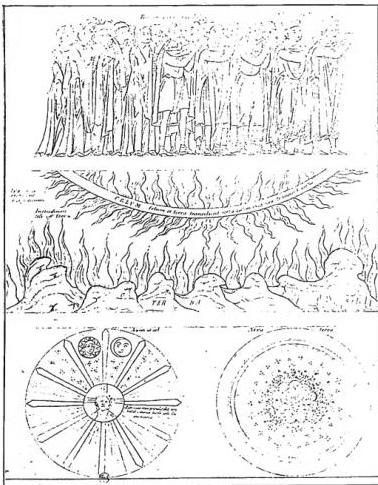
[caption": "(da Herrada di Landsberg, Hortus deliciarum, Strasburgo 1901, tsn. 67)"}]
GIUDIZIO DIVINO - G. d. universale: 1. Processione degli eletti: 2. Conflagrazione generale del mondo attuale: 3. Cristo al centro del nuovo firmamento, e terra nuova. Particolare delle miniature dell'Hortus deliciarum (ca. 1230).
Rôle du démon au jugement particulier chez les Pères, in Revue de sciences religieuses, 4 (1924), pp. 43-64; G. Ricciotti, S. Efrem Siro, Torino 1925, pp. 176-89; A. Vonier, Death and Judgement, Buckfast 1930; I. Tixeront, Histoire des dogmes, II, 9ᵃ ed., Parigi 1931, pp. 343-50, 429-35; M. Jugie, Theologia dogmatica christianorum orientalium, IV, ivi 1931, pp. 36-178; A. Janssens, La signification sotériologique de la parousie et du jugement dernier, in Divus Thomas Plac., 3 (1933), pp. 25-38; L. Labauche, Leçons de théologie dogmatique, II, 17ᵉ ed., Parigi 1934, pp. 349-434 (felice sintesi storica); G. Perrella, La dottrina dell'oltretomba nel Vecchio Testamento, in Divus Thomas Plac., 38 (1935), pp. 196-204; id., La valle di Giosafat e il giudizio universale, ibid., 40 (1937), pp. 45-50; M. Gordillo, Compendium theologiae orientalis, Roma 1937, pp. 188-95; B. Lavaud, Le jugement dernier, in La vie spirituelle, 57 (1938), pp. 113-39; L. Billot, De novissimis, 7ᵉ ed., Roma 1938, pp. 40-47, 170-76; H. Rondet, Le problème de la vie future, in Problèmes pour la réflexion chrétienne, Parigi 1945, pp. 65-98; I. Rivière, Rôle du démon au jugement particulier, in Bulletin de la littérature ecclésiastique, 48 (1947), pp. 98-126; R. Garrigou-Lagrange, L'altra vita e le profondità dell'anima, Brescia 1947, pp. 58-67; L. Lercher-F. Dander, Institutiones theologiae dogmaticae*, IV, II, 3ᵃ ed., Innsbruck 1949, pp. 428-30, 529-33;
A. Feuillet, Le triomphe eschatologique de Jésus d'après quelques textes isolés des Evangiles, in Nouvelle revue théologique, 81 (1949), pp. 701-22; P. Heinisch, Teologia del Vecchio Testamento, trad. II. di D. Pintonello, Roma 1950, pp. 329-44; A. Piolanti, De novissimis, 3ª ed., Roma 1950, pp. 18-33; 149-69. Antonio Piolanti
ICONOGRAPHY. — 1. Archaeology. — Christ is the judge of the dead, as the Apostle Peter declares in his teaching to the centurion Cornelius before baptizing him (Act. 10:25 ff.).
An inscription from Gaul dating from the 4th century expressly states: “Here rests in peace Dalmata, redeemed from death by Christ, and while the saints intercede for him, he joyfully awaits the day of the future judgment” (CIL, 12, 1694). Paulinus of Nola composed the epitaph for the child Ciengio, likewise expressing the same idea (ibid., 10, 1370). At Vercelli, in the inscription of the presbyter Sarmata, it is said that he will be presented to Christ by the martyrs Nazarius and Victor (ibid., 5, 6739). In later inscriptions one finds the supplicatory formula “per tremendum diem iudicii” directed against violators of tombs.
On the vault of a cubiculum in the cemetery of Domitilla, the Lord is seated in a chair, making a gesture of speech with his right hand while holding the scroll in his left. At his feet, two young men lie prostrate in supplication, assisted by two standing saints (A. Bosio, Roma sotterranea, Rome 1632, p. 231). On the ceiling of a cubiculum in the hypogeum known as that of the Nunziatella, there is likewise a scene of the Lord seated in a chair: around him are four praying deceased persons, each between two sheep, alternating with four saints who hold the scroll of the law. On the vault of a cubiculum in the Cemetery Major on the Via Nomentana, Christ the judge is also represented seated in a chair between two chests containing scrolls of the law and four praying deceased persons, two male and two female. In the cemetery of Vigna Cassia in Syracuse, a fresco, now lost, represented the Lord with a halo and the monogram g, inviting with his right hand the deceased Marcia, who was prostrate in supplication on the left; she had died at the age of 25 years, 7 months, and 25 days, as indicated by the epitaph in Greek. At Christ’s sides were the Apostles Peter on one side and Paul on the other, each holding the scroll of the law. On the arch was the inscription, also in Greek: “Remember your servant Marcia” (G. B. De Rossi, Arcosolio dipinto di singolare importanza, in Bull. arch. crist., 3rd series, 2 [1877], pp. 149–159 and pl. 11). In the cemetery of Bassilla, the Lord with a halo is seated in a chair on the tribunal; in his left hand he holds the scroll, while with his right he touches the head of a praying man standing before the tribunal, assisted by two saints as advocati. On the right side of a relief from the cemetery known as that of Saints Mark and Marcellinus, the Lord is seated in a chair above a high tribunal, distinguished by the monogram g engraved on his head and by the words ΔΕΣΠΟΤΗΣ ΗΜΩΝ “our Lord.” He places his right hand on the head of the deceased ΘΕΟΔΟΤΛΟΣ, humbly portrayed lower down between two sheep symbolizing the flock of the elect. Beside him is the Greek inscription of Aurelius Theodulus and Cecilia Maria; on the left side Moses was represented with the volume of the law, as is learned from the words ΜΟΤΗΣΗΣ ΠΡΟΦΗΤΗΣ (Wilpert, Pitture, pp. 382, 434, fig. 41; id., Sarcofagi, pl. 205, 2). For the deceased Aurelius Theodulus, the wish ΕΙΣ ΑΓΑΠΗΝ is expressed, namely, that he may be welcomed to the heavenly banquet, according to the Lord’s promise to the Apostles (Lc. 22:28 ff.). Other Christian inscriptions likewise end with the same wish: “Iuste nomen tuum in Agape, Licinius Iustinae coniugi merenti in Ag(e)p(e)” (G. B. De Rossi, in Bull. arch. crist., 4th series, 1 [1882], p. 113). Likewise, in the syncretistic hypogeum on the Via Appia, after her judgment the deceased Vibia is led (inductio Vibiae) by the angelus bonus into the heavenly garden to join the banquet with the other bonorum iudicio iudicati (Wilpert, Pitture, pl. 132, 1).
A beardless Christ in tunic and pallium carries out the separation of the sheep (the elect) from the goats (the guilty), according to Mt. 25:33 f., on a sarcophagus lid published by Wilpert (Sarcofagi, pl. 83, 1). This subject is repeated in the mosaics of S. Martino in caelo aureo (S. Apollinare Nuovo) in Ravenna (R. Garrucci, Storia dell'arte cristiana, IV, Prato 1880, pl. 248, 4), and St. Paulinus of Nola had it painted in the basilica of S. Felice (PL 61, 339). Enrico Josi
2. Art. — Later, the theme is frequently taken up in both Eastern and Western miniatures, especially in those attributable to Carolingian art, particularly to the school of Reichenau. Thus in the Psalter of Karlsruhe (CLXI), and likewise in the Gospel Book of Munich (LVII), where the universal divine judgment is represented in two superimposed scenes devoted respectively to the universal divine judgment and the resurrection of the flesh. Beside Christ the judge enthroned are the angels and the Apostles. Below, in addition to angels and groups of the elect and the damned, Satan appears accompanied by devils who chain the sinners. More complex is the Apocalypse of Bamberg (Cod. A. II, 42), also dating from around the year 1000, which likewise contains a vivid description of the resurrection of the bodies.
The oldest fresco with the universal divine judgment, that in the apse of S. Giorgio at Oberzell, also belongs to the school of Reichenau. In addition to the elements that had appeared up to that time, it shows the interceding Madonna and those rising from the earth at the various stages of their rebirth. The universal divine judgment of S. Angelo in Formis, near Capua, is iconographically connected with these Rhenish representations. The fresco, which extends across the wall of the entrance façade (ca. 1075), consists of five horizontal bands dominated by a gigantic image of Christ.
The iconographic scheme thus established spread, with additions or simplifications, through the sculptural decoration of Romanesque and Gothic cathedrals, leaving, in France alone, more than forty monumental complexes between the 12th and 15th centuries. In the oldest representations, located on the side portals of the façade or the naves, at Moissac, Arles, Beaulieu, Conques, and so forth, the central part of the lunette is occupied by the immense figure of Christ. But at Autun, around the middle of the 12th century, Gilebertus, reducing its size, was able to depict, besides the Majesty and the divine judgment, the resurrection and the weighing of souls, portraying the damned almost individually—the miser, the lustful man, and so forth. With the advent of the Gothic style (Laon, Chartres, 1212–20), the narrative also occupies the archivolts, while the Apostles, accompanied by the wise and foolish virgins and by the sibyls, are arranged vertically along the architectural moldings. Finally, at Notre-Dame in Paris, in the first quarter of the 13th century, the representation of the universal divine judgment occupies the place of honor in the entire decoration of the building, asserting itself in the great façade portal.
The lunette of the baptistery of Parma, dated 1196 and the work of Antelami, is likewise close to French sculpture. The Apostles are aligned in the archivolt, while the elect and the reprobate, still rising, occupy the architrave. In the central semicircle is Christ with his arms raised.
Italy still possesses a very important pictorial series of universal divine judgments extending from the 13th to the 15th century. The famous mosaic of Torcello, despite its evident Byzantine influences, should be regarded as a Western work, and it exerted a strong influence on analogous representations in Greece and the East. The scene, divided into six horizontal zones, may be considered the most extensive composition of the theme. Almost similar is the universal divine judgment in the baptistery of Florence, which occupies a quarter of the vault.
At Rome, between 1293 and 1295, Cavallini (v.) frescoed on the counter-facade wall of the basilica of S. Cecilia a great universal Last Judgment, preserved only fragmentarily, at whose center is Christ, between two rows of Apostles solemnly arranged on thrones. The blessed are divided into three companies, and the damned are hurled into hell. The representation of the individual punishments of hell occupies a large part of Giotto’s fresco at Padua (1303–1305), while already in the reliefs of the pulpits of Giovanni and Nicola Pisano, and later in the frescoes of the Strozzi Chapel at S. Maria Novella in Florence (the work of Nardo di Cione, second half of the fourteenth century), the divisions between saints, Apostles, and angels are no longer equally rigid, and representations of hell and paradise begin to accompany the universal Last Judgment, under the influence of Dante’s cosmography.
The final developments in the iconography of the universal Last Judgment are due to Signorelli, in the cathedral of Orvieto, supplemented by depictions of the Antichrist, the rain of fire, and the end of the world, attaining an extreme dramatic intensity; and to Michelangelo, who in the Sistine Chapel (1508–1512) animates the ancient arrangement with a new, overwhelming rhythm, culminating in the vision of Christ appearing in a supreme gesture of dominion that is also one of blessing. - Vedi tavv.
LII-LIII.