EFREM, saint. — Father of the Church, the most celebrated Syriac writer and one of the most distinguished Doctors, both for the abundance of his writings, predominantly poetic, and for the excellence of his doctrine. Benedict XV declared him a Doctor of the Church with the encyclical Principi Apostolorum of 5 October 1920 (AAS, 12 [1920], pp. 457–471).
E.’s fame was so great that his verses were translated into Greek immediately after his death and read after Holy Scripture (St Jerome, De viris illustribus, II, 5). Sozomen (Hist. eccl., III, 16) holds that E. surpassed even the Greek Fathers in elegance of style and profundity of thought. All Syrians—Catholics, Monophysites, and Nestorians—venerate E., who is called the “harp of the Holy Spirit.” In the history of Byzantine literature, E. had an interesting aftereffect: when his verses, composed according to the Syriac meter based simply on the number of syllables, were translated into Greek, the meter founded on the number of syllables was imitated in Greek for the first time as well—a meter that would later become classical in Byzantine hymnography.
I. LIFE
The first biographical source, apart from the scattered information in E.’s works, is his Testament, of which two recensions are preserved, one Syriac (ed. R. Duval, in Journ. Asiat., 18 [1901], pp. 234–419) and one Greek (ed. J. S. Assemani, S. P. Ephraemi opera, II, Rome 1743, pp. 230–47), neither free from some legendary elements. There is also a very ancient “Syriac biography” attributed to E.’s disciple Simon of Samosata, of which three recensions remain (ed. J. S. Assemani, Bibl. Orient., I, Rome 1719, pp. 26–55; Th. Lamy, S. Ephr. Syrii hymni et sermones, II, Malines 1882, pp. 3–89; IV, p. 1 ff.), likewise possessing a historical basis not devoid of some less certain information. This source underlies, if not Sozomen (Hist. eccl., III, 14, 16), at least the “Encomium” falsely attributed to St. Gregory of Nyssa, from which in turn the anonymous Greek bios (ed. J. S. Assemani, S. P. Ephraemi opera, I, Rome 1732) and Metaphrastes (ibid.) drew.E. was born at Nisibis during the reign of Constantine, probably around 306. According to some sources, his parents were Christians; others, however, make his father a priest of the idols. E. was not baptized as a child, but when he was eighteen or twenty-eight years old. It is known that he was a deacon; his priesthood, however, is uncertain. It is probable that E. was ordained by his friend St. James, bishop of Nisibis. The report that E. accompanied this bishop to the Council of Nicaea is false. He gave extraordinary proofs of fortitude during the threefold siege to which Nisibis was subjected by the Persians. When Jovian was forced to surrender the city to the Persians in 363, E., together with many other Christians, moved to Edessa, where he founded the celebrated school (v. IDESSA) known as the School of the Persians. E.’s journey to Egypt is fictitious (H. J. Polonsky, Ephraemi's Reise nach Aegypten, in Orientalia, 2 [1933], pp. 269–75). His journey to Caesarea in Cappadocia to visit St. Basil is also highly doubtful. E. cultivated religious perfection and probably led, at least during certain periods, a monastic life. He died at Edessa in 372, probably on 9 June. His feast is celebrated on 18 June.
II. WRITINGS
The works of St. E. are thus far a mare magnum. Sozomen attributes to him “an infinity of verses”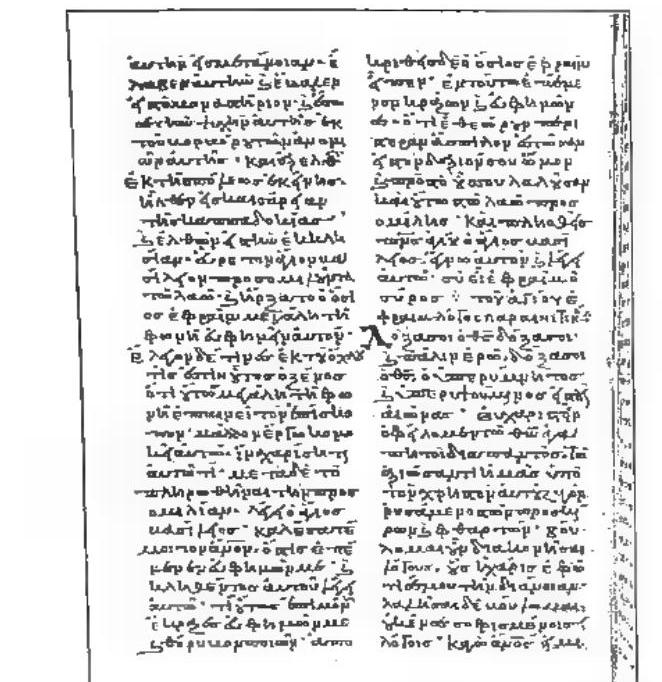
There are various editions of E.: 1. Comprehensive: J. S. Assemani, S. Patris N. Ephraemi Syri opera omnia quae graece, latine et syriace nunc primum e Vaticana Bibliotheca prudent, 6 vols., Rome 1738–43 (= AS), of which three contain Syriac writings and the others Greek and Latin ones. It is not a very critical edition: neither everything it contains is authentic, nor does it contain everything that is authentic. The Latin version from the Syriac is made with excessive freedom: Th. Lamy, S. Ephraemi Syri hymni et sermones, 4 vols., Mechlin 1882–1902 (= LA). Although much more perfect than the preceding edition, which it intends to complete but not replace, this edition too offers some doubtful passages.
2. Specialized: J. J. Overbeck, S. Ephraem Syri, Rabulae, Balai aliorumque opp. selecta, Oxford 1865 (= OV); C. W. Mitchell, S. Ephr. 1 Prae Refutations of Mani, Marcion and Bardakan, 2 vols., London 1921 (= MI); G. Bickell, Carmina Nisibena, Leipzig 1886 (= BI); I. E. Rahmani, Studia Syriaca, 4 vols., Scharfe 1904–1909 (hymn on the Nativity of Christ), Beirut 1927; (hymns on virginity), ibid. 1906. For the Armenian versions published by the Mechitarists of Venice, cf. J. B. Auches-G. Moessinger, Evangelii concordanti expostiis facta a 1. Ephraemo... in latinum translati, Venice 1876 (= AU); PP. Mechitariati, S. Ephr. commentarii in opp. divi Pauli... ex armeno in latinum translati, ibid. 1893 (= MK). The commentary on the Acts of the Apostles was translated from Armenian into English and Latin by F. C. Conybeare, The Comm. of Ephr. on Acts, in the book by F. Jackson-K. Lake, The Beginnings of Christianity, London 1926, I, III, pp. 373, 453. For some Greek versions V. S. J. Mercati, S. Ephr. Syri opp., I, Rome 1915 (the only one published).
E. wrote exegetical works following the Antiochene method. Thus the commentaries on Gen., Ex. (= AS IV), and the Diatessaron (v.), the latter being extremely important for establishing its text through the Armenian version (AU). The prose and verse works against the Gnostics (MI), 56 hymns against heresies (AS V), 4 hymns against Julian the Apostate (OV), 3 poems on faith (AS VI), and above all the 80 hymns “on faith against the scrutators” (AS VI), perhaps E.’s masterpiece as a theologian, are instead of a dogmatic and polemical nature. There are also many other writings, generally in verse, concerning liturgical, ascetical, biographical, and various themes. Thus, to mention only the principal ones, the Nisibene hymns (BI), those on Christmas (LA II), on fasting (LA II), on the unleavened bread (LA I), on the Crucifixion (LA I), on Easter (LA II), 15 hymns on St. Abraham Qidunaya (LA III), and 24 on St. Julian Saba (LA III), 51 hymns on virginity and the mysteries of Christ (LA II, IV), 52 hymns on the Church (AS V, VI, LA II, IV), songs on Nicomedia (I. Rahmani, Studia Syriaca, II, p. 21), and on the siege of Nisibis (ibid., p. 114). The liturgical books still attribute to E.—and in these cases criticism cannot decide with certainty—beautiful hymns on Baptism (LA I) and on the Madonna (LA II), as well as 15 hymns to the martyrs (LA III), 5 hymns to the Forty Martyrs of Sebastè (AS VI), and funeral hymns, or necretum (AS VI).
III. DOCTRINE
In his writings E. teaches a consistently orthodox doctrine, even on theological questions such as that of the union of the natures in Christ, which had not yet been elucidated by controversies. Especially worthy of note is E.’s Mariology, which earned him the title of doctor Marinum. Although he does not use a title equivalent to Theotokos, he does employ expressions alluding to the divine motherhood of Mary. Besides defending her virginity before and in childbirth, he maintains, with a clarity unique up to that time, her virginity after childbirth. To this end, he rejects one by one the principal objections to this truth drawn from the New Testament. E. was the first Father explicitly to affirm Mary’s complete immunity from every sin, using expressions that also exclude original sin:«You (O Christ!) and your Mother alone are beautiful in every respect, for there is no impurity in You, O Lord, and no stain in your Mother» (BI, p. 123). Recent attempts to diminish the force of this text on the grounds that E. did not possess very exact ideas concerning original sin must be regarded as inconclusive, since, as this is a negative proposition, it is enough for the author to exclude every stain, even if one grants that he did not have a perfect understanding of the nature of these stains. Mary is also «the cause of good» (LA II, 526), «the cause of life» (ibid.); through her the writing of our debts to the serpent was erased (loc. cit., p. 550).
E. treated Christology extensively and profoundly. The Word is one with the Father (although E. does not use a term parallel to Quodacus); He is truly His Son, since the statements of Scripture must be understood simply and not by following the cavillations of the «investigators». The Word assumed a true humanity while remaining a divine person. In Christ, divinity and humanity are intimately united. E. sometimes speaks of «mixture», which, however, according to the context, does not signify a true fusion and alteration. E. also approaches, albeit with some obscurity, the question of the two wills in Christ.
Here are some other points of E.’s theology. There is one God, invisible and omnipresent, three in Persons. The Holy Spirit is a divine person and proceeds from the Father. The texts cited to prove that E. declares the procession of the Spirit from the Son are either inauthentic or unclear. In the human person E., like his contemporary Syrians, distinguishes the body, the soul, and the spirit. Adam’s sin has passed to all human beings; his leaven corrupted the whole mass. There are texts by E. that seem to presuppose the soul’s falling asleep (not that of the spirit) near the dead body, that is, hypnopsychia. Other passages, however, speak of the destiny already attained by souls. Near paradise E. also recognizes a region in which certain souls «undergo the punishments assigned for their faults». The Church is one, the Body of Christ, infallible, holy, and perpetual. The primacy of s. Peter is clearly expressed, whereas nothing is said about Rome. There are also notable testimonies concerning Baptism, the subsequent Anointing, the Eucharist, and Orders. Some text speaks of Penance, but it is not known whether sacramental Penance is meant. The legitimacy of Marriage is also alluded to. — Vedi tav. VIII.