
ORIGINAL SIN. – The privation of sanctifying grace, or the lack of God’s friendship, in every human being at birth, caused by Adam through his sin for himself and all his descendants, together with the loss of other supernatural and preternatural gifts, especially immortality and exemption from concupiscence. This sin is distinguished into originating and originated, according to whether it is considered in Adam, who committed it, or in his posterity, who inherit it from him, contracting it as their own.
I. HOLY SCRIPTURE
Gen. 2:4b-3:24 recounts the particular creation of Adam and Eve, and how God did not merely make them the most perfect beings in the universe, but wished to bestow upon them special benefits and gifts, entirely superior and undeserved by their nature: He placed them in a most beautiful garden (v. PARADISO), so that they might live there, in filial familiarity with Him (ibid. 3:8), a happy, immortal life (ibid. 2:17; 3:19), without any suffering or fear. Innocence, the fruit of friendship with God, was the result of the perfect order that reigned in man, free from concupiscence. "And they were both naked, yet they felt no shame" (ibid. 2:25; cf. 3:7, 10 ff.). Shame, a reaction and defense against concupiscence, would arise with sin.God commanded them an act of obedience and reverence. Having given man freedom so that he might cooperate in his own salvation and merit it, He forbade man, under penalty of losing immortality, to eat of the tree (v.) of the knowledge of good and evil (ibid. 2:17), so called from the effects produced by disobedience; and this "so that man might understand and recognize that he is not an absolute possessor and master, but dependent on God even in the use of the benefits granted to him. Therefore, even if the matter of the prohibition was of little consequence, for the purpose intended by God, the precept was most grave; as indeed appears from the connected penalty" (A. Bea).
Some Catholic exegetes, abandoning the literal sense, hold that the tree with its fruit is merely a didactic, popular representation of the true divine precept violated by the progenitors. In this case, it would be impossible to specify what the divine prohibition consisted of, since none of the attempted explanations provides evidence capable of elevating it beyond the level of mere possibility. The explanation that it was a sexual sin, which has resurfaced here and there over the centuries (from Clement of Alexandria onward), and even recently, in various forms (Filocristiano, Quale fu il p. di Adamo e di Eva, Carrara 1920: cf. A. Fernandez, in Biblica, 2 [1921], p. 481 ff.; J. Coppens: cf. F. Asensio, in Gregorianum, 31 [1950] passim; and id., El primer pecado en el relato del Génesis, in Estudios Bíblicos, 9 [1950], pp. 174-91), even in the only form compatible with the context—that is, the prohibition of initiating the use of marriage before a divine command (or before a given term set by God: P. Mayrhofer, Der Fall des Menschen, in Theol. und Glaube, 28 [1936], pp. 133-62; cf. J. Miklik, in Biblica, 20 [1939], pp. 387-96)—remains a pure possibility. The popular narrative, in its simplicity, is psychologically subtle and profound. Given the gift of integrity and internal equilibrium, temptation could only come from outside; it could not be a carnal fault, since concupiscence was absent before the rebellion; it could only be disobedience. The rebellion of the lower part, with the movements of the concupiscible appetite, is the punishment for the rebellion against God.
The devil (in the guise of the serpent) pushes man toward disobedience, exploiting curiosity and that sense of reaction that every prohibition arouses in the will (cf. Rom. 7:7-13). Adam and Eve were endowed with perfect intelligence and a science bestowed upon them by God. Theoretically, they knew it was wrong to disobey and that they would be punished for it; they lacked the experimental knowledge of evil, which they acquired by committing sin. "Immediately their eyes were opened, and they realized they were naked" (Gen. 3:7); they feel movements and appetites in their members contrary to reason and seek to hide them. Accustomed to conversing familiarly with God, to entrusting themselves to Him as to a Father, now they tremble and seek to hide.
ORIGINAL SIN - The fall of the Protoparents, the miracle of Cana, the healing of the blind man, the resurrection of the son of the widow of Naim, Peter's denial, the healing of the paralytic, Abraham's sacrifice, Peter's capture, the miracle of the spring. 4th-century sarcophagus - Rome, Lateran Museum.
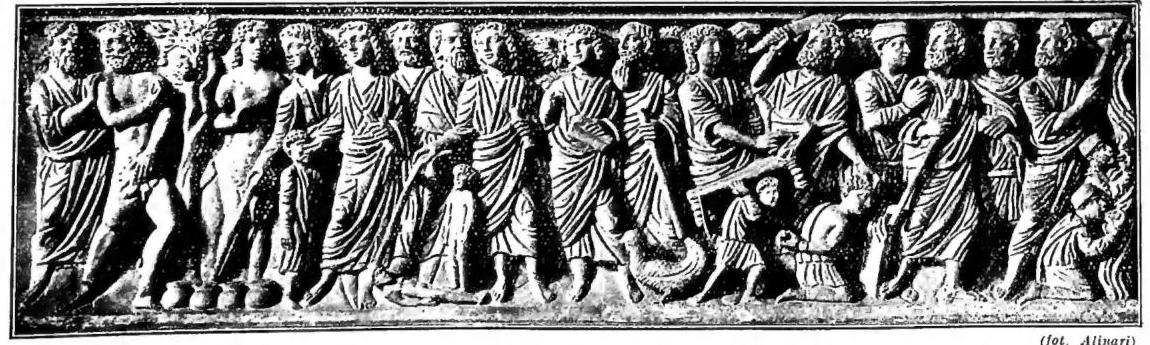
For death, the most expressive consequence of original sin, the Old Testament is explicit: «From the woman sin had its beginning, and because of her we all die» (Eccl. 25, 23); «God created man for immortality...; but by the devil's envy death entered the world, and those who belong to his party experience II. But the souls of the just are in the hand of God...» (Wis. 2, 23 ff.). «The first cause of death was Adam's sin, brought about by the devil's temptation (Gen. 3). Victims of death, however, are properly only the wicked, the devil's partisans; for the good pass to»
ORIGINAL SIN - Adam and Eve Driven from Paradise. Flemish tapestry of the 16th century - Florence. National Museum.
a blessed immortality" (A. Vaccari). The penalty pronounced by God ("you shall surely die"), beyond the loss of immortality, the actual separation of the soul from the body, and the dissolution of the latter ("you are dust, and to dust you shall return"), primarily sanctioned, with the descent of the soul into Sheol, the separation from God; this will cease for the just upon the descent of the Redeemer to the underworld, while it will be eternal for sinners. The Old Testament thus affirms the general idea of a change acquired by humanity in its relationship with God; man is no longer in a relationship of friendship with God; expulsion from Paradise affects the entire human race. It speaks of hereditary penalties: death, sufferings, concupiscence. Verse 7 of the Miserere (Ps. 51) and other passages (ibid. 54, 4; Job 13, 25-26; 14, 4) presuppose this state of native corruption, of congenital moral misery; a state of sin, which implies a certain moral solidarity. But the doctrine of hereditary original sin is not explicitly expressed in the Old Testament; in Jewish literature, it is entirely ignored.
It is taught by St. Paul (Rom. 5, 12-21), who bases himself on the sacred text (Genesis, Ecclesiasticus, Wisdom) and reveals its exact meaning. His intent is to demonstrate the universality and efficacy of Christ's salvific work, the sole source of life. He does so by establishing a parallel between the work of sinful Adam, who stands at the head and beginning of fallen humanity, and the work of Christ, the antitype, who stands at the head and beginning of redeemed humanity. Two relationships of universal and effective solidarity are contrasted; the first and second Adam are the progenitors of all men: the first founds the kingdom of sin and death, the second that of Grace and life. "Therefore, just as sin entered the world through one man, and death through sin, and in this way death came to all men, because all sinned." The apodosis is missing, well supplied by Origen: "so through one man righteousness entered the world and through righteousness life." Indeed, until the Law, sin was in the world, but sin is not imputed when there is no law (Rom. 5, 13); and yet death reigned from Adam to Moses, even over
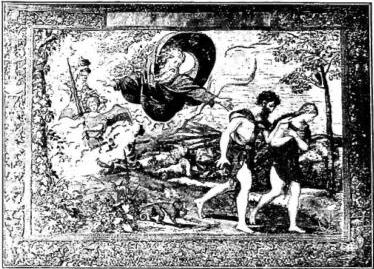
all its physical and moral consequences. St. Paul refers to the account in Gen. 3, 1-19; he disregards Eve because Adam is the head of humanity opposed to Christ. Death reigns over the entire human race, "because all sinned." The Greek Fathers, concerned with affirming, against the Manicheans, the integrity of man's freedom and responsibility, sought to explain "all sinned" (cf. Rom. 3, 23) as referring to personal sins committed in imitation of Adam; but they cannot explain vv. 13-14; and must reject the literal sense of V. 19. In reality, in vv. 13-14 St. Paul explains the preceding clause. A penalty is not inflicted unless it is decreed; now, death could not be said to be inflicted for personal sins, since, from Adam onward, no divine command regarding it is found expressed; the authentic promulgation of the divine Law occurs with Moses. The natural law, written in hearts, was not sufficiently manifest and characterized in its precepts and the sanctions accompanying them. Moreover, many men who were not guilty of personal sins also died. Their death, which entailed separation from God, would be a penalty without corresponding guilt; it must therefore be explained by their solidarity with Adam, in the penalty and in the very guilt inherited by them. This is what V. 19 clearly expresses. Truly, all sinned in Adam; although such precision is lacking in the original text: the Greek ἐφ' ὃ is merely causal (II Cor. 5, 4; Phil. 3, 12), and the same in quo of the Latin translation can be explained as "because" (Rom. 8, 3; Phil. 3, 12). St. Paul does not say how this infection took place; he does not develop the idea of a sin committed by humanity in its head, transmitted by generation; he is content to state the principle, to affirm the fact. He recalls the universal influence of Adam's fall to establish a fortiori the universal influence of Christ's work of justice; applying the same principle of solidarity: with Christ, the source of grace and life; with Adam, the source of sin and death. As soon as the necessities of the parallelism do not compel him, the Apostle no longer speaks of our participation in Adam's sin; it may therefore be said that
original sin plays an episodic role here; nor is it found elsewhere. In the expression "we were by nature (φύσει), like the others, children of wrath" (Eph. 2, 3), it concerns actual sins; φύσει emphasizes the idea of a property inherent, essential, to man deprived of Grace, without accentuating a sin of nature. Redemption eliminates sin, the separation from God; gives the strength to overcome the concupiscence that remains in the body (Rom. 7); will definitively triumph over death with the glorious resurrection of bodies (ibid. 8). Then the order formed by God in the beginning and lost by Adam through his fault, for himself and for all men, will be fully restored, and in a more perfect way.
II. TRADITION
The greatest controversies surrounding original sin arose due to its transmission to posterity.1. Errors
A first crisis erupted in the 4th–5th centuries through the work of Pelagius (v. PELAGIANISM), according to whom Adam’s sin harmed only Adam himself, who committed it, while it brought no damage to posterity other than that of a bad example. The present state of man is equal to Adam’s state before sin: in both, grace is not absolutely necessary for salvation but is merely useful, consisting more in external than internal aids. True internal grace is freedom, which makes man the arbiter of his destiny.In the 16th century, a crisis developed in the opposite direction. Luther (v.) held a pessimistic view of man and his present life, identifying its cause in original sin transmitted by Adam in such a way as to irreparably corrupt human nature through the loss of freedom and the consequent inability to do any good.
2. Catholic Doctrine
The Church condemned both errors: rigid Pelagianism at the Council of Carthage (418) under Pope Zosimus, and its mitigated form (Semi-Pelagianism) at the Second Council of Orange (529), approved by Pope Boniface II; Lutheranism at the Council of Trent (session V).The anti-Pelagian councils emphasized the consequences of Adam’s sin, and the Council of Orange in particular used grave phrases such as: «totum... in deterius... hominem commutatum». The Council of Trent, however, defended human free will despite original sin, attributing to it the faculty to resist grace or cooperate with it (sess. VI, c. 4, 5; Denz-U, 814 ff.). No one can overlook the difference in tone and climate among the canons of these councils, which the historian transforms into a problem for the theologian. Some critics hostile to the Catholic faith, such as Turmel and Buonaiuti, and rationalists like A. Harnack, claim to demonstrate on the basis of those canons that the Church sided with Augustine against all forms of Pelagianism at the Councils of Carthage and Orange, but at the Council of Trent became Pelagian itself. Yet there is no contradiction between the African councils and the Council of Trent, for they do not affirm and deny the same thing in the same sense. The doctrine of the ecclesiastical magisterium must be studied in relation to the heresies that prompted its definitions. In the 4th and 5th centuries, Pelagius, by denying all solidarity of the human race with its transgressing head and exalting the powers of nature and free will, undermined the very foundations of Christianity and its supernatural order with the redemptive grace of the Savior. To counter this presumptuous naturalism, it was necessary to emphasize human weakness and the need for Christ and His grace for sanctification and eternal salvation. The Church did so with the words of St. Augustine, who had devoted his life to the struggle against Pelagius. In the 16th century, however, Luther went to the opposite extreme; driven by a false mysticism, he repudiated all value in human nature, reducing man to a state of irremediable slavery and sickness, resistant even to the redemptive influence of the Cross. The Church then rose to defend the substantial integrity of human nature and its freedom, the foundation of morality and supernatural merit.
3. The Holy Fathers
As mentioned earlier, the Old Testament generally remains silent on the dire consequences of Adam’s fall, almost until the final Jewish period preceding Christian Revelation; and in the New Testament, neither St. Paul’s text in Romans nor other passages reveal the intimate nature of the transmitted sin, the manner of its propagation, or the degree of responsibility borne by posterity. St. Paul merely states the fact of original guilt transmitted on the basis of a solidarity between Adam and his descendants. It was the task of Tradition to specify and develop what is implied in Paul’s vigorous and rich expressions. Surveying the texts of the early Fathers on original sin, one immediately senses a doctrine in ferment. Starting from the data of Sacred Scripture, the Fathers affirm the concrete fact of Adam’s fall and its consequences for posterity; then they begin to seek an explanation for the fact, advancing opinions and assimilating extraneous elements along the arduous path. This resulted in a variety of expositions that at first glance may disorient.In general, the Eastern Fathers held an optimistic view of human nature and were deeply concerned with freedom and thus the moral responsibility of each individual. This vision was shaped by Hellenism on the one hand and the struggle against Gnosticism and Manichaeism on the other, in which pessimism and moral determinism prevailed. Consequently, they tended to regard original sin in posterity more as punishment than as guilt and did not clearly see the connection between Adam the sinner and the human race.
Among the early Fathers, the most important is Irenaeus, who at the end of the 2nd century gathered the tradition of both East and West and provided valuable insights. In his thought, Adam’s sin is the sin of all of us: «(Deum) in primo quidem Adam offendimus non facientes eius praeceptum; in secundo autem Adam reconciliati sumus oboedientes usque ad mortem facti. Neque enim alteri cuidam eramus debitores, sed illi cuius et praeceptum transgressi fueramus ab initio» (Adv. haer., V, 16, 3). Were there no other documents, this venerable testimony of a martyr bishop who filled nearly the entire 2nd century would suffice to attest the Church’s faith in original sin transmitted to Adam’s descendants.
Alongside this substantial doctrine, marginal or detailed opinions flourished, often derived from influences extraneous to Revelation. Thus, for example, in the same St. Irenaeus one finds the theory of the infancy of the progenitors, according to which Adam and Eve were created as children, ignorant of life. The Alexandrians, against Manichaean determinism, maintained that sin originates from freedom and not from a law of nature; therefore, they somewhat obscured the question of human solidarity with Adam in sin. Origen, however, reaffirmed the concept of a native contamination, which explains the practice of baptizing infants (In Levitt., 8, 3).
The Alexandrian school made significant progress with the Fathers of the 4th century. St. Athanasius first addressed the state of innocence in which Adam was created, emphasizing the purity and strength of the νῦος (in the Platonic manner), which conferred upon the first man a great contemplative power over divine things. Adam’s sin was a detachment from the sphere of contemplation and a turning toward matter, by which human nature fell into its ordinary state, losing the divine image of the «Logos». The children of Adam find themselves in this condition of decline and disorientation, from which they can be freed by the Word made flesh. Finally, St. Athanasius specified that in posterity there are not only the consequences of Adam’s sin but in some way the sin itself is transmitted: «Nam quemadmodum peccante Adamo, peccatum in omnes homines pertransiit, ita, postquam Dominus factus homo serpentem devicit, vis illa permanebit in omnes homines» (Adv. Arianos orat. quatuor, I, 51). The Cappadocians echoed these Alexandrians, particularly St. Basil and St. Gregory Nazianzen, and at length St. Gregory of Nyssa. All three spoke of a true transmission of the first sin.
If the Alexandrian school, imbued with Platonic mysticism of an intellectualist character, offered some foothold for the doctrine of original sin, despite its ideally optimistic tendency, the climate in the Antiochene school was entirely adverse to that doctrine. For the Antiochenes, a collective sin, a contamination of conscience through generation, a participation in the guilt of a third party was almost inconceivable. These anticipated humanists saw man as an individual responsible for his actions and arbiter of his destiny. The tradition of original sin was to find in them, if not true opponents, certainly very broad interpreters to the point of emptying that tradition of its real content.
Not without reason is the greatest heresy against the doctrine of original sin, Pelagianism, placed in close ideological and historical relationship with the school of Antioch.
From the latest critical studies, it emerges that the first open denial of the transmission of original sin arose within the Antiochene school; and precisely, it is found, before Theodore of Mopsuestia (as has been held until now, based on the assertion of Marius Mercator), in Diodore of Tarsus, who was the teacher of Theodore and of St. John Chrysostom. In a fragment of Diodore, it is indeed read that the sin of Adam was one alone and his descendants are guilty insofar as they imitate Adam. And in another fragment of his commentary on the Epistle to the Romans, Ἰερᾶς πάντες ἥμερτον (in quo omnes peccaverunt) is referred to personal sins.
The case of Theodore of Mopsuestia is debated. Initially, he affirmed the passage, from sinful Adam to his descendants, at least of mortality and an inclination to sin. But later, he seems to have denied any transmission of sin, as appears from some fragments and from Theodore’s close friendship with the Pelagians, especially with Julian of Eclanum. Devreesse, in his recent work Essai sur Théodore de Mopsueste (Rome 1944), completely exonerates him, while Vaccari and Ammann himself recognize that Theodore denied the transmission of original sin, albeit contradicting himself.
His fellow disciple, St. John Chrysostom, is much more cautious and moderate. A passionate interpreter of St. Paul, he first recognizes the consequences of Adam’s sin in his descendants: mortality, concupiscence (which, however, does not impair free will), the pains and miseries of this life; he acknowledges that all was lost and corrupted by that sin. Yet he does not speak of a culpable solidarity between Adam and his descendants; indeed, he interprets the Pauline expression "peccatores constituti sunt multi" not in the sense of true sinners, but of those condemned to death. Chrysostom, grappling with the Manichaeans, is dominated, like other contemporaries especially of the Antiochene milieu, by the principle of personal responsibility for one’s own acts and fears that the transmission of original sin might lead to the error of a natural necessity to sin even without an act of free will. From this brief overview, the exaggeration and falsity of certain critiques, which delight in presenting the Eastern Fathers as wholesale deniers of transmitted sin, become evident.
The Western tradition presents no notable difficulties. Of primary importance is African theology, which prepared the native environment of Augustine. Tertullian, connected with Irenaeus, attests to the common faith: "Ita omnis anima eo usque in Adam censetur, donec in Christo recensetur, tamdiu immunda quamdiu recensetur; peccatrix autem quia immunda" (De anima, cap. 40).
St. Cyprian took up his master’s doctrine and purified it of its dross, affirming more clearly than he the state of guilt in children before Baptism, guilt "non propria, sed aliena" (Epist. 65, 5).
In the Apologia prophetiae David, St. Ambrose reaffirmed without ambiguity the truth of transmitted sin: "Antequam nascimur, maculamur contagio... Et sic nec unius diei infans sine peccato" (I, I, cap. 11). "Omnes in primo homine peccavimus et per naturae successionem, culpae quoque ab uno in omnes transfusa successio est... Adam ergo in singulis nobis est. In illo enim condicio humana deliquit, quia per unum in omnes pertransivit peccatum" (I, II, cap. 12). The mysterious Ambrosiaster, author of a commentary on the Epistle to the Romans, spoke of Adam’s fall and its sad consequences for humanity: death, slavery to the devil. What is most interesting is that the unknown author, writing in Rome under the pontificate of Pope Damasus, affirms in a precise manner the solidarity between Adam and his descendants, relying on the Vulgate translation of "in quo omnes peccaverunt" and using an expression that is found in St. Augustine but with greater breadth and determination; he writes, indeed: "Manifestum itaque est in Adam omnes peccasse quasi in massa; ipse enim per peccatum corruptus, quos genuit, omnes nati sunt sub peccato." Some critics find in this passage the source of St. Augustine’s doctrine.
St. Augustine (v. AGOSTINO) tied his activity and much of his life to the doctrine of original sin in an incomparable way, in the struggle against Pelagianism. Like all great souls, St. Augustine acutely felt, indeed lived, the problem of evil and suffering. Tormented in his youth, he threw himself into Manichaeism, widespread at that time in the provinces of the Empire. The exacerbated dualism of Manichaeism offered St. Augustine a pessimistic vision of the world, a battlefield between good and evil personified in two opposing divinities, leaving no room for the exercise of human freedom. A stifling atmosphere, from which St. Augustine emerged with the initial help of Neoplatonism, then with the full aid of Christianity, which demonstrated to him the metaphysical non-existence of evil, the substantial goodness of the universe as a reflection of the goodness of the one God, and the possibility of redemption through Christ, to whom every man is called to adhere freely.
From his first conversion, St. Augustine knew and embraced the doctrine of original sin and that of Grace, but he deepened them in the long battle against Pelagianism. Augustine and Pelagius embody two visions of the world and of life in the light of Christianity. Pelagius, a cold dialectician and jurist, sees in God the legislator who awaits man on the threshold of eternity to judge and sanction him based on the fulfillment of his duty; and he sees in man a being rich in energies, free and personally responsible for his good and bad actions before God, capable of avoiding sin and arbiter of his temporal and eternal destiny.
St. Augustine sees God as the Lord and arbiter of the life of the universe and of man in particular, a God who does not wait but anticipates and inscribes Himself with the powerful influence of Grace even in man’s conscience to free him and decisively set him on the path of salvation. Man is not healthy; he is a fallen being who needs redemption: there is in his members a germ of evil, a native flaw that is eliminated only with the help of Grace. Humanity is a mass infected with sin, the kingdom of Satan, which Christ seeks to transform into the kingdom of God, the communion of Saints through His Church. This is Augustine’s anthropological realism with a pessimistic background, yet open toward the
The joyful liberation through Grace: the supernatural is effectively affirmed not only as an end but also as a means, not only as an individual relationship with God but also as the presence and action of God in an associated religious life. These contrasting visions justify and explain the tragic struggle that convulsed the Western Church, and in part also the Eastern Church, in the first half of the 5th century. Pelagius fell, Augustine triumphed: it was the defeat of naturalism and the victory of supernaturalism, the vital fabric of the Church and of Christianity, on the anthropological terrain. The thought of St. Augustine has been discussed elsewhere (v. AGOSTINO AURELIO, SANTO, santo, vol. I, col. 544 ff).
The Church made its own the master lines of his thought, but the disciples of St. Augustine—and worse, the heretics—embraced its cracks and dross.
4. Scholasticism
In the Middle Ages, the fact of original sin in Adam and his descendants was no longer debated; rather, the nature and essential characteristics of the transmitted sin were studied and deepened, simultaneously developing and clarifying the doctrine of original justice. All were influenced by St. Augustine, though to varying degrees and in different directions. Nevertheless, it is difficult to find in later theology a problem that St. Augustine had not already posed and sought to resolve.At the beginning of Scholasticism, St. Anselm deliberately addressed the age-old question. In his thought, death, concupiscence, and ignorance are rather the penalty of original sin. The guilt lies formally in that privation of original rectitude, which is voluntary insofar as all men are one nature with Adam. St. Anselm thus emphasized the character of guilt, placing sin within the proper moral sphere of the will and restricting concupiscence to the physical sphere. Another dialectician, more rationalist than Anselm, was Abelard, who, while drawing on St. Augustine, overturned his entire doctrine, reverting to the concept of original sin as a penalty in descendants, not admitting a true sin that is not actual. St. Bernard and Hugh of St. Victor reacted against Abelard with a return to Augustinian motifs, especially that of concupiscence, considered, in concrete terms, as the substance of transmitted sin. Hugh’s idea lived on in his disciple, Peter Lombard, who dominated all of Scholasticism up to St. Thomas with his Sententiae, causing the interesting contribution of St. Anselm to be set aside. The Master of the Sentences did not stop at concupiscence but spoke of a privation of supernatural gifts and a wounding of natural faculties, especially of free will (it is the famous phrase of Bede: « vulneratus in naturalibus, expoliatus in gratuitis »). The positions of Peter Lombard and Anselm represent a contrast in the conception of transmitted sin: the physiological sphere of concupiscence, the moral sphere of the will. This contrast was gradually resolved by later theologians: William of Auxerre, William of Auxerre, and especially Alexander of Hales, with whom the adoption of Aristotelianism began. This Franciscan theologian reconciled St. Anselm with Peter Lombard by suggesting a formula that was taken up by St. Albert the Great, St. Bonaventure, and St. Thomas: original sin is « formally » the privation of original justice and thus the deviation of the will, « materially » habitual concupiscence, the tinder of sins. He also clarified the voluntariness of the privation of justice to preserve the reason of guilt.
St. Thomas now had a foundation upon which to construct his theological schema on original sin. To understand the Angelic Doctor’s thought on Adam’s sin, one must first grasp his thought on original justice. He held that this has as its formal element the « rectitudo voluntatis », by which the higher faculties of the soul, reason and will, were subject to God; and as its material element, the subordination of the sensitive appetite to reason and will (II Sent., d. 32, q. 1). The first element, that is, the subordination of reason and will to God, does not exist, at least in the present order, without sanctifying Grace, and thus St. Thomas categorically affirms (De malo, q. 4, a. 2, ad 17): « Originalis iustitia includit Gratiam gratum facientem ». Elsewhere he states that Grace is « de ratione originalis iustitiae » (ibid., q. 5, a. 1, ad 13), which justifies the interpretation of those Thomists who see Grace as the formal element of original justice, even though one can abstractly distinguish between Grace and the subordination of reason and will to God. For St. Thomas, therefore, original sin, considered objectively, is the loss of original justice and has as its formal element the aversio of reason and will from God (loss of Grace) and as its material element the rebellion of the lower powers against reason: concupiscence (Sum. Theol., 1a-2ae, q. 82, a. 3).
In light of this concept of original justice as a gratuitous gift, St. Thomas matured the concept of natura pura with the aid of Aristotelian philosophy. The metaphysical essence of man is animality and rationality; the physical essence is the union of a soul and a body; this essence, in its twofold aspect, existed in Adam before sin and must remain in its ontological integrity even afterward, otherwise the fallen man would no longer be man. Therefore, human nature is essentially good, though it contains within itself, due to its complexity, a contrast between spirit and matter and thus concupiscence, corruptibility, and mortality, as well as the perfectibility of the intellect, which passes from ignorance to knowledge. God could have created man and left him in this state of pure nature with its congenital defects. Instead, He willed to enrich him with preternatural and supernatural gifts; St. Thomas definitively clarified the sharp distinction between nature and the supernatural (II Sent., d. 30, q. 1; De malo, 2-5, a. 1); indeed, he always showed solicitude for nature and its conditions and exigencies. Regarding original sin in posterity, these are the cornerstones of his doctrine: a) Through generation and the consequent unity of nature, men are one single thing, indeed one single man with Adam (Sum. Theol., 1a-2ae, q. 81, a. 1). b) Original sin is transmitted not only as punishment but also as guilt. However, it is not a personal sin but a sin of nature with singular characteristics (ibid.). c) The transmitted sin is not a personal act but a kind of habit or disordered disposition of nature induced by the sinful act of the first man in his descendants. d) In light of these principles, the voluntariness indispensable for every true guilt is also present in transmitted sin, not, however, as a positive exercise of the individual will of posterity but as the causal influence of the sinful act of Adam’s will (De malo, q. 4, a. 1; cf. II Sent., d. 30, q. 1, a. 2; and d. 31, q. 1, a. 1). e) Objectively, original sin is the act of disobedience that caused that loss. Formally, original sin consists in aversio a Deo, that is, in the loss of original justice in its formal element, which is the subordination of the soul to God through the bond of Grace; materially, however, it is the conversio ad bonum commutabile, that is, the loss of the balance of the passions and the subjection of the flesh. This material element of transmitted sin is, in concrete terms, first and foremost habitual concupiscence, the tinder of sin, and then death and ignorance, which rather have the character of punishment (De malo, q. 4, a. 2; Sum. Theol., 1a-2ae, q. 82, a. 3). Habitual concupiscence, as « pronitas vel habilitas ad concupiscendum praeter ordinem rationis », is not intrinsically culpable but can become so whenever the will consents, because the proper seat of true sin is reason and will, not the flesh or sensibility, except insofar as they become instruments of the will. For St. Thomas, concupiscence remains in the sphere of the physical order and does not touch the moral order except through the influence of the will (De malo, q. 4, a. 2, ad 4; Sum. Theol., 1a-2ae, q. 82, a. 3, and q. 73, a. 3, ad 2). f) Taking up the well-known saying of the Venerable Bede: « expoliatus in gratuitis, vulneratus in naturalibus », St. Thomas addresses the question of the effects of original sin. Sin affects not the sphere of man’s being but the dynamic, psychological sphere of his activity. Man, fallen through original sin, remains essentially man in his natural integrity but can no longer act as a man because he is wounded. The wounds are four, corresponding to the powers of the soul capable of virtuous acts, namely reason, will, the irascible appetite, and the concupiscible appetite (ibid.). To these four wounds is added the death of the body. g) Since original sin is not a personal sin, it cannot be the cause of a positive punishment inflicted on those contaminated by it but is the cause only of that punishment which necessarily follows sin as inversio a Deo. Therefore, children who die without Baptism will suffer no punishment of sense but will not enjoy the beatific vision (De malo, q. 5, a. 1-2). Thus, the Angelic Doctor eliminated the opinion of St. Augustine. h) Finally, St. Thomas clarifies and specifies the effects of Baptism, which, being incorporation into Christ the Redeemer, removes original sin as guilt, reuniting the soul with God through Grace; it also removes the eternal punishment due to guilt but does not remove in this life the other punishments derived from original sin, such as death, concupiscence, and other miseries. St. Thomas explains the famous phrase: « concupiscentia per Baptismum transit reatu, manet actu » not in the sense that concupiscence, as an element of original sin, persists in the baptized with its sinful activity but in the sense that it disappears as guilt and remains as sensuality not subdued by Grace and thus as tinder for sin (De malo, q. 4, a. 2, ad 10). i) Original sin is transmitted by way of generation, in the sense that Adam generates children by communicating a nature deprived of original justice.
Such is the lucid synthesis of St. Thomas, which gathers the flower of tradition, tempers, eliminates, specifies, deepens, and clarifies all the theology of original sin, in such a way as to almost remove the hope of being able to say it better than he did.
The balancing work of St. Thomas did not succeed in extinguishing the Augustinian current, which, strong in the authority of Peter Lombard and in part also of St. Bonaventure (who, despite the influence of Alexander of Hales, had retained some theses of the Bishop of Hippo), flared up again in the 14th century as a reaction to Thomism. The proponents of renewed Augustinianism were Henry of Ghent and the Franciscans Matteo d’Acquasparta and Pietro Auriol. Notable is the stance of Scotus, who this time substantially adopted Thomistic positions, adding, however, the thesis of the Immaculate Conception. More than in the Franciscan school, the Augustinian reaction is found in this period among the Hermits of St. Augustine, who had a valid representative in Gregory of Rimini. Thomism, however, was reclaimed and strengthened in the fine defense by the Dominican Natale Bervé (Nédellec), which prepared the best modern interpretation of the Angelic Doctor’s thought. But the Augustinian current, favored by nominalism, asserted itself almost sovereignly in the mysticism of the late Middle Ages and, gradually tinged with pessimism, degenerated in preparing the Lutheran explosion.
5. The Council of Trent. - The Church responded to Luther’s errors with the Council of Trent.
The synthesis of St. Thomas offered in advance a balanced solution that effectively avoided the two extremes: and the Council of Trent made free use of it, adopting its fundamental principles, rooted and guaranteed in written and oral Revelation. The canons of the Council (sess. V) provide this outline: a) The fact of Adam’s fall, who lost « sanctitatem et iustitiam, in qua constitutus fuerat ». b) The effects of Adam’s sin are transmitted to posterity by way of generation, not of imitation. c) This sin, transmitted by the first father through generation, « inhaeret » in each of his posterity as his own. d) Original sin cannot be removed except by being reborn in Christ through Baptism. e) Baptism radically eliminates original sin, both as guilt and as punishment, but leaves concupiscence, which is not intrinsically sin and serves to increase the merit of the Christian who combats II.
BIBL.:
Per s. Tommaso: Summa Theologica, ed. Leonina, Roma 1888 ss.; De malo, ed. P. Mandonnet, Parigi 1922; In II Sent., ed. Mandonnet, Parigi 1929. - Per la storia del dogma: J. Turmel, Histoire du dogme du péché originel, Parigi 1904; A. Vacant, Dict. de Théol. Cath., V. Péché originel; J. Rivière, Le dogme de la Rédemption, Parigi 1930; M. Jugie, De peccato originali, Roma 1933; H. Rondet, Le péché originel dans la tradition patristique et théologique, Parigi 1967; G. Philips, La grâce chez s. Thomas, Lovanio 1933; J. Gross, Entwicklungsgeschichte des Erbsündendogmas, Monaco 1960-1963; P. Galtier, De peccato originali et de redemptione, Roma 1954; F. Cayré, Patrologie et histoire de la théologie, Parigi 1936-1940; H. Denifle - A. Weiss, Archiv für Literatur- und Kirchengeschichte des Mittelalters, Berlino 1885-1900.
A. Michel
In this schema, the formal element of original sin in Adam and his descendants is emphasized, namely the death of the soul or the loss of the supernatural life of Grace, which unites man to God: the loss of integrity, designated as bodily death and misery, is a secondary element that follows the first. Sin does not lie in concupiscence or other miseries, which are rather a penalty, but lies principally in the rupture between man and God, determined by Adam and persisting in his posterity, who share in the guilt of the first father. This is an interesting point, which resolves many controversies and orients theologians for the future. The Council does not say how posterity participates in Adam’s guilt, but it asserts the fact and suggests that this guilt is unique and is transmitted «propagatione, non imitatione». Thus, it is native guilt, founded on the unity of the human race, independent of the will of posterity. The insinuation of a solidarity of ontological order, such as that upheld by St. Thomas, is quite evident. Against Luther and against the opinions of the Augustinians, concupiscence is excluded from the formal constitution of original sin: it can only be a material element, as the Angelic Doctor had already intuited.
6. Post-Tridentine tendencies. - The Council did not provide a definition of transmitted original sin but offered elements to future theology for formulating it; the vital point is included in the expression «inest unicuique proprium». One could ask whether Adam’s sinful act or only the consequent sinful state passes to his descendants. The Council had not settled the question, whereas St. Thomas had decided in favor of the state. In the acts of the Council, it is read that the Fathers had before them the doctrine of Albert Pighi, who restricted sin to Adam’s consciousness and extended it to posterity through a moral imputation. This opinion is linked to that of the Dominican Ambrogio Catarino (v. POLITICA, LANCELLOTTO), who speaks of Adam as the moral head of the human race and attributes his guilt to posterity by virtue of a pact that would have intervened between God and the first man, as the juridical representative of all descendants. In this way, the solidarity of the children with the father is reduced to the juridical-moral sphere, contrary to the spirit of Trent.
The opinion of Catarino exerted a strong influence on theologians of value such as Salmerón, De Lugo, Suárez, Gonet, and Billuart, who spoke of a pact, a juridical head, and a moral transference of the wills of posterity into Adam. Yet it would suffice to observe that there is no trace of such a pact in Sacred Scripture or Tradition, and moreover, it is unclear how one can sustain a transference of the wills of posterity, who do not yet exist. Thus, a juridical fiction to which the ruin of humanity would be tied. The idea of Lutheran imputation seems to emerge in such opinions.
Lutheranism extended into Baianism and Jansenism (v.), which repeat its fundamental motif, albeit attenuating II. Referring to the respective entries, it must be noted here that both Baius and Jansenius erred in their conception of Adam’s primitive state, considering it a natural state. God could not have created man otherwise than as He did, and therefore everything Adam had from the beginning, including Grace, if it was not a constitutive element (Luther), was certainly an element due to human nature (cf. propositions of Baius 21, 23, 24, 26). Baius and Jansenius denied, in other words, the possibility of the state of pure nature, which theologians defend to safeguard the gratuity and supernaturality of Grace and original justice. The concept of pure nature dates back to St. Augustine, and its possibility is the necessary presupposition for a sound theology of original sin and the supernatural order (cf. Pius XII, encyc. Humani generis).
7. Recent deviations. - Pope Pius XII, in the encyclical Humani generis (12 Aug. 1950), signaled some notable deviations, even among Catholics, in the doctrine of original sin. Some incautious innovators, adhering to the hypothesis of polygenism (v. MONOGENISM), have attempted to interpret the name of Adam in a collective sense (a moral person equivalent to primitive humanity appearing in multiple places on earth). Consequently, original sin would not be the action of an individual transmitted to posterity, but a perverse inclination inherent in human nature, determined either by the material and bestial origin of man or by the condition of individual human souls, which are moved by an initial impulse against God. Evidently, such opinions are in full contrast with Sacred Scripture and the dogma defined by the Church, especially at the Council of Trent. Therefore, Pius XII openly reproves them, recalling the Tridentine definition «de peccato originali, quod procedit ex peccato vere commisso ab uno Adamo, quodque, generatione in omnes transfusum, inest unicuique proprium» - Vedi tav. LXXIV.
BIBL.:
- Per la dottrina cattolica: S. Tommaso, Summa theol., I-II, q. 81-83; Suarez, De peccato originali, in Opera omnia, Parigi 1856-78, IV; Billuart, De peccato originali, in Summa S. Thomae, Parigi 1874, III; Palmieri, De peccato originali, Roma 1878; P. Galtier, De peccato originali et de Immaculata Conceptione, Roma 1904; J. Rivière, Le dogme de la Rédemption, Parigi 1931; M. Jugie, De peccato originali, Roma 1933; H. Rondet, Le péché originel dans la tradition patristique et théologique, Parigi 1948.
- Per le deviazioni: A. Vacant, Dictionnaire de théologie catholique, s. V. Baius, Giansenio, Lutero; J. Forget, Dictionnaire de théologie catholique, s. V. Poligenismo; Encicliche di Pio IX e Pio XII.
BIBLI: 1. OPERE GENERALI: X. Le Bachelet, Péché originel, in DFC. III, coll. 1735-55; A. Gaudel, Péché originel, in DThC. XII, 1, coll. 275-606. 2. S. SCRITTURA: M.-J. Lagrange, St Paul: Epître aux Romains, Parigi 1916; L. Pirot, Adam et la Bible, in DBs, I, coll. 86-101; F. Prat, La théologie de St Paul, II, 19ᵉ ed., Parigi 1930, p. 250 sgg.; A. Bea, De Pentateuch, Roma 1933; G. Philipps, De narratione lapsus generis humani et mythologia, in Revue ecclésiastique de Liège, 36 (1934-35), pp. 259-63; F. Ceuppens, De historia primaeva, Roma 1934; J. Boyer, Teologia de s. Pablo, Madrid 1946, p. 756 sgg.; J. Bonsirven, L'Évangile de Paul, Parigi 1948, p. 107 sgg.; F. Asensio, De persona Adus et de peccato originali originante secundum Gensim, in Gregorianum, 29 (1948), pp. 145-207; F. Heinisch, Teologia del Vecchio Testamento, trad. II. di A. Pintonello, Roma 1950, pp. 275-78 (bibl. a p. 272). 3. PADRI: A. Casamassa, Il pensiero di s. Agostino nel 396-97, Roma 1919 (critica a Buonaiuti); J. Tixeront, Histoire des dogmes, 3 voll., Parigi 1924 sgg.; passim; A. Slomkowski, L'état primitif de l'homme dans la tradition de l'Église avant St Augustin, Parigi-Strasburgo 1928; N. Merlin, St Augustin et les dogmes du péché originel et de la Grâce, Parigi 1931; Ch. Boyer, Essai sur la doctrine de St Augustin, ivi 1932, capp. 8-9; F. Di Sciascio, Pulgenzio di Rupe e i massimi problemi della Grazia, Roma 1941, pp. 36-60; T. Badurina, Doctrina s. Methodii de Olimpia de peccato originali et de eius effectibus, ivi 1942; J. Lonke, S. Augustinus patronus reformatorum in doctrina de peccato originali?, in Collatismus Brugensis, 44 (1948), pp. 288-292; M. Arattukulam, Doctrina s. Augustini de culmure ignorantiæ, Chochin [Roma] 1950; S. De Simone, Il problema del p. o. e Giuliano di Eclano, Napoli 1950.