
DRAGONE. — A (mythical) monster which in the ancient East symbolized the cosmic forces obstructing human life and well-being; devil (v.) or Satan in Apoc. 12–13 and 20:2. A terrible beast, for the most part lurking in the watery depths, it was conceived as an immense reptile or serpent.
The Greek term (δράκων, from δέρχομαι “I gaze fixedly”) occurs 26 times in the biblical version of the Septuagint (Vulg. draco), where it translates the Hebr. tannin 12 times (tannim twice: Ex. 29:3; 32:2), lišejáthán five times (v. LEVITAZIONE), náhás (“serpent”) twice, and in the remaining instances, incorrectly, tan “jackal” (also in Lam. 4:3, Vulg. lamiae), kēphír “lion cub,” péthen “viper,” and ’attūr “beak.” The Septuagint uses δράκων a further eight times: Esth. 1:1 and 10:3 c (Vulg. 11:6; 10:7); Wis. 16:10; Eccl. 25:16 (Vulg. 23); Dan. (Bel et draco, Vulg.) 14:22–27, where the cult of the serpent at Babel is in question.
The tannin (from tnn “to stretch out at length”) was a sea monster or cetacean (Gen. 1:21 is translated κῆτος; but Aquila, Symmachus, Theodotion: δράκων; Ps. 148:7; cf. Job 7:12; Is. 27:1), or a fearsome serpent (Ex. 7:9–12; Deut. 32:33; Ps. 91 [90]:13). In poetic passages this monster becomes an image of the powers of evil, at times associated with ráhabh “ferocity,” which likewise designates a sea monster: Is. 51:9 (God breaks ráhabh, pierces tannin, then dries up téhóm; this is absent from the Septuagint), Job 26:12 ff. (God breaks ráhabh and captures náhás). Like ráhabh, tannin metaphorically indicates the political enemy (Egypt: Is. 27:1; Ex. 29:3; 32:2), or in general the hostile forces beyond human control, which bring danger and death to human beings (Is. 51:9; Jer. 51:34; Job 7:12; Ps. 74 [73]:13; 91 [90]:13). God does not kill the d., but wounds or captures it and demonstrates his power over it; the d. is a creature of Yahweh (Gen. 1:21; Ps. 104 [103]:26: leviathan in the sea), whom it must fear (Ps. 148:7). An enemy of human beings, the tannin (or the leviathan, or the náhás) never appears as God’s direct enemy, unlike the d. of Apoc. 12–20.
From Ex. 7:9–15 the equivalence between tannin and náhás is evident (Vulg.: vv. 9–10 coluber, vv. 12 and 15 draco). Náhás is translated δράκων in Am. 9:3 (in the sea) and Job 26:13, whereas elsewhere it is rendered ὄφις “serpent,” including
Gen. 3:1–14, where P. Joion proposes understanding “d.” or a reptile (cf. P. F. Ceuppens, De historia primaeva, Rome 1934, pp. 166–79).
The Greeks too understood δράκων as an enormous serpent, from Homer (Il., XII, 202) to Pausanias (II, 28, 1); the tragedians use the feminine δράκων for the Erinyes: ἄδου δράκων (Euripides, Iph. Taur., 286; Aeschylus, Eumen., 128).
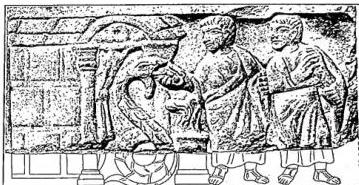
(from Wšpert, Sarajevo, tnn. 107, n. 1)
DRAGON — Daniel offers food to the dragon. Fragment of a sarcophagus (4th century). France, Château de Grozon (Ardèche).
“infinite,” sovereign of the universal sea, “which lies upon the water,” and carries the earth on its head or on its many heads (R. Goossens, p. 415). This d. was called by Ctesias (fr. 27) σκώληξ “worm” (cf. Dante, Inf., VI, 22: “Cerberus, the great worm”; XXXIV, 108: Lucifer is “the evil worm”). The Greeks (cf. R. Goossens, pp. 428-35) knew the “king of serpents,” ὁ βασιλίακος τῶν δρχεώνων. Hence the “basilisk” corresponds to venomous serpents (Hebr. péthen and 'ep'ēh) in the Septuagint (Ps. 90, 13; Is. 59, 5 [Vulg. regulus]); in the Vulgate, basiliscus occurs once (Ps. 90, 13) and regulus six times; Aquila has βασιλίακος (for δράκων) in Deut. 32, 33 and Is. 59, 5 (with ἐχίδναι), and Symmachus in Is. 30, 6. R. Goossens identifies it with the ἀδοντοδράκων (cf. Wis. 16, 10). The βασιλίακος has seven heads, in Pistis Sophia, 88, 34.
Leviathan has many heads (Ps. 74 [73], 14: “d.” in the Septuagint and Vulgate), and other hybrid and terrifying monsters appear in the poetic or allegorical passages of the Old Testament: the four beasts of Dan. 7, 3-8, the goat with one and four horns (Dan. 8, 5-22); but these are mere symbols that cannot be identified with the d. In the apocrypha, the d. recurs as equivalent to Satan or death, or to their instruments: Ps. Salom., 2, 25-31 (the pagan power [Pompey], whose ὑπερηγένια and ὄβρις are emphasized); Apoc. Baruch gr., 4 (the belly of the d. is Hades); Od. Salom., 22, 5 (the seven heads of the d., which has “roots” and “seed”; in version 7 it is the “slanderer,” or devil). The Midrashim and the Talmud identify the “serpent” of Gen. 3, 1-14 with Satan, who is called the “ancient serpent” (Siphre Deut., 32, 33), the “envious serpent” (Sanhedhrin, 59 b; Sōjāh, 9 b), with horns and feet (Gen. rabbá', 19, 1).
The biblical d. has no affinity with the mythical Babylonian d. According to the interpretation of many modern scholars, in Babylonia the origin of the world was conceived as a struggle against chaos, sometimes personified as a monster. It is certain that Enlil of Nippur was venerated as the subduer of the d. and maker of the world; when the city of Babel attained supremacy, it replaced Enlil with Narduk, whose struggle against Tiāmat for the creation of the world is narrated by the Enuma elis, a poem recited at every New Year. Ninurta (Nin-ib), the son of the god Enlil, was celebrated as the victor over the d. Each Babylonian city celebrated its god as the victor over the d., transforming the god of the defeated city into a d.
Similarly in Egypt, the baleful Seth-Typhon (serpent or crocodile) was defeated by the young sun-god Horus, son of the goddess Isis, persecuted by Seth. The Hittites celebrated the god Tešup for his victory over the serpent Ilujankā. The Indians told of the d. Vṛtrā, defeated by Indra; the Persians of the serpent-shaped d. Azhi-Dahāka, enemy of mankind. In Greek mythology, Apollo killed the d. Python, draco ingenu son of Earth (B. Allo, L'Apoc., pp. 189 ff. and 197 ff.); Hercules killed the d., son of Tryphon, which guarded the golden apples of the Hesperides, in addition to the Hydra of Lerna; for the d. of Asklepios, cf. Macrobius, Saturnal., 1, 20. Macrobius (loc. cit., 9) reports: “Phoenices... draconem finxerunt in orbem redactum, caudamque suam devorantem, ut appareat mundum et ex se ipso ali et in se resolvi”.
Abusing certain biblical poetic images, H. Gunkel (followed by A. Jeremias, H. Gressmann, etc.) asserts that divine creation and providence are conceived in the Bible as a struggle against personified chaos, and brings the d. into connection with the tēhām, which he identifies with Tiāmat; he understands tauniu, leviathan, rāhabh, bēhēmāth (v.) and tēhām as reflections of the Babylonian myth of Marduk’s struggle against the d., although the ancients never translated them as špākav. H. Gunkel’s thesis still has various adherents. But even if the Babylonians had a metaphysical-dualistic conception of the origin of the world,
expressed through the struggle against the d., later expounded in detail by M. Witzel, there is no trace of it in the Bible. Nothing permits us to affirm that tauniu and leviathan participate there in a drama of creation or represent chaos. Tēhām, “abyss,” never appears there as a living monster; it is the immense sea, viewed poetically, which God limits and contains. It is also false to identify the d. with Tiāmat, and consequently the struggle against the d. with creation; the d. defeated by Marduk (and later by Nabū) was the mūruštu, a mixture of lion, serpent and bird, depicted on the gate of the temple of Ištar at Babel; such a d. appears on many Babylonian cylinders and engravings, often with horns and sometimes with diadems.
F. Boll (followed by W. Bousset, A. Loisy, etc.) assigns the d. a Hellenistic astronomical origin; J. Freundorfer refutes him effectively. At times, moreover, a connection was posited between the d. and the constellations (Iob 3, 8: leviathan in the heavens). The error of these critics is to seek precise meanings and ideological derivations in ancient documents that vaguely express the allegory of danger and evil, rich in variations in the sagas of all ages and also in modern poetic representation, from Dante to Calderón, Goethe and C. Brentano. The struggle of a god or hero against a monster or d. was a theme common to all peoples wherever poetry and apocalyptic literature were able to draw upon II.
In the Apocalypse, the d. is the principal symbol, Lamb (v.), whose chief enemy it is, conducting every open or hidden struggle against Him and His saints (B. Allo, L'Apoc., p. LXX); it is identified (12, 9) with the “ancient serpent” (of Gen. 3, 1-15), devil (v.) or Satan (v.).
The high point of the book is chapter 12, in which the d. appears. A “great sign,” a Woman (“Ecclesia”: Victorinus of Pettau; “civitas Dei”: St. Augustine; in a secondary sense: Mary Most Holy), clothed with the sun, with the moon as her footstool and a crown of twelve stars, is about to give birth; but opposite her appears “another sign”: a great fiery-red d. (cf. Euripides, Iphig. Taur., 1245: αἰνωτὸς βράκων; Plutarch, Is. et Osir., 22: τὸν Τύρωνα ... πυρρόν) with seven heads (opposed to the “seven spirits of God”: 1, 4; 3, 1; 4, 5; 5, 6), crowned, and ten horns (Dan. 7, 7). It is a king: “the ruler of this world” (Io. 16, 11, etc.). Defeated in heaven by the angelic army, the d. has fallen “with his angels” to earth, where it confronts the Woman in order to devour her newborn child (the future universal king, caught up to the throne of God); the Woman flees, carried by the “two wings of the great eagle (God),” into the desert for three and a half years (until the d. is vanquished at the parousia), while the
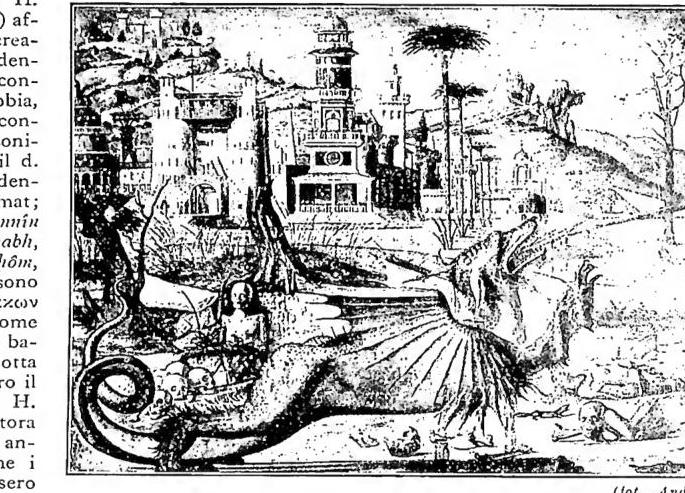
The d. fights the Church by arousing the two Beasts, Antichrist (v.) (Apoc. 13, 1-18); but it is defeated: «the d., the ancient serpent, who is the Devil and Satan», is bound for a thousand years (20, 2: cf. J. Ph. Vogel, p. 199: the «king of serpents» Sesa hangs head downward for a thousand years). Cf. Io. 12, 31; Rom. 16, 20; Hebr. 2, 14. Also in I Pt. 5, 8 the devil is a d. that «devours». The d. here has nothing in common with the tauniu, still less with Tiāmat, as H. Gunkel maintains, arguing for the Babylonian origin of Apoc. 12; it is not a cosmic or mythical monster, but a malevolent spiritual power, Satan (v.), the perpetual principle of evil.
Among Christians the d. remained a frequent metaphor for the devil (Passio s. Perpetuae, 4); it is often mentioned in the magical papyri (K. Preisendanz, 4, 994: θεῖ ἁγῶν ... κατέγων βράκωνα; cf. II Thess. 2, 6). But naturalists took pains to describe, in addition to the basilisk or «regulus» (Pliny, VIII, 21 [33]; St Isidore of Seville, Erymel., XII, 4, 6: «rex serpentium»), the d. in nature: St Isidore, loc. cit. 4-5, «draco maior cunctorum serpentium, sive omnium animantium super terram»; St Albert the Great, De animalibus, XXV: «dracones indici»; cf. Physiologus, IV, 155 f. Ulisse Aldovrandi collected this «science» in Serpentium et draconum historiae libri duo, Bologna 1640.
calypse, in Revue biblique, 31 (1922), pp. 203-14; B. Allo, A propos d'Apoc. 11 et 12, ibid., pp. XLVIII-LI, 174-99, 307-309; E. Lohmeyer, Das 12. Kapitel der Offenbarung Joh., in Theologische Blätter, 4 (1925), coll. 285-91; F. Hommel, Ethnologie und Geographie des Alten Orients, Monaco 1926, pp. 121, 125, 215-219, 224, 247, 404-07; J. Ph. Vogel, Indian serpent-lore or the nâgos in hindu legend and art, Londra 1926; H. Gressmann, Altorientalische Texte zum Alten Test., Berlino-Lipsia 1926, pp. 138-41; id., Altorientalische Bilder zum A. T., ivi 1927, pp. 106-17; P. Joilon, Le grand dragon, l'ancien serpent (Apoc. 12, 9 et Gen. 3, 14), in Recherches de science rel., 17 (1927), pp. 444-46; C. Rüsch, Mulier, draco et bestia in Apoc. 12, in Virbum Domini, 8 (1928), pp. 271-74; E. Landett, Dragons et génies, Parigi 1928; A. Freundorfer, Die Apokalypse des Apostels Joh. und die hellenistische Kosmologie und Astrologie (Biblische Studien), 23, 11, Friburgo in Br. 1920, pp. 124-146; B. Renz, Der orientalische Schlangendruck, Augusta 1930; W. Foerster, Die Bilder in Offenbarung 12f. und 12f., in Theologische Studien und Kritiken, 104 (1932), pp. 279-310; id., Ἀφύσων (= ἄρθρα, ὄφρα), in G. Kittel, Theol. Wörterbuch zum Neuen Test., II, pp. 384-86; R. Lehmann-Nitsche, Der apokalyptische Drache (Apok. 12), in Zeitschrift für Ethnologie, 63 (1933), pp. 193-230; R. W. Schütz, W. Foersters Erklärung der Bilder in Offenbarung Joh. 12f. u. 12f., in Theol. Studien u. Kritiken, 105 (1933), pp. 456-66 (against W. Foerster); A. Delatte e C. Josserand, Contribution à l'étude de la démonologie byzantine, in Mélanges J. Bides, I (Annuaire de philologie et d'histoire orientales, 2 [1934, 1]), pp. 207-32; R. Goossens, Les nâgos et le basilic dans le monde gréco-romain, ibid., pp. 415-449; P. Humbert, A propos du « serpent » du mythe de Môt et Abba, in Archiv für Orientforschung, 11 (1936), pp. 235-37; id., Etudes sur le récit du paradis et de la chute dans la Genèse, Neuchâtel 1940, p. 78; E. D. van Buren, The dragon in ancient Mesopotamia, in Orientalia, 15 (1946), pp. 1-14; J. Coppens, La connaissance du bien et du mal et le péché du Paradis, Gembloux-Lovanio 1948, pp. 36, 89-131. On the d. in the magical papyri and in later writers; H. van Herwerden, Lexicon grecum suppletorium et dialecticum, I, 2ᵃ ed., Leida 1910, p. 403; J. H. Moulton e G. Milligan, The vocabulary of the greek Testament, Londra 1914-29, p. 170; K. Preisendanz, Die griechischen Zauberpapyr, I-II, Lipsia-Berlino 1928-31, passim. On the d. (= Satan) in medieval and modern Greek folklore; B. Schmidt, Das Volks leben der Neuerische, Lipsia 1871, p. 190; P. Pradel, Griechische und süditalienische Gebete, Brachsbrungen und Rezepte des Mittelalters, Giessen 1907, p. 86; C. Josserand, Anædota Atheniensia: I. Textes grees relatifs à l'histoire des religions, Liegi 1927, p. 235. Antonino Romeo
ARCHAEOLOGY. — The draco magnus venerated by the Babylonians was made to burst by Daniele by means of a cake (Dan. 14:22–26). The scene, unknown in cemetery painting, is instead represented several times on Christian sarcophagi from Rome, Italy, Gaul, and Africa. The prophet, often assisted by an angel, is depicted in the act of offering the cake to the draco, which has the form of a serpent, sometimes with a crest (galeatus), and rises from the ground or extends from a tree around which it is coiled.
In some examples (Verona and Grozon, Wilpert, Sarcofagi, I, p. 150, 2; tav. 197, 1), the temple is also shown and, near the prophet, an altar, either burning or overturned, or an overturned torch (ibid., 197, 5). In this scene the prophet Daniele prefigures Christ, while the draco is the “serpens antiquus qui vocatur diabolus et satanas, qui seducit universum orbem” (Apoc. 12:9).