
PISTIS SOPHIA

PISTIS SOPHIA. – This is the title given by Schwartz to a Gnostic writing of the 3rd century in the Coptic language, contained in the Codex Askewianus of the British Museum.

The text consists of four books. The first three, which form a single unit, deal with P. S., that is, the faith that seeks Wisdom. The work is attributed to the Saviour, namely to Jesus Himself. P. S. is an aeon, fallen from heaven into matter, who is restored to his original celestial abode by Jesus. The writing contains many references to apocryphal works, among which are also the 5 Odes of Solomon (v.), as well as apocryphal Gospels and probably also an apocryphal Apocalypse (v. L. H. Puech, in Coptic studies in honor of W. E. Crum, Boston 1950, p. 122). The fourth book is an independent work, dealing especially with penance. It is probably older than P. S. Placing P. S. within its Gnostic context may become possible after the publication of the Gnostic codices in Coptic discovered in 1946 in the region of Nag-Hammadi.
Bibl.: ed.: C. Schmidt, Koptisch-gnost. Schriften, Leipzig 1905. Ed. of the Coptic text, Copenhagen 1925. New tr. ed., Leipzig 1925. Monographs: K. R. Köstlin, Das gnost. System des Buches P. S., in Theol. Jahrb., 13 (1854), p. 1 ss., 137 ss.; A. Harnack, Über das gnost. Buch P. S. (Texte und Untersuch. zur Gesch. der altchr. Liter., 7, II), Leipzig 1891, p. 1 ss. V. also the articles by C. Schmidt, in Zeitschr. für neutestam. Wissenschaft, 14 (1925), p. 218 ss.; F. C. Burkitt, in The Journal of theol. studies, 23 (1925), p. 271 ss.; 26 (1925), p. 391 ss. and by R. P. Casey, ibid., 27 (1926), p. 374 ss. On astrological doctrines, V. W. Gundel presso Fr. Boll, Sternglaube und Sterndeutung, 4th ed. Berlin 1931, p. 187 ss. and Gundel, Paranatellonta, in Pauly-Wissowa, XX, II, cols. 1913-21. On new Gnostic texts in Coptic, V. Mina, in Vigiliae christianae, 2 (1948), p. 129 ss.; 3 (1949), p. 129 ss.; J. Doresse, ibid., p. 137 ss.

Erik Peterson

PISTOCCHI MARIO – PISTOIA

The area of the diocesan territory (including the diocese of Prato [v.]) is 1083 sq. km., and its population (including the diocese of Prato) is 262,403. There are 169 parishes and 25 deaneries. There are 250 priests. The diocese possesses 7 male religious houses and 50 female ones. From as early as 1446, by concession of Eugenius IV, it had a college of clerics with the rules and privileges already granted to the famous Eugenian College of Florence. In 1690 Bishop Leone Strozzi founded the Seminary, which was enlarged by Bishop Colombino Bassi; it was later transferred by Bishop Scipione de’ Ricci to the suppressed monastery of S. Chiara. The patron saint of the diocese is St. James the Apostle.

I. CIVIL HISTORY

Pistorium arose on the Via Cassia, in the valley of the Ombrone, at the foot of the Apennine foothills, perhaps in the 1st century B.C. It was already a city under the Roman Republic: in 690 A.U.C., in its territory the army of Catiline was broken by the arms of Antony. Pliny the Elder lists P., which belonged to the Vebina tribe, among the cities forming Tuscia annonaria. Very scanty are the notices about P. in the first four centuries A.D. It seems that during the reign of Theodoric it enjoyed a period of peace and prosperity. It was subject to the Ostrogoths and the Byzantines; around 590 it fell under Lombard rule, whether peacefully or subdued by force is uncertain. Under Liutprand it struck coinage. Meanwhile, in the heart of the city stood the tower of the guardhouse, from which an armed escort kept watch over the city itself; the supreme magistrate was the gastald. In the Carolingian period it was governed by a count. It was then under Matilda of Tuscany; afterwards it was ruled by the elders, the podestà, and the captain of the people. Later it too was divided into factions, now the Guelphs prevailing, now the Ghibellines, represented the one by the Cancellieri family, the other by the Panciatichi. They struggled against each other with varying fortunes, suffering the same fate as the Guelphs and Ghibellines in nearby Florence. And with the division of the Guelphs in that city, the Cancellieri sided with the Blacks, the Panciatichi with the Whites. Caught between Lucca and Florence, it endured assaults now from one, now from the other. In 1301 the Blacks were expelled from it (P. in pria dei Negri si dimagra: Dante, Inf., XXIV, V. 143). Then Castruccio Castracani, lord of Lucca, reduced it to his obedience; subsequently it was under the political hegemony of Florence. Near P., at Gavinana, in 1530 Ferrucci met his death, defending Florentine liberty against imperial arms. With the establishment of the duchy and the grand duchy, P. too came under the sovereignty of the Medici, then under the Lorraines; it experienced French occupation and, after the political vicissitudes that preceded the end of the grand duchy, became, like the rest of Tuscany, part of the Kingdom of Italy.

II. RELIGIOUS HISTORY

There are no reliable data to define the time and circumstances in which Christianity was introduced into the territory of P. It is certain, however, that by the close of the 5th century the see of P. was already established, since Pope Gelasius I (492–96) complains that a bishop of P. had paid homage to King Theodoric before venerating the thresholds of the Apostles. In 556 Pelagius I excommunicated a bishop of P., whose name is unknown, because in the divine service he omitted the name of the Pope. In 716 a bitter dispute over jurisdiction arose between the bishop of P. and that of Lucca, which was judged by a messenger of King Liutprand. The 8th century, in which the name of a Bishop John, elected by the clergy and people, is known, was fruitful for the diocese in monastic foundations. Already before this, an hermit, Barontus, later venerated as a saint, had lived in penance on Mount Pietraia; later the Roman Peter became known. Meanwhile famous abbeys arose, of which the diocese came to possess fourteen. Among these are remembered the abbey of S. Barontus of Montalbano (11th century) and that of Montepiano (11th century); the abbey of S. Bartholomew (8th century) and of S. Michael in Forcole (8th century); of S. Salvatore of Vaiano and of S. Mary of Grignano. Of Bishop Lamprand it is known that in 826 he took part in a council under Eugenius II; in 844 Bishop Gansprand was present in Rome at the coronation of Louis, King of Italy; in 870 Oschisius is legate of the Emperor in Calabria; in 963 John takes part in a Roman synod convoked by Otto I. Other names of bishops of this period are Asterius, Hubert, Rambald, and Anthony.

Article illustration
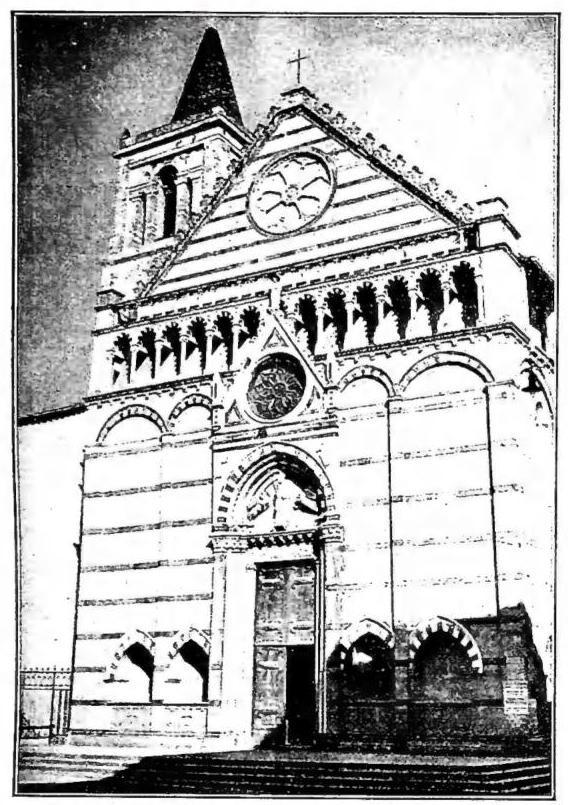
Pistoia, Diocese of – Church of S. Paolo, built at the end of the 13th century, with a portal from 1227.

It is certain that before the year 1000 and shortly thereafter, the bishops of P. enjoyed great authority and exercised feudal jurisdiction over castles and lands within the diocese, including Quarrata and Lamporecchio, although this was contested by the rising Commune. Even earlier, their preeminence was attested by the annual homage of a deer hide paid by certain populations in the Maremma. In the 11th century, the episcopate of the Vallombrosan Pietro dei conti Guidi stood out; he was chosen by Countess Matilda to succeed Bishop Leone, who died in 1085. No less illustrious was the other Vallombrosan, Atto, venerated as a saint, who greatly contributed to spreading the cult of St. James in P. It was at this time that the cathedral, originally dedicated to St. Martin and rebuilt and reconsecrated to St. Zeno in the 8th century (venerated by the Lombards), was rebuilt anew. There stood the “sacristy of fine furnishings,” from which Vanni Fucci stole (Dante, *Inf.*, XXIV, V. 138). The cathedral later underwent further adaptations and restorations in 1443 under Bishop Donato dei Medici, and again in the 17th century. The bishops also zealously promoted discipline among the clergy and people through numerous synods. The first was held under Bishop Ermanno in 1308; the Synod of Bishop Diamanti dates to 1406. After the Council of Trent, that of Bishop Lattanzio Lattanzi took place, followed by others in the 17th and 18th centuries, up to the one held by Colombino Bassi in 1721.

Then came the episcopate of Scipione de’ Ricci, whose Synod of 1786, marked by regalist and Jansenist tendencies and involving lay elements from Pistoia, was neither welcomed nor accepted by the local clergy. The innovations he attempted in worship likewise met with popular hostility, so much so that Ricci was forced to resign the see, which was then taken by Francesco Folchi, who annulled the Synod itself. Pius VII condemned Ricci’s doctrines with the bull *Auctorem fidei*.

Among other bishops, Marcello Mazzanti is noteworthy; his Synod took place in 1892.

III. ILLUSTRIOUS FIGURES

Among those to be remembered are Canon Sozomeno, a humanist who participated in the Council of Constance; the Jesuit Father Zaccaria, a learned and highly erudite writer; Cardinal Carlo Agostino Fabbroni, who played a major role in the constitution *Unigenitus* against the errors of Quesnel; Alessandro de’ Medici, who moved from the see of P. to become Archbishop of Florence and later became pope under the name of Leo XI; Cardinal Giulio Rospigliosi, who held high offices in the Roman Curia and, upon his election as pope, took the name Clement IX; Bishop Colombino Bassi, who left a reputation for outstanding virtue in the diocese; Canon Antonio Longinelli, who died in 1800 while held hostage in France; Monsignor Enrico Bindi, a learned commentator on the classics who later rose from the see of P. to become Archbishop of Siena.
BIBL.: M. Salvi, *Historia di P.*, Rome 1652; Ughelli, III, pp. 282-317; F. A. Zaccaria, *Bibliotheca Pistoriens*, Turin 1752; I. M. Fioravanti, *Memorie storiche della città di P.*, Lucca 1758; I. Lami, *S. Ecclesiae Florentinae monumenta*, I, Florence 1758, p. 562 ff.; III, p. 1575 ff.; A. M. Rosati, *Memorie per servire alla storia dei vescovi di P.*, Pistoia 1766; *Atti dell’assemblea degli arcivescovi e vescovi della Toscana*, held in Florence in 1790, Florence 1787; *Atti e decreti del Concilio diocesano di P. dell’anno 1786*, Pistoia 1788; F. Tolomei, *Guida di P.*, 1788; E. Repetti, *Dizionario geografico storico della Toscana*, IV, Florence 1841, p. 401 ff.; Cappelletti, XVII, p. 73 ff.; V. CAPPONI, GINO, *Bibliografia pistoiese*, Pistoia 1878; G. Arcangeli, *Brevi notizie sul Seminario collegio vescovile di P.*, Pistoia 1891; G. Beani, *La cattedrale di P.*, 1891; P. Kehr, *Italia pontificia*, III, Berlin 1908, pp. 117-43; G. Beani, *La Chiesa pistoiese*, Pistoia 1912; N. Rodolico, *Gli amici e i tempi di Scipione de’ Ricci*, Florence 1920; Maya, *P. artistica*, Pistoia 1927; L. Chiappelli, *Storia di P. nell’alto medioevo*, 1932; R. Matteucci, *Scipione dei Ricci*, Brescia 1941.

IV. THE SYNOD OF P

It was held in the church of the seminary and ecclesiastical academy of St. Leopold from the morning of September 18 to the afternoon of September 28, 1786, under the direction of the Jansenist Bishop Scipione de’ Ricci (v.) and under the protection of Leopold, Grand Duke of Tuscany, from whom, rather than from the Pope, it was said in the inaugural oration that “permission had come for so many learned theologians to attend, in the firm hope that the grace of the Lord would dispel the spirit of darkness and division.”

Article illustration

The Synod was attended by French and Dutch Jansenists, and it was prepared by the most prominent Italian Jansenists, who were present at least in a moral sense; it cannot therefore be considered a provincial or regional episode, but rather almost the culmination of the Jansenist trajectory from Louvain to Port-Royal and Utrecht, and a point of convergence of the errors of the movement with other related or adventitious errors such as Gallicanism, Richerism, and the like.

There were seven sessions and ten preparatory congregations, three of which were extraordinary and seven ordinary. Some 250 priests attended, driven by the bishop’s overbearing manner and often violent methods; these included, from the diocese of Pistoia, the parish priests, curate chaplains, and canons by right, who were called “Fathers of the Council”; secular and regular priests expressly invited, who were termed “consecrated priests”; among these TAMBURINI, PIETRO (v.), to whom—especially the latter, who was its main promoter—the drafting of the

The Pistoia decrees. De' Ricci was its president, and Giuseppe Paribeni was vice-president and legate of the Grand Duke. From a nearby villa, Leopold followed its progress. The Synod, soon dubbed the “Pistoian comedy,” unfolded amid the fear of the Pistoiese clergy, most of whom were unaware of the coercion used to secure subscriptions, which, however, were only apparently unanimous; and amid the exultation of the not a few Jansenists or extradiacese Gallicans present, who believed that a definitive triumph of heresy had thus been assured. The acts were published in full, and the propositions condemning the bull Auctorem Fidei of 28 Aug. 1794 mark its deviations. From the 85 principal propositions extracted from the synodal constitutions and arranged under 44 headings according to their various subjects, 7 were condemned as heretical and the rest proscribed with varying censures, often on account of the multiple senses in which they might be interpreted (false, temerarious, scandalous, proximate to heresy, etc.). Also stigmatized was the praise accorded to the Gallican Articles of 1682, which had been maliciously inserted into the decree on faith, and the judgment already pronounced against them by Innocent XI and Alexander VIII was reaffirmed. Such condemnation became necessary because of the circulation of the Synod’s acts throughout Europe. In a Latin codex of the Vatican Library it is noted that “a printer in Livorno has been obliged to print 1,800 copies to send to Spain and France,” and from Spain the doctor Lorenzo was warned that he could no longer prevent the reprinting of the acts in Spanish without a prior formal condemnation. The Synod was attended by ecclesiastics and laity from France, Austria, Germany, the Netherlands, and Poland. The schismatic Church of Utrecht, the Archbishop of Salzburg (Colloredo), and French abbots such as Belle-garde, Maulrot, and Clément sent letters; the Nouvelles ecclésiastiques, the Gazette universelle, the Gazette d’Europe, and the Gazette française among the periodicals extolled the Pistoian conciliabulum, whose decrees were immediately issued in three editions: Italian, Latin, and French. As a complement to the Synod, as had been hoped, a national council was to be held in Florence to put an end to all the rumors and intrigues that the Roman court and its adherents might attempt. The Tuscan bishops, however, rendered this plan (v. GIANSENIO; GIANSENISMO; RICCI, SCIPIONE) vain, and the schismatic design, like the Jansenist heresy, may be considered historically concluded in the bull of condemnation.

BIBL.: Atti e decreti del Concilio diocesano di P., Pistoia 1788 (in Latin, Pavia 1788; in French, Paris 1789); J. Carrey, Pistoie (Synode de), in DThC, XII, 11, cols. 2176–99; B. Matteucci, Scipione de’ Ricci, Brescia 1941 (with exhaustive bibliography).

BENVENUTO MATTEUCCI

V. ARTE

With the Romanesque period, the first artistic manifestations appear in P. The present aspect of the city indeed depends in large measure on constructions from the 13th and 14th centuries. The only remnant of Roman monuments, apart from the city plan, which can mostly be reconstructed, is a private dwelling of the 3rd century AD with fine mosaic floors.

Romanesque architecture in this city has its own distinctive features, where forms of minute decoration, of predominantly Pisan and also Florentine origin, spread widely. The polychrome and ornamental effect often becomes overwhelming and prevents the architectural structures from displaying those characteristics of organic unity that are typical of all Romanesque architecture. Participating in this trend are San Giovanni Fuorcivitas, the cathedral rebuilt in the 12th century, San Paolo, San Bartolomeo in Pantano, and Sant’Andrea, with its unusual central nave, very high and narrow. A characteristic of Pistoiese Romanesque churches is the absence of a rood screen. In 1166, Graumonte, “magister bonus,” together with his brother Adeodato and a master Enrico, worked on the architecture of the portal of Sant’Andrea, revealing himself as a follower of that Guglielmo who had executed the pulpit for the Pisan duomo (now in the cathedral of Cagliari). It is likely that the same sculptor, and perhaps with the same collaborators, worked the following year on the architrave of the portal of San Bartolomeo in Pantano; and later, without assistance, on that of San Giovanni Fuorcivitas. The pulpit of San Michele in Groppoli, in the environs of the city and dated 1194, reveals the influence of Guglielmo’s art, probably learned by the anonymous master through Graumonte. Guido Bigarelli of Como, who in 1246 had executed the baptismal font of Pisa, in 1250 worked with assistants on the pulpit of San Bartolomeo in Pantano. Guido brought to Pistoia the Lombard tradition, at least in its characteristics of simplicity and relief, sought in contrast with the hollow space, even if softened and smoothed. Influences of Guido da Como’s style can be seen in the anonymous master who carved the portal of the church of San Pier Maggiore. Romanesque painting did not develop significantly in Pistoia; noteworthy in the Duomo is the large painted cross of 1274 by Coppo di Marcovaldo in collaboration with his son Salerno. In the 14th century, Sienese and Florentine architectural forms spread. The Palazzo Comunale, begun in 1294 and enlarged in 1345 by the Sienese Simone di Ser Manno, displays distinct Sienese features overall, even though its loggia links it to Lombard public palaces. The local architect Cellino di Nese (1337–59) executed the octagonal baptistery, perhaps following a design by Andrea Pisano, and it is likely that he himself provided, in 1367, the design for the Palazzo di Giustizia.

In the field of sculpture, Pisan sculptors were predominant in Pistoia during the 14th century. In 1270, the most faithful follower of Nicola Pisano, Fra Guglielmo, executed the pulpit of San Giovanni Fuorcivitas. In 1273 Nicola worked on the altar of the church of San Jacopo (now destroyed), and the holy-water stoup of San Giovanni Fuorcivitas, datable to the same year, reveals the hand of Giovanni Pisano in his early phase, closely related to the plastic forms of Nicola. Between 1298 and 1301, Giovanni Pisano executed the pulpit of the church of Sant’Andrea, his masterpiece, on commission from Arnoldo degli Arnoldi. The probable authors of the tomb of Cino da Pistoia (1337–39) were the Sienese Agostino di Giovanni and Agnolo di Ventura.

Pistoiese painting in the Trecento was, in the first half of the century, also dominated by the Florentine tradition. In the second half, Emilian influences prevailed instead, as seen in the frescoes of San Domenico and in the paintings of the Chapter of San Francesco, works by Emilian artists and Pistoiese masters under their influence. The Bolognese Dalmazio de’ Scannabecchi and his son Lippo settled in Pistoia for a long time, exerting a strong influence on local painting.

In the Renaissance, Pistoia’s importance in the history of art became very limited. The field was dominated predominantly by Florentine masters, both painters and sculptors. In 1477 Lorenzo di Credi painted the Madonna di Piazza for the Duomo. The Civic Museum preserves works by Cosimo Rosselli, from the school of Botticelli, and by Ridolfo del Ghirlandaio. In 1477 Verrocchio began for the Duomo the monument to Cardinal Niccolò Forteguerri, which was continued by followers and partly dismantled in the 18th century. In 1487 Antonio Rossellino executed the bas-relief portrait of Donato de’ Medici, also in the Duomo, and his brother Bernardo, in collaboration with him, executed the monument to Filippo Lazzi in San Domenico. Andrea della Robbia, with assistants, in 1505 decorated the central door of the Cathedral with a terracotta relief, while Giovanni della Robbia is responsible for the decoration of the Ospedale del Ceppo. — See pl. CXI.

BIBL.: F. Tolomei, Guida di P. per gli amanti delle belle arti, Pistoia 1821; G. Beani, La Cattedrale pistoiese, ibid. 1903; O. Giglioli, P. nelle sue opere d'arte, Florence 1904; A. Chiti, P., Pescia 1931.