
SAPIENZA (in the BIBLE). – An ideological-ethical attitude among the ancient Israelites (Hebr. hokhmáh); it was not simply an intellectual gift, but also the foundation and at times the sum of an individual’s morality. It originates from God (Ex. 28, 3; I Reg. 3, 9; 5, 9; Is. 28, 26; Ecc. 38, 6); its basis is the “fear of God” (Prov. 1, 7; 9, 10; Iob 28, 28; Ecc. 1, 16-22; Ps. 110, 10). Especially after the exile, s. became the preferred theme of the inspired scribes. At times it is presented as a person, in addition to being an intrinsic attribute of God.
Five texts are especially characteristic in this regard. In Iob 28, 20-27 s. is personified and described as inaccessible to man, who always remains within a material sphere; God alone knows it perfectly, and created the world through II. According to the majority of exegetes, this is simply a poetic personification of this essential attribute of God. The same idea reappears in Bar. 3, 9-4, 4, which adds the notion that the Mosaic Law constitutes a more evident manifestation of it for men (ibid. 3, 37). In Prov. 8, 22-36 the personification of s. is much more pronounced; it is described as the idea that guided God in his work; while insisting upon s. as a divine attribute, the hagiographer presents it as something distinct, endowed with its own personality (ibid. 8, 27-31). In Eccl. 24, 1-47 the same concepts are presented in a somewhat different form: s. is something eternal and intrinsically divine; and its personification is emphasized even more (cf. ibid. 24, 3-4). This concept takes a further step in Sap. 7, 22-8, 1, where s. is described as “intelligent (νεξός), holy, unique, manifold, immaterial, noble, discerning, immaculate, transparent, almighty, watching over all, penetrating all intelligent and pure spirits...; it is a vapor of the power of God and a pure emanation of the majesty of the Universal Ruler”; these expressions leave no doubt concerning the personification of s. The ancient apologists and writers on Trinitarian dogma already used similar texts to prove the personal existence of the Son of God.
The question remains active among exegetes as to whether these books contain simply a poetic personification or the revelation of the personality of the Son of God. Certain authors (F. S. Patrizi, R. Cornely, E. Tobac, U. Lattanzi) maintain that, at least in the “fuller sense,” there is here a partial revelation of the mystery of the Most Holy Trinity: “The personal divine S. of the Old Testament is the incarnate Word” (U. Lattanzi [V. op. cit. in bibl.], p. 38). For other authors (A. Vaccari, J. Lebreton, P. Heinisch, F. Ceuppens, P. Van Imschoot, etc.), this is the poetic personification of a divine attribute, and the whole constitutes a providential preparation for the revelation that took place with the New Testament; its application to Christ is possible by virtue of the “fuller sense.” Only in the “consequent sense” can the various texts be applied to the B. V. Maria, as has been done in the liturgy.
The difference between the two opposing opinions lies chiefly in the different way of determining the limits of the literal sense of the Bible. If the latter is determined according to what the ancient Israelites or the hagiographers were able to understand, it is illogical to see a divine person in s.; this would conflict with rigorous Jewish monotheism. If, on the other hand, the literal sense is taken more broadly, including what God himself intended without regard to whether or not the immediate hearers understood it, one can recognize in the cited texts something much deeper than a simple poetic personification.
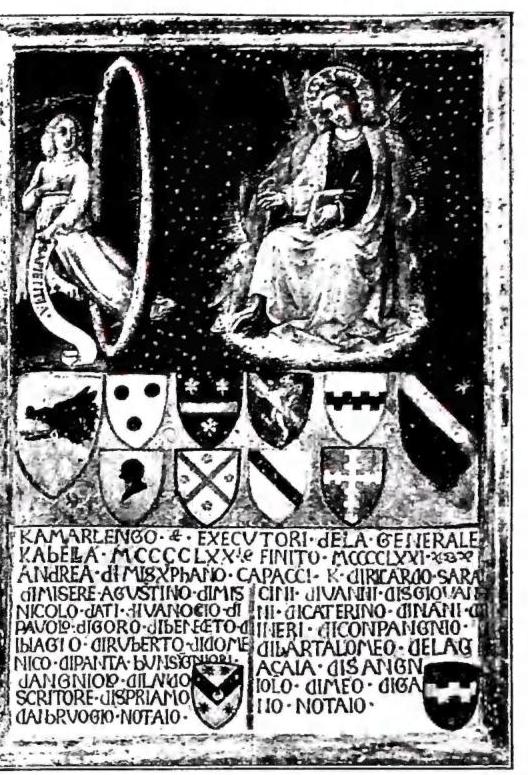
(Courtesy of the President of the Tourism Board, Siena) WISDOM (in the Bible) - Wisdom emanating from God. Tablet of the Biccherna, painted by Sano di Pietro (1471) - Siena, State Archives.
In the historical section, the true benefits and privileges of the patriarchs are described in broad strokes as the effect of wisdom (10:1 - 11:4), then the punishments inflicted by God upon the Egyptians and the Canaanites are contrasted, always highlighting divine justice and clemency in punishment (11:5 - 12:23). Idolatry is condemned in 13:1 - 15:19. The book concludes (16:1 - 19:22) with a new comparison between the Israelites and the Egyptians, summarizing the various episodes that preceded and accompanied the liberation of the Hebrews from Egypt: these are signs of God’s predilection for His chosen people and of His justice against idolatrous oppressors.
The book has great doctrinal-dogmatic value. Its unmistakable characteristic, shared in some way only with II Mach., is its insistence on an ultraterrestrial reward reserved for the just, who will live a blessed life with God (3:1-9; 4:7; 5:16), and thus on the immortality of the soul. Such beatitude is the fruit of wisdom, insofar as wisdom is the primary source of justice (1:15; 3:15; 4:2; 5:16). In describing the fate of the wicked, the text emphasizes their unhappiness in this life (2:21; 3:10; 4:3-6), but it also clearly speaks of their future misery (1:16; 3:19; 4:19 - 5:14). Equally valuable are the affirmations regarding the knowability of God through creation (13:4-9; cf. Rom. 1:20), divine power and providence (12:12-15; 15:7; cf. Rom. 9:19-23), and idolatry and the corruption of paganism.
Often, especially among Protestants, serious errors in the book are pointed out, as it would presuppose the preexistence of souls (8:20) and the eternity of matter (11:18). In reality, in the first case, it is a resolute affirmation of the superiority of the soul over the body; in the second, the term ἄμαρρος ὕλη should not be interpreted in the sense of unformed, uncreated matter from which the world would have originated according to Greek philosophers, but in that of chaos, which is presented in Gen. 1:2 as the first effect of God’s will.
Although notable stylistic similarities with the books of the Hebrew Bible are observed, it is certain that the original language was Greek. The many compound words, certain paronomasias, the often elegant way of connecting various propositions, and the use of technical terms from Greek religion or among philosophers are clear indications that the book was written in that language. Moreover, the ancients were already convinced of this (cf. St. Jerome, Proefatio in libros Salomonis: PL 28, 1307-1308). Since these characteristics extend throughout the book, the various hypotheses about an original, even if only partial, Hebrew text have not been followed.
The fact that the author presents himself as the famous wise King (7:1 ff.) poses no difficulty. It is merely a literary device, which does not imply any special conclusion regarding inspiration. Already St. Augustine (De doctrina christiana, II, 8, 13; De civitate Dei, XVII, 20, 1) affirmed that the learned did not even doubt that the work was not composed by Solomon («non autem esse ipsius, non dubitant doctiores»).
Intrinsic examination shows that the author was an Egyptian Jew and that he wrote for his coreligionists in that region to dissuade them from idolatry and to confirm them in the Mosaic religion, comforting them for the injustices they suffered (cf. 2:10-20; 15:14). This latter circumstance suggests the time of Ptolemy IV Philopator (221-204 B.C.) or Ptolemy VII Physcon (170-163 B.C.), who were hostile to the Jews. Other indications make the latter date more likely. However, a more recent period is not excluded. The idea, reported by St. Jerome (loc. cit.), that the book was by Philo can be considered unlikely, although some modern scholars have revived II. Wisdom is not at all a philosophical work nor an attempt to reconcile Platonic concepts with the Mosaic. Its rare allusions to Greek philosophy are explained by the cultural environment and the author’s concern to warn his coreligionists about the dangers inherent in false doctrine.
The Book of Wisdom is part of the group of deuterocanonical books (v. BIBLE), because it was not included in the Hebrew canon, at least in Palestine. It is therefore rejected by Protestants as well. In favor of its canonicity stands, first of all, the infallible authority of the Church and a venerable tradition of Fathers and ancient writers. St. Jerome excluded it as «pseudepigraphical»; for this reason, he did not translate II. The Church, therefore, still reads it in the translation of the Vetus Latina. The book is never explicitly cited in the New Testament, but allusions are not lacking (Rom. 1:20; 9:19-23; etc.).
Münster 1874; H. Lesêtre, Parigi 1880; R. Cornely-F. Zorell, ivi 1910; P. Heinisch, Münster 1912; F. Feldmann, Bonn 1926; G. Girotti, in La S. Bibbia, VI, Torino 1938, pp. 245-344. Acattolici: C. Siegfried, in E. Kautzsch, Die Apocrypha und Pseudopigraphen des Alt. Test., I, Tubinga 1900, pp. 476-507; A.T.S. Goodrick, Londra 1913; S. Holmes, in H. Charles, The Apocrypha and Pseudopigrapha of the Old Test., Oxford 1913, pp. 318-68; J. Fichter, Tubinga 1938. Studi: W. Weber, Die Unsterblichkeit der Weisheit Salomo, in Zeitschrift f. wissenschaftl. Theologie, 48 (1905), pp. 409-44; id., Die Seelenlehre der Weisheit Salomon, ibid., 51 (1909), pp. 314-33; M.-J. Lagrange, Le livre de la Sagesse. La doctrine des hus dernières, in Revue biblique, 16 (1907), pp. 85-104; G. Heinisch, Die griechische Philosophie im Buch der Weisheit, Münster 1908; F. Feldmann, Die literarische Art von Weisheit: Kap. 1-1-1, in Theologie und Glaube, 1 (1909), pp. 178-84; G. Sceneria, L'allégorismo nel libro della S., in Rivista di scienze teologiche, 6 (1910), pp. 173-46; A. Beel, Auctor libri Sapientiae, in Collaliones Brugensis, 31 (1931), pp. 134-42; id., Analysis libri Sapientiae, ibid., pp. 196-202; P. Van Imschoot, De libri Sapientiae scriptore. De loco et tempore compositionis libri Sapientiae, in Collaliones Gaudacenses, 20 (1933), pp. 117-21, 181-83; R. Schütz, Les idées euthéologiques du livre de la Sagesse, Parigi 1935; S. Lange, The Wisdom of Solomon and Plato, in Journal of biblical literature, 55 (1936), pp. 293-302; H. Bäckers, Die Unsterblichkeitlehre des Weisheitsbuches. Ihr Ursprung und ihre Bedeutung, Münster 1938; J. P. Weisengoff, Death and immortality in the book of Wisdom, Washington 1940; L. Bigot, Sagesse (livre de la), in DThC, XIV, coll. 703-44; L. Allevi, L'ellenismo nel libro della S., in La scuola cattolica, 71 (1943), pp. 337-48.