
SALMI DI S. — An apocryphal work comprising a group of 18 brief religious compositions, inserted among the “Solomonic” books in certain manuscripts of the Greek translation of the Bible. In content and literary form they closely resemble the Psalms; this explains their title.
Like the Davidic Psalter, the small collection treats various subjects from a religious perspective; praise of God is combined with the didactic genre; the vivid description of a grave humiliation suffered by the Holy City and the people is matched by the expectation of a very different future, when the Messiah, presented especially as the king of Israel (16, 1 ff.), will inaugurate a new historical period. The particular circumstances bring into relief the problem, treated several times in the texts of the Old Testament, of the persecuted and oppressed righteous person and of the proud self-assurance of sinners. In the 18 songs, almost all the literary genres identified in the Davidic Psalter can be discerned.
The similarities become even greater when the phraseology and external form of the various compositions are compared. With the exception of the first, all the psalms have a title, in which the celebrated King of Israel is always named, while different terms are used to indicate the literary genre, such as “psalm” (2; 3; 5; 13; 15; 17; 18), “hymn” (10; 14; 16), “apostrophe against flatterers” (ἄναλογή; 4), or “psalm with ode” (15; 17). There is often also a specification concerning the particular subject, such as “on Jerusalem” (2); “on the righteous” (3), etc. In 18, 9, the term Βιδ/αλαμ occurs, which in the Greek translation of the Davidic Psalter corresponds to the enigmatic Hebrew selah.
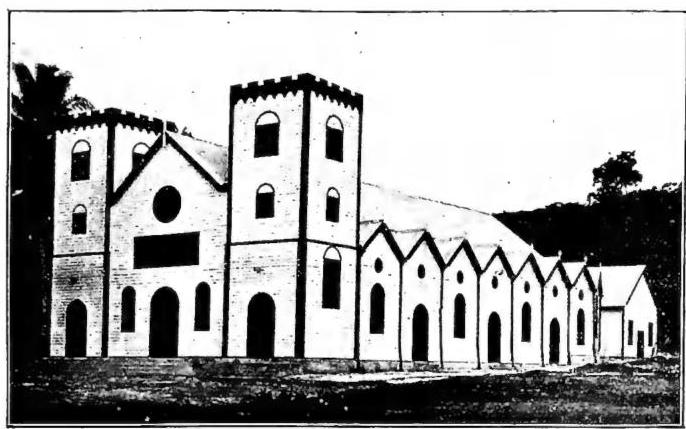
(photo Fides)
SALOMONE MERIDIONALI, VICARIATO APOSTOLICO delle Isole — The cathedral of Visale, on the island of Guadalcanal, blessed on 11 May 1930.
he advanced as far as the Holy of Holies, perhaps driven above all by an irresistible curiosity about the mystery with which the Jews surrounded that place (Tacitus, Historiae, V, 9). Much more problematic is the identification of the “righteous,” who are often mentioned (2, 36; 3, 8; 4, 1.6.8, etc.), with Asidei (v.) from the period of the Maccabean struggles (cf. I Mach. 2, 42).
The Salmi di S. have come down to us only in the Greek text. Since they are found in biblical manuscripts, they have been published in critical editions of the Bible. H. B. Swete (The Old Testament in Greek, III, 4th ed., Cambridge 1912, pp. 765–87) reproduces cod. 253, while A. Rahlfs (Septuaginta, II, Stuttgart 1935, pp. 471–89) gives the edition of O. Gebhard (Texte und Untersuchungen, 12, II), Leipzig 1895. R. Harris discovered a Syriac text containing the Salmi di S. together with the Odi di S. He published it in collaboration with A. Mingana (The Odes and Psalms of Salomon, I. The text, Manchester 1916; II. The translation with introduction and notes, ibid. 1920). Scholars, however, agree that these are translations of a Hebrew or Aramaic text, composed after 63 by a Jerusalemite Jew.

The work is recognized as the product of a Christian writer of the 3rd century, who probably made use of Jewish documents from the 1st century A.D. The writing has come down to us
only in the original Greek text, already published in PG 122, 1315–58, of which C. C. McCown (The Testament of Solomon, Lipsia 1922) produced a critical edition. Angelo Penna