
GREGORIO NAZIANZENO. — Together with Basilio di Cesarea and Gregorio di Nissa, G. di Nazianzo forms the triad of the so-called “luminaries of Cappadocia.” He did not possess the virtue of action—or did not possess it to the same degree as Basilio—nor the speculative vigor of the Nisseno; but he did possess, albeit to a lesser extent, both virtues (although his was a meditative temperament, fond of solitude, and his mind was more that of a man of letters than of a philosopher). And greater than in the other two was his gift of speech; not, however, speech for its own sake, which is the reason for the impression of emptiness and falsity left by the books of contemporary pagan writers, but speech filled with all its dialectical and emotional significance. Rather than “theologian,” as he was called, he would deserve to be called “the orator.”
SUMMARY:
I. LIFE
II. WORKS
III. DOCTRINE.I. LIFE
G. of Nazianzus was born, probably in 330, at Arianzo, a village of Tiberina in Cappadocia, near Nazianzus. His father, also named Gregorio, had converted to Christianity after having belonged to the Judeo-pagan sect of the Hysistari, worshippers of the «Most High»; he had then become a priest and subsequently a bishop. His mother, Nonna, was a Christian, and was «a woman in body, but in character superior to a man» (De vita sua, 59). She wished to see a male child in her household — G. recounts — and turned to God, offering the unborn child to him as a gift; and a nocturnal vision appeared to her, revealing the appearance and name of the child who was to be born. And when the son came, he was already alieni iuris,he belonged to God «like a lamb or a calf, a most noble victim adorned with reason». He began his studies at Caesarea in Cappadocia, where he met Basilio, with whom he was to form a devout friendship, unharmed by the difference in their temperaments (G.’s being changeable and inconstant, Basilio’s resolute and assured), and in which G.’s part always preserves the tone of a generous humility. He then went to Caesarea in Palestine, where the rhetorician Thespesio was his teacher, and afterward to Alexandria, at the time when Atanasio was patriarch; and from there, after an adventurous journey, to Athens, where Basilio joined him, and where he heard Proeresio, the Christian rhetorician, and met Giuliano, the future apostate emperor. He stayed at Athens somewhat longer than Basilio, and perhaps lectured there on rhetoric; on the return journey to his homeland, he stopped at Byzantium, where he met his brother Cesario and received Baptism (apparently in 360). Returning to Nazianzus, he «danced for his friends», as he himself says; that is, he acted as a rhetorician. Uncertain whether to abandon himself to the solitude he desired and thus realize his ideal of an ascetic life — an ideal which his stay in Alexandria, with the examples of cenobitic life it provided, must have confirmed in his mind — or to give the necessary assistance to his elderly and sick parents, he chose a middle course, dividing his time between Nazianzus and Basilio’s hermitage near Neocaesarea.
From this period perhaps dates, together with the compilation of the monastic rules, the Philocalia, a series of extracts, also made in collaboration with Basilio, from the works of Origene, whose memory he had found alive in the schools of Caesarea in Palestine and Alexandria, and whose influence he was not to escape without difficulty. The conditions of the Church of Nazianzus in fact made G.’s presence necessary, at a time when the danger of heresy — the formula of Rimini, signed also by G.’s father, «through simplicity of mind», as the son’s biographer says —
and the disturbances of the monks threatened the peace and unity of the Church. G. restored peace, probably in 360; the following year — if the date is certain — he was ordained a priest by his father, «by a tyrannical act», as he himself says; and he then fled, bewildered before the magnitude of the task, to Pontus, to his friend Basilio. He returned only after his father’s insistent prayers, and remained beside him for nine years, assisting him in the administration of the diocese. One of the most notable acts he carried out during this period was the reconciliation, through his good offices, of Eusebio, bishop of Caesarea, and Basilio. In 368 his brother Cesario died; in 371 Basilio, already for a year archbishop of Caesarea, during his jurisdictional struggle with Antimo, bishop of Tiana, created several new dioceses and placed his friend G. at the head of that of Sâsima. The dreary village, situated midway along Cappadocia’s main road, dusty and echoing with shouts, cries, and the clanking of chains, inhabited by foreigners and travelers, was certainly not a suitable setting for that life of «philosophy» which G. dreamed of; from the religious point of view, it offered the unpromising prospect of a period of turmoil and conflict. G. was unable to refuse, despite the sadness and indignation aroused in him by Basilio’s decision, but he did not take possession of the diocese; indeed, immediately after the election, he had already, as his biographer says, «meditated flight in his heart». He withdrew into solitude, but once again returned from it at his father’s prayers, serving as his coadjutor. When,
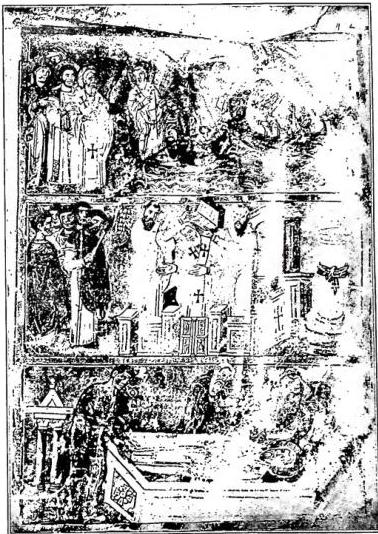
in 374, his parents died, G. was free («free at an unfortunate moment», οὐ καλῶς ἐλεύθερος), and then left Nazianzus to withdraw to the convent of S. Tecla, at Seleucia in Isauria; it was there that he learned of the death of Basilio, which had occurred in 379 (though only in 381 would he be able to deliver his funeral eulogy at Caesarea). Meanwhile, however, events were developing that were to draw him once more from his quiet retreat.
At Valente’s death, Teodosio succeeded him in 379 in governing the Eastern Empire; by an edict of 27 February 380, the new Emperor announced to his peoples that all were to profess «the religion already taught by the apostle Peter to the Romans, and currently proclaimed by Pope Damaso and by Pietro, bishop of Alexandria». In Constantinople the Arians still held possession of the churches, headed by the bishop Demofilo;
but as soon as the situation began to become more favorable, the orthodox regained courage and thought of reorganizing themselves. The orthodox of the East encouraged this revival among their friends in Constantinople, and from among them G. was chosen, as early as the time of his retreat at S. Tecla, to govern that nucleus of orthodox believers. G. allowed himself to be pressed at length, but finally, in 379, was persuaded to depart for the “new Rome.” A makeshift little church, the Anastasia, with its beautiful symbolic name, received the small flock of the Nicenes and witnessed—until the Cathedral was restored to the Catholics—the triumph of G.’s great eloquence (the five theological orations, which earned him the name of “Theologian,” belong to this period), for the sake of which Jerome traveled from Syria to Constantinople to hear the words of the man whom he was to greet as his teacher (De viris ill., 177). But the task of the new pastor was made particularly difficult, in addition to the hostility of the Arians, by the rivalries and dissensions among the Catholics. The case of Maximus, an ambiguous figure, a Cynic philosopher and ascetic who, relying on the support of Peter, bishop of Alexandria, after insinuating himself into the friendship of the good G., attempted by a coup de main to have himself proclaimed bishop of Constantinople, is characteristic of the religious customs of the time. Maximus was driven out by the mass of the faithful who loved G., and vainly attempted to obtain justice from Theodosius and from the bishop of Alexandria—and subsequently, it seems with greater success, also in Rome, from Damasus—but snares of every kind and acts of violence (at the beginning G. had already run the risk of being stoned) were ultimately to exhaust a constitution such as G.’s; he would have fled once again had he not been restrained by the thought that “the Trinity would have departed from Constantinople together with him.” Meanwhile, the situation was being resolved in his favor. Theodosius entered Constantinople on 24 November 380 and, two days later, took the churches from the Arians and restored them to the Catholics; Demophilus was compelled to leave Constantinople. G., following the Emperor, was led in procession to S. Sophia with great solemnity, amid a broad deployment of forces. In the church, where the sun, suddenly breaking through the windows into the cloudy morning, had seemed a sign of God’s favor, the crowd acclaimed G. as bishop; and he was in fact bishop even before the Council convened by Theodosius in 381, under the presidency of Meletius, bishop of Antioch—at least during the arrival of the first bishops—had proclaimed him bishop of Constantinople. New difficulties nevertheless soon arose. Meletius died during those days, and the succession to the see of Antioch was opened. G., conciliatory and meanwhile called to preside over the assembly, supported the succession of Paulinus, who had been bishop of Antioch during the schism of that see and whose appointment was the natural solution, also advocated by the Westerners. But the Meletians, who formed the majority in the Council, decided not to recognize Paulinus and set up another candidate against him, Flavian. Meanwhile new participants in the Council were arriving, the bishops of Egypt and Macedonia, favorable to Paulinus (among them Timothy, who had succeeded Peter in the see of Alexandria); not out of hatred for G., but against the Meletians who had elected him, they began to challenge G.’s election, on the pretext that he, as bishop of Sasima, could not, by virtue of the canon of Antioch, be transferred to another see (in reality G. had never taken possession of the diocese of Sasima). All this deeply embittered G., who ultimately resigned his office—in which he was replaced by Nectarius—and in July 381, after bidding farewell to his church of Constantinople, returned to Cappadocia, to Nazianzus. He remained there for two years, administering that church, which had long been without its bishop; afterward, having had a successor appointed in the person of Eulalius, he withdrew to Arianzus, where he lived—apparently until 389 or 390—amid ascetic practices and his beloved studies, from which the events of life, at times tumultuous, had distracted him but not entirely separated him.
Doctor of the Church, feast 9 May; in the Greek Church, 19 or 25 January.
II. I and II), Symeon Metaphrastes, etc
Studies: In addition to the well-known treatises on Church history and Christian literature: Tillemont, IX, p. 305 ff.; C. Ullmann, Gregorius von Nazianz, Gotha 1867; L. Montaut, Revue critique de quelques questions se rapportant à St G. de N. et à son siècle, Paris 1878; A. Benoit, St G. de N., ibid. 1884; J. Sajdak, Quæ ratio inter Gregorium Nazianzenum et Maximum Cynicum intercedat, in Eos, 15 (1909), pp. 18–48; A. Puech, Hist. de la litt. grecque chrétienne, III, Paris 1930, pp. 318–95; E. Fleury, Helléisme et christianisme, St G. de N. et son temps, ibid. 1930; S. Giet, Sasime, une méprise de St Basile, ibid. 1941; P. Gallay, La vie de St Grégoire de Nazianze, Lame-Paris 1943.II. WORKS
The work of G. is very extensive: it comprises 45 orations, 245 letters, and a large quantity of verse, approximately 17,000 lines, distributed among several hundred poems. Of the orations, very few are exegetical in character (XXXVII, XLV: what Jerome relates, Ep. 2 ad Nepotianum, concerning a statement G. allegedly made to him on exegetical matters is less a proof—indeed, it is not a proof at all—of the speaker’s superficiality in this field than of the habits of the crowd, “which admires most what it does not understand”), and few are moral in the strict sense. Among the latter, the most beautiful is that on love for the poor, XIV, delivered at Caesarea, probably in 373, some time before the construction of that great hospice for the poor and lepers which was the “city of Basil” (and with which it must in any case be connected). Most are occasional or polemical discourses; few, but of the greatest importance, are the theological orations.Among the occasional discourses, the Epitaphs, or funeral orations, deserve particular mention: for his brother Cesario (VII, delivered between 368 and 369: it should be said at once, although the observation does not concern this oration, that the chronology of the orations is in many cases disputed), for his sister Gorgonia (VIII, between 369 and 374), for his father (XVIII, from 374), and especially that for Basil, which many, and not without reason, regard as G.’s masterpiece (XLIII, from 381): all are rich in familial and historical information, and fresh with memories and vivid impressions, despite the rhetorical conventions of the genre. Of particular importance is the Apology for his flight (II, from 362, following shortly after I, delivered upon his return from his flight): in it—the extant oration being an elaboration of the one delivered—he justifies his flight after his father had ordained him a priest. This justification, however, deals above all with the duties and obligations of the priest, faced with the magnitude of which he had fled, not through cowardice or weakness, but from fear of proving unequal to a task whose incomparable, superhuman greatness he perceived, unlike others: the homily is therefore almost a treatise, and deserved to be kept in mind by s. Giovanni Crisostomo when composing his splendid De sacerdotio.
The two “invective discourses,” λόγοι στηλετευτικοί—IV and V, from 363–64—directed against Giuliano l’Apostata, stand apart from the others by virtue of their particular nature; they were almost certainly never delivered. They are discourses of overflowing violence, and therefore perhaps not always dispassionate in their assessment of events, laden with rhetorical artifices, but animated by a breath of sincere and powerful passion. Some are panegyrics of saints (of s. Cipriano d’Antiocchia [XXIV, from 379], and s. Atanasio [XXI, from 373 or 379]) or eulogies (of Merone, an Alexandrian philosopher in whom the Cynic Massimo has been recognized [XXV, from 379], and of the Maccabees, XV, from 373), or discourses intended for particular festive celebrations (Christmas, XXXVIII, from 379–80; Epiphany, XXXIX, from 380–81; Easter, XLV, later than 383; Pentecost, XLI, between 379 and 381, together with the discourse on Baptism, XL, delivered the following day; In novam dominicam, XLIV, from 383).
Of particular interest are those discourses that refer to events and episodes in G.’s life, or to events that concerned him, even indirectly: his appointment as bishop of Sassima (IX–XI, from 372); Massimo’s attempt (XXVI, from 380); his proclamation in S. Sofia (XXXVI, November 380); his definitive departure from Constantinople after his resignation (XLII, from 381); the schism of Antioch (XXIII and XXXII, from 379); the conduct of his audience (III, approximately from 362); his installation in the church of Nazianzo (XII, from 372); the consecration of Eulalio, bishop of Doara (XIII, from 373); conditions in the city of Nazianzo (XVI, XVII, from 373; XIX, from 374); the controversy with the Arians concerning the restoration of the churches (XXXIII, XXXV, from 379–80); the arrival of the Egyptians (XXXIV, from 380); and the reconciliation between G.’s father and the monks (VI, perhaps from 364).
The theological orations are five (XXVII–XXXI) and were delivered in 380, specifically, it would seem, after 28 February and before 24 November, at Constantinople, in defense of Nicene orthodoxy against the Arians: they represent the finest achievement of theological eloquence in the fourth century. In the first, directed against the Eunomians, he speaks of the qualities—which are not possessed by just anyone, even one endowed with talent, but require the attainment of a high degree of moral perfection—that must be possessed by anyone called upon to speak about dogma. In the second, he discusses the nature and attributes of God, and reaffirms the impossibility of defining him in positive terms without resorting to anthropomorphic expressions, which would nevertheless entail the risk of falling into idolatry. In the third, whose subject is the dogma of the Trinity, he establishes the equality of the Three Persons and, by appealing to the texts of Scripture and to faith, affirms the divinity and consubstantiality of the Son, in opposition to the views of Eunomius. In the fourth, he gives the correct interpretation of the biblical texts, above all of Prov. 8:22, on which the Arians relied. In the fifth, against the objections of the Pneumatomachi, or Macedonians—who drew strength from the absence of any reference to the matter in Scripture—he affirms the divine nature of the Holy Spirit, who is not begotten (unlike the Son), but proceeds from the Father by ἐκπρόσωσις, by procession. Other discourses of a theological character are XX and XXXII: the former, De dogmate, demonstrates the necessity of knowledge of Scripture and holiness of life in those who wish to engage in theology (and, against Arius and Sabellius, affirms the unity of nature and the trinity of Persons in God); the latter, De moderatione in disputationibus, combats the theological mania of the Orientals. The first was delivered in 379, the second in 380–81. Also polemical, but fundamentally doctrinal in content, are the aforementioned discourses XXXIII and XXXV, against the Arians, and that on the arrival of the Egyptians (XXXIV).
The epistles seem to belong for the most part to the final years of G.’s life (383–89): important from a literary point of view—they appear to have been written with publication in mind—they are less important, or not as important as the letters of Basil or even those of Giovanni Crisostomo, from the historical and documentary standpoint. Some—the CI and CII to the priest Cledonio, and the CCII—also have theological importance, both for the clarification they provide of dogmatic concepts and for the battle they wage against heresy, especially Apollinarianism; they also exerted considerable influence—the CI—on the theological formulation of the Councils of Ephesus and Chalcedon. The authenticity of epistle CCXLIII, to Evagrius, is doubtful, although it too is significant from a theological standpoint (the authenticity of letters XLI, XLII, and XLIII has also been disputed, but apparently without sound basis).
The poems, likewise produced for the most part during the final years of G.’s life, could be divided into autobiographical poems (among them, particularly noteworthy, is the long poem De vita sua, consisting of 1,949 lines; the satirical and polemical poems could also be included in this section, such as that against Massimo and those against Apollinaris), poems concerning “others,” and theological-moral poems. The epitaphs and epigrams would constitute a separate section; the iambics to Seleucus seem to be by Amfilo-chio di Iconio. Many of these poems, and not only those serving exclusively practical purposes, are nothing more than prose put into verse; but in many there is genuine poetry—those in which the author “confesses,” questions himself, addresses his soul, expresses sentiments new and unknown to pagan poetry, and sometimes does so with a new accent—and which reflect his temperament even more than the orations and letters.
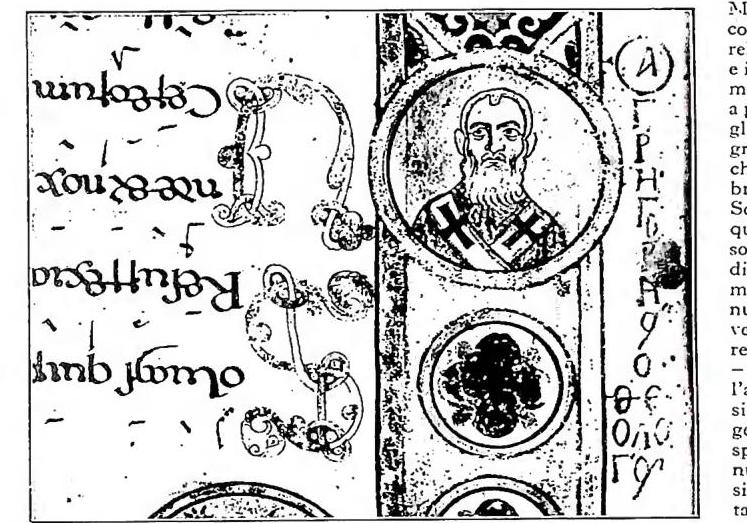
Of disputed authenticity—but apparently unjustly—is the Testament, by which G., as early as 381, before departing from Constantinople, disposed of his property in favour of the church of Nazianzus.
On the letters: M. Guignet, Les procédés épistolaires de st G. de N., Parigi 1911 (in an appendix to the volume cited above); G. Przychocki, De Gregorii Nazianzeni epistulis quaettiones selectae, Cracovia 1912; P. Gallay, Langue et style de st G. de N. dans sa correspondance, Parigi 1933; id., Liste des manuscrits des lettres de st G. de N., in Revue des ét. grecques, 1944, pp. 106-24. - On the poems: A. Grenier, La vie et les poésies de st G. de N., Clermont-Ferrand 1858; P. Stoppel, Quaettiones de Gregorii Nazianzeni poetarum scatenorum imitatore, Rostock 1881; W. Ackermann, Die didaktische Poesie des Gregor von Nazianz, Lipsia 1903; L.F.M. De Jonge, De Gregori Nazianzeni carminibus quae inscribi solent negl. fauxus, Amsterdam 1910; Q. Cataudella, Le poesie de G. N., in Atene e Roma, 1927, pp. 88-96; M. Pellegrino, La poesia de G. N., Milano 1932; B. Wyss, in Museum Helveticum, 6 (1949), pp. 177-210.
III. DOCTRINE
G., despite the vices of the prevailing Asianism, largely redeemed by the sincerity of his feeling, was a writer of uncommon qualities, a vigorous and effective orator, a lively controversialist, and a lucid and well-equipped reasoner; but he was not an original thinker or a philosopher. He created, nor did he even possess, any precise system of doctrines outside the dogmatic field. He knew the Greek philosophers, and influences of Plato are recognizable in his work (for example, the idea that like is known by like, etc.), as are those of the Stoic and Cynic philosophers (in certain aspects of morality), and of Neoplatonism (the world of spiritual essences, etc.). Unlike certain currents of Christian thought, he did not reject secular science, but wished it to be the handmaid of sacred science. In the moral sphere, and especially in the social sphere, certain of his radical affirmations are noteworthy concerning the natural equality of all human beings—slaves and free, rich and poor—and concerning the problem, in any case viewed in its moral function, of individual property and wealth; but here too the authority on which he relies is essentially constituted by the sacred books and apostolic tradition.Despite the nickname “Theologian” that he bore, and the authority he acquired in this field, on account of which Rufinus could say (in the preface to his translation of some of G.’s orations, CSEL, 46) non esse rectae fidei omnem qui in fide Gregorio non concordat, his work cannot be placed on the same level as that of those who built the edifice of Catholic theology. It would not, however, be just to reduce G.’s work, as is often done, to that of a simple authorized representative of the common belief of the Greek Church of the fourth century, that is, merely an interpreter of the doctrine received through tradition.
Certainly, he is a first-rate interpreter of the Trinitarian faith, a lucid and coherent expositor of the doctrine of Athanasius and Basil (the formula he defends, “one essence in three hypostases,” is clarified by the other, unum tres divinitate, et hoc unum tres proprietatibus, which expresses with admirable clarity his doctrine concerning the indivisibility of the divinity in the distinction of the three hypostases); but it must also be added that he does not share Basil’s hesitations, which G. attributes to his «ἐκκλησία», that is, to prudent concessions dictated by the circumstances of the moment, on one point of Trinitarian doctrine, namely, the divinity of the Holy Spirit. G. does not hesitate to proclaim it openly (“Is God the Spirit? Certainly. Therefore consubstantial, ὁμοιόσιον? Yes, if he is God,” Or., XXXI, 10); and in defining the relationship among the Three Persons, particularly the relations of the Holy Spirit with the other two Persons, regarding which there was not yet an entirely settled doctrine, he contributes clarification and precision, going beyond what his predecessors had done in formulating the doctrine of the procession (ἐκπύρευσις) of the Holy Spirit. He defines the first of the Three Persons (hypostaseis) by means of the ἐκκλησία, the second by means of the γέννησις, and the third by means of the ἐκπύρευσις. The Holy Spirit—he says in the same theological oration V—insofar as he proceeds from the Father, is not a creature; insofar as he is unbegotten, he is not the Son; insofar as he stands between the unbegotten and the begotten, he is God. “You ask me what this ἐκπύρευσις may be: well then, tell me what the ἀγεννησία of the Father is, and I will explain to you what the γέννησις of the Son and the ἐκπύρευσις of the Holy Spirit are.” Catholic theology needed only to take one further step, with the proclamation of the Filioque, in order to arrive at orthodoxy as it was subsequently and definitively established.
Also in the problem of the two natures in the person of Christ, Basil had not been sufficiently rigorous, at least not as rigorous as G., who fought the Apollinarian heresy tenaciously (Basil, on the other hand, was accused of having maintained good relations with Apollinaris), asserting the impossibility that Christ possessed only the divine νοῦς and not also the human νοῦς, and demonstrating that the Redemption could only have been the work of a Jesus in whose person the two natures, human and divine, were united, without either of them having suffered any diminution. He explicitly acknowledges Mary’s title of Θεοτόκος, Mother of God. With regard to the doctrine of the Redemption, G., unlike the others, categorically condemns the idea of a ransom price—which would be Christ—paid by God to the devil: to believe such a thing seems to him an insult to the Lord. He admits the existence of an original sin and, while not denying the contribution made by human beings, attributes to Grace the beginning and the completion of every good; against the Novatians, he believes in the efficacy of penance.
In biblical exegesis, G., while clearly experiencing the influence of Origen, adopted, like the other Cappadocians, an intermediate position between the allegorical interpretation of the Alexandrians and the literal interpretation of the Antiochene school (but, unlike the Nissen, with a more pronounced tendency toward the former); moreover, he regards as custodians of revealed truth not only the Bible but also all those who, under the influence of the Holy Spirit, were enlightened by II.