TESTAMENT. — It is the act by which a person disposes, for the time when he shall have ceased to live, of all or part of his property (Italian Civil Code, art. 587).
1. Meaning
A testament is a solemn and formal act; that is, its validity is subject to compliance with certain forms established by law, which may not be waived. It confers upon the instituted heir the status of heir in the strict sense when the attribution of the property is made by universal title, that is, comprising the entirety of the testator’s property or a share of the whole; it is understood, however, that by testament one may also leave individual assets or groups of individual assets as an inheritance, when it is expressly stated or is manifest that they are attributed as a share of the estate; if, on the other hand, individual assets are disposed of as such, that is, by particular title, there is simply a legacy (v. art. 588). The law prohibits a single testament from being made by several persons, even if the heir or legatee is possibly one and the same person; it likewise prohibits the same act from containing a reciprocal testament, that is, reciprocal testamentary dispositions (art. 589); it is not prohibited, however, to draw up two or more testaments in favour of the same or of different persons, or even with reciprocal dispositions by two or more testators, on the same sheet or series of sheets.A testament is essentially revocable, that is, it is not permissible for it to be conceived and implemented in such a way that the testator cannot subsequently change what he has disposed of by testament; every clause or condition contrary to this rule is legally without effect (art. 679). Revocation of a testament may be effected by a new testament or by an act received by a notary in the presence of two witnesses, provided that in the latter case the testator states that he wishes to revoke the previous testament in whole or, where appropriate, in part (art. 680); the aforesaid revocations may themselves be revoked under the same conditions, thereby legally restoring the testament that had previously been revoked (art. 681). A new testament that does not expressly revoke the previous testament or testaments annuls only those prior dispositions that are incompatible with it (art. 682). Likewise, a testament may be revoked by destruction, tearing or erasure; this, however, may be done only by the testator with the intention of altering in whole or in part the previous dispositions (art. 684); finally, «dispositions by universal or particular title, made by one who at the time of the testament did not have, or was unaware that he had, children or descendants, are revoked by operation of law by the existence or subsequent arrival of a legitimate child or descendant of the testator, even if posthumous, or legitimated or adopted, or by the recognition of a natural child» (art. 687), unless the testator has likewise provided for the possible existence or recognition of children, and in all cases provided that the children or descendants in fact actually succeed to the inheritance.
Suspensive or resolutory conditions are lawful in a testament (art. 633); they are nevertheless deemed not to have been attached if they are impossible or contrary to mandatory rules, public order or good morals (art. 634), or if they prevent first or subsequent marriages (art. 636), or are subject to reciprocity (art. 635).
Substitution is also permitted, both ordinary (arts. 688-91) and fideicommissary (arts. 692-99): by the former, the testator may substitute another person for the heir instituted by him if the instituted heir cannot or does not wish to accept the inheritance; by the latter, the testator imposes upon his child the obligation to preserve, in whole or in part, the assets constituting the disposable portion (not therefore the reserved portion, which cannot be encumbered) for the benefit of all the children already born or yet to be born of the heir, or for the benefit of a public body; he may similarly impose this obligation upon a brother or sister who have likewise been instituted as heirs: in matters of inheritance, no other cases of fideicommissary substitution are permitted (art. 692).
2. Forms
Italian legislation provides for two different forms of testament, the ordinary and the special. The ordinary form comprises two types of testament, of which the first, the classical one, is that constituted by a holographic testament; the second is that made by notarial act. The special form is reserved for wholly exceptional cases specifically provided for by law.A holographic testament (art. 602) must be written entirely in the testator’s own hand, from beginning to end; the handwriting must be such as to be capable of serving as evidence: writings in block letters, shorthand and the like are therefore excluded; nevertheless, a testament written with a pen or pencil, on paper, metal, leather or similar materials, is holographic, while all printed matter, typewritten texts or writings produced by mechanical means are consequently excluded. A holographic testament must also bear a signature; in addition to the first and family names, pseudonyms are recognized as signatures when they leave no doubt whatsoever as to the identity of the testator; under the same condition, signatures consisting only of a nickname, a simple set of initials, or descriptions which, considered in relation to the heir, identify the testator (e.g., your father, your mother, your paternal grandfather, your maternal grandmother and the like) are recognized; in every case the signature must be affixed at the end of the testamentary dispositions. It is also indispensable to indicate the date, comprising the day, month and year; this indication may also be implicit, provided that it admits of certain interpretation (e.g., Christmas Day of the first year of the pontificate of Pius XII); it is not necessary to indicate the hour.
A testament by notarial act may be public or secret: a) in a public testament (art. 603), the testator states aloud to the notary, in the presence of two witnesses, what he intends to dispose of; the notary writes it down himself or has it written down by another person by hand; the notary then personally, and never by substitution, reads to the testator what he has written or had written under his dictation and which contains the testamentary dispositions; in a public testament it is indispensable that, in addition to the date, the hour at which the testator signed be indicated, together with the place where the testament was received; b) a secret testament (arts. 604-605) may be written, including by mechanical means, by the testator or by a third party on his behalf; if it is written by a third party or mechanically, the testator must sign each individual half-sheet in his own hand; the whole is then placed in an envelope or other packet and sealed; it is then brought to the notary, to whom, in the presence of two witnesses, the testator declares that the packet contains his own testament; finally, the notary draws up the instrument, which is preserved in accordance with the law.
(phot. Catholic Encyclopedia)
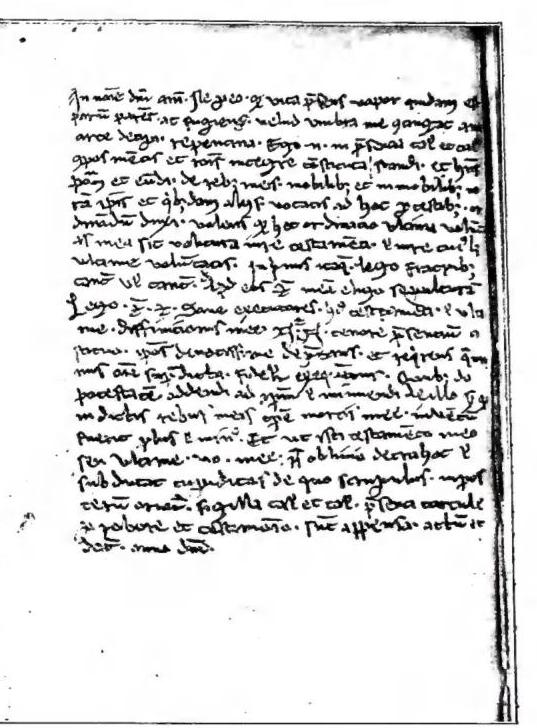
TESTAMENTO - Model of a private will transcribed by a fourteenth-century hand on a blank page of cod. Reg. lat. 84, f. 19° of the eleventh century, published by A. Wilmart in Analecta Regimenia, Vatican City 1933, pp. 287–88 – Vatican Library.
in all cases, however, in the presence of at least two witnesses aged sixteen or over (art. 609); 2) a will on board ship is received by the commander: it must be drawn up in two original copies before two witnesses and signed by the testator, by the person receiving it, and by the two witnesses (arts. 611–12); 3) a will made on an aircraft is received by the commander, but only one witness is required (art. 616); 4) the will of military personnel belonging to mobilized corps or services, or employed in war, or held in captivity, is received by an officer, a military chaplain, or an officer of the Red Cross in the presence of two witnesses and signed by the testator, the recipient, and the witnesses (arts. 617–18). Wills made in special forms remain valid until the expiry of the third month from the time when the testator is able to resort to ordinary forms, in accordance with the provisions of arts. 610, 615, 616, 618.
3. Subject
There is an active subject: the testator, and a passive subject: the person in whose favor the will is made.All those who are not expressly excluded by law are capable of making a will. Under art. 591, the following are incapable of making a will: a) those who have not reached the age of eighteen; b) persons interdicted on account of mental illness, under art. 427; c) those who, although not interdicted, are proven to have been, for any cause, even temporary, incapable of understanding or willing at the time when they made the will (art. 591); a will made by one of the persons listed above may be declared null at the request of the interested parties within five years from the time when the will itself was executed; d) under art. 32 of the Penal Code, those sentenced to life imprisonment are likewise incapable of making a will, and any previous wills of theirs are also invalidated; the nullity is automatic and may be invoked without any limitation of time by anyone having an interest therein.
Passive subjects are those who are not excluded by law from receiving under a will. Some are subjects by law and necessarily; under the rules referred to in arts. 565–86, a specific share of the testator’s estate must necessarily be assigned to them, and they are called forced heirs. Others may freely be called by the testator to succeed to his disposable property. Particular limitations are nevertheless provided for in arts. 592–600. In addition to those born, or at least conceived, at the opening of the succession, the children of a specified person living at the time of the testator’s death may also be passive subjects of a will, even if they have not yet been conceived (art. 462).