**TESTAMENT** IN SACRED SCRIPTURE. — The Latin term *testamentum* in the Vulgate often translates the Hebrew *bērîṯ*, which denotes both a covenant between private individuals and an alliance between nations or ethnic groups (*Gen. 21:22 ff.; Ex. 23:32; 34:12, 15; Deut. 7:2; Josh. 9:9 ff.; Judg. 2:2, etc.*). Generally, it refers to the covenant established between God and His people: a privileged relationship, willed and realized by God, which is bilateral insofar as it is always expressed as a condition of God’s faithfulness to His promises upon the observance of the Law.
In this sense, the Latin term *testamentum* is not entirely appropriate; it was adopted under the influence of the Septuagint, which rendered *bērîṯ* as *διαθήκη* (*disposition*, more often *testament*). Aquila and Symmachus preferred *συνθήκη* (*covenant*), and St. Jerome (*In Mal. 2:4: PL 25, 1555*) already warned that the word *T.* in many places in Scripture does not mean the will of the deceased but a covenant between the living. The ordinary meaning, however, can be found in *Gal. 3:15* and *Heb. 9:16*. This sense applies well to the writings of the New Testament, inasmuch as their content can be considered an inheritance, a good (Redemption) closely connected with the death of Jesus Christ. For the books that contain the history and prophecies of the Hebrew people, it is more logical to speak of writings concerning the *covenant* between God and humanity.
The use of *T.* in the sense of a collection of inspired books is very ancient in Christian tradition. It is already found in the Bible: St. Paul (*2 Cor. 3:14*) speaks of the *reading* of the Old Testament; 1 Macc. 1:60 describes the persecution promoted by Antiochus IV Epiphanes against *the books* of the Lord’s Testament.
**
**APOCRYPHAL TESTAMENTS. —** *I. Testament of the Twelve Patriarchs.* An apocryphal book of the Old Testament, originating in circles of the 2nd–1st century B.C., later interpolated by Christian hands from the 2nd century A.D. onward, important for understanding the religious mentality of Judaism in the 1st century, especially regarding messianism.
It contains the words that each of the twelve sons of Jacob would have spoken before dying to their descendants and to all Israel, in imitation of Jacob himself (*Gen. 49*), Joseph (*ibid. 50:24 ff.*), and Moses (*Deut. 31–33*). Each *testament* has a historical or biographical section (the patriarch recalls his life, especially the virtue or vice by which he was distinguished), a section on kinship (he recommends or dissuades imitation of his conduct), and a prophetic or eschatological section (he predicts that his descendants or the whole people, because of their sins, will be punished but will thus return to God, thus becoming worthy of receiving messianic salvation).
The problem of its time of origin is complicated by the presence of many interpolations. At first, the clear allusions to Christian doctrines (even to the Incarnation of God and His birth of a Virgin) led it to be considered entirely of Christian origin (Sinker, Deane).
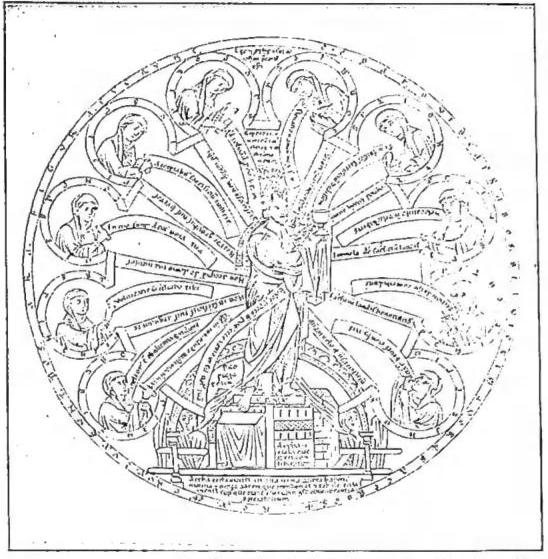
(from Rerrodz di Landsberg, *Herbas Delicurarum*, edited by A. Straub, G. Keller, Strasbourg 1901, p. 87) Testament in Sacred Scripture – Old Covenant and ritual law, miniature from the *Hortus Deliciarum* of Herrad of Landsberg, fol. 67r (c. 1230).
**T. APOCRYPHA. — I. Testament of the XII Patriarchs.** An apocryphal book of the Old Testament, originating in circles dated to the 2nd–1st century B.C., interpolated by Christian hands from the 2nd century A.D. onward, important for understanding the religious mentality of Judaism in the 1st century, especially regarding messianism.
It contains the words that each of the twelve sons of Jacob would have addressed to their descendants and to all Israel before dying, in imitation of Jacob himself (*Gen. 49*), of Joseph (*ibid. 50:24 ff.*), and of Moses (*Deut. 31–33*). Each *testament* has a historical or biographical section (the Patriarch recalls his life, especially the virtue or vice by which he was distinguished), a section on kinship (he recommends or dissuades imitation of it), and a prophetic or eschatological section (he predicts that for its sins the people will be punished, but will thus return to God, thus obtaining messianic salvation).
The problem of its time of origin is complicated by the presence of many interpolations. At first, the clear allusions to Christian doctrines (even to the Incarnation of God and His birth of a Virgin) led it to be considered entirely of Christian origin (Sinker, Deane).
**T. APOCRYPHA. — I. Testament of the XII Patriarchs.** An apocryphal book of the Old Testament, originating in circles dated to the 2nd–1st century B.C., interpolated by Christian hands from the 2nd century A.D. onward, important for understanding the religious mentality of Judaism in the 1st century, especially regarding messianism.
It contains the words that each of the twelve sons of Jacob would have addressed to their descendants and to all Israel before dying, in imitation of Jacob himself (*Gen. 49*), of Joseph (*ibid. 50:24 ff.*), and of Moses (*Deut. 31–33*). Each *testament* has a historical or biographical section (the Patriarch recalls his life, especially the virtue or vice by which he was distinguished), a section on kinship (he recommends or dissuades imitation of it), and a prophetic or eschatological section (he predicts that for its sins the people will be punished, but will thus return to God, thus obtaining messianic salvation).
The problem of its time of origin is complicated by the presence of many interpolations. At first, the clear allusions to Christian doctrines (even to the Incarnation of God and His birth of a Virgin) led it to be considered entirely of Christian origin (Sinker, Deane).
**T. APOCRIFI. -** *I. Testamento dei XII patriarchi.* Apocryphal book of the Old Testament, originating in circles of the 2nd–1st century B.C., later interpolated by Christian hands from the 2nd century A.D. onward; it is important for understanding the religious mentality of Judaism in the 1st century, especially regarding messianism.
It contains the words that each of the twelve sons of Jacob were said to have addressed to their descendants and to all Israel on their deathbeds, in imitation of Jacob himself (*Gen. 49*), of Joseph (*ibid. 50:24 ff.*), and of Moses (*Deut. 31–33*). Each *testament* includes a historical or biographical section (the patriarch recalls his life, especially the virtue or vice for which he was distinguished), a section on kinship (he either recommends or dissuades imitation of his conduct), and a prophetic or eschatological section (he predicts that, because of its sins, the people will be punished, yet will return to God and thus be disposed to receive messianic salvation).
The question of its date of origin is complicated by the presence of numerous interpolations. At first, the clear allusions to Christian doctrines (even to the incarnation of God and His birth of a Virgin) led scholars to consider the entire work as of Christian origin (Sinker, Deane).
It contains the words that each of the twelve sons of Jacob, on the point of death, would have addressed to their descendants and to all Israel, in imitation of Jacob himself (*Gen. 49*), of Joseph (*ibid.* 50:24 ff.), and of Moses (*Deut.* 31–33). Each *τ.* has a historical or biographical section (the Patriarch recalls his life, especially the virtue or vice by which he was distinguished), a section on kinship (he recommends or dissuades imitation of it), and a prophetic or eschatological section (he predicts that, because of its sins, his descendants or the whole people will be punished, but will thus return to God and be disposed to receive messianic salvation).
The problem of its date of origin is complicated by the presence of many interpolations. At first, the clear allusions to Christian doctrines (even to the Incarnation of God and His birth of a Virgin) led to the belief that it was entirely of Christian origin (Sinker, Deane).
**TESTAMENTI APOCRIFI. — I. Testament of the Twelve Patriarchs.** An apocryphal book of the Old Testament, originating in circles judged to be of the 2nd–1st century B.C., interpolated by Christian hands from the 2nd century A.D. onward, important for understanding the religious mentality of Judaism in the 1st century, especially regarding messianism.
It contains the words that each of the twelve sons of Jacob, on the point of death, would have addressed to their descendants and to all Israel, in imitation of Jacob himself (*Gen. 49*), of Joseph (*ibid.* 50:24 ff.), and of Moses (*Deut.* 31–33). Each *τ.* has a historical or biographical section (the Patriarch recalls his life, especially the virtue or vice by which he was distinguished), a section on kinship (he recommends or dissuades imitation of it), and a prophetic or eschatological section (he predicts that, because of its sins, his descendants or the whole people will be punished, but will thus return to God and be disposed to receive messianic salvation).
The problem of its date of origin is complicated by the presence of many interpolations. At first, the clear allusions to Christian doctrines (even to the Incarnation of God and His birth of a Virgin) led to the belief that it was entirely of Christian origin (Sinker, Deane).
**TESTAMENTI APOCRIFI. — I. Testament of the Twelve Patriarchs.** An apocryphal book of the Old Testament, originating in circles judged to be of the 2nd–1st century B.C., interpolated by Christian hands from the 2nd century A.D. onward, important for understanding the religious mentality of Judaism in the 1st century, especially regarding messianism.
The problem of its time of origin is complicated by the presence of many interpolations. At first, the clear allusions to Christian doctrines (even to the incarnation of God and His birth of a Virgin) led it to be considered entirely of Christian origin (Sinker, Deane).
**T. APOCRYPHA. — I. Testament of the Twelve Patriarchs.** An apocryphal book of the Old Testament, arising in circles dated to the 2nd–1st century B.C., interpolated by Christian hands from the 2nd century A.D. onward, important for understanding the religious mentality of Judaism in the 1st century, especially regarding messianism.
It contains the words that each of the twelve sons of Jacob were said to have addressed to their descendants and to all Israel before dying, in imitation of Jacob himself (*Gen. 49*), of Joseph (*ibid. 50:24 ff.*), and of Moses (*Deut. 31–33*). Each *testament* has a historical or biographical section (the patriarch recalls his life, especially the virtue or vice by which he was distinguished), a section on kinship (he recommends or dissuades imitation of it), and a prophetic or eschatological section (he predicts that for its sins the people will be punished but will thus return to God, thereby obtaining messianic salvation).
The problem of its time of origin is complicated by the presence of many interpolations. At first, the clear allusions to Christian doctrines (even to the incarnation of God and His birth of a Virgin) led it to be considered entirely of Christian origin (Sinker, Deane).
**T. APOCRYPHA. — I. Testament of the Twelve Patriarchs.** An apocryphal book of the Old Testament, arising in circles dated to the 2nd–1st century B.C., interpolated by Christian hands from the 2nd century A.D. onward, important for understanding the religious mentality of Judaism in the 1st century, especially regarding messianism.
It contains the words that each of the twelve sons of Jacob were said to have addressed to their descendants and to all Israel before dying, in imitation of Jacob himself (*Gen. 49*), of Joseph (*ibid. 50:24 ff.*), and of Moses (*Deut. 31–33*). Each *testament* has a historical or biographical section (the patriarch recalls his life, especially the virtue or vice by which he was distinguished), a section on kinship (he recommends or dissuades imitation of it), and a prophetic or eschatological section (he predicts that for its sins the people will be punished but will thus return to God, thereby obtaining messianic salvation).
The problem of its time of origin is complicated by the presence of many interpolations. At first, the clear allusions to Christian doctrines (even to the incarnation of God and His birth of a Virgin) led it to be considered entirely of Christian origin (Sinker, Deane).
**T. APOCRYPHA. — I. Testament of the Twelve Patriarchs.** An apocryphal book of the Old Testament, arising in circles dated to the 2nd–1st century B.C., interpolated by Christian hands from the 2nd century A.D. onward, important for understanding the religious mentality of Judaism in the 1st century, especially regarding messianism.
It contains the words that each of the twelve sons of Jacob were said to have addressed to their descendants and to all Israel before their death, in imitation of Jacob himself (*Gen. 49*), of Joseph (*ibid.* 50:24 ff.) and of Moses (*Deut.* 31–33). Each testament has a historical or biographical section (the Patriarch recalls his life, especially the virtue or vice by which he was distinguished), a section on kinship (he recommends or dissuades imitation of it), and a prophetic or eschatological section (he foretells that his descendants or the whole people, because of their sins, will be punished but will thus return to God, thereby obtaining the Messianic salvation).
The question of its date of origin is complicated by the presence of many interpolations. At first, the clear allusions to Christian doctrines (even to the Incarnation of God and His birth of a Virgin) led to the belief that it was entirely of Christian origin (Sinker, Deane).
**TESTAMENTI APOCRIFI. — I. TESTAMENT OF THE TWELVE PATRIARCHS.** Apocryphal book of the Old Testament, originating in circles dated to the 2nd–1st century B.C., interpolated by Christian hands from the 2nd century A.D. onward, important for understanding the religious mentality of Judaism in the 1st century, especially regarding messianism.
It contains the words that each of the twelve sons of Jacob were said to have addressed to their descendants and to all Israel before their death, in imitation of Jacob himself (*Gen.* 49), of Joseph (*ibid.* 50:24 ff.) and of Moses (*Deut.* 31–33). Each testament has a historical or biographical section (the Patriarch recalls his life, especially the virtue or vice by which he was distinguished), a section on kinship (he recommends or dissuades imitation of it), and a prophetic or eschatological section (he foretells that his descendants or the whole people, because of their sins, will be punished but will thus return to God, thereby obtaining the Messianic salvation).
The question of its date of origin is complicated by the presence of many interpolations. At first, the clear allusions to Christian doctrines (even to the Incarnation of God and His birth of a Virgin) led to the belief that it was entirely of Christian origin (Sinker, Deane).
The problem of its time of origin is complicated by the presence of many interpolations. At first, the clear allusions to Christian doctrines (even to the incarnation of God and His birth of a Virgin) led to the belief that it was entirely of Christian origin (Sinker, Deane).
**T. APOCRYPHA. — I. Testament of the XII Patriarchs.** Apocryphal book of the Old Testament, originating in circles dated to the 2nd–1st century B.C., interpolated by Christian hands from the 2nd century A.D. onward, important for understanding the religious mentality of 1st-century Judaism, especially regarding messianism.
It contains the words that each of the twelve sons of Jacob were said to have addressed to their descendants and to all Israel before dying, in imitation of Jacob himself (*Gen. 49*), of Joseph (*ibid. 50:24 ff.*), and of Moses (*Deut. 31–33*). Each *testament* has a historical or biographical section (the patriarch recalls his life, especially the virtue or vice by which he was distinguished), a section on kinship (he recommends or dissuades imitation of it), and a prophetic or eschatological section (he predicts that, because of its sins, the people will be punished but will thus return to God, thereby obtaining messianic salvation).
The problem of its time of origin is complicated by the presence of many interpolations. At first, the clear allusions to Christian doctrines (even to the incarnation of God and His birth of a Virgin) led to the belief that it was entirely of Christian origin (Sinker, Deane).
**T. APOCRYPHA. — I. Testament of the XII Patriarchs.** Apocryphal book of the Old Testament, originating in circles dated to the 2nd–1st century B.C., interpolated by Christian hands from the 2nd century A.D. onward, important for understanding the religious mentality of 1st-century Judaism, especially regarding messianism.
It contains the words that each of the twelve sons of Jacob were said to have addressed to their descendants and to all Israel before dying, in imitation of Jacob himself (*Gen. 49*), of Joseph (*ibid. 50:24 ff.*), and of Moses (*Deut. 31–33*). Each *testament* has a historical or biographical section (the patriarch recalls his life, especially the virtue or vice by which he was distinguished), a section on kinship (he recommends or dissuades imitation of it), and a prophetic or eschatological section (he predicts that, because of its sins, the people will be punished but will thus return to God, thereby obtaining messianic salvation).
The problem of its time of origin is complicated by the presence of many interpolations. At first, the clear allusions to Christian doctrines (even to the incarnation of God and His birth of a Virgin) led to the belief that it was entirely of Christian origin (Sinker, Deane).
**T. APOCRYPHA. — I. Testament of the XII Patriarchs.** Apocryphal book of the Old Testament, originating in circles dated to the 2nd–1st century B.C., interpolated by Christian hands from the 2nd century A.D. onward, important for understanding the religious mentality of 1st-century Judaism, especially regarding messianism.
It contains the words that each of the twelve sons of Jacob, before dying, would have addressed to their descendants and to all Israel, in imitation of Jacob himself (*Gen. 49*), of Joseph (*ibid.* 50:24 ff.), and of Moses (*Deut.* 31–33). Each *τ.* has a historical or biographical section (the Patriarch recalls his life, especially the virtue or vice by which he was distinguished), a section on kinship (he recommends or dissuades imitation of it), and a prophetic or eschatological section (he predicts that, because of its sins, his descendants or the whole people will be punished, but will thus return to God, thereby obtaining the messianic salvation).
The problem of its time of origin is complicated by the presence of many interpolations. At first, the clear allusions to Christian doctrines (even to the Incarnation of God and His birth of a Virgin) led it to be considered entirely of Christian origin (Sinker, Deane).
**TESTAMENTI APOCRIFI. — I. TESTAMENT OF THE TWELVE PATRIARCHS.** Apocryphal book of the Old Testament, originating in circles dated to the 2nd–1st century B.C., interpolated by Christian hands from the 2nd century A.D. onward, important for understanding the religious mentality of Judaism in the 1st century, especially regarding messianism.
It contains the words that each of the twelve sons of Jacob, before dying, would have addressed to their descendants and to all Israel, in imitation of Jacob himself (*Gen. 49*), of Joseph (*ibid.* 50:24 ff.), and of Moses (*Deut.* 31–33). Each *τ.* has a historical or biographical section (the Patriarch recalls his life, especially the virtue or vice by which he was distinguished), a section on kinship (he recommends or dissuades imitation of it), and a prophetic or eschatological section (he predicts that, because of its sins, his descendants or the whole people will be punished, but will thus return to God, thereby obtaining the messianic salvation).
The problem of its time of origin is complicated by the presence of many interpolations. At first, the clear allusions to Christian doctrines (even to the Incarnation of God and His birth of a Virgin) led it to be considered entirely of Christian origin (Sinker, Deane).
**TESTAMENTI APOCRIFI. — I. TESTAMENT OF THE TWELVE PATRIARCHS.** Apocryphal book of the Old Testament, originating in circles dated to the 2nd–1st century B.C., interpolated by Christian hands from the 2nd century A.D. onward, important for understanding the religious mentality of Judaism in the 1st century, especially regarding messianism.
The problem of the time of origin is complicated by the presence of many interpolations.