Machine translation of the 1948–1954 Italian original. The original text is authoritative.
GROSSATESTA (GREATHEAD), ROBERT. — English theologian and philosopher, born at Stradbrook (county of Suffolk) c. 1175, died at Lincoln in 1253. He studied at Lincoln and Oxford, where in 1222 he was elected chancellor of the University. Master of theology at the studium of the Friars Minor of Oxford (1224–35), archdeacon of Leicester (1229–32), in 1235 he was appointed bishop of Lincoln (hence the medieval designation Lincolniensis). In the administration of the diocese, which was then the largest in England, he engaged in bitter struggles for the implementation of a broad programme of reforms; he also resisted Innocent IV when that Pope asked him to confer benefices on clerics from other countries.
The opposition was rather the result of untimely zeal than an indication of rebellion, since G. was a fervent champion of the Roman primacy; Anglican historians therefore wrongly regard him as a precursor of Protestantism.
Although G. did not study, as seems probable, in Paris, his relations with Alexander of Hales and John of La Rochelle (de Rupello) nevertheless linked him to the intellectual movement of that centre, whose programmes he clearly followed. His numerous philosophical treatises (about 27, critically edited by L. Baur, Die philosophischen Werke des Robert Grosseteste, Bischofs von Lincoln [Beiträge zur Geschichte der Philosophie und Theologie des Mittelalters, 9], Münster 1912) deal with problems of metaphysics, psychology, and above all natural philosophy (astronomy, cosmology, physics, optics), in which he had Roger Bacon as a disciple and continuator.
(phot. Almeri)
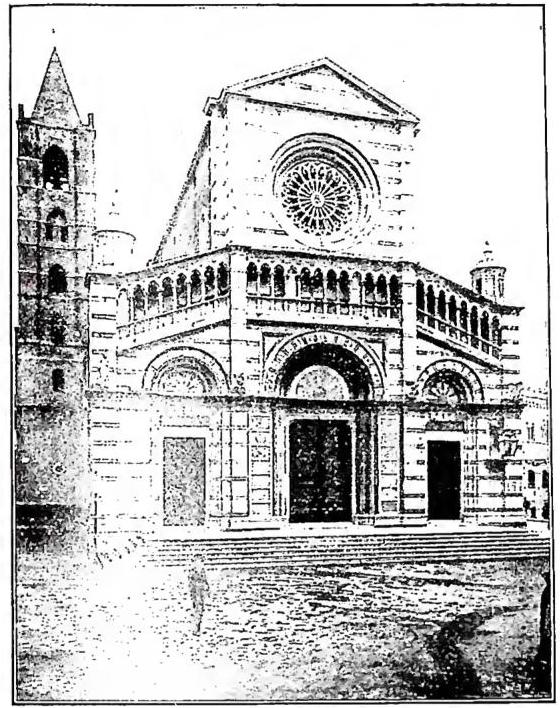
GROSSETO, DIOCESE of — Cathedral. Work of Sozzo di Pace di Rustichini (a. 1294). The bell tower, dating from 1402, was restored in 1912.
But G.’s fame is connected with his numerous translations from Greek, which had an impact, in part, on the general development of medieval thought: the Testament of the Twelve Patriarchs; the Letters of St Ignatius of Antioch (middle recension); the works of Pseudo-Dionysius with the scholia of Maximus; the De fide orthodoxa of St John Damascene; various pseudo-Aristotelian treatises; Aristotle’s Nicomachean Ethics (completed c. 1243, it is the first Latin translation), with the commentaries of Eustratius of Nicaea, Michael of Ephesus, and Aspasius. In this work he was assisted by John of Basingstoke (d. 1252) and Nicholas the Greek (d. 1279).
His extensive correspondence, valuable for historical purposes, was edited by H. R. Luard, Roberti Grosseteste, episcopi quondam Lincolnensis, epistolae (London 1861). Through his extraordinary activity G. won the admiration of his countrymen, who urged his canonization in Rome (which never took place), and of the celebrated chronicler Salimbene, who defined him as «unus de maioribus clericis de mundo» (Cronica fratris Salimbene de Adam Ordinis Minorum, in MGH, Scriptores, XXXII, p. 233).
BIBL.: Hurter, II, cols. 330–33; A. Gatard, s. V. in DThC, VI, cols. 1885–87; I. Felten, Robert Grosseteste, Bischof von Lincoln, Fribourg in Br. 1899; F. S. Stevenson, Robert Grosseteste, Bishop of Lincoln, London 1899; L. Baur, Das philosophische Lebenswerk des Robert Grosseteste, in Dritte Vereinsschrift für 1910 der Görresgesellschaft, Cologne 1910, pp. 64–67; id., Die Philosophie des Robert Grosseteste (Beiträge zur Geschichte der Philosophie und Theologie des Mittelalters, 18), Münster 1916; E. Franceschini, R. G. e le sue traduzioni latine, in Atti del reale Istituto veneto di scienze, lettere ed arti, 93 (1934), pp. 1–138; id., Grosseteste translation of the Πρόλογος and Σχόλια of Maximus to the writings of the Pseudo-Dionysius Aerop., in The journal of theol. studies, 34 (1933), pp. 335–63; id., La revisione moerbekana della «translatio Lincolnensis» dell’Etica nichomachea, in Riv. di filosofia neoscol., 30 (1938), pp. 50–62; U. Gamba, Il commento di R. G. al «De mystica theologia» dello Pseudo-Dionigi, Milan 1942; M. De Wulf, Storia della filosofia medievale, II, Italian translation by V. Miano, Florence 1945, pp. 35–38, 80–85 (with an extensive account of G.’s philosophical thought); A. Callus, The Date of Grosseteste's Translations and Commentaries on Pseudo-Dionysius and the Nicomachean Ethics, in Recherches Th. anc. médiévale, 14 (1947), pp. 186–210; I. De Ghellinck, Le mouvement théologique du XIIe siècle, 2nd ed., Bruges–Paris 1948, pp. 386–93 (on the translation of the De fide orthodoxa of Damascene, with reference to the studies of Fr Hocedez). Antonio Piolanti
Cite this article
“GROSSATESTA (GREATHEAD), ROBERT.” Enciclopedia Cattolica, vol. VI (1951), p. 706. Azione Romana digital edition, https://azioneromana.com/article/grossatesta-greathead-robert.