INNOCENZO IV, PAPA

INNOCENT IV, POPE. — Sinibaldo Fieschi, born at the end of the 12th century to the Count of Lavagna, of a Genoese family; he studied under the guidance of a paternal uncle who was bishop of Parma, attended the famous schools of canon and Roman law in Bologna, listening to illustrious masters such as Azone and Accursio, and became one of the most renowned canonists of his time (he played, among other things, a major role in the development of the doctrine of juridical persons); in 1226 he moved to Rome where he held positions in the Curia and carried out legations; on 23 September 1227 Gregory IX, who had known him for some time, elevated him to the cardinalate, assigning him the presbyteral title of S. Lorenzo in Lucina. At the death of Celestine IV (10 November 1241) there followed a vacancy of no less than 18 months while the Church was in extremely grave conditions due to the hostility of Emperor Frederick II; finally the few surviving cardinals unanimously elected Fieschi (24 June 1243) who took the name of Innocent IV.
The new Pope initially showed an intention to negotiate with the Sovereign, but very soon any agreement became impossible because both parties had excessive demands; moreover, Innocent felt unsafe in Rome and moved to Genoa and from there to Lyon, where he convened a general council for June 1245. Despite the defence by Taddeo di Sessa, Frederick was solemnly declared a heretic for the second time and deposed from the throne; this was followed by

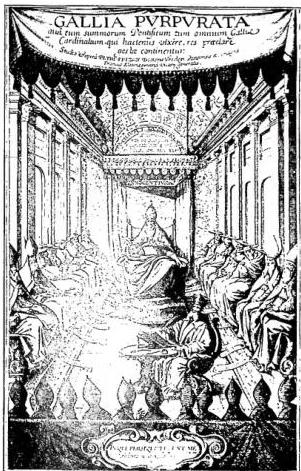
GALLIA PURPURATA
Cardinalium qui hactenus exire, res praedita
est la continenta:

INNOCENT V — INNOCENT VI

Innocent V, Pope, Blessed — Lead seal of Innocent V found in the Valle di Thora above Sarre (Aosta), 1 August 1897 — Aosta, Museum of the Academy of St Anselm.

as penitentiary major, accompanied Gregory X to Beaucaire (21 April 1275) and to Lausanne (6 October).

At the death of the Pontiff, which occurred in Arezzo on 10 January 1276, Cardinal Peter, present at the Conclave, was chosen as his successor (21 January) and took the name of Innocent V; then on 22 February in Rome he was enthroned and crowned. The few months of his pontificate were intensely occupied with preparations for the Crusade, which political difficulties rendered unrealizable, with the pacification of Genoa with Charles of Anjou and the cessation of hostilities between Ghibelline Pisa and the Tuscan Guelph League. The months of March and April were particularly devoted to the Eastern problems of the Crusade and Union, sanctioned by the Council of 1274, which dealt with the envoys of Michael VIII Palaeologus, George Metochites, archdeacon of Constantinople, and Theodore, the grand intendant. Unfortunately, in the course of these delicate negotiations Innocent was unduly influenced by Charles of Anjou and Philip of Courtenay, Latin Emperor of Constantinople, as is evident from the tone of the instructions given to the general of the Friars Minor, Jerome of Ascoli, head of the mission that was to conclude negotiations with the Palaeologus. The mission was then interrupted by the Pope’s death. Innocent’s too evident sympathies for Charles of Anjou placed the Pope in serious difficulties with the elected Roman Emperor, Rudolph of Habsburg. Innocent also concerned himself with the canonization process of Margaret of Hungary. As for his alleged hostility towards the Servite Order, it appears that this is a groundless legend. His cult was confirmed by Leo XIII on 14 March 1898. Feast day, 22 June.

Works. — Peter of Tarentaise occupies a distinguished place among the scholastics of the 13th century, and his writings enjoyed considerable diffusion not only in the university milieu but also in the principal European cultural centres, as is evident from the approximately 280 manuscripts (13th–16th centuries; the list is susceptible to further enrichment) found in the libraries of the continent, and from the monumental 17th-century edition of the commentary on the Sentences. He belongs to the transitional period of the Dominican school, which moved from Augustinianism with Neoplatonic hues to Christian Aristotelianism alongside the two great masters, his contemporaries and friends, St Albert the Great and St Thomas Aquinas. Peter’s works represent the fruit of his university teaching, but unfortunately their analysis is laborious for most readers because the greater part of them remains in manuscript. Peter was not only a refined compiler, as is evident chiefly from the commentary on the Sentences, but a true thinker capable of supporting his solutions with originality and firmness. His scholarly output includes, as do those of the great scholastics of the 13th century, commentaries on Scripture and the Sentences and particular theological questions in which the peculiarity of his thought can be discerned.

Works belonging to his first teaching include: 1) *In IV libros Sententiarum Commentaria*, composed between 1257 and 1259, but published between 1259 and 1264 (cf. ed. by T. Turco and Giovanni Battista de Marinis, 4 vols. in-fol., Toulouse 1649–52). The author made use of the parallel commentaries of St Bonaventure and St Thomas; the latter had to analyse the work at the request of John of Vercelli, to whom he then addressed the *Explanatio dubiorum* already mentioned. 2) Version A of the gloss *Dedi te in lucem gentium* on the Epistles of St Paul, prior to 1264. Of this gloss there exists a Version B by an anonymous author, in the past often attributed to the Dominican Nicholas de Gorran and printed several times under his name (Cologne 1478, etc.). Of particular theological interest are the *distinctiones* and the *dubitationes* that interrupt the literal commentary.

To his second teaching are to be attributed: 1) the *Quodlibet* containing 37 questions (cf. ed. P. Glorieux, in *Recherches de théologie ancienne et médiévale*, 9 [1937], pp. 237–80). Question 36 on salvation in the state of innocence was refuted by St Thomas in *Quodlibet* V, q. 5, a. 8). 2) The questions *De lege et praeceptis* (over 50), definitively claimed for Peter. The first question on the existence of the Eternal Law has been published in full (cf. ed. O. Lottin, in *Ephemerides theologicae Lovanienses*, 14 [1937], pp. 295–97). The solutions given to the questions of dogmatic and moral character treated in it and in the *Quodlibet* allow one to grasp the most original aspects of the thought of our author. Thirteen sermons certainly authentic are also attributed to Peter. His glosses on the Pentateuch and on St Luke have not yet been rediscovered.

Bibl.: On Innocent V there are now two fundamental works that supersede everything previously written about him: *Beatus Innocentius PP. V (Petrus de Tarantasia O. P.). Studia et documenta*. Rome 1943 (the controversy over his birthplace is studied by A. P. Frutaz; his writings by H.-D. Simonin, a fundamental work, and by I.-M. Vosté); M.-H. Laurent, *Le bienheureux Innocent V (Pierre de Tarantasia) et son temps* (Studi e Testi, 129), Vatican City 1947 (definitive biography, rich in erudition, with a regesta of Innocent’s acts; in the appendix L.-B. Gillon re-examines the writings and C. Giannelli publishes the report of Metochites). See also: K. Renner, *Die Christologie des Petrus von Tarantasia*, Rome 1941; M. Grabmann, *Handschriftliche Mitteilungen über Abbreviationen des Sentenzenkommentares des seligen Papstes Innocenz V.*, in *Divus Thomas Freiburg*, 24 (1946), pp. 109–12; I. Tomko, *De inhabitatione Spiritus Sancti in anima iusti sec. b. Petrum de Tarantasia*, 1950 (unpublished thesis of the Lateran Athenaeum). A. Pietro Frutaz