Machine translation of the 1948–1954 Italian original. The original text is authoritative.
GIOVANNI di DIO, saint. – Founder of the Hospitaller Order of the Fatebenefratelli. Born at Montemor-o-Novo in Portugal on 8 March 1495, he lived and carried out his apostolate in Spain. Taken in as a child at Oropesa (New Castile) by a prosperous farmer, he was a shepherd and agricultural worker; as a soldier, he took part in the war between Charles V and Francis I and in the defense of Vienna, besieged by Soliman II. Once again a shepherd in Seville, he went to Ceuta, working as a laborer on the city’s fortifications and distributing his wages to relieve the poor. Returning to Spain, he engaged in the itinerant trade of books at Gibraltar, then opened a small bookshop in Granada (1536).
After a sermon by the Blessed Giovanni d'Avila, he decided to devote himself entirely to deeds, penance, and works of mercy. To atone for his sins and bring humiliations upon himself, he feigned madness and was consequently confined in the Royal Hospital, where he patiently endured the harsh therapeutic treatment then in use. In 1537, although poor, with the help of certain generous benefactors, he founded a hospital in Granada. In organizing it, despite having undertaken no medical studies, he displayed great hygienic and charitable insight: he established separate wards for patients with fevers, contagious diseases, disabilities, paralysis, chronic illnesses, and mental disorders, placing only one patient in each bed, with the beds set apart from one another. At the same time, he assisted the needy, girls in danger, and women of ill repute, providing them with lodging, food, clothing, education, and work. Several companions gathered around him; after his death, having increased in number and founded other hospitals in Spain and Italy, they were first established as a simple Congregation (Pius V, 1571), and later as a religious Order (Sixtus V, 1586; Paul V, 1611 and 1617). From the words with which the Saint, late in the evening, begged for alms in the streets of Granada: « Do good, brothers, to yourselves, for the love of God », his disciples in Italy are called: Fatebenefratelli. He died at Granada on 8 March 1550. He was canonized by Alexander VIII in 1690 (the bull of canonization was promulgated by Innocent XII in 1691). Leo XIII proclaimed him patron of hospitals and the sick (1886), and Pius XI patron of nurses and their associations (1930; cf. AAS, 23 [1931], p. 8 ff.). His feast is celebrated on 8 March.
(courtesy of Fr. Russotto)
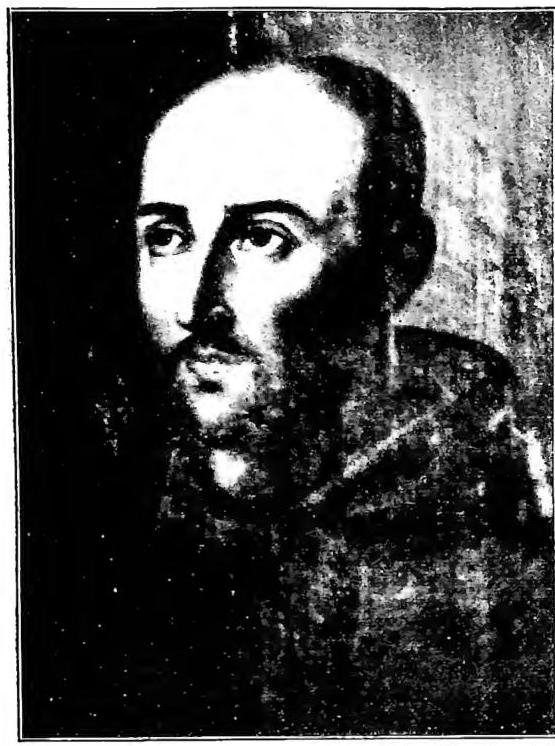
GIOVANNI DI DIO, saint – Portrait by D. V. Diaz (17th century).
Fresco in the church of the « Dulce Nombre de Maria » – Valladolid.
BIBL.: L. del Pozo, S. Juan de Dios, 5ª ed., Madrid 1929; O. Marcos, Cartas y escritos de S. Juan de Dios, there 1935; R. Jardim de Castro, S. João de Deus, um herói português do século XVI, 2ª ed., Lisboa 1946; I. Giordani, G. di D. santo del popolo, Firenze 1947; L. Ruland, Gespräche um Johannes von Gott, Würzburg 1947; M. Gomez-Moreno, Primicias historicas de S. Juan de Dios, Madrid 1950. Gabriele Russotto
Cite this article
“GIOVANNI DI DIO, SANTO.” Enciclopedia Cattolica, vol. VI (1951), p. 351. Azione Romana digital edition, https://azioneromana.com/article/giovanni-di-dio-santo.