VIENNA (WIEN, Latin Vindobona), Archdiocese of — Metropolitan see and capital of the Austrian Republic. The territory of the archdiocese covers an area of 9,220 sq. km. with 2,049,224 Catholics (out of a total population of 2,310,642), of whom 1,459,255 (out of 1,780,000) live in the city of Vienna alone. It has 593 parishes, 186 of which are in the city of Vienna, served by 1,813 priests (1,025 in the city of Vienna). There are 39 male religious orders and congregations and 43 female congregations (cf. Personalstand 1952; Ann. Pont. 1953, p. 447). It has a major seminary in Vienna and a minor seminary at Oberhollarbunn.
I. HISTORY
Vienna lies at the crossroads of very ancient trade routes: toward the Balkans along the Danube and from the Baltic to the Adriatic (Bernsteinstrasse). The precise spot of the river crossing was fixed where the terrace of the present-day city centre, between a branch of the Danube and the Wien stream, forms a well-protected platform. Traces of fortified settlements dating back to the Neolithic age are found on the nearby heights to the right (Bisamberg, 360 m.) and to the left (Leopoldsberg, 423 m.) of the Danube. When, in 15 B.C., the region passed under Roman rule, there were not a few Celtic settlements on the territory of present-day Vienna. The one located at the strategic point mentioned above was transformed, in the second half of the 1st century A.D., into the “castrum Vindobona”; another centre, along the Danube road between the present-day districts III and IV, developed as a civilian town of about 10,000–15,000 inhabitants. Trajan stationed a legion there; Marcus Aurelius died in the castrum of Vienna in 180. Around 395 the capital Carnuntum, gravely devastated during the barbarian invasions, declined; but life continued in and around Vienna, and the civilian town moved within the safer precincts of the surviving castrum, enduring all the storms. St Severinus, the apostle of Noricum (d. 482), often stayed near ancient Vienna; recent excavations in the church of St James at Heiligenstadt (district XIX) would indeed have brought to light the original tomb of the Saint (his remains, during the great exodus of the Roman element in 488, were taken to Italy). Jordanes, in his Gothic History, mentions Vienna under the name of Vindomina (551), and a document of 881 under that of Wenia.With the House of Babenberg (976–1246), which governed the reconstituted Carolingian Eastern March (Ostmark), Vienna grew rapidly and became a point of contact between the Germanic, Slavic, Magyar and Italian worlds: in 1130 it appears under the present name Wien; in 1137 it is recorded as a city, and in 1156 it becomes a ducal residence.
After the extinction of the Babenbergs, Austria passed to Ottokar II, King of Bohemia (1251–78), who greatly favoured Vienna. But the true fortune of the city began with the advent of the House of Habsburg (1278–1918), under whom Vienna remained for centuries (1439–1806) not only the capital of the “Holy Roman” Empire, but also the centre of the Austrian dominions (1526: union of the Bohemian and Hungarian crowns with the House of Austria). In 1365 Rudolph IV founded the University of Vienna; under Maximilian I (1493–1519) the city became one of the first centres of German humanism; in 1498 the “Hofmusikkapelle” was established, one of the earliest and most important. Twice Vienna was the bulwark of Christian Europe against Muslim power: in the famous sieges of 1529 and 1683. It suffered the occupation of Napoleon I in 1805 and 1809, and was the seat of the great Congress of Vienna in 1814–15. Although Francis II in 1806 laid down the crown of the German Empire, Vienna continued to be the capital of the Austro-Hungarian Empire. Under the long reign of Francis Joseph I (1848–1916) the city was renewed, enlarged and embellished (notably the “Ringstrasse”), becoming a modern metropolis. By 1910 it had surpassed two million inhabitants.
A severe blow to Vienna was the dissolution, in November 1918, of the Austro-Hungarian Empire and the consequent reduction to the capital of the small Austrian Republic. After the first difficult decade, recovery began under Federal Chancellors Seipel and Dollfuss, also in religious and cultural spheres; but Nazi rule (1938–45) and the Second World War plunged the city and country into a grave material, religious, social and cultural crisis. This time recovery, under the burden of the four-power Allied occupation, is far from easy, yet is now under way with visible effects in all sectors of public and religious life.
II. THE DIOCESE
In Roman times VIENNA belonged to the see of Carnuntum (q.v.). During the Carolingian period the missionary activity of Salzburg at first penetrated the area; but soon the whole region came under Passau (q.v.). Once Vienna became the residence of the Babenbergs, lords of the Margraviate of Austria, attempts began to secure not only political but also ecclesiastical independence. A first attempt to establish a bishopric in Vienna under Henry II Jasomirgott, marked by the dedication (1147) of the great church of St Stephen (the patron of Passau Cathedral), failed, as did a second under Leopold VI (c. 1209), despite the consent of Innocent III. A further attempt was made in 1258–63, during the rule of Ottokar, King of Bohemia, who also had a great provincial synod celebrated in Vienna (1267). Under the Habsburgs and their growing power these efforts became more insistent. Not even Rudolph IV (1358–65) succeeded; yet he gave the final impetus to the rebuilding of the future cathedral. At length Emperor Frederick III obtained from Paul II the erection of Vienna as an exempt diocese and the appointment of its first bishop, Count Leo of Spaur (18 January 1469); but, owing to the determined resistance of Passau, he was unable actually to govern. Only on 7 September 1480, in St Stephen’s, destined to be the cathedral, was the bull In supremae dignitatis published, by which the two exempt sees of Vienna and Wiener-Neustadt were erected, though with very restricted territories.During the period of Protestant penetration into Austria, noteworthy is the brief interval when St Peter Canisius administered the diocese of Vienna (1554–55). A great and complex episcopal and diplomatic figure appeared with the first cardinal of Vienna, Melchior Klesl (q.v.), under whom (1614–30) the Counter-Reformation achieved its definitive triumph. In 1631 the bishop of Vienna received the title of Prince of the Empire. Bishop Count Breuner had the magnificent episcopal palace rebuilt by the Coccapani brothers (1631–48). Cardinal Sigismund von Kollonitsch (1716–51) is famous; under him (1722) Emperor Charles VI obtained from Innocent XIII the elevation of Vienna to an archbishopric and metropolitan see (with Wiener-Neustadt as suffragan), together with a considerable enlargement of territory. Joseph II, by his own authority, finally suppressed (1783) all foreign ecclesiastical jurisdiction in Austria; after Passau’s formal renunciation (4 July 1784) he also secured papal confirmation by the bull of Pius VI, Romanus Pontifex, of 28 January 1785, by which the whole Austrian territory formerly dependent on Passau was divided among the new dioceses of Linz (Upper Austria), Vienna and Sankt Pölten (Lower Austria), the last created by transferring the see of Wiener-Neustadt; Vienna became the metropolitan see.
After the Napoleonic era, the Josephine regime gradually softened. Finally, Cardinal Joseph Othmar Rauscher (1853–75), undisputed leader of the Austrian episcopate and principal architect of the Concordat of 1855, marked the public resurgence of Austrian Catholicism.
The last archbishops (all cardinals) were: Anton Josef Gruscha (1890–1911); Franz Nagl (1911–1913), organiser of the 1912 International Eucharistic Congress in Vienna; Friedrich Gustav Piffl (1913–32), formerly provost-abbott of Klosterneuburg (q.v.); Theodor Innitzer (from 1932; cardinal in 1933), who lived through the Nazi period (1938–45) which struck Austria and Catholicism particularly hard, and through the difficult recovery of 1945 amid immense material and spiritual ruins. During his episcopate there appeared, before 1938, the newspapers Wiener Kirchenblatt and Zwei-Groschen-Blatt, a daily of very high circulation, due to the initiative of Monsignor Josef Gorbach, who used its proceeds to build many parish churches in the suburbs of Vienna; and Caritas socialis, a work founded by the Austrian chancellor Monsignor Ignaz Seipel (q.v.) in cooperation with Mrs Illegard Burian, who died in a reputation for holiness. During the period of Nazi persecution, Cardinal Innitzer founded in Vienna the Theologische Laienjahr, a kind of practical-theological seminary for the training of lay co-workers; today it offers a two-year course for academics and non-academics and, since 1950, also a Fernkurs; it grants a diploma qualifying students to work directly in the cura animarum. In 1946 the same cardinal promoted the Katholische Akademie, seated in the abbey of the Scots (“Schotten”), an advanced institute of culture. In 1947 the Austrian episcopate launched the Siedlungsaktion to promote, with Church funds and on Church-owned land, the construction of workers’ housing. In 1948 the diocesan institute for pastoral care, created to study, coordinate and strengthen pastoral initiatives, became the Österreichische Seelsorgeinstitut; notable are its annual study weeks and its journal Der Seelsorger. On 27 April 1952 the Domfest was celebrated, i.e. the inauguration of the rebuilt cathedral of St Stephen, and the first Österr. Katholikentag of resurrected Austria took place (10–14 September), commemorating the liberation of Vienna from the Turks (1683): a highly significant event in the country’s present circumstances.
The three phases of growth in religious life in Vienna coincide with three periods of general Catholic revival: 1. The Middle Ages. — The first place belongs to the Benedictine abbey of the Scots (“Schotten”), founded by Henry II in 1158 and staffed by Scottish monks until 1418; it earned great merit in the field of general culture and higher education in particular with its gymnasium (cf. Cottineau, II, col. 3366). The Franciscans settled in Vienna around 1120; from 1447 in the Minoritenkirche. St John Capistran, preaching in Vienna in 1451 the crusade against the Turks, founded there a convent of Observ
V. COTTINEAU, II, col. 3366). The Franciscans settled in Vienna around 1120; from 1447 they were at the Minoritenkirche. St. John Capistran, preaching in Vienna in 1451 the Crusade against the Turks, founded there a convent of Observants, which later (1389) moved into the city centre, to the Franziskanerkirche. The Dominicans arrived in Vienna in 1226. As early as 1220 the Knights of Rhodes (now of Malta) settled there, and shortly afterwards the Teutonic Knights, Vienna serving as a natural base for passage to the East. In 1327 the Augustinian Hermits were called, in 1360 the Carmelites (though these died out around 1550). All built large churches, most of which were transformed in the Baroque period.
3. The modern period. — It opens in 1810 with the Mechitarists, who form in Vienna a congregation of their own, especially meritorious for their Armenian printing press. Following the activity of St. Clement M. Hofbauer (v.) the Redemptorists were admitted in 1820; soon afterwards the restored Society of Jesus. In 1855 the Lazarists settled in Vienna, in 1857 the Brothers of the Christian Schools, in 1912 the Salesians, to say nothing of the many other modern Congregations.
As for the female religious houses, mention is made of them in Vienna as early as the 12th century. The Poor Clares appeared there only in 1305 (they ceased in 1451), the Dominican nuns (Second Order) in 1324. Empress Eleonora of Gonzaga, consort of Ferdinand II, called the Carmelites to Vienna in 1629; they were suppressed by Joseph II but returned in 1879. Eleonora, consort of Leopold I, introduced the Ursulines in 1660 for the education of girls; in 1709 the hospital of the Elisabethines was opened; Empress Amalia, consort of Charles VI, erected in 1717 the convent and church of the Salesian Sisters (Order of the Visitation). These last three religious families escaped the Josephine fury because they were devoted to education and therefore “of public utility”. In 1832 Empress Caroline Augusta called to Vienna the Daughters of Charity of St. Vincent; many other religious families followed; today there are 43 of them.
III. ARCHAEOLOGY
In the plan of the city the various stages of its historical development are clearly distinguishable. Notable remains of the castrum have been uncovered by recent bombardments, 4–8 metres below the pavement of the “Hoher Markt,” the ancient forum. The city museums preserve abundant archaeological material from the Palaeolithic age and especially from the Roman period. The “Altertumsverein” and the “Geschichtsverein,” in addition to the official bodies, take an interest in the antiquities of Vienna.Within the territory of the archdiocese of Vienna there are also other Roman centres, especially along the Danube limes, such as Carnuntum (q.v.), Cannabica castrum with Asturis (Klosterneuburg), Augustianis (Traismauer) and Comagene (Tulln), and along the “thermal line,” with sulphurous hot springs already frequented by the Romans, such as at Meidling (12th district of Vienna), at Baden (Aquae) and Vöslau. Despite the many Roman archaeological finds, no Christian elements have come to light, apart from Carnuntum. In 1953, however, important remains of Roman buildings were discovered at Klosterneuburg, including a triapsidal structure that could be Christian, and at Heiligenstadt the primitive tomb of St Severinus with a rough baptismal font nearby (5th century).
IV. CHURCHES AND SHRINES
The archdiocese of Vienna is very rich in churches notable both for their architecture and their internal furnishings. All styles are represented, from Romanesque to modern; Gothic churches prevail, often later Baroque-ized, and purely Baroque ones: this is explained above all by the Turkish devastations, especially that of 1683 (v. Arte).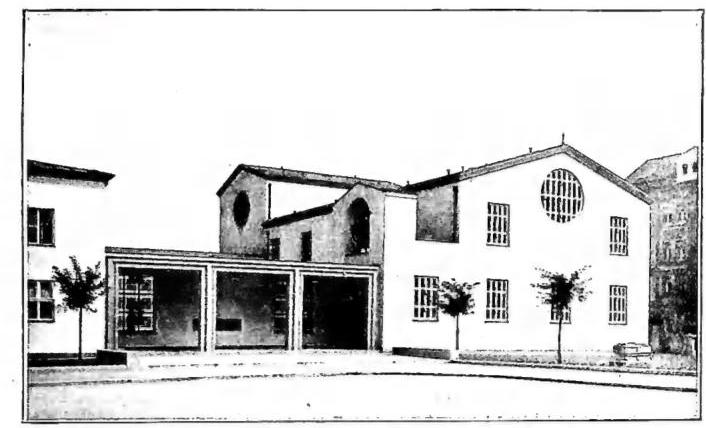
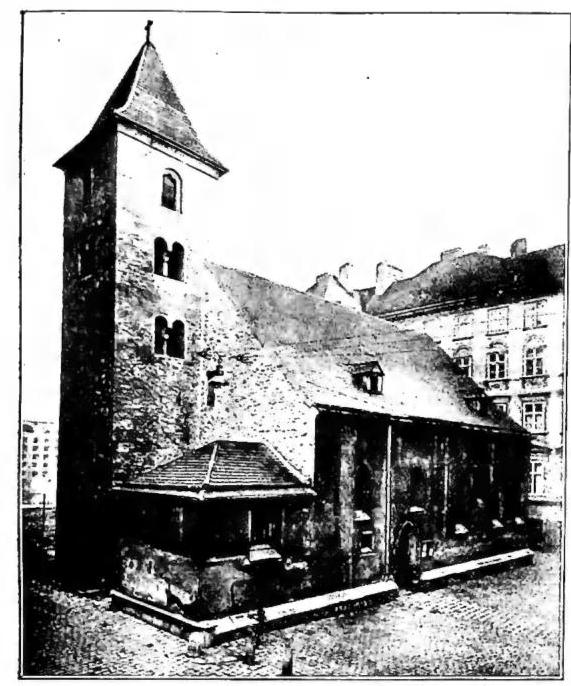
The oldest church still extant in Vienna is the Ruprechtskirche (District I), erected in the 8th century; the present structure dates from the 12th–15th centuries, and the bell tower is Romanesque. Of the same period (792) is the Peterskirche (District I), but rebuilt from its foundations in splendid Baroque by Gabriele Montani (1703), completed (1732) by Lukas von Hildebrandt, with sculptures by S. Mattielli and A. Galli Bibiena, and paintings by Martin Altomonte, Martin Rottmayr and G. M. Schmidt. The third church by age would be Maria “am Gestade” (“by the shore,” District I), erected in the 9th century, rebuilt in Romanesque form; with a high Gothic choir and a curious heptagonal bell tower with a Gothic cupola (1330–53); the nave was rebuilt (1394–1415) by Master Michael Chnab (?); there are remains of stained glass from the 14th and 15th centuries, sculptures of the early Gothic on the piers, and a rare Renaissance altarpiece carved by Johann Perger (1520). The Michaelerkirche (District I) is the largest remaining example in Vienna of Romanesque style (second half of the 13th century), with a Gothic choir (1327) and a tall bell tower (1340–44); the classical high altar dates from 1781. The Minoritenkirche (District I) is a “Hallenkirche” (1251–76) with a characteristic squat bell tower, left thus since 1529. It contains the famous mosaic copy of Leonardo’s Last Supper, commissioned by Napoleon I. The Augustinerkirche (District I) is also a “Hallenkirche” (1330–39), more advanced in design; its architect was D. Ladtner; another similar church was that of the Carmelites (1386–1405), called Am Hof (District I), which passed in 1553 to the Jesuits and was completely Baroque-ized (1607–10), with an elegant façade and loggia by C. A. Car
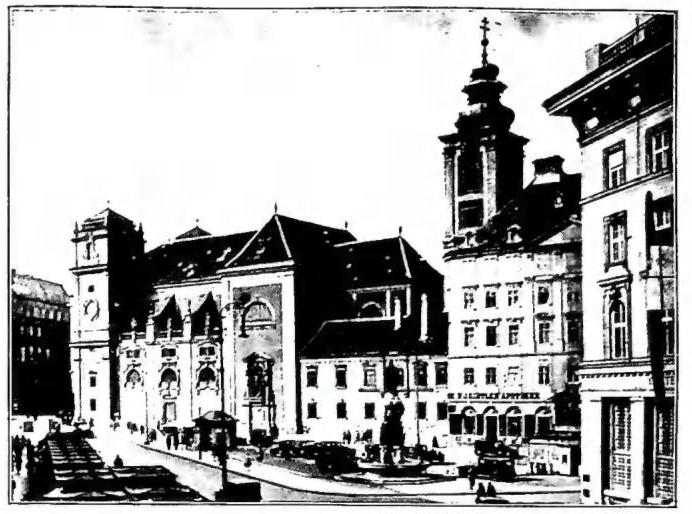
lone (1622), and paintings by M. Altomonte, Gioacch. Sandrart, G. M. Schmidt. Notable is the Franziskanerkirche (District I), which presents Renaissance style with curious Gothic reminiscences, containing works by Ant. Pozzo, G.M. Rottmayr and G.M. Schmidt. The Kapuzinerkirche (District I), built in 1622–32, is very simple but well known for the “Kaisergruft,” the imperial tombs, established by Matthias (first interment in 1633) and repeatedly enlarged. There lie, in 136 sarcophagi, 140 deceased members of the House of Austria, including 12 emperors and 15 empresses. The Universitätskirche (District I), in the style of early Italian Baroque, dates from 1628–31; its interior, executed by Ant. Pozzo, is exuberant Baroque (1705–1709). The Dominikanerkirche (District I) was originally a Romanesque church of 1262 with a Gothic choir of 1302, but it was completely rebuilt in Italian Baroque style in 1631–34.
Among the grandest churches of Vienna is the Karlskirche (District IV), built as a votive offering by Charles VI during the plague of 1713, a masterpiece by G. Bernardo Fischer von Erlach and his son Gius. Eman. (1716–39), in the form of a Greek cross with a lofty dome and two slender bell towers shaped like twisted columns, adorned with high-reliefs commemorating the life of St. Charles Borromeo (q.v.). Rivaling it is the nearby (District II) Salesianerinnenkirche (1717–30) by Dom. Fel. Allio, a harmonious complex of domed church and convent. Of high interest is the Altlerchenfelderkirche (District VII), dedicated to the “Seven Refuges” (a typical Baroque devotion), created by the Romantic artists of Vienna (1850–61); its Romantic-Neoclassical architecture is by G.S. Müller, with frescoes of the period by Gius. Führich, L. Kupelwieser, K. Klaas, etc. Typical is the Votivkirche (District IX), erected to commemorate the escape of Francis Joseph I from an assassination attempt (18 Feb. 1853) by H. von Ferstel (1856–79), a perfect imitation of French Gothic, with fine stained glass by Ed. von Steinle and G. Führich. Besides these, there are Neo-Gothic and Neo-Romanesque churches (19th–20th c.), and modern ones: the Don-Boscokirche (1918), the Seipelkirche (1933–34), and the steel church of the Madonna del Carmine by H.L. Prutscher (1942).
The oldest sanctuary of Vienna would be that of Mariabrunn, said to date from the time of St. Gisela, consort of St. Stephen, King of Hungary (993). The present church was built by Ferdinand II (1639–45). In the Sixth District, which takes its name from it, stands the Mariahilferkirche, erected in 1686–89 on the site of a wooden chapel (1660), completed in 1713–30; its rich interior contains celebrated frescoes by P. Troger. More imposing is the Piaristenkirche Maria Treu, a work by G.L. von Hildebrandt (1716–21).
2. Outside the Municipality of Vienna
In certain regions less exposed to the ravages of war, notable monuments of Romanesque style have been preserved; especially remarkable are two rare examples of round churches with domes: at Petronell, now the family tomb of the counts Abensberg-Traun, from the second half of the 12th century, and the parish church of Scheiblingskirchen, documented from 1164 but older.A monument of the first rank is the principal church (cathedral from 1468 to 1784) of Wiener-Neustadt, with a façade flanked by two bell towers and three Romanesque basilica naves, a primitive Gothic choir (1300–30), figured portals, and Baroque furnishings; here is admired the tomb of Cardinal Klesl, attributed to G. L. Bernini (1630).
A unique Romanesque monument is the parish church of Schöngrabern, from the first half of the 12th century, its apse exterior covered with Romanesque sculptures depicting cycles drawn from the Bible and apocrypha. At Deutsch-Altenburg the parish church likewise belongs to the first half of the 13th century, a three-aisled Romanesque basilica with a Gothic choir of the 14th century. Notable is the church of the ancient town of Mödling, one of the largest “Hallenkirchen,” with Romanesque elements, rebuilt after the Turkish destruction of 1529. Also to be remembered is the parish church of Zistersdorf (c. 1620), which preserves a Madonna by L. Cranach the Elder.
Monuments characteristic of the Turkish epoch are the many “Wehrkirchen,” i.e., fortified churches. Typical too are the many “Karner” (ossuaries), almost all in Romanesque style, among them those of Tulln (1321), with a figured portal and 15th-century frescoes; that of Mödling (1345), similar to the preceding; that of Deutsch-Altenburg, with a carved portal; and many simpler ones, even Gothic.
For the abbeys V. KLOSTERNEUBURG; HEILIGENKREUZ. Joseph II suppressed (1782) the Carthusian monastery of Mauerbach, founded by Frederick II the Fair (1313), and rebuilt in Baroque form (1616–31); and the Benedictine abbey of Kleinmariazell (1136–1782), with a Romanesque church splendidly Baroqueized (now a parish church).