
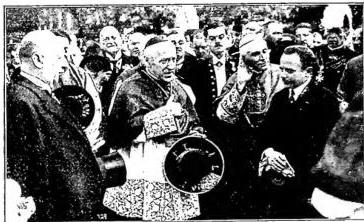
DOLLFUSS, ENGELBERT. - Austrian statesman, b. at Texing in Lower Austria on 4 Oct. 1882, d. assassinated in Vienna on 25 July 1934. After completing his early studies at the seminary of Ober-Hollabrunn, he subsequently studied theology in Vienna and Innsbruck, law in Vienna and political economy in Berlin. After the Great War, in which he took part as a volunteer, he devoted himself to Catholic social organizations, particularly to the trade-union organizations of peasants and mountain people.
He was secretary of the Union of Peasants of Lower Austria, director of a provincial Chamber of Agriculture, and in 1928 he founded the Institute of Agricultural Insurance of Vienna, Lower Austria and Burgenland; in 1930 he became a member of the directing committee of the Austrian federal railways. A profound connoisseur of the agricultural sciences, he fostered their development and dissemination, especially after he was called in 1931 to the direction of the Ministry of Agriculture, as a representative of the Christian Social Party. On 20 May he was called, by the confidence of the head of state, President Miklas, to the office of chancellor, after the withdrawal of Buresch. In foreign policy he relied on Italy and Hungary in order to resist internal and external pressures in favor of the annexation of Austria to Germany. In domestic policy his program was the formation of a Christian-German, corporative, authoritarian State. He therefore took care first of all to assimilate into the State the right-wing forces organized militarily (Heimwehrme) and dominant in the Länder, in order to counterbalance the predominance of the Social Democrats in Vienna: a predominance that ended only when Social Democracy was outlawed following the insurrection of Feb. 1934.
Convinced of the deficiencies of the Austrian parliamentary regime, owing to the multiplicity of parties, incapable of ensuring an efficient government, he promoted a constitutional reform of the State. The new constitution came into force, by decree of the government, on 1 May 1934. On that day the Concordat with the Holy See, signed in May of the previous year, was also ratified. A year later he was killed by a group of insurgents, of Nazi tendency, who wanted to seize the government.
Bibliography8 works
Celestino Melzi