
DÖLLINGER, IGNAZ von. — Historian and theologian, born in Bamberg on 28 February 1799, died in Munich on 10 January 1890.
After an initial course of varied studies (history, literature, philosophy, theology, mathematics, and the natural sciences), he decided to devote himself chiefly to theology, and therefore chose the ecclesiastical state. Dissatisfied with the theological courses at the University of Würzburg and at the seminary of Bamberg, he supplemented them with private study, though he was unable to make up for the deficiencies in his specifically dogmatic formation. Ordained a priest in 1822, after a few months of pastoral ministry he devoted himself to academic work: professor at the Aschaffenburg lycée in 1823, and at the University of Munich in 1826, where he remained active until his death.
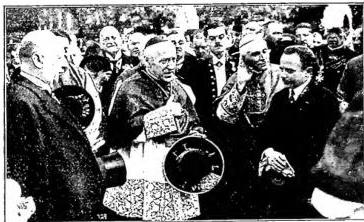
DOLLFUSS, ENGELBERT. - Reception of the papal legate, Cardinal La Fontaine, in Vienna, on the occasion of the Allgemeinen Deutschen Katholikentag 1 (8–12 Sept. 1933), held in remembrance of the 250th anniversary of the liberation of Vienna from the Turks (1683). In the front row, from right to left: Chancellor D., Nuncio Sibilia, the Cardinal Legate, President of the Republic Miklas.
Through his efforts, that University became one of the principal centers for the dissemination of the renewal of Catholic studies. In Munich he soon became part of the Görres circle and of the editorial staff of the Eos. He shared their politico-religious ideas and joined them in fighting for the freedom of the Church from State interference and for the penetration of the Christian ideal into every sphere of life.
Sent to the Frankfurt Parliament in 1848, he there defended the Church’s independence from the State (not their separation), and the equal treatment of all confessions by the State. With no less tenacity he pursued the program of a united, or national, German Catholic Church—not autonomous with regard to the Apostolic See or privileged in comparison with other nations, but closely united in its members around the national synod of bishops and a primate. In this way the Catholic half of the German people would have been better able to make itself respected in the various States and by the various confessions, and would have led the entire nation to fulfill a great mission in the service of truth and Catholicism. D. represented these ideas at the first gathering of Catholic organizations in Mainz (1848), at the Episcopal Conference of Würzburg (1848), before the Austrian Catholics (Linz, 1849), before the political authorities, and in every sphere reached by his very wide field of activity. During these years D. was perhaps the most eminent personality in German Catholicism. Yet if one compares his position, for example, with that of the canonistic school (Phillips), characterized by its strong emphasis on the Roman primacy, or with the wave of general enthusiasm among the population, which from the arrest of the Archbishop of Cologne (1837) onward saw in the Holy See the primary guarantee and protector of ecclesiastical freedom in Germany, one finds that D. was completely absent from these currents. In reality, during these years his activity began to arouse the first suspicions in Catholic circles. D. had always been more a man of study and scholarship than of action and practical life, and was therefore prone to become rigidly fixed in theoretical positions, often hesitant and subject to the influence of others.
The decade 1850–60 marked a phase of exclusively literary and scholarly activity. Having returned to the chair in 1849, D. added to his works of the preceding years (including a Lehrbuch der Kirchengeschichte, Ratisbona 1836–38; a study of Muhammad, Mohammeds Religion, 1838; and the celebrated Die Reformation [3 vols., there 1846–49]) his most important writings in the field of ecclesiastical history: Hippolyten und Kallitus (there 1853), Heidentum und Judentum (there 1857), and Christentum und Kirche (there 1860). The latter was to constitute an effective Catholic counterweight to the rationalistic interpretation (Bauer-Strauss) of apostolic Christianity.
A scholarly journey by D. to Italy in 1857 left him disappointed because of the distrust he encountered in Rome on account of the consistently negative position he had maintained on the question of the dogma of the Immaculate Conception.
Around 1860 he returned to politico-religious activity. His position toward Rome became publicly and dramatically evident after his lectures of 1861 at the Odeon in Munich (subsequently developed in the book: Kirche und Kirchen, Papstthum und Kirchenstaat, Munich 1861), in which D. expressed his impressions of the situation of the Papal States and his expectation of their imminent fall. Meanwhile, in the world of ecclesiastical studies, the struggle was raging between the neo-Scholastic movement and the so-called German theology, which cultivated the evolutionary aspect of dogmas and of Church history and opposed any limitation through authoritative dogmatic decisions.
The struggle was extremely bitter on both sides and was not always conducted with due charity. The neo-Scholastic tendency generally enjoyed the support of Rome; the other side increasingly relied on the political powers, and D. was aligned with II. Involved in so difficult a question and drawn into increasingly embittered opposition—which broke out openly at the Congress of German Catholic scholars in Munich in 1863—the great scholar gradually moved away from the ecclesiastical point of view. Significant in this regard were his campaign against the establishment of diocesan seminaries and his fierce opposition to the Syllabus. In the thesis of papal infallibility he saw a reversal of the constitution of the Church and a danger to the State. Therefore, in the period immediately preceding the First Vatican Council, he devoted all his learning and political influence to opposition.
Excluded from the preparatory consultations for the council, D. intensified his propaganda among the clergy and people, through articles, through the Reflections (Erwägungen, etc.) addressed to the bishops of the Council in October 1869, and through assiduous efforts with the various governments to foster their distrust and opposition. He went so far as to portray infallibility as implying the Pope’s dominion over the entire temporal order, and thus as destructive of State authority, and to call for State intervention against the council’s decisions. During the Council, D., informed by persons present in Rome, composed from Munich the Briefe vom Konzil and other writings of violent opposition, until April 1870, when he was invited to remain silent. After papal infallibility was proclaimed, D. refused to submit; he respected the excommunication while disputing its legitimacy, and relinquished his chair at the university, where he nevertheless continued to exercise considerable influence as president of the Academy of Sciences (he delivered the Akadem. Vorträge, later published in 3 vols., 1889–91). He took no active part in the origin of the «Old Catholic» sect, nor did he ever join II. His influence on the politics of the Kulturkampf cannot at present be assessed. He worked enthusiastically for the reunion of the separated Churches, on the basis of broad tolerance among the various confessions, but with meager and ephemeral results. An indefatigable scholar even in the later years of his old age, he completed a publication of sources on the history of the Council of Trent (Ungedruckte Berichte..., 2 vols., 1876), a Geschichte der Moralstreitigkeiten in der röm.-kath. Kirche seit dem 16. Jahrhundert (2 vols., 1889), the 2 vols. of his Geschichte der gnostisch-manichäischen Sekten im früheren Mittelalter (Munich 1890), and various other writings. For knowledge of D.’s politico-religious activity during the various periods of his life, the publication of his Kleinere Schriften, edited by F. H. Reusch in 1890, is also very useful. Until his death, D. refused to submit to the Council.
D.’s importance lies in having opened the way to a rigorously objective study of ecclesiastical history. His influence on the development of positive theological studies can scarcely be overestimated.
BIBLI: A complete and impartial biography is still lacking. Rich but one-sided is that of E. Michael, I. von D., Eine Charakteristik, 3rd ed., Innsbruck 1894; J. Friedrich, I. von D., 3 vols., Munich 1899–1901; H. Schröer, Briefe D.'s an eine junge Freundin, there 1914, preceded by a brief but excellent introduction to D.’s world; J. Grisar, s. V. in Staatslexikon der Göringgesellschaft, 5th ed., I, cols. 467–72; St. Lösch, s. V. in LThK III, cols. 373–78, with an extensive and orderly bibliography; R. Keussen, D. und die altkatholische Kirche, in Internationale kirchliche Zeitschrift, 26 (1936), pp. 168–92.