
COUNCIL. —
I. ORIGIN
The rise of heresies in the second century A.D. imposed upon the bishops the necessity of assembling in meetings to legislate concerning the errors then emerging: Tertullian (De ieiunio, chap. 13) calls these gatherings concilia, whereas Dionysius of Alexandria (Eusebius, Hist. eccl., VII, 7) and the Canons of the Apostles (can. 38) use the designation synodus. The two appellations, used interchangeably, indicated not only the assemblies but also the place where they gathered. Subsequently, these names came to be reserved solely for assemblies in which bishops took part in deliberating on ecclesiastical matters. Hence the distinction between royal and ecclesiastical councils: in the former, besides the bishops, counts, dukes, and other secular princes also took part; in the latter, only the bishops assembled. Later, the name council was reserved exclusively for meetings of ecclesiastical prelates (L. Thomassin, De vet. et nova eccl. discipl., Paris 1688, part 2, III, chap. 36; Benedict XIV, De synodo dioec., I, Prato 1844, chap. 1, pp. 1–5).The series of councils begins with the Apostles themselves (v. GERUSALEMME). From the words of the Lord (Mt. 18:20: «ubi duo vel tres congregati sunt ecc.»), confirmed by the Apostles (Act. 15:28: «visum est Spiritui Sancto et nobis ecc.»), some theologians inferred the divine origin of councils: a thesis also upheld by St. Gregory (Greg. I registrum epist., ed. P. Ewald, in MGH, Epist., I, 1, 24, Berlin 1887, p. 36). Although no one can deny the appropriateness and usefulness of councils, there is nevertheless insufficient evidence from which to infer their divine origin. Christ provided sufficiently for the preservation of the integrity of his doctrine through the institution of the primacy (Wernz-Vidal, II, p. 524).
After the council of the Apostles, the first councils recorded by history date from the second century. Apollinaris, bishop of Hierapolis, mentions many synods held in Asia Minor (Eusebius, Hist. eccl., V, 16); others were held in connection with the controversy over Easter (Eusebius, Hist. eccl., V, 23). About the year 220, Agrippinus, bishop of Carthage, inaugurated the series of African councils (Cyprian, Epist., 71, 73). Subsequently, other councils were held at Iconium in 230 and 235 (Cyprian, Epist., 75), and at Antioch in 264 and 269 (Eusebius, Hist. eccl., VII, 7). Bishops, presbyters, and even deacons took part in these councils; the laity, as mere observers, were not excluded. Only the bishop had the decisive vote.
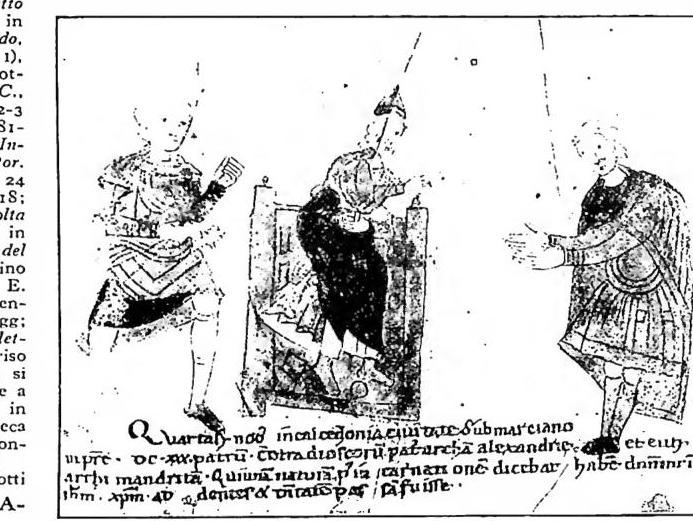
At first, the acts were signed only by the metropolitan; later, also by the other bishops and sometimes by the presbyters, but only in the form of an expression of consent. The object of the deliberations was to condemn heresies and resolve disciplinary questions; legislative authority was exercised only rarely (Hinschius, System des K. Kirchenrechts, III, Berlin 1869–79, p. 475). If questions of great importance for the faith arose, all the bishops of the province took part in the meetings. Such was the Council of Alexandria in 320, concerning the case
II. DEFINITION AND DIVISION
The council may therefore be defined as the legitimate assembly of bishops for deliberating and decreeing on ecclesiastical matters. If the bishops of the entire universal Church are summoned to participate in these assemblies and in fact represent it, the council is called ecumenical; if, on the other hand, only some bishops of Christendom take part, the council is called particular. The latter may be plenary if the bishops of several ecclesiastical provinces participate (CIC, can. 281); provincial or metropolitan if the bishops of a single province assemble (CIC, can. 283). All of them possess a particular juridical character that gives them a special jurisdiction, distinct from that of individuals, for legislating in religious matters. This prerogative distinguishes councils from episcopal conferences (CIC, can. 292).III. ECUMENICAL COUNCIL
1. Composition
Those called to participate in it by divine right are only residential bishops; by ecclesiastical law, cardinals who have not received episcopal consecration are also now summoned; abbots and other prelates nullius,the general abbots of monasteries united in a congregation, and the major superiors of Orders (CIC, can. 223).
2. Convocation. — Only the Roman pontiff has the proper and exclusive right to convoke the ecumenical council (Leo X, constitution Pastor aeternus, 19 Dec. 1516; CIC, can. 222 § 1). This prerogative derives from the primacy of jurisdiction that he possesses over the whole Church and over each and every bishop. No one else may arrogate this right without infringing the inalienable rights of the bishop of Rome. The right of convocation necessarily entails the power to transfer, suspend, and dissolve an ecumenical council (Pius IX, constitution Cum Romani Pontificis, 4 Dec. 1869; Pius X, constitution Vacante Sede Apostolica, 25 Dec. 1904, no. 28). The convocation of the first eight ecumenical councils by the emperors reflects the circumstances of those times. Only the emperor could assemble so many bishops in council, since the Eastern bishops would have been unlikely to respond to an invitation from the Roman pontiff, and because only the emperor could make the most rapid means available for their journeys and support. This does not derogate from the primacy of the Roman pontiff, since in fact the emperors arrogated this right to themselves at the pope’s request or with his express or tacit consent, which is sufficient for a legitimate convocation.
3. Constitution. — The constitution of the ecumenical council is effected immediately after the participation of a sufficient number of bishops to represent the universal Church. The number of participants required has never been defined: certainly, it is not required by law that all the bishops of the world be present, which is morally impossible, nor can one consequently have recourse to an absolute majority, since this often does not represent the wiser part of the Church. The necessary condition, therefore, is that the bishops represent the universal Church only when they are united with the successor of s. Peter; only in this way can there be a legitimate college of bishops united with the pastor—that is, the head united with the members. The absolute necessity of the consent of the majority of bishops cannot be demonstrated; indeed, the pope may reject decisions adopted by the absolute majority of bishops. To achieve this intimate union between the head and the members, it is required that the bishop of Rome preside over the council personally or through his legates (CIC, can. 222 § 2; Wernz-Vidal, II, no. 460; Benedict XIV, De symbolo dioec., XIII, chap. 2, no. 3; Hefele-Leclerq, I, pp. 71, 752).
4. Authority. — The ecumenical council possesses ordinary and supreme authority in the universal Church. It differs from the authority of the Roman pontiff solely in the number of those who exercise it: the pope, in fact, possesses the same complete and supreme jurisdiction in the universal Church. There is an intimate relationship between the two: while the power of the Roman pontiff is understood to be one, sole, universal, and supreme, these same qualities cannot, on the other hand, be ascribed to the ecumenical council unless it is united with the vicar of Christ (M. D. Bouix, De papa, ubi et de conc. oec., II [Paris 1869], pp. 503, 687). This consideration definitively excludes the possibility of an appeal from the pope’s judgment to the ecumenical council. The competence of the universal council extends to everything intimately connected with the dogmatic and moral patrimony (CIC, can. 228).
5. Celebration. — Questions must be proposed by the Roman pontiff; the bishops too, in a subordinate capacity, are granted this right, subject to the prior approval of the presiding officer of the council (Pius IX, constitution Multiplices, 29
Nov. 1869, no. 2; CIC, can. 226). The discussion must be free, in order to allow for a fuller elucidation of the questions and also because doctrine ought not to be authoritatively imposed, but should naturally and spontaneously emerge from the infallible teaching office of the Church. Once the various questions have been discussed, they are put to a vote. It is self-evident that dogmatic questions and universal decrees should require an absolute majority. But even in this matter, if the smaller number of bishops constitutes the wiser part and is in harmony with the vicar of Christ, it may reject the position of the majority.
6. Approval. — The bishops gathered in council are true judges, by virtue of the power received from God. Their decisions are genuine definitions and judgments, not mere counsels: that is, they are juridical acts performed by virtue of their jurisdiction. This power is not absolute, but subordinate to the approval of the Roman pontiff. This confirmation by the bishop of Rome is essential, not accidental, as the head is essential to the body; without it, the acts of the bishops have neither full value nor universal binding force (R. Bellarmino, De conciliis et eccl., I, chap. 18; D. Palmieri, De Romano Pont., 2nd ed., Prato 1891, p. 683). Confirmation by the Roman pontiff may be antecedent, through a special mandate; concomitant, when he himself presides; or subsequent (CIC, can. 227). The chronology of the ecumenical councils follows; for each one, V. the relevant entry.
7. Chronology. — 1) Council of Nicaea, A.D. 325, convened by Constantine under the pontificate of St. Sylvester (against the Arians). 2) First Council of Constantinople, A.D. 381, assembled under Pope Damasus and the emperor Theodosius the Great (against the Macedonians). 3) Council of Ephesus, A.D. 431, under the pontificate of Celestine I and Theodosius the Younger (against Nestorius). 4) Council of Chalcedon, A.D. 451, Pope Leo the Great and the emperor Marcian being in office (against Eutyches). 5) Second Council of Constantinople, A.D. 553, convened by the emperor Justinian against the will of Pope Vigilius, became ecumenical through the subsequent approval of the Pontiff (it resolved the question of the Three Chapters). 6) Third Council of Constantinople, A.D. 680, convened under Pope Honorius, was approved by Agatho (against the Monothelites). 7) Second Council of Nicaea, A.D. 787, under the regency of the empress Irene, Pope Adrian I being in office (against the iconoclasts). 8) Fourth Council of Constantinople, A.D. 869–70, under the pontificate of Adrian II (against Photius). 9) First Lateran Council, A.D. 1123, the first ecumenical council in the West, Pope Callistus II being in office (at the end of the investiture controversy). 10) Second Lateran Council, A.D. 1139, under Innocent II (to settle the schism of Pier Leone). 11) Third Lateran Council, A.D. 1179, Pope Alexander III being in office (ratification of the peace with Frederick Barbarossa). 12) Fourth Lateran Council, A.D. 1215, under Innocent III (the most important of the Middle Ages, on account of the doctrine formulated and the errors condemned [Joachinism, the Albigensian heresy, etc.], and on account of the disciplinary norms issued). 13) First Council of Lyons, A.D. 1245, under Innocent IV (against Frederick II). 14) Second Council of Lyons, A.D. 1274, convened by Gregory X (for union with the Easterners) in France. 15) Council of Vienne, A.D. 1311–12, under the pontificate of Clement V (for the case of the Templars and the condemnation of various heretical doctrines). 16) Council of Constance, 1414–18, in that part which was approved by Martin V (for the settlement of the Western Schism and the condemnation of Hus and Wyclif). 17) Council of Florence, A.D. 1439–45, convened by Eugenius IV (for union with the Greeks and other Easterners). 18) Fifth Lateran Council, A.D. 1512–17, convened by Julius II, continued and approved by Leo X (for the condemnation of various doctrines directed against those who denied the immortality of the soul). 19) Council of Trent, convened by Paul III in 1545, was concluded by Pius IV in 1563 (against the errors of the Protestants and for the true reform of the Church). 20) First Vatican Council, convened by Pius IX and personally inaugurated on 8 December 1869, subsequently suspended on account of political events on 20 December 1870 (famous for the condemnation of materialistic errors and, in general, of rationalism [const. Dei Unigenitus] and the defi-
definition of the Primacy and of the infallible magisterium of the Roman pontiff [const. Pastor aeternus]).
IV. PLENARY COUNCIL
To celebrate a plenary council, the prior permission of the Roman pontiff is required; in granting it, he appoints a legate to convene and preside over the council (CIC, can. 281). In addition to the legate, all archbishops, residential bishops, administrators, vicars, and apostolic prefects must participate; abbots and prelates nullius, and capitular vicars; if titular bishops are summoned, they have a deliberative vote (CIC, can. 282). The other regulations are the same as those concerning the provincial council.Plenary councils to which all the bishops of a state are invited are more properly called national councils.
Italy was divided (by measures of the Sacred Consistorial Congregation of 15 February and 22 March 1919 and 29 September 1933) into nineteen conciliar regions, in each of which—with a few exceptions—the regional council, which is a true plenary council, is to be held in place of the provincial councils (v. qui appresso).
V. CONCILIO PROVINCIALE
Its origin predates the Council of Nicea, which prescribed its celebration twice a year (can. 5), a provision renewed by the Council of Chalcedon (can. 17; Leone I, Epist. 14, cap. 7 [a. 445]; Greg. I, Reg. 4, 9). The convocation belongs to the metropolitan, who presides over the assemblies (CIC, can. 284). Its composition is established by the code. The following must participate: 1) all the bishops, even those of the province who have not been consecrated, 2) the apostolic administrators, 3) coadjutors with full administration of the diocese, 4) exempt bishops assigned to the province, 5) all abbots and prelates nullius, 6) capitular vicars (CIC, can. 286). Its competence is restricted almost exclusively to common law, whose application it must promote through particular provisions, so that faith and morals may be preserved in complete integrity (CIC, can. 290). Its acts, sent to the Holy See, are submitted to the judgment of the Congregation of the Council. This approval confers no newauthority on the decrees, except where it is given in forma specifica. Once published, the decrees bind the entire province; the bishops may grant dispensations only in particular cases (CIC, can. 291).
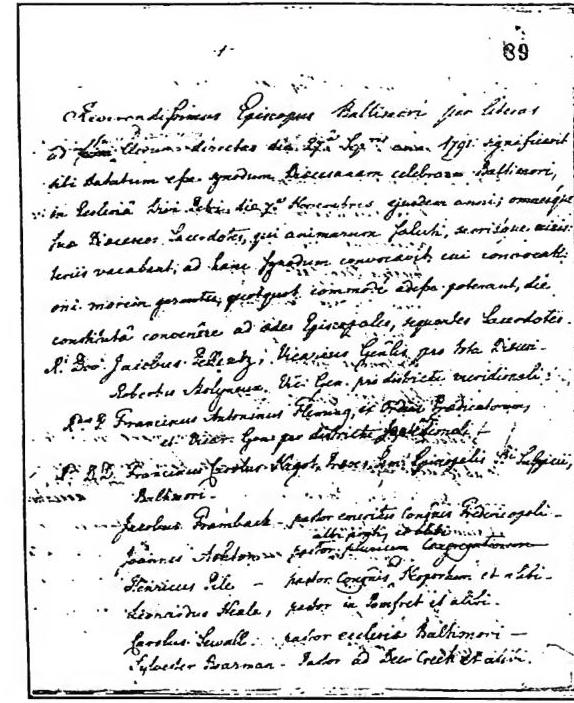
In Canada there were seven provincial c. and the plenary C. of 1909.
In northern Europe, the following were celebrated: one Synod in the apostolic vicariate of Scotland (1700), three Irish Synods (Thuam 1633, Meath 1686, Dublin 1770), and the four provincial C. of Westminster (1852, 1855, 1859, 1873) in England, as well as the plenary C. of Maynooth (1875) in Ireland.
The Eastern Church likewise had a large number of c. and synods, among which were the Provincial Synod of Mount Lebanon (1736) for the Maronites, the National C. of the Armenians (1911), the National Synods of Carcapha (1806), which was not approved, and of Ain-Traz (1835) for the Melkites; for the Ruthenians, the Provincial Synod of Zamošća (1720).
In India, after the C. of Goa and Diamper and the Synod of Cranganore (1606), there was the Synod of Pondichery in 1844, and no plenary c.
After the Synod of Juthia (1665) in Indochina, there was a small number of synods and c. In 1934 the first plenary C. took place.
In China, the Synod of the apostolic vicariate of Sant'Quien took place in 1803; it was approved only in 1822 and then extended to the whole of China. In subsequent years several others were celebrated; the synods of the various regions into which that immense territory had been divided deserve mention. In 1924 the first general C. was celebrated in Shanghai.
In Japan and Korea, conciliar activity was very limited. In 1890 the Regional Synod of the two territories was celebrated. In Tokyo, the two provincial C. met in 1895 and 1924, and in 1931 another Regional C. took place.
Indonesia records only one Synod in the apostolic vicariate of the Lesser Sunda Islands; and the Philippine Islands, which were always independent of Propaganda, had the diocesan Synod of Manila (1582), that of Nueva Segovia (1773), and the provincial C. of Manila (1907).
The Australian and New Zealand Church lists several c. held in Sydney (1844, 1885, 1895, 1905), Melbourne (1862, 1869, 1885, 1907), and Wellington (1899); in 1937 it had the IV plenary C., also celebrated in Sydney.
In Africa, various synods were held at St-Denis, Algiers, and Carthage. In the more recent period, however, there have been very few synods and numerous conferences of the Ordinaries.