
TUAM, ARCHDIOCESE of. — City and archdiocese in western Ireland. It has an area of 7,560 square miles and a population of 158,400 inhabitants, of whom 147,300 Catholics, distributed among 56 parishes served by 176 diocesan priests and 228 religious; it has one seminary, 15 male and 27 female religious communities (Ann. Pont. 1952, p. 435). It comprises approximately half of the counties of Galway and Mayo and a small part of County Roscommon. It is the largest diocese in Ireland. It includes the territories of five ancient dioceses: T., Annaghdown, Cong, Mayo, and Aghagower.
The primitive diocese of T. was founded by St. Jariath around the year 520, and became the archiepiscopal and metropolitan see of Connacht at the Synod of Kells in 1152.
At that time seven suffragan bishops were subject to T., namely, the bishops of Mayo, Killala, Roscommon, Clonfert, Achonry, Clonmacnoise, and Kilmacduagh. At present the archbishop of T. has as suffragans the bishops of Achonry, Elphin, Clonfert, Killala, and Galway. In 1152 Hugh O' Hession became the first archbishop of T.; upon his death in 1161 he was succeeded by Cathal O' Duffy, who was present at the Lateran Council of 1179. Maurice O' Filhily, a Franciscan who was made bishop in 1506 and died at Galway in 1513, was known as Flos mundi on account of his great erudition; he commented on many works of John Duns Scotus. Another Franciscan, Florence Conry, was archbishop from 1609 to 1629 but never visited his see; he was highly versatile in the works of St. Augustine and defended the interests of Irish Catholics at the court of Spain and elsewhere while he was archbishop. Malachy O' Queely, who was archbishop from 1630 to 1645, reconciled many heretics to the true Church and administered the sacrament of Confirmation to 100,000 souls; he was an ardent patriot and was killed on the battlefield near the city of Sligo. The most representative bishop was John MacHale (v.). John Mac Evilly, who died in 1902, was likewise a learned and zealous prelate: he wrote English commentaries on almost the whole of the New Testament.
In the diocese of T., near the city of Westport, lies the holy mountain of Croagh Patrick, where St. Patrick (v.) fasted and prayed for 40 days and nights; every year, on the last Sunday of July, thousands of the faithful go there on pilgrimage. Another place of pilgrimage in the diocese is Knock, where the Blessed Virgin, with St. Joseph and St. John the Evangelist, seems to have appeared at the end of the last century; the faithful from many regions visit Knock each year.
#### TU AUTEM, DOMINE, MISERERE NOBIS.
— With these words, to which the choir responds « Deo gratias », the reader concludes the individual lessons of the Divine Office and the readings in the refectory, a practice already in use in the eighth century (Ordo Romanus XIX, 13 [ed. Andrieu]).
To bring to an end the formerly more extended reading of the Office, the superior gave a sign, a blow on the table (loc. cit., 11; Charlemagne is said to have given the signal « baculo aut sono gutturis »), or, according to the Ordines Romani XI, 8, and XII, 14 (ed. Mabillon), the deacon recalled to the reader the opening words « Tu autem », and the reader continued by repeating them and saying the entire verse. Therefore, after « Tu autem » no words such as « cessa », « desine », or similar expressions are to be understood. In addition to the T. a., other endings were also in use, as still occurs in the first Nocturn of the sacred triduum after the Lamentations of Jeremiah, « Jerusalem, Jerusalem, convertere ad Dominum Deum tuum », or after the reading of the prophets, « Hsec dicit Dominus... », or after that of the Apostle, « in Christo Jesu Domino nostro », etc. The short Chapters of Vespers, Lauds, and the Minor Hours, because they had earlier been fixed and recited from memory, do not end with the T. a., but are followed by « Deo Gratias ».
T. a. is explained as a request for God’s forgiveness for any shortcomings during the reading or, better, as a prayer for obtaining the fruits of the reading. Analogously to this final thanksgiving of the reading, a blessing for the reader precedes II.
(photo Fides)
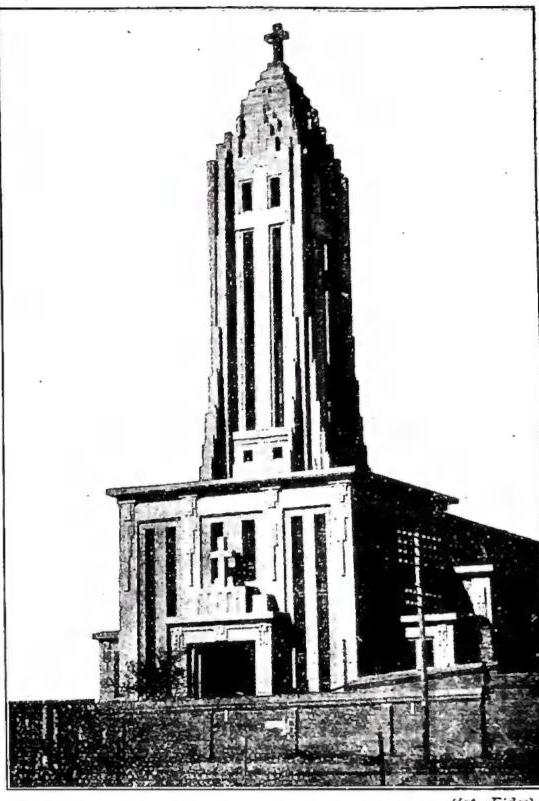
TSITSIKAR, APOSTOLIC PREFECTURE of — The Cathedral — Tsitsikar.