
CHARLEMAGNE, king of the FRANKS and of the LOMBARDS, EMPEROR.
SUMMARY:
I. Birth and early years
II. Conquests in Italy
III. Conquests outside Italy
IV. Schools and culture
V. Relations with the Church
VI. Relations with Byzantium
VII. The Frankish Empire
VIII. Cult
IX. Iconography
X. Reform of the liturgy.I. BIRTH AND EARLY YEARS
An energetic and lively personality, rich and complex in both man and leader, Charlemagne (Carlo Magno), whom contemporary chroniclers—uniquely in history—dubbed "the Great," closes the barbarian age by hastening the spontaneous maturation of the times and inaugurates feudal civilization. Between the decline and dissolution of the Western Empire and the rise of the Romano-Germanic Empire in its most singular representatives, Otto I and perhaps Barbarossa or even Frederick II, his is the greatest stature, towering over the Frankish people, Christianized yet still primitive, and propelling them to dominate the European stage. After the first emergence of autonomies following Rome’s disintegration, he forges the face of Europe that will endure throughout the long Middle Ages.His work connects to that of his father and grandfather (and, viewed in this light, represents its careful and sagacious perfection). His place is within the great current of Christ’s neophytes and the Roman Church, though he adapts to it with the freedom of an exuberant temperament. His action is far from an unbroken sequence of miracles or strokes of fortune. Yet where compromise still prevailed, he substitutes a straight and sure line, clear and coherent action that does not halt until the goal is achieved. Expanding the borders of Pepin’s already substantial kingdom, he evidently pursues the realization of a Christian empire that will be the Middle Ages’ magnificent legacy and its highest achievement—until the formula (echoed in the Lateran mosaic, "Beate Petre donas vitam Leoni papae et victoriam Carolo regi donas", where the Apostle gives to the two figures kneeling at his feet, with one hand the pallium and with the other the banner) of perfect equilibrium and unity between the supreme powers falters before the rise of individual consciousness. Charlemagne’s greatness lies perhaps even more in his defeats, from which he accepts lessons and draws experience, in the tenacity and patience that admirably combine in him with the swiftness of his movements and his immediate grasp of reality. Though heir to a tradition, he stands before enemies and allies like a force of nature—not only for his physical and moral qualities and personal valor, but also because of the scant biographical details and news of his personal life, so much so that the silence of even the closest sources about his life before ascending the throne may even seem a device to exalt his personality beyond usual limits. From nature, he possesses the gift of passing from violence and untamed fervor to serenity and great calm, to recollection and expectation, composing himself in a superior equilibrium that is the quality most astonishing and elevating in a man nourished by passions. Yet nothing escapes his understanding—even in theological matters, he seeks to leave his mark—just as he, uneducated and nearly illiterate, becomes the animator of a cultural movement that will remain tied to his name.
He was born at the end of the first year of his father Pepin the Short's reign, after the death in 741 of Charles Martel, victor of Poitiers and founder of the family's power. At the age of nine, he witnessed the maturation of his father's plan with the deposition of the last of the rois fainéants, Childeric III; meanwhile, with the Lombard invasion of the Exarchate and the Roman Duchy and the journey across the Alps of the new pontiff Stephen II, seeking Frankish aid against Aistulf, the drama of Italy, the Church, and Rome unfolded—one which the unwitting child would be called to resolve. Certainly, among the rare memories of the future emperor's youth is the meeting, to which his father wished him to be present, with his younger brother Carloman, between Pepin and Stephen II. At Ponthion and Quierzy, the foundations were laid for agreements whose distant outcome would be the Respublica Romana Francorum and the renewal of the Empire in the West and, for the time being, the Promissio Carisiaca (based on the claim, expressed in the forged Constitutum Constantini, by ecclesiastical circles to dominion over vast former imperial possessions) and the conferral upon the king of the Franks of the Roman patriciate. On 28 Aug. of that year, 754, Charlemagne was present at the ceremony in St-Denis where the Pope crowned Pepin and Bertha or Bertrada and was consecrated king by Stephen II, along with his brother Carloman. In exchange, Pepin marched against the restless Aistulf, first in one war and then in another, as the agreements made with the Lombard were not upheld. Then, between 760 and 763, Charlemagne appears in some monastic donations,
accompanies his father on the Aquitanian campaign, and receives certain counties.
II. CONQUESTS IN ITALY
Few months pass: and before the end of 771 the young daughter of Desiderius is sent back to her father, and the understanding pursued by Bertrada is broken. The fact is that on 4 December Carloman had died, and C[arlomagno], disregarding the sons of his brother, had himself acclaimed king also on the other side of the kingdom; and the widow of the deceased, Gerberga, with the orphans, had taken, at the same time as Desiderata, the road to the court of Pavia, with which, abruptly, relations were severed. These are closely connected events, but which in turn have their explanation in something that may have had the strength to bring C[arlomagno] back onto the path marked out by Pippin. Having secured his rear with the new matrimonial policy, Desiderius had resumed his push towards the lands considered the patrimony of St Peter, perhaps pursuing the vain dream of a Lombard Italy, whose premises had been laid with the duchies of Spoleto and Benevento. To detach from the Pope’s side the representatives of the anti-Lombard party, Christopher, primicerius of the notaries, and his son Sergius, secundicerius, and under the pretext of settling the long-standing dispute over the iustitiae of St Peter, Desiderius had gone to Rome: disturbances had broken out between his band of fideles and the two notables,supported by smaller Frankish contingents (little is known about their presence there, which may date back to the beginning of Carloman’s reign), and the Lombards had prevailed. The Pope, putting a good face on a bad situation, had abandoned his friends to Desiderius and his intermediary or representative, the cubicularius Paul Afiarta, and had even written to the Frankish court vilifying the memory of the former and praising the conduct of the latter. But, virtually a prisoner, what he affirmed about the restitutions carried little weight. These restitutions neither occurred nor were they going to occur: the Roman Church was well aware of this. Similar and other news, reaching France, must have stirred discontent there and provoked a reaction against Bertrada’s policy. The death, moreover, of Carloman, and the reunification of the two parts of the kingdom, gave free rein
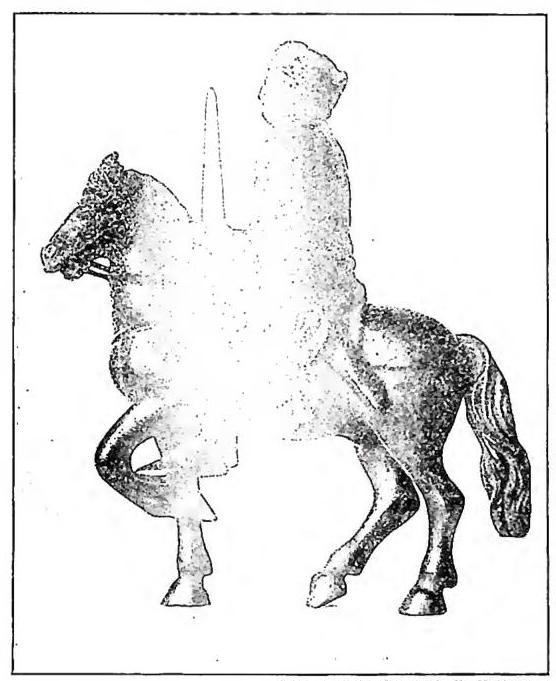
CARLOMAGNO — Bronze equestrian statuette said to be of C.
Paris, Carnavalet Museum.
C. changed his tactics: clear evidence of this is the repudiation of his Lombard wife. The peace-at-all-costs policy, influenced by the wound inflicted on Desiderius’s pride, rapidly gave way to war.
Stephen III, a pope of quite different stature, had succeeded to the See: Adrian I, a Roman nobleman above factional strife. Embassies passed between Rome and Pavia, but to no avail. Adrian no longer trusted the Lombard king’s promises, while Desiderius, bent on avenging his daughter’s humiliation, demanded from the Pope recognition of Carloman’s orphaned sons—his wards who, in Lombard interest, might have renewed the political situation. Adrian may have prudently refused. Certain it is that Desiderius invaded the lands of the Exarchate, holding them as a pledge to secure the Pope’s solidarity. The treacherous murder of the envoy, Afiarta, drove relations between Lombards and Rome to breaking-point: the Pentapolis was accused and Roman Tuscany invaded. At this juncture Adrian repeated the moves of Gregory III and Stephen II by appealing for Frankish aid. Yet such aid would not have arrived in time—Desiderius, with renewed fury, was marching on Rome at the head of an army, bringing with him the widow and two sons of Carloman—had not the threat of an anathema once more stayed the king and forced him to retreat as far as Pavia. Nevertheless, relations did not improve: each side was now committed and could not withdraw. Whoever yielded would lose everything. Even over the iustitiae of St Peter. In vain did C. attempt the gesture of a monetary payment almost as ransom for the disputed territories. Receiving a negative answer, the Frankish intervention became inevitable, dictated by the prestige of king and dynasty. Dividing his forces, entrusting one part to his uncle Bernard, C. after a council of magnates at Geneva descended through the Mont Cenis pass; the encircling movement closed in the Dora Riparia valley behind the defensive line that Desiderius and his son had drawn up at the Chiusa. The rout was complete: the surviving Lombards shut themselves up with Desiderius in Pavia, and with Adelchis and Gerberga in Verona. It was September 773. Soon Verona surrendered. The siege of the capital lasted until the following June, yet this did not prevent C. from continuing his activity elsewhere in Italy. After the surrender came the submission of the dukes. King Desiderius, Queen Ansa, and their daughters were consigned to monasteries: of them no more was heard. From the royal house only Adelchis, who had escaped the capitulations of Verona and Pavia, remained a proud adversary of the Franks; in exile on the Bosphorus he kept alive the hatreds of the Byzantine court against them. C. assumed the double dignity of King of the Franchi and of the Lombards: the personal union of the two crowns left the Lombard constitution intact; outwardly, it seemed that nothing had changed, no revolution had occurred. In reality, drawn into the Frankish orbit so thoroughly as to leave no room for hope or illusion (only in Friuli did a revolt flare up, quickly suppressed), the Lombards in 774 retained nothing but the name.
C. had not waited for the fall of Pavia before setting out for Rome: in the spring, while the Lombard kingdom was already collapsing, he had set forth accompanied by his magnates. Thirty miles from the city he was met by representatives of the clergy and militia, who then lined the road in his honour outside the walls. Adrian I awaited him before St Peter’s, embraced him, and led him by the hand into the basilica as the clergy sang “Benedictus qui venit in nomine Domini.” It was the Byzantine ceremonial accorded to the Frankish monarch. Days of festivity followed; on the fourth day Pope Adrian demanded from C. confirmation of the agreements made between Pippin and Stephen II, and of the donations envisaged in the Promissio Carisiaca (there is dispute over their extent, since it is impossible to credit the biographer of Adrian in the Liber Pontificalis). Thus began those relations of collaboration which the conferment and acceptance of the patriciate rendered natural, though with the limitation imposed by C.’s new status as king of the Lombards and his consequent duty to reconcile the temporal and Italian interests of papacy and crown.
From 774 to 800, when the name of Empire was reborn, ran the most intense years of C.’s activity. On a now clear course, yet never abandoning prudence and balance, he gave unitary form—after the manner of the ancient Empire—to Western Europe; the years were also marked by constant dealings with the popes Adrian I and Leo III, and by religious expansion in which the Christian idea (and war as its instrument) became the underlying motive of a king who was deeply religious yet fully aware of the political value of the ideal that inspired him.
III. CONQUESTS OUTSIDE ITALY
These are the years in which the triple thrust takes shape: towards Saxony, towards Bavaria, on the middle Danube. The wars against the Saxons, the warlike tribes still pagan and inhabiting Westphalia, last, one might say, throughout the reign of C.: it is a series of revolts, with the emergence of a true national hero, Widukind, which forces the Frankish king to continuous campaigns, sudden returns, and which does not give him security at his rear; and he reacts violently with massacres (4,500 dead at Verden), with the destruction of idols, with mass forced baptisms. There is, however, a gradual approach, there is, amidst undoubted ferocity, prudence; and there is, as in the Italian enterprise, a pursuit of the goal until its achievement, with the tenacity that scatters the enemy’s ranks. The Bavarian question is simpler: it is all about reducing Bavaria from a semi-independent state to a region of the Empire; and it is a family matter, which leads back to relations with his brother-colleague, Carloman. The duke of Bavaria, Tassilo III, who had not moved to prevent the fate of the Lombard people, realized too late his mistake: the sources attribute to his wife, the Lombard Liutberga, daughter of Desiderius, the weaving of plots with the Byzantine court (where Adelchis was) and Beneventan court (where the other sister, Adelberga, was). Even at Regensburg, as at Benevento, the weakening of the central Lombard state and the supposed Frankish acquiescence enlarged appetites: from duchy it passed to principality, and for Bavaria dreams of independence arose, while Carinthia was annexed. With the sharp decisiveness that was his hallmark and strength, C. in 782, just as the Italian kingdom was consolidated, cut short Tassilo’s ambitions. At the assembly of Worms, the latter swore an oath of vassalage and left hostages. But he resumed his plotting: discovered again in 787, fearing C.’s vengeance, he sought the support of the Church, before which Bavaria, a Catholic kingdom and always a faithful state, could not fail to find favour. But the king did not stop at the pleas of the “frater sum” Adrian, indeed forced him to take a position against the rebel, that is against one who withholds from his lord the loyalty due, and in 787, after a new expedition, Tassilo yielded and renewed his oath. To begin again, perhaps his heart could not bear to see his state reduced to the rank of one of the many duchies of the Frankish kingdom. This time, C. no longer pardoned: condemned to death, Tassilo ended his days in a monastery, and Bavaria, as such, ceased to be an individual entity in history. Bavaria was a necessary bridgehead for the third enterprise: that against the Avars, whose movements in the middle Danube zone presaged a new leap towards the West. To stop them in time, amid the ongoing Saxon campaigns, was the concern of the Frankish court: at first peaceful means were tried, so that at the assembly of Worms envoys of the Khan are seen and one can imagine Franks at his court. But when some collusion with the court of Regensburg became clear and every agreement proved impossible, in 791 the campaigns against the Avars opened, long and bloody, which, after fluctuating fortunes, ended with the forcing of the barbarian Ring, with immense spoils and the slaughter of the vanquished, in 799. To lead the armies this time were valiant lieutenants of C.: the Bavarian duke Gerold and the duke of Friuli, Eric, both fallen in battle. Saxons, Bavarians, Avars: these were three points resumed from the programme of Pippin the Short, with the strengthened relations with the Church and the resolution of the Lombard question. But what had been anticipatory hints are now achievements that seemed prodigious to contemporaries, and the breadth of horizons now allows the outline of the immense construction of the Carolingian Empire.Elsewhere, for Benevento and Spain, which were the points of junction and friction with the only two terrestrial powers that C. felt equal to or in any case formidable, the Byzantine Empire and Islam, he would show quite different prudence. Only on his fourth descent into Italy did C. show that he was aware of the independence claims of the Beneventan prince and of
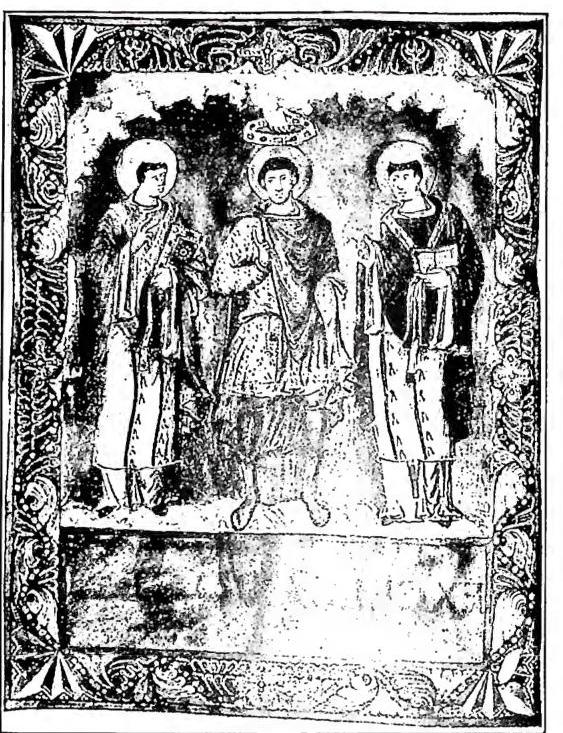
CARLOMAGNO - Portrait of C. identified by Lauer in the Sacramentary of Drogon (825-55), also called the Metz Sacramentary — Paris, Bibliothèque Nationale, ms. lat. 6428.
IV. SCHOOLS AND CULTURE
What had been outlined, through conquests and vassalages, during the intense work of CHARLES, extending from Britain, which acknowledged itself tributary, to the Marca Hispanica, from Aquitaine to Langobardia with its dependent duchies, to Westphalia, Bavaria, and Slavia, was the largest aggregate of nations the world had known since the Roman Empire. It was not a unitary State: CHARLES left each people its customs and institutions, contenting himself with a religious-military formula from which feudalism would draw great strength, thus favouring that autonomy of the great which, however, he was inclined to level. But the reward of loyalty had become for him a principle of government. Yet from the Carolingian creation—a creation, let it not be forgotten, of barbarian origin—there could not develop a harmonising civilisation such as had been that of the ancient Empire. The unifying element that had drawn its greatest expansion precisely from the Frankish countryside remained the Church. And CHARLES drew close to it, recognised its value, and developed to the utmost its civilising possibilities: yet without sacrificing anything of his authority as regulator of temporal affairs, of his powers as a sovereign whose sense of authority derived from God and for which the Pope could have no role other than that of an intermediary. As long as the Chair of Peter was occupied by a man like Hadrian, who, though perhaps more concerned to create a temporal base for the papacy, was nonetheless a upright and enlightened shepherd, there was no discord or problem that could not be peacefully resolved. But when, at the end of December 795, Hadrian was succeeded by a little-known Roman priest, Leo III, lacking unanimity around him and of a more pliable temperament, then the hand of the king became more harshly felt. A new problem then arose regarding the relationship between the king of the Franks and Lombards and Patrician of the Romans and the Pope, just as new was the relationship, after Christmas 800, between the Empire of the East and the revived Western Empire. The other problems, instead, could be said to have been resolved or set on the path to solution.With remarkable clarity, while preserving the greater autonomies, without having anything to fear from them, CHARLES had placed at the head of certain territories his sons, with royal title but in reality with viceregal powers: Pippin in ex-Langobard Italy, Louis in Aquitaine. Sensitive to the currents of culture, to the arts and sciences, so much so that he desired careful and complete education for his sons, he gathered around himself learned men, artists, philosophers, and scientists from every provenance, entrusting them with the establishment of a palace school and an academy in what, definitively departing from Frankish tradition, was now the fixed seat of the court and the resplendent capital of new buildings and treasures of art: Aachen. There converged Alcuin the Englishman, Paul the Deacon the Lombard, Einhard the Frank: the first, the greatest scholar of the age and an expert counsellor to the king, met by chance in Parma in 781 and from then on never forgotten; the second, who had come to Francia to plead the cause of Lombard prisoners, among whom was a brother, and remained there, almost as a pledge of superior collaboration in the ideal and interest of culture, the great historian of his people; the third, the most faithful, biographer, attentive and acute. With them also appeared Peter of Pisa and Paulinus of Aquileia, a grammarian and a poet, the king’s chivalrous cousin Adalhard (the only one to lament the fate of Desiderata, the most unfortunate), Rabanus Maurus, Gottschalk, Jonas, Agobard, Walahfrid Strabo, Ermoldus Nigellus—also a Carolingian—and then Ethelwulf, Angilbert, Fridugisus, Theodulf.
V. RELATIONS WITH THE CHURCH
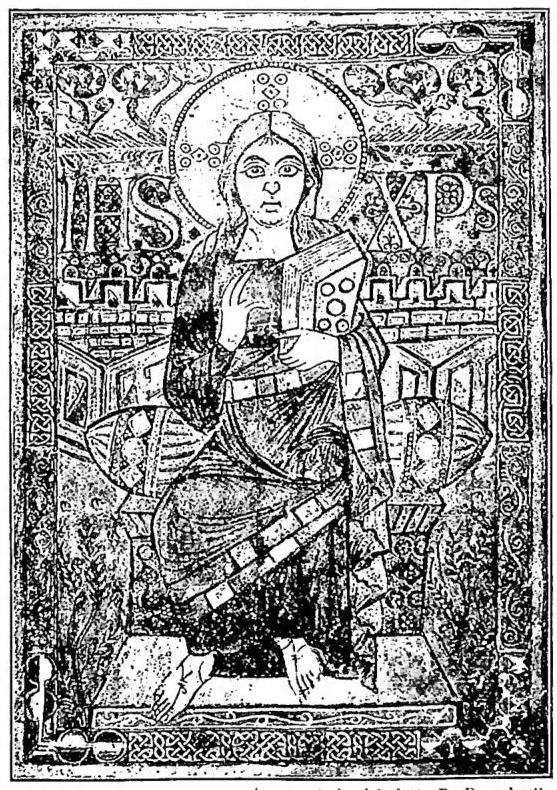
Personal inspiration and state interest likewise led him (and here a negative aspect of his centralizing personality was reflected) to direct interventions in the most jealously guarded sphere of the Church: in matters of ecclesiastical discipline and theological controversies. As the driving force behind the missionary activity, which from St Boniface to St Willibrord had reached its greatest impetus, C. did not hesitate to give instructions to the clergy himself, to act as their judge and to regulate the liturgy (v. below). But at the summit of his concerns were theological problems, the distance of which from the passions of politics he either did not perceive or, if he did, wished to help restore to what he considered the right path through his authority. Indignant that without his participation (though with that of the papal legates) the Council of Nicaea could have been defined as ecumenicalCARLOMAGNO — Christ in Majesty. Miniature from C.’s Gospel book, work of the scribe Godescalc (781–82) — Paris, Bibliothèque Nationale, lat. 1203, nouv. acq., f. 3.
In 787, the council that definitively condemned iconoclasm did not refrain from convoking a council of its own at Frankfurt, where the question was reopened and the tithe was made obligatory (and enforced by secular power as law). Pope Hadrian’s embarrassment was considerable when, in the Libri Carolini, the entire question of images was taken up again in opposition to the decisions of Nicaea, though with a return to the felicitous expression of Gregory the Great that images might be objects of veneration only insofar as they stirred devotion in the masses. Thus, in the Spanish Adoptionist controversy (the heresy that made Christ, as man, the adopted Son of God, recently upheld by Bishop Felix of Urgel) and in the Filioque dispute (the procession of the Holy Spirit from the Father and
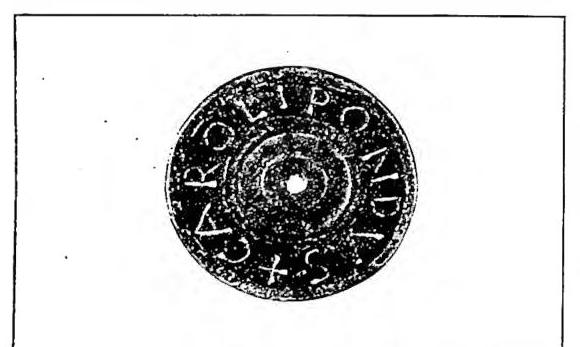
CARLOMAGNO — The so‑called pound of C. or Caroli pondus. Weighs 41.5 g = 1½ ounces of a pound of 328.40 g. Probably coined at Rome — Biblioteca Vaticana, Museo Sacro.
he wished to intervene, securing the condemnation of the former and the promotion of the latter in synods that he himself presided over. The Pope’s sincere warnings availed nothing. Yet the times were not yet ripe for a clash on this field between the two powers. Death alone, moreover, probably stayed C. from executing a sweeping ecclesiastical reform, traces of which remain in the sources and in the work of continuators of the Carolingian movement, such as Hincmar of Reims and Gerbert of Aurillac.
A jealous guardian of the rights of the State, C. allowed the same Adrian little room for advance: the confirmation of the Promissio Carisiaca amounted to a formal act, the papal aspirations over the ex‑Lombard territories were largely frustrated, except for the retrocession of southern Tuscany, where around Viterbo and Orvieto the Patrimonium Sancti Petri would take shape, later to become, with the Donation of Sutri, the foundation of the temporal State. Even in what he yielded or acknowledged, the king did not leave the Pope’s authority free: unlike Pippin, C. never for a moment abandoned the annexation to his title of Patrician of a meaning no longer merely honorific. Before the papacy he was indeed the devoted believer, yet as quasi‑defender of the faith he regarded himself as responsible for the order willed by God and therefore assumed—often with difficulty—the stance of protector. As Patrician he also gave concrete form to those special powers over the Roman people which the pontiffs had never envisaged except in a defensive capacity for themselves and their dignity.
The situation worsened, and in a sense was resolved, with the succession of Leo III to Adrian I. Whatever the pontificate of the latter had obtained from the Romans, the pontificate of his successor from the outset bore the marks of strife and turmoil. Leo, immediately after his election, adopted toward the Frankish king an attitude almost of subjection: he wrote, announcing his election and promising fidelity and obedience, sending the keys of St Peter’s confession and the city banner, and requesting that a messenger be sent to receive the oath of loyalty from the Romans. C. dispatched Angilbert and admonished the Pope, in his reply letter, concerning the duties of his office. Such patent weakness may have been at the root of the Roman conspiracy of 799: on 25 April, as the Pope rode in procession toward St Lawrence’s, near the monastery of SS Stephen and Sylvester, he was set upon by a mob of armed men, thrown from his horse, beaten and left half dead in the monastery of St Erasmus (legend, collected by the papal biographer, claims that the Pontiff’s eyes were gouged out and his tongue cut off, from which he was miraculously healed). Some faithful removed him under cover of night and brought him back to St Peter’s; thence the Duke of Spoleto Guinigis hurried to convey him to safety. Whether to excuse himself or to lay charges, the Pope set out for Francia just as C. was preparing a new expedition against the Saxons. In July, at Paderborn, king and Pope met, and Leo received the most marked tokens of deference. Two or three months the Pontiff remained in Francia, yet the sources tell us nothing of his conversations with the king. Toward the end of September, with a large escort, Leo returned to Rome, arriving on 30 November. With him came Frankish envoys charged with an inquiry; Paschal the Primicerius and Campulus the Sacellarius were found guilty of conspiracy and assault and sent as prisoners to Francia. The gravity of the affair, however, made C.’s presence—promised to the Pope on parting—necessary to restore peace in Rome. He announced this task, at the assembly of Mainz in August 800, declaring his intention to descend with an army (entrusted to his son Pippin, which was to march from Ancona toward the Duchy of Benevento, though it never arrived, or was halted by the plague then raging). At Nomentum he was met in person by the Pope and the Roman nobility. On 24 November he made his solemn entry into the city; a week later, in St Peter’s, before a large gathering of ecclesiastical and lay notables, Frankish and Roman, he convened the parties. A Frankish chronicler states that the Pope’s adversaries failed to substantiate their charges. On 23 December, in the same basilica, Leo III was induced to swear an oath asserting his innocence. Only then, a few days later, did C. bring Paschal, Campulus and their followers before his tribunal and pronounce sentence of death, later commuted to exile in Francia.
Yet between these last acts of the Roman drama, on Christmas Day a yet grander ceremony had taken place. The flower of Roman and Frankish nobility was present at the Mass celebrated by the Pope. As the king knelt before the altar, Pope Leo placed a golden crown upon his head, while the bystanders thrice raised the acclamation: “To Charles Augustus, crowned by God, great and pacific emperor, life and victory!” Then, kneeling himself, the Pope did homage to the new emperor.
It was, and contemporaries so understood it, the revival of the Empire in the West; and that it should occur in Rome, amid the jubilation of the Romans—who from C.’s first coming had heard once more the voice of the past (so that writers of every nation thereafter vied to celebrate the city that had given birth to universal glory)—prevented close scrutiny of the fact that the conferrer was the Pope and of the further fact that another empire still lived across the sea, likewise calling itself the Roman Empire, inviolate until then by the barbarians, unlike the West. Yet if the Roman and Frankish circles, the politicians and literati of the two courts—among whom the idea of imperial exaltation had taken shape and who had adroitly stage‑managed the scene—saw only its lights, the emperor must have pondered its shadows, then and later, if the famous remark of Einhard (relating to the assumption of the imperial title: “which at first he so shrank from that he declared he would not have entered the church that day, though it was a great feast, had he been able to foresee the Pope’s intention”) truly reflects his feeling. Not perhaps so much on account of the Pope’s part in the coronation (though the different arrangement of Louis’s coronation at Aachen in 813 may carry some weight); but for the diplomatic repercussions of the act upon the court of Byzantium, to which the continuation of Einhard’s text undoubtedly alludes: “Yet he bore with great patience the envy aroused by the title he had assumed, the Roman emperors being indignant over it,” even if “he met their contumacy with a magnanimity in which he was undoubtedly far their superior, sending frequent embassies to them and addressing them in his letters as brothers.”
VI. RELATIONS WITH BYZANTIUM
Charles’s position toward the Eastern Empire was one of the utmost delicacy: the hostility aroused by the conquest of Lombard Italy had not resulted in war only because of the patience and positive efforts of Charles, who had refused to embark on Beneventan adventures and had set the city of Rome as the limit to his interests on the peninsula. On the other hand, the independent stance of the Beneventan prince and the general collusion of the Byzantines with his enemies greatly disturbed him, even though distance and the lack of a fleet prevented him from achieving a military solution. Charles, who did not want war unless peace proved impossible, anxiously sought avenues of agreement. This seemed possible when, during his third descent into Italy, at Rome in 781, Byzantine envoys arrived to ask for the hand of his daughter Rotrude for the very young Constantine Porphyrogenitus, who had ascended the throne the previous year under the regency of his mother, the beautiful and ambitious Irene, who, by restoring the cult of images, had inspired a renewal of relations with the Roman Church and the West. It was a time when the papacy was definitively breaking away, under Frankish protection, from any—even formal—Byzantine dependence: no trace of it remained in public and private acts or on coins. The Pope may well have taken advantage of the occasion to obtain imperial consent to the changes that had occurred in Italy and to the independence of the ecclesiastical state. But of the hoped-for marriage between the two young princes nothing is known: or rather, it is known only that it did not take place, perhaps because Charles had become aware of Irene’s ambitious designs or because of the subsequent clashes with Byzantium, whose complicity in the periodic Bavarian and Beneventan revolts became ever more evident. In 788, in Calabria, Franks and Lombards, under the command of Grimoaldo, together halted the Byzantines who had landed there. Even in the religious question, Charles convened a council at Frankfurt so that one might not be ecumenical only at Nicaea. A shudder of horror swept through Christendom in 797 at the news of the outrage perpetrated by Irene upon her own son, whom she had blinded and confined to a monastery in order to assume the throne herself. The Empire was then considered vacant, both because of the crime and because it was held by a woman; and to the voices extolling Rome’s illustrious past were added the first ideas of a translatio of imperial dignity from the East back to the West.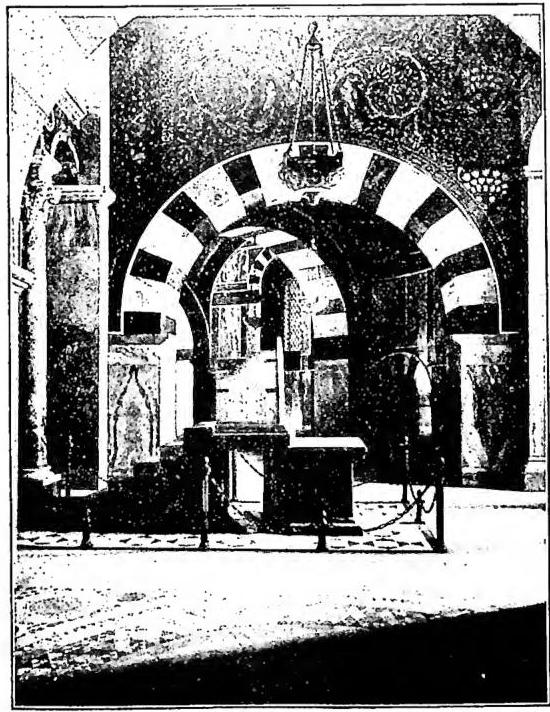
When this was signed at Aachen in 811, the long and intense life of the emperor was rapidly drawing to a close, saddened by the premature loss of his sons, King Pepin of Italy (810) and his eldest son Charles (811). The act of succession by which, in 806, he had (once again following his father’s example, though reserving the imperial title, of which so little mention is made) divided the great Empire no longer held good: only one of his sons remained, Louis, whom his contemporaries, lacking other virtues,
CARLOMAGNO - Throne of the coronation of C. in the upper gallery of the cathedral of Aachen.
He had finally concluded peace with Benevento, had entrusted the viceregal powers over Italy to the young BERNARD, son of the valiant PIPINO, and could die in his Aachen on 28 January 814.
VII. THE FRANKISH EMPIRE
An immense construction, with contours too imprecise and conducted with too heavy a hand, lacking unity and its own vitality, and therefore lacking stability, the Empire of CHARLEMAGNE, founded on the exceptional personality of its founder, may be said to enter into crisis as soon as he dies. It will be a long crisis: from 814 to 888. Yet even when, for the second time after the collapse of the Roman world, those nations and States of the West receive new life from that crisis, the work of CHARLEMAGNE will not appear less great and, for the purposes of history, less providential. From him, who had traversed it, staining it with blood and holding it firm with his iron fist, there emerge the great nations of France and Germany. Even Italy owes to him, despite the halt in the unifying function of the Lombards, at least the first unitary name of the Italic kingdom. Christian civilization becomes the common denominator of diverse peoples, the only possible basis for a moral and political unity subsequent to that of the Roman Empire. Which is, in truth, if one looks closely, the first European unity, that is, Western and which surpasses the boundaries of Latinity or Germanic barbarism, and founds and sets in motion an organic process of culture.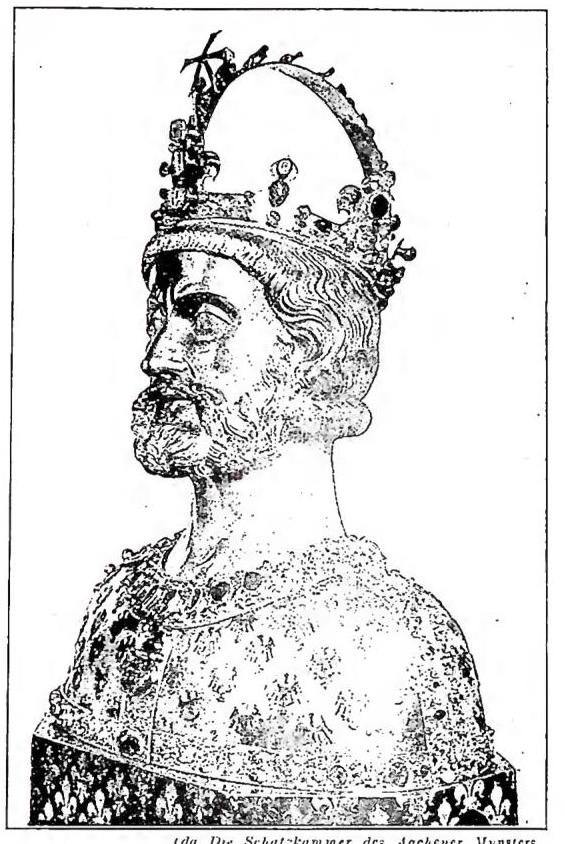
CARLOMAGNO - Bust reliquary of C. (14th c.), Aachen, museum.
He obtained from Hārūn al-Rashīd recognition of a moral protectorate over the Holy Places for Christian pilgrims and more concrete protection from the Abbasid caliph. This was like the necessary prologue to the Crusades, laying down their fundamental premise: the safeguarding of the Holy Sepulchre.
It is easy to understand how, even during his lifetime, C. was surrounded by admiration and respect such as men had not known for many centuries, a legend grew up around him. Details supplied by Einhard or the Annales Laurissenses provided the basis for the monk of St Gall’s fanciful biography. Then popular imagination took possession of the emperor. The chansons de geste, the chivalric poems, the dramatic poetry exalted the man and his deeds. Not only where his cult would seem most natural: in France, destined to become the seat of a universal empire. Even in Germany, which he traversed as a conqueror, saga raised him above even the heroes of resistance, Arminius or Widukind: perhaps already in the popular soul there was a consciousness of a nation brought to civilisation and history by the tenacious opponent of the Saxons. Also in Italy, Spain and England. Thus—perhaps his most fervent aspiration—he would take his place, in the imaginations and legends of the Middle Ages, beside those great figures of antiquity to whose thought he had always turned and whose work he had more or less consciously resumed.
VIII. CULT
In keeping with the idealization of the emperor’s figure woven by the Middle Ages—colored in sagas and legends, with a particular political intent at one of the crucial moments in the struggle between Church and Empire—the antipope Paschal III proceeded, in 1165, to the canonization of CHARLES. The initiative came from Rainaldo of Dassel, chancellor of Barbarossa. Although the decree was applied in Aachen, where devotion flourished around the tomb and on the anniversary of his death (28 January), the Church, as was only right, never recognized the act of the antipope.In the Middle Ages and until the reform of diocesan Propers begun by Pius X (1912), CHARLES was venerated in various dioceses of France and especially of Germany; today this cult is confined to the single city of Aachen, of which he is the patron (cf. Proprium dioecesanum, approved by the Sacred Congregation of Rites and published in 1932).
IX. ICONOGRAPHY
The iconography of CHARLES is largely nourished by legend. His features are those fixed by his biographers. The only contemporary image, perhaps, is the bronze statuette of Carolingian art in the Carnavalet Museum, which depicts him on horseback, upright and wearing a diadem. Rough, yet not devoid of some truthful elements, is the miniature in Codex 84 of Gotha, of Franconian school from the 10th century. Conventional is the figure of CHARLES, kneeling at the feet of St. Peter and beside the Pope, in the mosaic that once existed in the Lateran Triclinium and was placed there by Leo III, later restored several times.Pier Fausto Palumbo
X. Reform of the Liturgy
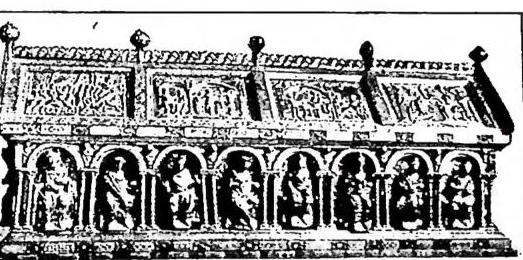
The direct influence of CHARLES must be credited with the establishment of the Roman liturgy beyond the Alps and theCARLOMAGNO - Reliquary casket of CHARLEMAGNE begun by Frederick Barbarossa in 1165, completed by Frederick II in 1213. Aachen, Cathedral Treasury.
His definitive triumph in the Latin West was also a triumph for the Roman liturgy. He accelerated and made effective that liturgical movement toward Rome whose first traces appear in Gallican liturgical books from the end of the 7th and the first half of the 8th centuries, such as the Missale Gotlicum (ed. H. M. Bannister, London 1917; C. Mühlberg, Augsburg 1929), the Missale Francorum (ed. J. Mabillon, Paris 1685), the Missale Gallicanum vetus (ed. J. Mabillon, ibid. 1685), and the Missale of Bobbio (ed. E. A. Lowe, London 1920). This movement was intensified by the provident action of St Boniface, the apostle of Germany, of St Chrodegang of Metz, of St Remigius of Rouen, and above all of Pippin, after the latter’s sojourn at the Frankish court (753–55) of Pope Stephen II. Pippin’s principal concern was the reform of chant, that is, the song which he wished to restore to the purity of Roman sources (cf. MGH, Capitularia, I, p. 80: Epistola generalis, written between 786 and 800; Walafrid Strabo, De ecclesiasticarum rerum exordiis et incrementis, 35: PL 114, 957). Naturally the reform of chant also provoked a reform of the other books required for psalmody, that is, for the entire choral office (Office and Mass), and first of all of the Sacramentary. Thus, about the middle of the 8th century, a Benedictine produced the book called by E. Bishop the “Gelasian Sacramentary of the 8th century,” which could satisfy the reformer’s requirements by combining the ancient Gelasian Sacramentary with a Gregorian one, without neglecting some usages of the old Gallican liturgy which were certainly very dear to the clergy (cf. P. de Puniet, Le Sacramentaire de Gellone, Rome n.d., offprint from Ephemerides liturgicae, 1934–38; V. SACRAMENTARIO). Consequently, Lectionaries and Gospel Books of the same type were immediately composed in parallel (cf. Th. Klauser, Das römische Capitulare Evangeliorum, Münster in Westphalia 1935). The Capitulare de imaginibus (Libri Carolini) assures us that Pippin was concerned with this reform “ut non esset dispar ordo psallendi, quibus erat compar ardor credendi” (I, 6: MGH, Concilia, II, suppl., p. 21), or, as the Admonitio generalis of 23 March 789, § 80, puts it: “ob unanimitatem Apostolicae Sedis et Sanctae Dei Ecclesiae pacificam concordiam” (MGH, Capitularia, I, p. 61).
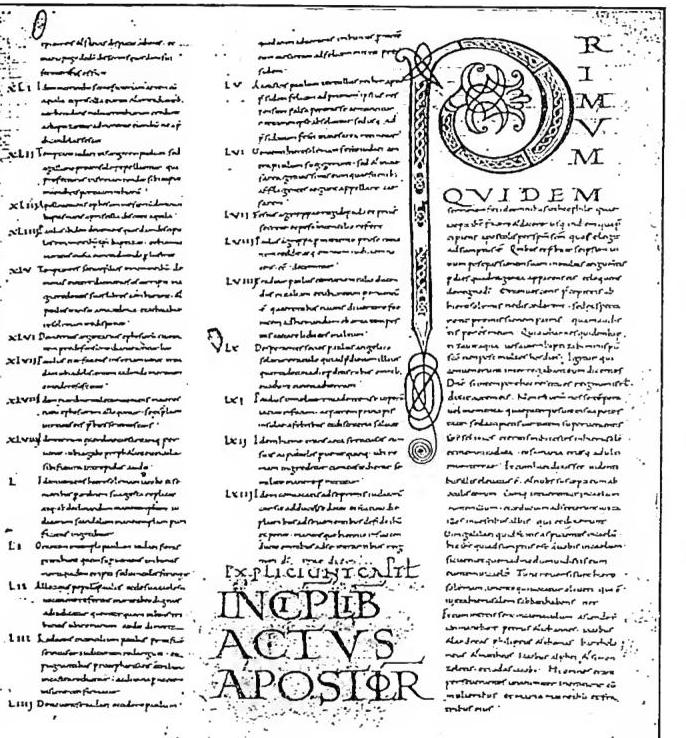
CARLOMAGNO - « Bibbia di Alcuino », codice fatto copiare da C. nello scriptorium di Tours - Roma, biblioteca Vallicelliana, cod. B 6, f. 303.
che, nel corso del secolo seguente, fece poi ritorno a Roma, divenendo la base del messale della curia, antesignano dell'odierno Messale romano. Grazie quindi all'azione di C. tutto il Sacramentario gregoriano « immixtum », ricevuto dal Papa Adriano e, per mezzo del supplemento alcuiniano, alcune parti dell'antico Gelasiano e testi della liturgia gallicana sono passati nel nostro Messale romano. Anche i libri liturgici ambrosiani subirono qua e là l'influsso della riforma di C.
C. provvide pure alla compilazione e alla divulgazione di un nuovo lezionario per le letture dell'Ufficio divino, che affidò alla nota sagacia di Paolo Diacono (cf. MGH, Capitularia, I, pp. 80-81: Epistola generalis, scritta tra 786 e l'800; V. ed. del lez. di Paolo Diacono curata da F. Wiegand, Das Homiliarium Karls des Grossen,
pure a spogliarsi delle formule relative a questi ultimi; per ragioni pratiche esse furono riunite agli Ordines, dando così origine al cosiddetto Pontificale corolingio - di cui i primi esemplari risalgono appunto all'inizio del sec. IX - protoparente del Pontificale romano-germanico del sec. X e quindi dell'odierno Pontificale romano.
Nel suo lavoro di riforma, C. fu validamente aiutato dall'episcopato che si fece un dovere di aderire pienamente al volere imperiale, come risulta dagli atti dei sinodi tra i quali si ricordano quello di Rispach (Baviera) del 798 e i sinodi riformatori dell'812 tenuti ad Arles, Reims, Magonza, Chalon-sur-Saône e Tours (cf. MGH, Concilia, II, pp. 196 sgg., 245 sgg.), nonché dagli Statuti di Rispach, Frisinga e Salisburgo del 799 e dell'800 (cf. MGH, Capitularia, I, pp. 229-30), dai Capitula de examinandi ecclesiasticis, dell'802 (cf. ibid., p. 110) e dai Capitula ecclesiastica, dell'807-23, del vescovo Haito di Basilea (cf. ibid., p. 363).
C. pensò anche alla trasmissione accurata dei testi liturgici, allora assai difficoltosa: infatti nell'Admonitio generalis, del 23 marzo 789, § 72 (cf. ibid., p. 60) egli stabilì che il Vangelo, il Salterio e il Messale fossero copiati diligentemente da uomini di età matura, «perfectae aetatis»; tale ordinanza ha certamente contribuito a invogliare i grandi «scriptoria» - primo tra tutti quello di Tours - dell'evo carolingio a preparare i numerosi codici scritturistici e liturgici di gran lusso, talvolta perfino purpurei, con lettere d'oro e d'argento, scritti nella nitida minuscola carolina, con rare abbreviazioni, e riccamente ornati e miniati, i quali costituiscono oggi ancora il più bell'ornamento di molte biblioteche pubbliche e private.
Però, malgrado tutte le sollecitudini dell'Imperatore (esistono al riguardo interessanti racconti leggendari) e dell'episcopato, la riforma procedette, per svariate cause, piuttosto a rilento. Due furono le principali difficoltà: 1) la povertà impedi molte chiese e monasteri, spesso depredati, di procurarsi subito tutta la biblioteca, allora occorrente, per la celebrazione della liturgia; 2) le diversità esistenti fra gli stessi principali libri liturgici, giunti da Roma, dovettero generare una certa qual confusione, come si rileva anche dal fatto che Amalario credette opportuno occuparsi di queste discrepanze nel suo Liber officinalis e di comporre il Liber de ordine Antiphonarii (cf. ed. critiche di J. M. Hanssens [*Studi e Testi, 139-40], Città del Vaticano 1948-49). Ad eccezione dello schema generale del «Temporale» e del «Santorale» non esisteva infatti tra questi libri: un'unità assoluta, per la semplice ragione che le maggiori basiliche romane dalle quali provenivano avevano ognuna un calendario proprio. In tal modo il Comes romane, riveduto da Alcuino, e il Sacramentario*, inviato da Adriano I, pur essendo dello stesso tipo e contemporaneamente in uso a Cambrai non concordano tra loro, tranne che nella Quaresima, nelle Tempora e in poche feste del «Santorale». Comunque la riforma liturgica, solidamente impostata, fu condotta con tutti i mezzi allora disponibili e illustrata dalle opere dei grandi liturgisti dell'epoca più o meno tributari di Alcuino, come Wala, abate di Corbie, Walafrido Strabone, Paolo Diacono, Elisacario, Amalario di Metz e Rabano Mauro. L'intenso lavoro liturgico promosso dalla riforma di C. ha pure il merito di averci conservato, in più manoscritti, quasi tutti i documenti della liturgia romana anteriori al sec. X.
BIBL.-C. Kriev, Die liturgischen Bestrebungen im harolingischen Zeitalter. Antrittsprogramm, Friburgo in Br. 1888; S. Bäumer, Histoire du Bréviaire, trad. fr. di R. Biron, I, Parigi 1905, pp. 237-342; E. Bishop-A. Wilmart, Le génie du Rit romain, Parigi 1921; id., La réforme liturgique de Charlemagne, in Ephemerides liturgicae, 45 (1931), pp. 186-207; A. Wilmart, Les anciens Missels de la France, ibid., 46 (1932), pp. 237, 242-43; id., Le lectinnaire d'Alcuin, ibid., 51 (1937), pp. 136-97; Th. Klauser, Die Liturgischen Austauschbeziehungen zwischen der römischen und fränkisch-deutschen Kirche vom 8.-11. Jahrhundert, in Historisches Jahrbuch der Görresgesellschaft, 53 (1933), pp. 169-89; C. Callewaert, Liturgicae Institutiones, I, 3ª ed., Bruges 1933, pp. 69-79; Ph. Oppenheim, Introduktio in litteraturam liturgicam, 2ª ed., Torino 1945, pp. 28-33; id., De libris liturgicis deque iure ex eis manante, ivi 1940, pp. 17-82; M. Andrieu, Les Ordines Romani du haut moyen âge (VIIIe-Xe siècle): I. Les Manuscrits, Lovanio 1913, pp. 466-548; II. Les Textes, ivi 1948, pp. XVII-XIX; P. Borella,
Inflarsi carolingi e monastici sul Messale ambrosiano, in Miscellanea liturgica in honorem L. C. Mohlberg, Roma 1948, pp. 73-115.