POITIERS, DIOCESE of. — City and diocese of the department of Vienne in France; it comprises the two civil departments of Vienne and Deux-Sèvres, with an area of 12,970 sq. km. and a population of 620,000, of whom 580,000 are Catholics, distributed among 61 deaneries with 643 parishes, served by 666 diocesan priests and 100 religious priests. The Major Seminary is at P., the Minor Seminary at Montmorillon; it also has the « Ecole cléricale » at Châtillon-sur-Sèvre and Collège St-Joseph at Bressuire; the diocese has 14 male and 195 female religious communities. The diocese is suffragan to Bordeaux. It was the capital of the Pictavi under the name of Limonum and formed part of the Roman province of Aquitania.
After the Saracens occupied Poitou, they were defeated by Charles Martel in 732; the region then passed to the Carolingian kingdom and the Duchy of Aquitaine, and subsequently came under the English through the marriage of Henry Plantagenet to Alienor d’Aquitaine. It was reunited with the crown of France by Philip Augustus. In 1423 Charles VII established at P. the Parliament of Paris, which remained there until 1436. Four catalogues of the bishops of P. earlier than the 13th century are known; that of Robert of Torigny, now in ms. Lat. 6042 of the Bibliothèque nationale in Paris, ends with Gilbert de la Porée (1142–54); the other, in ms. 4955 of the same Library, ends with John « aux Blanches mains » (1169–82), as does ms. 450 of the Regina collection (Christina of Sweden) in the Vatican Library; while ms. 711 of the same collection reaches William III (1184–97). The last three lists were compiled at St-Aubin d’Angers at the end of the 12th century; the mss. Bibl. nat. 4955 and Regina 711 derive from II. The catalogue contained in the great chronicle of Tours reaches the bishop Philip (1233); while the Cartulary of P., known by the title of the Grand Gautier, dates from the beginning of the 15th century; it seems identical with that of the chronicle of Tours, but continued into the 15th century. John XXII (1316–34) detached territories from P. in order to create the new dioceses of Maizellay and Luçon.
St Hilary was already bishop of P. ca. 330; he was sent into exile after the Council of Béziers in 356 and took part in the Council of Seleucia in Isauria in 359. The Hieronymian Martyrology commemorates him on 13 January, the day on which he died in 367 or 368. Next are recorded Adelphius, present at the Council of Orléans in 511; Daniel participated in that of 541; he was followed by Pientius, who died after 561 and is commemorated on 13 March, and then by Pascentius, abbot of St-Maixent, to whom Fortunatus dedicated the Life of St Hilary in 565; then by Maroveus, mentioned several times by Gregory of Tours between the years 585 and 590 (Hist. Franc., VII, 24; IX, 30, 33, 39–41, 43; X, 15, 16), and succeeded by Plato, archdeacon of Gregory of Tours, who was present at his entry into the diocese (id., Miracula s. Martini, IV, 132). Then came Venantius Honorius Clementianus Fortunatus, whose epitaph was composed by Paul the Deacon (Hist. Langobard., II, 13). Later there were Dido, uncle of St Leodegarius of Autun, ca. 628–70; Ansoald, who transferred the relics of St Leodegarius to St-Maixent at the end of the 7th century; John, for whom Alcuin dictated the epitaph (PL 101, 750); Ebroin, who took part in the Council of Ver in 844 and was killed by the inhabitants of P. ca. 850; Engenald, who participated in the Councils of Toul in 860 and Douzy in 871; Ecrifidus, to whom Pope John VIII wrote in 878 (Jaffé-Wattenbach, 3145, 3181). The following are then recorded: St Peter (1087–1115), exiled by William IX, count of P.; Gilbert de la Porée (1142–54),
(from L. Lefrançais - Pillon, Cart roman, Paris n. d., loc. I; D)
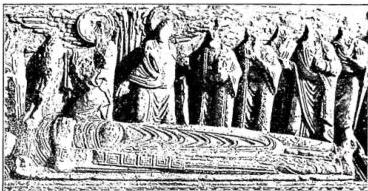
POITIERS, DIOCESE of. — Tomb of T. Hilary. Relief depicting the death of the Saint (13th century) — Church of St Hilary of Celle.
Blessed William Tempier (1184–97), Blessed Walter de Bruges (1278–1306); Arnaldo d'Aux (1306–12), made a cardinal in 1312; Guido di Malsec (1371–75), made a cardinal in 1375, and Simone di Gramaud (1385–91), who in 1413 became administrator of the diocese until 1422; while in 1394–95 the bishop was L. De Bar, later a cardinal in 1397, who was its administrator in 1423; also G. G. Orsini (1449–57), Cardinals G. F. De Tremouille (1505–1507), G. De Grammont (1532), Cl. de Longwy de Giory (1534–51), and A. Barberini (1632–57). Pius VII consecrated D. de Pradt bishop of P. in Paris in 1805; he was born in 1837; from 1849 to 1880 the bishop was L. PIEVE (v.), later a cardinal.
On 2 September 1792, the parish priest of Niort, Jean Gozet, was martyred in the Carmelite convent together with his vicars Pierre Landry and Jean Philippe Marchand; they were beatified by Pius XI in 1926. They are venerated in a chapel of the church of Notre-Dame in Niort, erected between 1491 and 1520. Charles VII established a university at P., which was approved by Eugene IV in the bull of 28 May 1431; Bacon was among its students. There were ten colleges attached to the University. In 1540 M. A. Muret was at the Collège Sainte-Marthe; in 1570 Fr. Maldonado came to P. to establish a Jesuit college, which in 1605 passed to the Collège Sainte-Marthe, to which the Collège de Puygareau was later joined. In 1674 the Jesuits founded a college for Irish ecclesiastical students. The University was suppressed by the French Revolution.
The Cathedral is dedicated to St Peter. Begun in 1166, it was completed in 1271, except for the two outer towers and the upper part of the façade, completed between the 14th and 16th centuries. It was consecrated in 1379. The interior has three naves with eight bays and measures 90 × 27 m. The windows date from the beginning of the 13th century and contain magnificent contemporary stained glass; the most notable, depicting the triumph of the Cross, was donated by Thibaud de Blason, seneschal of Poitou, for the victory at Navas (1212). The choir stalls also date from the 13th century. On the exterior, the three portals are decorated with scenes of the death, coronation of the Virgin, and Last Judgment. On the north side is the portal known as that of St Michael, with scenes from the life of the Blessed Virgin; near the southern transept are the chapels of St Martin and St Hilary, reconstructed in the 19th century on the presumed sites of St Martin’s cell and St Hilary’s dwelling. Nearby is the baptistery of St John, with a pentagonal apse and added apsidioles; at the centre of the rectangular hall is the octagonal basin. The columns came from Roman buildings, as did some of the capitals, which were imitated in the 7th century. The building was later converted into a parish church; it was restored and enlarged after a fire in 1018 with a narthex and a small bell tower. On the walls are remains of a decorative scheme with frescoes from the 12th–16th centuries, depicting the Ascension, saints, emperors, the Blessed Virgin, and so forth. The interior is now used as a museum.
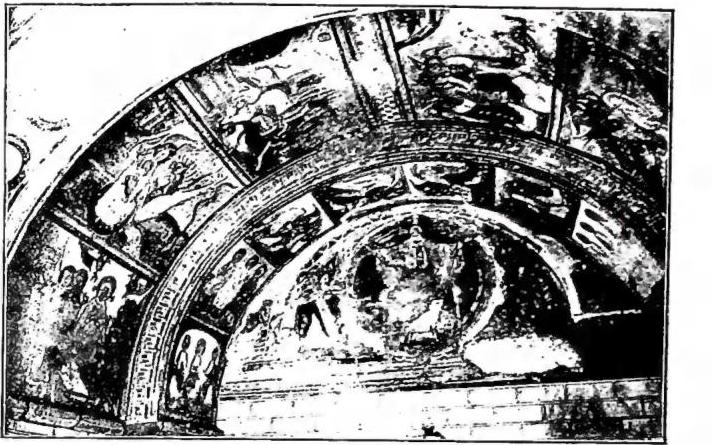
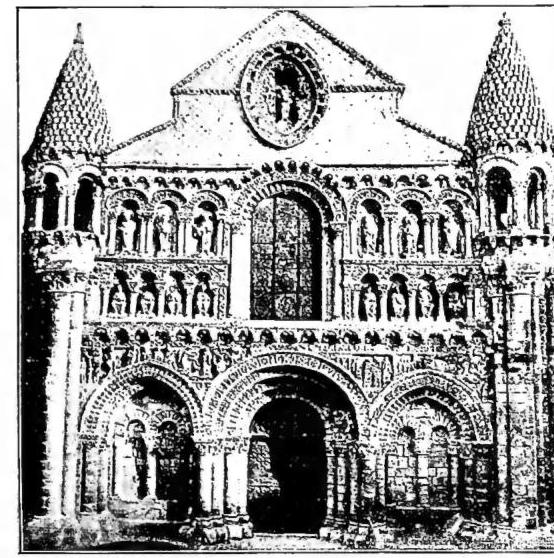
Notre-Dame-la-Grande, so called to distinguish it from Notre-Dame-la-Petite or l’Ancienne, known as « de la Chandelière ». It has three aisles, with a choir and central bell tower dating from the end of the 11th and the beginning of the 12th century, while the chapels on the north side are from the 16th century. The apse on the south side, with the chapel of the Holy Sepulchre, was erected by Jvon du Fou, seneschal of Poitou, in 1475. The statue of Notre-Dame-des-Clefs, from the 16th century, is greatly venerated. Particularly precious is the cycle of paintings discovered in 1857. At the centre of the vault is Christ in Majesty, surrounded by the symbols of the four Evangelists, the sun, and the moon; above is the divine Lamb amid adoring cherubim, below is the Madonna enthroned with the Child and an inscription now almost invisible (only « Matri » can be read); to the right and left of the divine Lamb are the elect, and then, all around the central scenes, the twelve Apostles, originally accompanied by their names. P. Deschamps dated the paintings to the 12th century, with some additions from the 13th century (P. Deschamps, Les peintures du chœur de Notre-Dame-la-Grande de P., in Comptes rendus de l’Acad. des Inscr. et belles lettres, 1949, pp. 288-93).
S. Radegonda: originally the church was S. Maria fuori le mura and served as a burial place for the nuns of S. Croce, but it later took the name of S. Radegonda, founder of the abbey, who died in 590 and was buried in the crypt. The church burned in 1083; rebuilt, it was consecrated in 1099. To this date belong the choir, ambulatory, lower part of the portico and bell tower; the remainder is from the 12th century, while the Gothic nave is from the 13th century and the portal from the 15th. Inside there is an upper gallery; the capitals are decorated with foliage or rough scenes, such as Adam and Eve and Daniel. The richly decorated portal, with Christ enthroned and saints beneath tabernacles, has a double entrance; around it are stone benches with angels and lions, where ecclesiastical justice was administered « inter leones ». In a niche on the right, the Lord is represented appearing to St Radegonda shortly before her death. The stained-glass windows (13th–14th centuries) contain episodes from the life of the Saint and the Last Judgment. G. B. De Rossi reported the discovery of a gold ring with a seal (Radegondis), probably belonging to Queen Radegonda (Bull. arch. crist., 1 [1863], p. 40).
St-Porchaire: this is a 16th-century building with two aisles and decorated capitals, including one depicting Daniel among the lions. The large bell tower (late 16th century) rises above the entrance porch. Notable for 17th-century art is the former chapel of the Jesuit college, with its artistic sacristy (now « Licée des garçons »). The church of St-Hilaire-de-la-Celle was built in the 12th century on the site of the original tomb of St Ilario; it has a transept covered by an octagonal dome and a tower. The chapel of the monastery of S. Croce (erected in 1865) preserves memorials of St Radegonda.
Near P., at the place known as « la pierre levée », there is a large Gallo-Roman, later Christian, necropolis, where Fr. C. De la Croix discovered a vaulted funerary monument with an underground chamber. On its door were the following two inscriptions: « In the name of God, I, Mellebaudo, debtor and servant of Christ, built this subterranean tomb for myself, in which, although unworthy, I shall be laid. I made it in the name of the Lord Jesus Christ, whom I loved and in whom I believed, because he must be acknowledged as the living God, resplendent in glory. In him are peace, faith, and charity. He is God and man, and God is in him. If anyone does not wish to worship the Lord Jesus Christ here and destroys this monument, let him be anathema, “maranatha”, until the end of the ages ». The other inscription reads: « Here is the tomb of Mellebaudo, abbot and debtor of Christ ... beginning and end, since everything grows worse each day, the end of time approaches ». On the threshold a cabalistic formula is engraved: « grama, grumo, ax, cax, pix ». In the crypt were found stone sarcophagi, some inside large niches; at the rear was an altar base. The barbarous form of the Latin and the crude decoration of one of the sarcophagi, with the archangels Raphael and Raguel, indicate the end of the 7th century (L. Duchesne, La crypte de Mellebaudo et les pretendus martyrs de P., in Revue poitevine et saintongeaise, 1885, pp. 120-54; L. Le Blant, Nouveau recueil des inscriptions chrétiennes de la Gaule, Paris 1892, pp. 250-73; L. Lavillain, La « memoria » de l’abbé Mellebaudo, in Bulletin de la Société des antiquaires de l’Ouest, 3e serie, 2 [1911], pp. 355-416; H. Leclercq, Mellebaudo, in DACL, XI, 1, cols. 241-66. A. W. Clapham, English romanesque architecture before the conquest, Oxford 1930, p. 43, fig. 14).
Montierneuf: that is, monasterium novum, founded by Count Guido Goffredo Guglielmo around 1078 under the direction of the monk Ponce of Cluny and consecrated by Urban II in 1096, as recorded by an inscription inside. It has a Romanesque ambulatory with chapels and a Gothic apse. Its Library is rich, with more than 75,000 volumes, 215 incunabula, and 629 manuscripts, including a Carolingian uncial Gospel book from the end of the 8th century; a Vita of St Radegonda and a Pontifical from the 11th century; and the Psalter of Jeanne de Laval from the 15th century. The municipal archives are attached to it, with parish registers dating back to 1412.
The « Société des Antiquaires de l’Ouest » has established three Museums: the « de l’Echevinage » contains a prehistoric collection, furnishings from the ancient Gallo-Roman necropolises of Poitou, and material from the Middle Ages and the Renaissance, including the capital known as the capital of discord, formerly in St. Hilaire-le-Grand, and the scene of St Ilario and St Triaise; the « de Chièvres » Museum contains a lapidary collection, furniture, ceramics, and paintings from the Flemish, German, and other schools; Merovingian art is assembled in the baptistery of S. Giovanni. The « Musée des Beaux-Arts » contains collections of paintings from the Italian, French, and Flemish schools, enamels, furniture, objets d’art, and sculptures, including the archaizing Hellenistic statue of Minerva in marble and a small bronze statuette of an athlete. The « Musée des Augustins » is the seat of the « Société de Antiquaires de l’Ouest ». Its portal comes from the former Augustinian church. It is rich in collections of porcelain, ceramics, furniture, bronzes, tapestries, enamels, and ivories; it has a room of religious art and a lapidary museum. Beneath an altar in the chapel of S. Sisto, a lead reliquary was found with an inscription commemorating the bishops Sisto and Isinicio (L. Levillain, Note sur l’ancien reliquaire en plomb trouvé dans la chapelle de St-Sixte et la cathédrale de P., in Bull. de la Soc. des antiq. de l’Ouest, 2ª serie, 10 [1906], pp. 54-56).
Principali santuari della diocesi sono Notre-Dame de l'Agenouillée a Azay-sur-Thouet, Notre-Dame de Pitié presso la cappella S. Lorenzo, Notre-Dame de Beauchene a Cerizay. A Ligugé venne fondato il più antico monastero di Francia da s. Martino, onde il nome dell'abbazia, soppressa dalla Rivoluzione Francese e ristabilita nel 1853. La sala alla base dell'attuale campanile corrisponde al transetto sud della chiesa primitiva, dove fu rappresentato ca. il 1075 il festino di Erode e la decollazione di s. Giovanni Battista (P. Deschamps - M. Thibout, op. cit., pp. 65-66 e fig. 66). La chiesa abbaziale, rifatta nel sec. XV, è stata restaurata di recente (P. Monsabert, Le monastère de Ligugé, Ligugé 1929; Cottineau, I, col. 1613). L'abbazia benedettina di St-Savin sur Gartempe, nel circondario di Montmorillon, fondata alla fine dell'VIII o all'inizio del sec. IX, venne ricostruita nel sec. XI; passò alla Congregazione dei Maurini nel 1643. La chiesa abbaziale rimonta al sec. XI; è a tre navate, terminanti ciascuna con un'abside; nel deambulatorio si aprono cinque cappelle pure absidate, come le due estremità del transetto; nella cripta è deposto s. Savino. La cripta, l'interno della chiesa e il portico offrono il più interessante ciclo iconografico finora conosciuto in Francia. Nel portico sono i principali episodi dell'Apocalisse; nella nave centrale il ciclo biblico occupa ca. 412 mq.; esso è disposto su due registri per ogni lato; dal nord comincia con la creazione del mondo, di Adamo ed Eva, tutta la loro storia, Caino e Abele, Enoch, la storia di Noè, l'esodo degli Ebrei. La tribuna è decorata con scene consacrate alla passione di Cristo, mentre nella cripta sono episodi relativi al martirio dei ss. Savino e Cipriano. La tecnica, lo stile e le iscrizioni concordano nella datazione proposta delle pitture alla fine del sec. XI, fin dal 1905 da E. Mâle (in A. Michel, Hist. de l'art, I, Parigi 1906, p. 758; Cottineau, II, coll. 2881-82; E. Maillard, L'église de St-Savin sur Gartempe, Parigi 1926; P. Deschamps - M. Thibout - A. Grabar, Observations sur les fresques de St-Savin, in Cahiers archéol., 4 [1949], pp. 135-47; P. Deschamps - M. Thibout, La peinture murale en France, le haut moyen-âge et l'époque romane, Parigi 1951, pp. 71-86; figg. 21-27, tavv. 23-32 e 37,1).