Machine translation of the 1948–1954 Italian original. The original text is authoritative.
PLUTEUS. - This denotes an element, usually of marble, though sometimes of wood (in Syria), used as an enclosure.
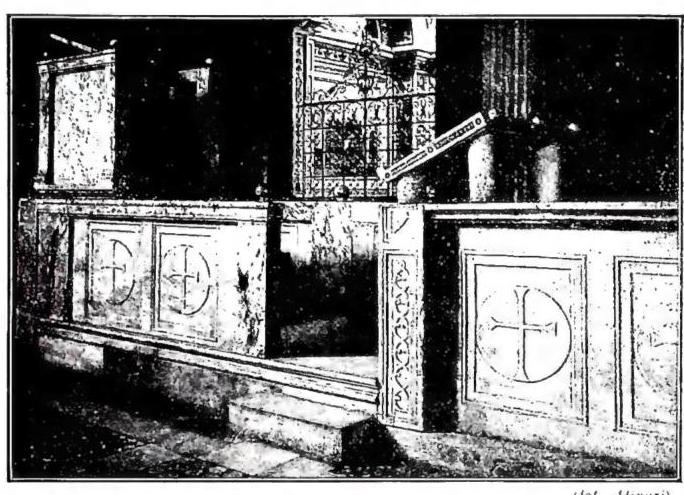
The plutei of Traiano (anaglypta Traiani), in the gallery of the rostra in the Roman Forum, were famous; they were richly carved. The earliest plutei in Christian buildings of worship (S. Pietro in Vaticano, S. Agnese) were similar to those carved in one of the bas-reliefs of the arch of Costantino. In the 6th century they appear with a cross in the centre, as in S. Clemente, S. Pietro, S. Lorenzo in Rome, and in Costantinopoli; or with monograms, as in S. Clemente (of Giovanni II); or richly decorated, as at Ravenna;
(phot. Alineri)
PLUTEO - P. of the rebuilt basilica of S. Clemente (12th cent.) - Rome.
braided decoration continued to develop and flourish in the Lombard period (v. ENOCH. Catt., VII, col. 1519), the Carolingian period, and in Rome down to that of the Cosmati.
BIBL.: F. Mazzanti, La scultura ornamentale romana nei bassi tempi, in Arch. stor. dell'arte, 2nd series, 2 (1896), pp. 33-57, 161-85; T. Rivoira, Le origini dell'architett. lombarda, I, Milano 1902, p. 335 ff.; E. A. Stückelberg, Langobard. Plastik, Monaco 1909; G. Mendel, Musées impériaux ottomans; catal. des Sculptures grecq., rom. et byzantines, II, Costantinopoli 1914, pp. 471 ff.; J. Braun, Der christl. Altar, 2 vols., Monaco di Bav. 1924, passim. Enrico Josi
Cite this article
“PLUTEO.” Enciclopedia Cattolica, vol. IX (1952), p. 985. Azione Romana digital edition, https://azioneromana.com/article/pluteo.