
CONSTANTINE (Imp. Caesar Flavius Valerius Constantinus Augustus), ROMAN EMPEROR, called the GREAT.
SUMMARY. —
I. Life
II. Personality
III. Ecclesiastical policy
IV. Personal piety
V. Political motives for Constantine’s conversion
VI. The caesaropapism of Constantine
VII. Constantine in legend and cult
VIII. Constantinian constructions in Rome and Palestine
IX. Constantine’s Donation.I. LIFE
He was born at Naïssus (Dacia) on 22 Feb., not before 280 (according to Seeck, in 288), to Caesar Constantius I and Helena; he died at the villa of Achyron, near Nicomedia, on 22 May 337. In 289 Constantius separated from Helena and married Theodora,stepdaughter of Maximian Herculius. Constantine was educated at the court of Diocletian and Galerius in the East, where he was virtually held as a hostage. After the abdication of Diocletian and Maximian (1 May 305), Constantius, now first Augustus, summoned his son to Gaul, and when he died shortly afterwards at Eboracum (York), the troops proclaimed Constantine emperor (25 July 306). At the same time, in Rome, Maxentius, son of Maximian, proclaimed himself emperor (28 Oct. 306), with his father’s support. Maximian and Maxentius then formed an alliance
(from F. Gurecki, I medaglioni romani, I, Milan 1911, pl. 7, no. 17)
COSTANTINO - Coin.
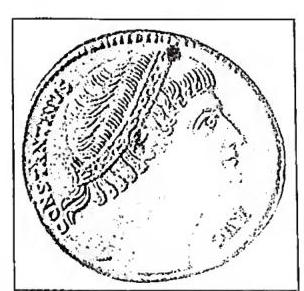
began to conspire even against his son-in-law, Constantine had him imprisoned and executed (according to others he died by suicide) in July 310.
After the death of Galerius (May 311), the two emperors of the East, the Augustus Licinius and the Caesar Maximinus Daia, came into discord: Daia took the side of Maxentius, Licinius instead approached Constantine and married Constantia, his half-sister. In the spring of 312, Constantine began the war against Maxentius and defeated him in the battle at the Milvian Bridge (28 Oct. 312), in which Maxentius met his death. The Senate gave Constantine the title of First Augustus. In February 313 Constantine met with Licinius in Milan, where they celebrated the wedding of Licinius to Constantia and issued the so-called "Edict of Milan" (cf. infra). After returning to Gaul, the first war between Constantine and Licinius broke out. Constantine defeated him at Cibalae (near Sirmium) and in the peace kept Illyricum for himself, thus making himself master of a good half of the empire. In 315 Constantine and Licinius were consuls. New disputes, in which the persecution of Christians resumed by Licinius in 321 was not unrelated, caused a second war in which Licinius was defeated at Adrianople (3 July 323), then at Chrysopolis in Asia Minor (18 Sept. 323) and finally shut up in Nicomedia. Constantia intervened, and Constantine promised clemency; however, conspiracies of Licinius with the barbarians gave Constantine cause to have him executed (324). Thus, after 40 years of divisions, Constantine remained the sole head of the empire.
On 20 May 325 Constantine was present at the opening of the Council of Nicaea. From July to September 326 he stayed in Rome, and at that time he decreed the death of his eldest son Crispus at Pola. The reasons for this decision are obscure; it seems there was a palace intrigue involving Fausta, stepmother of Crispus. Convinced later of Crispus’s innocence through the intervention of his mother Helena, Constantine had Fausta executed. On 26 Nov. 326 he laid the first stone of Constantinople, the new capital that was solemnly inaugurated on 11 May 330. Of the three sons he had by Fausta, he had already given the title of Caesar in 317 to Constantine (II), and in 323–24 to Constantius (II).
In 333 he also appointed the last, Constans, and in 335 Dalmatius, son of his half-brother Julius Constantius. Evidently he intended to revive Diocletian’s tetrarchy, entrusting it to his kinsmen. Hannibalianus, younger brother of Dalmatius, married Constantia, daughter of Constantine, and the kingdom of Pontus. In 337, while preparing for a war against Shapur II, king of Persia, Constantine fell ill and died, having been baptized by Eusebius, bishop of Nicomedia. His body was buried in the basilica of the Apostles in Constantinople.
II. PERSONALITY
He is undoubtedly one of the greatest figures among the Roman emperors, and his rule one of the most fortunate. His character: above all, it is that of a passionate and daring man. In the army he inspires men and is a bold strategist; at court he loves display, magnificence, and plays the part of a fine gentleman and wit, always delighting in action and creation. He seeks to dazzle, to win the hearts of his subjects, and to secure the attention of posterity. To satisfy his ambition or even his vanity, he spares neither reforms nor expenditures, reckless of consequences or repercussions, for his decisions, more often than not, are sudden. He is impulsive, open to influences, yet deeply convinced of his mission. “His passion for domination is sustained and, as it were, magnified by his sense of duty and his confidence in his destiny” (J. R. Palanque).In a certain sense, Constantine is the first true sovereign of the Roman Empire, whereas the emperors from Augustus to the end of the 2nd century were rather supreme magistrates, and those of the 3rd century were generals or dictators. The Byzantine emperors, as well as Charlemagne and the medieval emperors, felt themselves—and were—far more the successors of Constantine than of Augustus or Trajan.
III. ECCLESIASTICAL POLICY
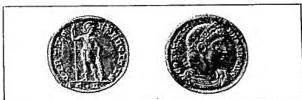
When Constantine took power, persecution had in fact long since ceased in the West, and in the East it had done so since 311 thanks to Galerius’s edict. Relying on Eusebius (Hist. eccl., IX, 9, 12), some scholars (Burckhardt, Boissier; against: K. Bihlmeyer, Das angebl. Toleranzedikt K. von 312, in Theol. Quartalschr., 96 [1914], pp. 65-100) held that Constantine issued a toleration edictCOSTANTINO - Gold coin.
Before the battle at the Milvian Bridge. It is certain that at the meeting with Licinius at Milan (February 313) the norms to be followed in the matter of the Christians were established, from which resulted the edict issued by Licinius in the name of both emperors at Nicomedia on 13 June 313 (full text in Lactantius, De mort. pers. 58; excerpt in Eusebius, Hist. eccl., X, 5, 2-3), briefly called the “Edict of Milan,” of which here is the summary: 1) Christians, like all others, may follow their own religion. 2) The laws previously issued against Christians are abolished. 3) Places of worship must be restored to Christians without ransom; if, after confiscation, they have passed into private hands, the owners may seek compensation from the treasury.
Among the laws subsequently issued by Constantine in favor of the Church, the principal ones are: in 313 or 315, exemption from the tributum and the annona (Cod. Theod., XI 1, 1); exemption for clerics from “public burdens.” In 321 Sunday is recognized as a holiday; churches are declared capable of accepting testamentary legacies (Cod. Theod., XVI 2, 4). In 321 and 333 the arbitration of bishops (audientia episcopalis) is compulsory even if invoked by only one of the two parties (the latter clause was abolished by Arcadius in 398 and Honorius in 408); there is no appeal from the arbitration of bishops to civil judgment.
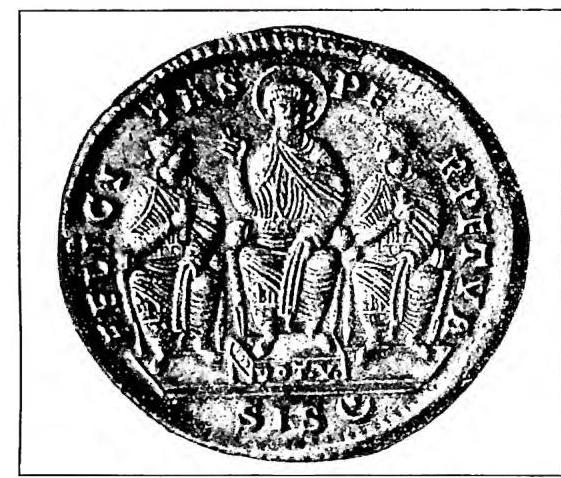
From the outset C. showed great concern for the unity of the Church. In 313 he entrusted Pope Miltiades (310–14) with the arbitration in the Donatist controversy. In 314 he convened the bishops of the states then under his rule at a Council in Arles to deal with the same issue (cf. DONATISM). He played an important part in the convocation and successful outcome of the Council of Nicaea (see) in 325 against Arius. Although after the Council he reinstated bishops Eusebius of Nicomedia and Theognis of Nicaea, who had been deposed by the Council, this was probably due to the intrigues of his sister Constantia, widow of Licinius. Later he went even further: he consented to the deposition of Eustathius of Antioch (330) and other bishops who adhered to the Nicene definition, and removed Athanasius (335) from his see in Alexandria (see ARIANISM).
IV. PERSONAL RELIGIOSITY
Constantine was a “practising” Christian, yet he never was one in the full sense. He received baptism only on his deathbed, and his actions did not always remain within the bounds of Christian morality. On the other hand, he was certainly convinced of the truth of the Christian faith, loved and highly esteemed the Church and its representatives, and desired the propagation of the faith (see the letter of Constantine to Shapur, king of the Persians, in N. H. Baynes, Constantine the Great and the Christian Church, p. 26).There was certainly an evolution in his religious thought. Modern scholars have sought to trace its stages: solar syncretism, philosophical monotheism, superstitious Christianity (cf. J. R. Palanque, in Pliche-Martin-Fruta, III, pp. 30–34). Yet one must bear in mind that Constantine does not seem to have been a thinker capable of subtle distinctions; he was rather a practical realist. Moreover, the expressions of pagan panegyrists, the fact that imperial coins continued for years to bear pagan emblems, the title Pontifex Maximus (which was suppressed only by Gratian in 382), cannot be decisive in judging his religious stance. Likewise, his conviction—rooted in him—that he had received a divine vision or manifestation before his victory over Maxentius, and the dream that led him to choose Byzantium as his new capital (Cod. Theod., XIII, 5, 7; Sozomen, Hist. eccl., II, 3), do not suffice to make him a habitual visionary or a mystic.
The Vision of 312. — A panegyric of 313 (Kirch, Enchirid. no. 363) and another of 321 (ibid., no. 392) allude to the vision; Lattanzio (De mort. pers., 44), Eusebio (Hist. eccl., IX, 9, 1–11; De vita Const., I, 27–29), Socrate (Hist. eccl., I, 2, 5–10), Sozomen (Hist. eccl., I, 3), Filostorgio (Hist. eccl., fr. 6), and Gelasio of Cyzicus (Hist. conc. Nicaeni, I, 4, 1) narrate it, though they differ on details. According to Lattanzio, the vision occurred in a dream on the night before the battle of the Milvian Bridge; according to Eusebio (De Vita Const.), it happened much earlier, while Constantine was still on the march, and in broad daylight, with soldiers present; Filostorgio speaks of a vision of stars. Yet since these accounts must derive from Constantine’s own testimony, it is possible that he himself varied the details in recounting the episode, as often happens when one repeatedly and complacently recalls an event from one’s youth. The substance of the fact, however, cannot reasonably be doubted.
When Constantine assumed power, the general situation, especially in the West, did not require a policy favorable to Christianity. Christians were still a minority (not much more than 10% of an empire-wide population estimated at 50 million) and had never formed a political party nor taken part in the internal struggles for control of the empire. The prejudices of the masses and the educated classes against them still persisted. Constantine would have had an interest, particularly in the West, in not introducing changes that would clash with public opinion and in continuing the administrative direction given to the empire by Diocletian. By espousing the cause of the Christian God, Constantine could not expect to derive any advantage from them in the struggle against Maxentius, since Maxentius did not persecute Christians; indeed, he had begun to restore their confiscated goods (Optatus, Contra Parmenianum, I, 18). Just as the campaign against Maxentius had no religious character, so too Constantine’s conversion, if it occurred during this campaign, could not have been purely political in nature. One can speak of political motives only in the sense that Constantine, having clearly perceived the disastrous consequences for the empire of Diocletian and Galerius’s persecutory policy, must have felt compelled not to repeat their mistake; but this is rather a commitment to good governance of the State than a political calculation.
VI. THE CAESAROPAPISM OF C
In a certain sense C. may be regarded as the first representative of the system which modern historians call caesaropapism, that is, the system which considers the prince as the head, in a certain way, of the Church as well. C. believed it his duty to promote the interests of the Church, and for this purpose he convened councils, issued laws, and made provisions concerning ecclesiastical matters, so much so that one might well think that the primacy of the Roman Pope concerned him very little. “It is extraordinary the disproportion between his magnificence toward the Roman Church and the small place which he assigns to the papacy in his ecclesiastical policy” (Battifol). Certain of his dispositions after the Council of Nicaea, when under the influence of his sister Constantia and Eusebius of Nicomedia he lent himself to Arian intrigues, were very harmful to the Church. Nevertheless, it may be said that C., rather than governing the Church, intended to be its great benefactor; not to regulate the “creed” of his subjects, as his son and successor Constantius did, but to remove the divisions which heretics created within it, thus in a way anticipating the theory of the secular arm of the medieval Empire. And the bishops, especially in the East, dazzled by this unexpected benevolence following the most atrocious of persecutions, considered themselves bound by a limitless devotion to him, imagining that every good for the Church would henceforth come from the Emperor. To all the acts which appear to us caesaropapist, C. was led by the prayers of the bishops. Thus, without being a caesaropapist by principle, he inaugurated this system in the Byzantine Church.VII. CONSTANTINE IN LEGEND AND CULT
Constantine does not appear to have been, like so many other great figures, the subject of popular legends, but rather of literary ones. The most important is that of his baptism by the hands of Pope Sylvester and his healing from leprosy; it is found in the 6th century in the Liber Pontificalis, but may go back to the second half of the 5th century (on the Donatio Constantini, see below). Such legends also became the subject of artistic representations, such as Giulio Romano’s Donatio Constantini, the 17th-century frescoes in S. Giovanni in Laterano, and especially the much older ones in the oratory of the Four Saints. The liturgical cult of Constantine, which perhaps arose among the Arians (H. Leclercq, s.V. in DACL, III, col. 2688), spread throughout the Greek East, where Constantine was celebrated as “equal to the Apostles” and the “thirteenth Apostle” (feast on 21 May, together with St Helena, as well as among the Armenians). For isolated cults that arose through relics in England, Bohemia, Sicily, and Calabria, see Acta SS. Maii, V, pp. 12-14. In Calabria, there still exist S. Costantino near Mileto and S. Costantino di Rivello near Sapri.BIBL. Literary sources: Lactantius, De mortibus persecutorum, from ch. 24 onwards; Panegyrici Latini, VI-X; Eusebius, Hist. eccl., VIII-X; De vita Constantini; Zosimus, 118-39; Aurelius Victor, Caesares, 40, 2-41, 17; Eutropius, IX 22-X 10; a Byzantine-era biography of Constantine published by H. G. Opitz in Byzantium, 9 (1934), pp. 535-39. Acts and letters of Constantine in A. Crivellucci, Della fede storica di Eusebio nella Vita di Costantino, Livorno 1888; id., I documenti della vita di C., in Studi storici, 7 (1898), pp. 412-29, 343-59; A. Mancini, Osservazioni sulla vita di C. d’Eusebio, in Rivista di filologia, 33 (1905), pp. 309-60; G. Pasquali, Die Composition der Vita C. des Eux., in Hermes, 43 (1910), pp. 369-86; genuine at least in substance: O. Seeck, Die Urkunden der Vita C., in Zeitschrift f. Kirchengesch., 17 (1897), pp. 321-45; A. Pistelli, I documenti costantiniani negli storici ecclesiastici, Firenze 1914; A. Casamassa, I documenti della Vita C. di Eusebio Cesarea, in Letture costantiniane, Roma 1914, pp. 1-60; I. Daniele, I documenti costantiniani della «Vita Constantini» di Eusebio di Cesarea (Anal. Gregor., 13), Roma 1938. On the Oratio ad sanctum coetum, in Theol. Quartalschrift, 1910, pp. 399-417; A. Kurfess, in Zeitschr. f. Neutest. Wissenschaft, 1910-20, pp. 72-81. Laws of Constantine: Cod. Theodos., Const. Sirmondi, Cod. Inst. Epigraphic sources: H. Dessau, Inscriptiones Latinae selectae, I, nos. 681 ff. Numismatic sources: J. Maurice, Numismatique constantinienne, 3 vols., Paris 1906-13. A very complete bibliography up to 1914 in H. Leclercq, s.V. in DACL, III, II, cols. 2522-95. Up to 1930 in Norman H. Baynes, Constantine the Great and the Christian Church (Proceedings of the British Academy, 15), London 1931, a work written with great discernment and highly valuable; Konstantin d. Gr. und seine Zeit (Gesammelte Studien, ed. F. J. Dölger), in Röm. Quartalschr., suppl. 19 (1913); Ed. Schwartz, Kaiser Konstantin u. d. christl. Kirche, 5th ed., Leipzig 1913; O. Seeck, Regesten der Kaiser und Päpste, Stuttgart 1910, pp. 150-84; E. Stein, Gesch. d. spätromischen Reiches, I, Vienna 1928, pp. 125-201; P. Battifol, La paix constantinienne et le catholicisme, 4th ed., Paris 1929; A. Piganiol, L’empereur Constantin, Paris 1932; J. R. Palanque, Constantin (Hommes d’État, 1), ibid. 1936, pp. 340-426; W. Sexton, Recherches sur la chronologie du règne de C. le Grand, in Revue des études anciennes, 39 (1937), pp. 197-218; J. R. Palanque, in Fliche-Martin-Frutz, III, pp. 17-100; J. Ortiz de Urbina, La politica di C. nella controversia ariana, in Atti del V Congr. internazionale di studi bizantini, Roma 1939, pp. 284-98. For the 16th centenary of Constantine’s death (1937), many commemorative articles appeared: A. Ferrus, in Civ. Catt., 1937, IV, pp. 385-94; H. Lietzmann, Der Glaube Konstantins d. Gr., in Sitzungsb. d. Preuss. Akademie d. Wiss. Phil.-hist. Kl., 20 (1937); H. Grégoire, La «conversion» de Constantin, in Revue de l’Univ. de Bruxelles, 36 (1930-31).
pp. 331-72; A. Schenck V. Stauffenberg, Der Reichsgedanke K. s., in Festschrift Haller, 1940, pp. 70-94; A. Kanluth, Die Beisetzung Kaiser K. d. Gr., Untersuchungen zur religiösen Haltung des Kaisers (Breslauer hist. Forschungen, 18), Breslau 1941.
On the vision: The sources collected in Kirch, Euchiridion, nos. 363, 365, 391, 392, 453, 457, 716, 843, 915, 953. Special studies: H. Schroers, K. d. Gr. Kreuzerscheinung, Bonn 1913; id., in Zeitschr. f. kath. Theol., (1916), pp. 238-37, 485-523; F. Savio, in Civ. Catt., 1913, II, pp. 11 ff., 385 ff., 556 ff.; 1913, III, p. 3 ff.; Pio Franchi de’ Cavalieri, Il labaro descritto da Eusebio, in Studi romani, 1 (1913), pp. 61-86; Ancora del labaro descritto da Eusebio, ibid., 2 (1913), pp. 161-23; A. Alföldi, in Pisciculi (Miscellanea Dölger), Münster 1939, pp. 1-18; J. Zeiller, in Byzantium, 14 (1939), pp. 329-39; H. Grégoire, La vision de C. liquidée, ibid., 14 (1939), pp. 341-51; see LABARO.
On the legend of Constantine’s leprosy and his baptism by Sylvester, cf.: J. Döllinger, Papstfabeln, 2nd ed., Munich 1890, p. 61 ff.; F. J. Dölger, in Röm. Quartalschr., suppl., 19 (1913), pp. 377-447; W. Levinson, Konstantinische Schenkung und Silvesterlegende (Miscell. Ehrle, II, in Studi e Testi, 38), Rome 1924, pp. 159-247; G. B. Giovenale, Il Battistero lateranense, ibid. 1929. Ludovico Hertling
VIII. CONSTANTINIAN BUILDINGS IN ROME AND PALESTINE
I. General Order
The grand purpose of Constantine the Great was to reunite the Roman Empire and to rebuild it on the foundations of Christian doctrine, ethics, and discipline. The Emperor took an interest in promoting the Christian Church and in strengthening its prestige. A good means to this end seemed to him to be the construction of monumental buildings for the worship of the new religion.This activity manifested itself in three ways: 1) in restoring places of assembly to both private individuals and Christian communities in accordance with the Edict of Milan (313); 2) in raising, enlarging, and extending existing places of worship; 3) in constructing sacred buildings anew both in the West and in the East.
2. Places of Worship in the West
In the West this activity began after the victory over Maxentius at the Milvian Bridge (28 October 312), and according to the Liber Pontificalis eleven places of worship are attributed to the personal initiative of the Emperor. Perhaps immediately after taking possession of the Urbs, as an episcopal church for the Bishop of Rome, the Basilica in honor of the Saviour was erected, in connection with a baptistery and a papal palace (Lib. Pont., I, p. 176). The entire structure was built on imperial property in the Lateran (domus Faustae), extending over a road and the demolished barracks of the Equites singulares (E. Josi, Scoperte nella basilica costantiniana al Laterano, Roma 1934). In the same city, though later in time, a church in honor of the Holy Cross was built in the Sessorium, since this was the property of Helena Augusta (ibid., I, p. 179).Outside the walls, five cemetery churches arose either immediately over the martyrs’ tombs or in the area above the crypts of the cemeteries along the consular roads. But the most important structure is undoubtedly the basilica of St Peter above the tomb of the Prince of the Apostles, which was built by cutting into the Vatican hill down to the level of the tomb, filling in the pagan cemetery with its monuments and constructing above it a five-aisled basilica (ibid., I, p. 176). Simpler and more modest in its dimensions was the small basilica of St Paul above the Apostle’s tomb in the marshy region of the Tiber between the Iter Vetus and the Via Ostiensis (ibid., I, p. 178). Likewise modest in scale were the basilica of St Lawrence “super arenario cryptae” in the cemetery of Ciriaca on the Via Tiburtina (ibid., I, p. 181) and also the Basilica in honor of the martyrs Marcellinus the Presbyter and Peter the Exorcist on imperial land at Ad Duas Lauros, in connection with the mausoleum of the Empress Helena (ibid., I, p. 182). Of similarly modest proportions was the church in honor of St Agnes, virgin and martyr, on the property of the imperial princesses on the Via Nomentana (ibid., p. 180).
Four of the following churches are of a more administrative character, arranged from a military point of view: a church at Ostia (ibid., I, p. 183), the port linking with Spain and Africa, and a baptismal site; one at Naples (ibid., I, p. 186), a station of the fleet for the East; another at Albano Laziale (ibid., I, p. 184) together with an episcopal residence, using the “scheneca deserta” of the Legio Parthica II; and a fourth at Capua on the Via Appia (ibid., I, p. 185).
On the basis of the data of architectural history for this period, the Basilica Apostolorum on the Via Appia and the Basilica of Theodorus in Aquileia may also be attributed to this time. In addition, the Liber Pontificalis provides detailed lists of donations (furnishings, fittings) and foundations (money, landed property, pharmacies).
3. Places of Worship in the East
In the East Constantine began to build Christian churches after overcoming Licinius, his adversary, in 324. Eusebius, the imperial historian, mentions eight churches expressly built by Constantine. The church most likely built first was the Octagon in Antioch (q.v.) as a kind of commemorative church of the victory of 324 and the unification of the Roman Empire.Almost a trilogy in glorification of the divine manifestations of the Nativity, Resurrection, and Ascension of the Lord, the buildings of worship in Bethlehem, Jerusalem, and on the Mount of Olives were constructed. The structure at Bethlehem comprises a longitudinal five-aisled building and, in place of an apse, an octagon above the cave of the Nativity (Eusebius, Vita Constantini, III, 43). That at Jerusalem comprises a five-aisled basilica, the Martyrium, and a central building above the
CONSTANTINE - Statue of Constantine by G. L. Bernini (1670).
Vatican Palace, Rome.
the cave of the Sepulchre and of the Resurrection, the Anastasis (Eusebius, Vita Constantini, III, 30-40). The third, on the Mount of Olives, consists of a three-aisled prayer hall above the cave of the teaching, connected with a sanctuary at the very place of the Ascension on the summit of the mountain (Eusebius, op. cit., III, 43). The basilica-type building at Mambre is also considered of this kind, around the altar, the well and the terebinth of Abraham (Eusebius, op. cit., III, 51). Besides these, churches attributed to Constantine are enumerated: a basilica at the place of the temple of Jupiter at Heliopolis (Eusebius, op. cit., III, 65), a basilica at Tyre, in compensation for another destroyed (Eusebius, op. cit., X, 4, 25), and above all the Apostoleion at Constantinople in relation to the mausoleum of Constantine himself (Eusebius, op. cit., IV, 58).
Eusebius also provides a special description of the churches at Tyre, Jerusalem, Antioch and Constantinople. To the description of the basilica of Tyre he adds an interpretation of the Christian place of worship in a liturgical and mystical sense.
4. Characteristics
The architectural form varies according to the purpose of the building. A central structure (round or octagonal) is normally found for mausolea (St Helena on the Via Labicana, St Constance on the Via Nomentana, Constantine’s mausoleum at Constantinople), for baptisteries (St John Lateran) and for memorials (Anastasis in Jerusalem, the Octagon at Bethlehem and that at Antioch Eleona [?]), an apse-ended structure for the tombs of martyrs (St Peter in the Vatican, St Paul on the Via Ostiense) as well as for underground crypts (St Lawrence outside the Walls, St Agnes outside the Walls, SS Peter and Marcellinus on the Via Labicana), and finally a longitudinal structure for prayer halls and liturgical assemblies, whether five-aisled (St Saviour at the Lateran, St Peter in the Vatican, the Martyrion in Jerusalem, the Basilica at Bethlehem, the Apostoleion at Constantinople [?]), three-aisled (St Paul outside the Walls, St Lawrence outside the Walls, Albano [?], Capua, Naples, Mount of Olives, Mambre, Heliopolis, Tyre) or single-aisled (St Agnes outside the Walls).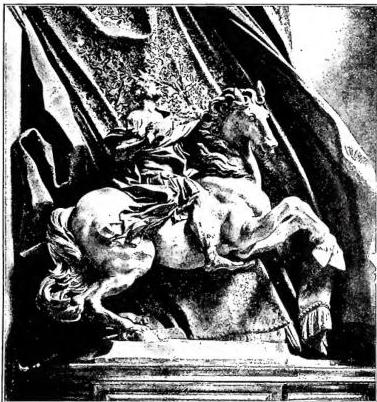
The vertical section of the places of worship almost always shows an elevated space with a row of windows, and with two or four porticoes added laterally.
The rule of orienting places of worship on an east-west axis seems to have been observed. Ten churches have their apses facing west (Lateran, St Peter, St Paul, St Lawrence, Basilica Apostolorum, Jerusalem, Tyre, Antioch, Heliopolis, Constantinople), five have their apses facing east (Holy Cross in Jerusalem, Albano, Capua, Bethlehem, Eleona, Mambre) and four in a divergent sense (St Agnes outside the Walls, Ostia, Naples, SS Peter and Marcellinus).
Ludovico Voelk!
IX. DONATION OF C
Commonly called today the Constitutum Constantini, this is a medieval forgery purporting to be the diplomatic act by which the emperor Constantine allegedly donated in 314 Rome, Italy and the West to Pope Sylvester I (314-35) and his successors, granting them on these territories the honours and powers of true temporal sovereigns and, over all the churches of the world, primatial jurisdiction and the right to legislate on matters of faith and morals.The document’s content falls into two clearly distinct parts. In the first, the confessio (C. Mirbt, Quellen zur Geschichte des Papsttums und des römischen Katholizismus, Tübingen 1934, no. 228, 1-10), after the complete formal protocol and a professio fidei, follows the narrative of Constantine’s miraculous healing from leprosy and his baptism. When all medical remedies had proved useless, the pagan priests had suggested that he bathe in a vat filled with the blood of innocent children. Moved by the mothers’ weeping, Constantine refused. That night the Apostles Peter and Paul appeared to him and promised healing if he would receive baptism from Pope Sylvester. Recognising in an image that Sylvester showed him the Apostles he had seen the previous night, he asked for
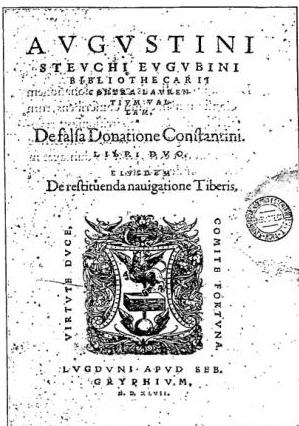
CONSTANTINE - Frontispiece of the De falsa donatione Constantini, Lyon 1547, by A. Steuco - Rome, copy from the library of the Istituto di archeologia e storia dell’arte.
In the second part, the donatio or dispositio (C. Mirbt, op. cit., 11-20), Constantine, in agreement with all his satraps and with the entire Senate and also with the optimates and all the Roman people, establishes that the Roman Church be honored by granting it imperial powers, dignities, and honors. He wishes that the bishop of Rome have the principatus over the four Eastern patriarchs and over all the Churches of the world; that the Lateran Basilica be venerated as the principal (caput et vertex) of all the Churches of the world; that the imperial palace itself, the Lateran palace, become the residence of the popes; that they may wear imperial insignia; that the clergy of Rome have the same honors and vestments as the officials of the Emperor. Finally, he grants the Pope civil jurisdiction, firma imperiali censura, over Rome, Italy, and the entire West. Consequently, the Emperor contents himself with the lands of the East, where he would have his new capital, “quoniam ubi principatus sacerdotum et christianae religionis caput ab imperatore coeleste constitutum est, iustum non est ut illic imperator terrenus habeat potestatem.” This is followed by the escatocol with the sanctio or threat of spiritual penalties against violators of the document’s provisions and the corroboratio, in which he declares that he has authenticated the act with his own signature and placed it upon the tomb of St. Peter, swearing for himself and his successors to observe it faithfully.
The text, drawn up in obscure and bombastic form, has come down to us in Latin, Greek, and Slavic versions. The most complete and definitive Latin text, ordinarily preferred by editors, is the Frankish or Dionysian one because it is preserved in a manuscript from the monastery of St-Denis in Paris, written in the 9th century (Paris, Bibliothèque Nationale, ms. lat. 2777). Closely related to it is the maior version of the Pseudo-Isidorian Decretals, which, however, also presents a minor version that includes only the confessio. Instead, in the letter of Pope Leo IX to Michael Cerularius of 1054 (Jaffé-Wattenbach, 4382; Mansi, XIX, pp. 663 ff.), only the part properly called the donatio is reported. These Latin versions derive from a common archetype. In the Vatican Library there are manuscripts containing the Greek text, made known by Agostino Steuco (De falsa donatione Constantini libri duo, Lyon 1547, pp. 99-103). These also appear in two versions, which, unlike the Latin ones, are absolutely independent of each other and are reflected in manuscripts that contain the full text (ms. Vat. gr. 614, 778, 789, 973) or a part of it, namely only the confessio (ms. Vat. gr. 1416) or only the donatio (mss. Vat. gr. 81, 606, 848, 849, 850, 1115). One, the older, reproduces the structure of the minor Isidorian and Leonine text; the other, more recent, is a literal translation of the Frankish Latin text. Pavlov made known (in Vizant. Vremen., 3 [1896], p. 21 ff.) several Slavic versions of the document, all of which, rather than being based on the Greek text most faithful to the original, derive from a reading resulting from the combination of the confessio from the better Greek text with a late translation of the donatio.
The manuscript tradition already reveals the wide diffusion of the Donation. If one accepts the hypotheses of Gaudenzi and Cessi, one must admit a complicated history of the text even before the end of the 8th or the beginning of the 9th century, when the Paris manuscript was drawn up, reproducing the definitive text.
It has been sought to see a reference to the donatio in a remark by Pope Hadrian I contained in a letter to Charlemagne of 778 (Jaffé-Wattenbach, 2423), where mention is made of Constantine’s largesses; but rather than referring to the donatio, he intended in general to allude to the Emperor’s merits, which were very well known, if only thanks to the Liber Pontificalis; all the more so since none of Hadrian’s successors up to Leo IX makes mention of the donatio, although it was very well known through the Pseudo-Isidorian collection.
In the 10th century Otto III rejected a copy that was being passed off as an original and had been fabricated by the deacon John of the severed fingers. It was Leo IX who first made official use of it, sending to Constantinople a copy of the Greek text of the donatio in a letter to Michael Cerularius of 1054 (Mansi, XIX, pp. 663 ff.). The initial controversies then subsided both in the East, as witnessed by Balsamon and Blastares and the Slavic versions, and in the West, as shown by its insertion in the Decretum Gratiani in the 12th century. Canonists and civilians were agreed on its authenticity, though the latter criticized its content; a criticism that Dante echoed (Inf., XIX, 115-117).
The first in the West to address the critical problem of the authenticity of the Donation and to conclude negatively were the humanists of the 15th century: Nicholas of Cusa, Lorenzo Valla, Reginald Pecock. In vain attempts were made thereafter until the 19th century to save the document. By now it is universally regarded as a historical and diplomatic forgery.
It remains to determine the origin and purpose of the forgery. Excluding that the author of the Donation is John of the severed fingers, who lived in the 10th century, possible authors have been proposed: the Pseudo-Isidore (A. Natale, R. Cessi, W. Martens, F. Gregorovius), the Lateran cleric Gregory (H. M. Colombier, C. Bayet, I. Döllinger), Pope Leo III (L. Duchesne), the deacon cardinal John (L. G. Morin, Pierre de la Marca), Christopher, head of the papal chancery (Hartmann), Pope Hadrian I himself (J. Langen), Stephen II (Hauck), Paul I (J. Friedrich), a subordinate of the latter (Scheffer-Boichorst), and even Anastasius Bibliothecarius (Schnürer).
As for the place, the eastern origin being ruled out, the choice lies between Rome and St-Denis in France. As for the time, opinions are even more varied. Setting aside the anticipated opinions, the critics who admit the textual unity—and they are the overwhelming majority—limit themselves to the period between Pepin and Charles the Bald (750–850). Many believe the donatio was fabricated in Rome to justify and validate the political aspirations of the popes, partly incorporated in the pact of Quierzy of 754, or to secure the full execution of those promises, noting affinities of terms and views between the text of the donatio and the papal documents of the time. According to Döllinger, Stephen II (III), when going to France in 753, was even carrying the document with him; according to Cantel, Böhmer, and Hauck, the document would have appeared between 753 and 754; according to Mayer, Scheffer-Boichorst, and K. Zeumer, in the time of Paul I; according to Hartmann, Verminghoff, and Brackmann, in the time of Stephen III. Others see in the forgery the intention of preparing and justifying the imperial coronation of Charlemagne. Yet even among these critics, some remain firm on the Roman origin (Duchesne), while others (Thomassin, Zaccaria, Hergenröther, M. Buchner, Soranzo, etc.) observe that the oldest manuscript tradition is of French origin (cod. Paris, 2777 and the Pseudo-Isidorian decretals), that the first to cite it were French writers (Adon of Vienne, Aeneas of Paris, Hincmar of Reims), and among the popes the first who certainly was a Frank was Leo IX, in the mid-11th century; finally, that the donatio served as a model for a series of forgeries prepared precisely in that monastery of St-Denis, where the oldest text of the donatio was preserved, and they conclude that the forgery was composed in France between 774 and 824. One does not perhaps stray far from the truth in thinking that the entire document was compiled to emphasize the relations of independence of the Church in the face of civil power, or to legitimize the creation of the new Western Empire.
Recently, Cessi, denying the textual unity of the document, believes that as it stands today it is the result of a long elaboration: to the initial Latin nucleus of political-jurisdictional content intended to affirm the authority of the Church in the face of the Empire, which dates back to the time of Gelasius in the 7th century, there was added a mystical-religious addition under the influence of the Sylvester legend, later collected in the Acta Silvestri, of which our document is itself the primary source; and finally, in the time of Pope Adrian I, no later than 774, the political-territorial addition was inserted, namely the donatio properly speaking. — See pl. XL.
Studies: G. P. Kirsch, La donatio di C., in La scuola cattolica, 1913 II, pp. 198–213; A. Schönegger, Die kirchenpolitische Bedeutung des Constitutum Constantini im früheren Mittelalter, in Zeitschrift für katholischen Theologie, 42 (1918), pp. 337 ff. (with an extensive and reasoned bibliography). Later works: W. Levison, Konst. Schenkung und Silvester-Legende (Studi e testi, 38), Rome 1925; G. Luehr, Die Konstanz. Schenkung in der abendländ. Liter. des M. A. (Hist. Studien von Ebering, 166), Berlin 1926; E. Caspar, Geschichte des Papsttums, I, Tübingen 1930, pp. 103 ff., 580 ff.; R. Cessi, Il Costituto di C., fonti ed età di composizione, in Annali della R. Università di Trieste, 1 (1929); id., Il Costituto di C., in Rivista storica italiana, 48 (1931), pp. 155–76; M. Buchner, Rom oder Reims die Heimat des Constitutum Constantini, in Historisches Jahrbuch, 53 (1933), pp. 137–68.