
CRISTIANO, archbishop of Mainz. — Born around 1130 into a comital family of Thuringia. Early distinguished himself for military valor, linguistic knowledge, and diplomatic skill, so that by 1161 he already had supporters who wished to see him as archbishop of Mainz. His candidacy then failed, but his qualities won him the favor of Emperor Frederick Barbarossa, who took him to Italy in 1162, appointed him chancellor, and from 1164 made him imperial legate in Tuscany. Toward the end of that year he led troops against Rome to install the antipope Paschal III. In 1165 he went to Genoa to reconcile it with Pisa. When Conrad of Wittelsbach was deposed from the see of Mainz in that same year, C. was elected to the position but was consecrated only two years later (5 March 1167).
His spiritual care for the vast archdiocese interested him less than politics and war. John of Salisbury called him “non Christianus sed Antichristus.” In 1167 he freed Rainald of Dassel, besieged at Tusculum by the Romans, defeated them at Monte Porzio (29 May 1167), and with the emperor obtained the surrender of Rome. After Rainald’s death from plague, C. succeeded him as imperial chancellor. In April 1168 he helped the Romans, now allies of the Germans, to destroy Albano. The following year he helped elect the emperor’s son Henry as king of the Romans. In 1170
CRISTIANO DI MAGONZA — CRISTINA
he attempted to reconcile the two traditions, of Tyre and of Bolsena, by locating Tyre near Lake Bolsena: Eodem die (24 July) apud Italiam in Tyro, quae est circa lacum Vulsinium, natale s. Christianae virginis in lacum Vulsinium iactatae. This naive solution, the fruit of topographical ignorance, did not resolve the question.
There are two martyrs named C., one venerated at Tyre in Phoenicia and the other at Bolsena in Italy, or is it one and the same? The discovery made by L. Cammelli in 1911 of the Oxyrhynchus papyrus, datable to the 5th century, with a brief fragment of the Greek Passion, has not shed more light than before, so that the Latin Passion may be considered a translation of the Greek.
Various considerations, but chiefly the monumental remains found at Bolsena, led G. B. De Rossi to believe that there was only one C., martyred and venerated at Bolsena since the 4th century, though born at Tyre in Phoenicia. There is no need to think of a translation of the martyr’s body from Tyre to Bolsena, as the Bollandists propose, yet De Rossi’s view of her eastern origin is not very convincing. P. Paschini believes she was born in Italy, probably at Bolsena, while the Passion was written in Egypt during the 5th century, when the cult of C. had already spread beyond her homeland. It is not impossible that the Egyptian hagiographer, in composing his work, had before him the account of Eusebius (De martyribus Palaestinae, 6) concerning the virgin Theodosia of Tyre, a martyr of the last persecution, but it cannot be ruled out that the notice of C.’s birth at Tyre is a product of the author’s imagination. It is worth noting the great similarity between the Passion of C. and that of St. BARBARI (v.). After the 11th century, some versions of the Latin Passion place her birth, martyrdom, and tomb at Bolsena, just as the authors of the Translations of her relics to Belgium and Westphalia suppose that the sacred remains were taken from Bolsena. The most plausible hypothesis is that C. was born and martyred at Bolsena, where her tomb is still preserved.
C. appears in the partial museum of Sant’Apollinare Nuovo in Ravenna among the martyrs Sabina (Roman), Anatolia and Victoria (of the Sabine), which Archbishop Agnellus had executed in the 6th century. At Bolsena her cult probably supplanted the most solemn amphitheater games that until the 4th century were celebrated annually at Bolsena with the gathering of populations from Tuscany and Umbria. The so-called “mysteries,” animated representations of the martyrdom of C. performed during the procession on her feast day (24 July), are a reminder of those idolatrous institutions.
ST. C. IN FOLKLORE. — The people participate in the cult of C. especially through the performance of the “mysteries” held at Bolsena on 24 July. These consist of tableaux vivants, that is, silent scenes represented by living persons (young women, young men, and local men) who stand solemnly motionless before the eyes of the spectators. The “mysteries” are performed on special stages set up at various points in the town, and before each one the procession pauses, carrying the image of the Saint from her church to that of the Savior. Each stage is veiled by a curtain, which is drawn when the procession stops before it, so as to reveal the scene for a few minutes. The principal episodes of the Saint’s passion are thus represented: St. C. tossed on the lake, tormented by the “great wheel,” imprisoned, boiled in a cauldron, scourged, overturning idols, enveloped by serpents, etc. Especially the scene in which the girl portraying the Saint has her neck and arms actually wrapped in numerous large serpents, with vivid realism, makes a deep impression on the assembled crowd.
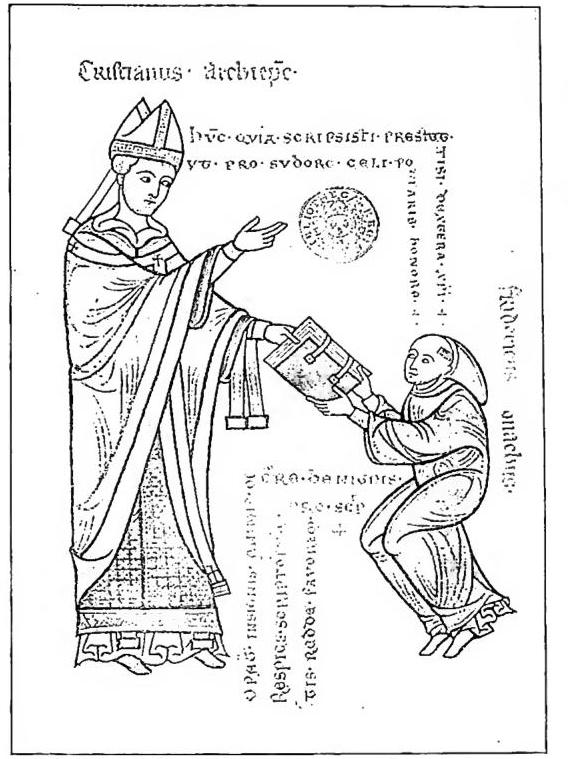
(from V. LÉRINS, Les pontificaux manuscrits, Paris 1937, tav. 18)
CRISTIANO, archbishop of MAINZ — The monk Frederick offers a book to Archbishop C. Mainz Pontifical (1167–83). Paris, Bibliothèque Nationale, ms. lat. 946, fol. 127.
He was sent as an ambassador to Constantinople. On his return to Italy he failed to reconcile Genoa and Tuscany to the emperor; better success attended his efforts in the Romagna, except Ancona. With Venetian help he laid a harsh siege to it, but without success (April–October 1173). Engaged in central Italy, he could not come to the aid of Barbarossa at Legnano. He then advised the emperor to make peace with Alexander III and led the ambassadors sent to negotiate it to Anagni (1176). The following year, at Venice, he abjured the schism and was absolved from excommunication. Remaining in central Italy to safeguard imperial policy, he worked to reconcile the surviving schismatics with Alexander III and forced the antipope Callistus III to beg for forgiveness. He took part in the Third Lateran Council of 1179. Taken prisoner by his enemies (September 1179), he bought his freedom with a large ransom and the promise to leave Italy (1180), which he later did not keep. Invoked by Lucius III against the Romans at war with the papal town of Tusculum, he died there of fever on 25 August 1183.