
GIOVANNI di SALISBURY. — Medieval scholastic, a complex figure of philosopher, historian, and humanist, b. in Salisbury ca. 1110–20, d. at Chartres in 1180. He was educated in France (1136–48), where he had, among others, Abelard and Gilberto Porretano as his teachers. Returning to England, he became, on the recommendation of s. Bernardo di Chiaravalle, first secretary to Teobaldo, archbishop of Canterbury, and subsequently to his successor, s. Tommaso Becket. Employed on embassies to the Holy See, and disliked by King Enrico II because he was considered too papal in his sympathies, he was, following the murder of s. Tommaso, forced to settle in France, where he held the bishopric of Chartres (1176, until his death).
G. di S. occupies a prominent place in the history of philosophical and political thought in the 12th century. Well versed, moreover, in the Latin classics and particularly in Cicero, his works, in prose and verse, display rare dignity and stylistic propriety. He wrote: Entheticus seu de dogmate philosophorum (in verse: PL 199, 965 ff.); Polycraticus sive de magis curialium et vestigiis philosophorum (ed. C. J. Webb, 2 vols., Oxford 1909, and PL 199); Metalogicon, containing a complete treatise on logic (ed. Webb, Oxford 1929 and PL 199); Letters (in J. A. Giles, Johannis Salisbentiensis opera omnia, 5 vols., Oxford 1848, I and II: PL 199); Historia pontificalis (MGII, Scriptores, XX: only a fragment); Vita Anselmi Cantuariensis (PL 199, 1000–1040); Vita Thomae Cantuariensis (PL 199, 193–234); Carmen de membris conspirantibus (doubtful: J. A. Giles, op. cit., V).
Regarding the problem of universals, G. di S. recounts its developments in his time, observing that in it « laborans mundus iam senuit » and « plus temporis consumptum est quam in adquirendo et regendo orbis imperio consumpserit Caesarea domus » (Polyc., VII, 12: ed. cit., II, p. 141). G. di S. adheres to a moderate realism. In logic, his admiration goes to Aristotle, who was then entering the Latin world with the « new logic »: an entry that he defended with such passion in Book IV of the Metalogicon against the retrograde Cornificius (an ideal or real name?) and against his followers, « Boetio fere solo contenti » (ibid., IV, 27). The psychology of G. di S., too, although Augustinian in inspiration, moves toward Aristotelian positions and derives rational knowledge from sensory data through the three degrees of physical, mathematical, and metaphysical abstraction.
But where G. di S. occupies a unique place in the history of 12th-century thought is in connection with political doctrines, developed in the Polycraticus, written, as C. Schaarschmidt explains in interpreting the title, « in usum civitates regentium » (cf. A. J. Carlyle, A history of mediaeval political theory, III, London 1946, p. 102). He wants the prince to be learned because « rex illiteratus est quasi asinus coronatus » (IV, 6); his power comes from God (« omnis potestas a Domino Deo est », IV, 2; ed. cit., I, p. 236), and in the Christian world, through the authority of the Church (« hunc ergo gladium de manu Ecclesiae accipit Princeps »). But if the prince turns into a tyrant, that is, to the detriment of the people, his authority ceases, and it is right and honorable to remove him, even by murder. « Hoc tamen cavendum docent historiae, ne quis illius moliatur interitum cui fidei et sacramenti religione tenetur adstrictus... Sed nec veneni, licet videam ab infidelibus usurpatam, ullo unquam iure indultam lego licentiam » (VIII, 20). In the Entheticus, G. di S. had sung: « libera philosophi vita est et libera lingua: est libertatis auctor utrique Deus » (PL 199, 1003). Perhaps the free tongue of the free philosopher did not here impose all the limits that the case required.
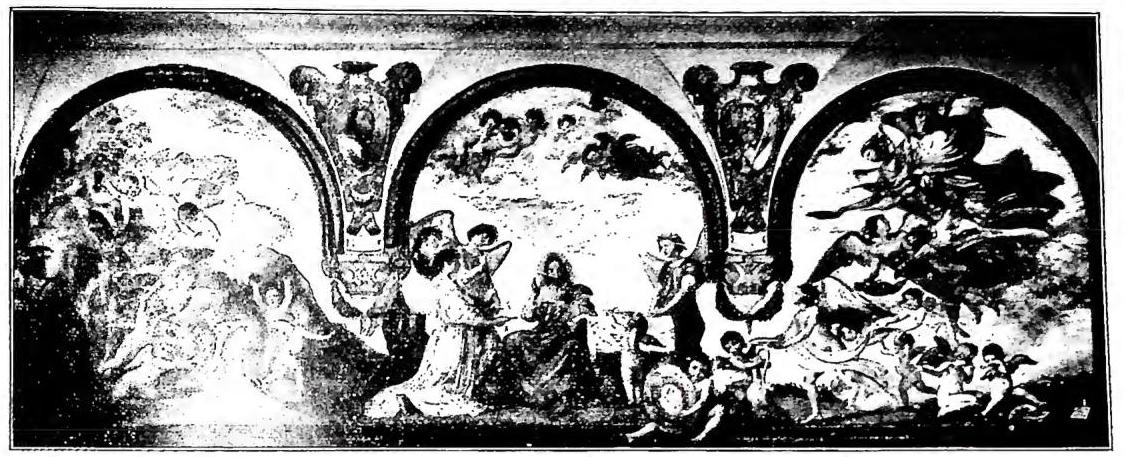
(Alinari photograph)
GIOVANNI DA SAN GIOVANNI – The Redeemer at table served by angels. Fresco – Fiesole, Badia.