BERNARDO DI CHIARAVALLE

BERNARD OF Clairvaux, Saint and Doctor of the Church.

SUMMARY:

I. Life

II. Writings: 1. *Epistolae*; 2. *Sermones*; 3. *Tractatus*. - III. Thought: 1. Religious Life;

2. Theology

IV. Influence: 1. Religious Influence; 2. Political Influence; 3. Defender of the Faith; 4. Theological Influence; 5. Ascetic Influence;

6. Philosophical Influence

V. Iconography.

I. LIFE

He was born in 1090 (1091?) at the family castle of Fontaines-lès-Dijon (Burgundy) to the nobles Tescelin “le Saur” and Aletta of Montbard. He studied at the school of the Canons of Châtillon-sur-Seine the trivium and part of the quadrivium; but on a Christmas night, consoled by a vision of the Child Jesus, he decided to withdraw to a monastery with the resolve to observe strictly the Rule of St Benedict. After a period of struggle and anxiety over his vocation, and having lost his mother as well (1106-1107), at about 22 years of age, in 1112, he obtained admission to the monastery of Cîteaux, founded in 1098 by the Blessed Robert, abbot of Molesmes, bringing with him to the cloister numerous noblemen, among whom his uncle Gauderic, four brothers (the youngest, Nivardo, along with his father Tescelin, would follow later) and friends: it was the beginning of the remarkable flourishing and expansion of the new order that would later take the name of *Cistercian*. In the Rule of St Benedict, which dedicates several hours of the day to the choral celebration of the Divine Office (*opus Dei*), to spiritual reading or study (*lectio divina*), and to manual labor, Bernard found great support for his ideal. The continuous and meditative study of Holy Scripture and the Holy Fathers made the Bible so familiar to him that he not only frequently quoted entire passages, but even transformed his own speech into a continuous embroidery of biblical allusions and phrases.

Article illustration

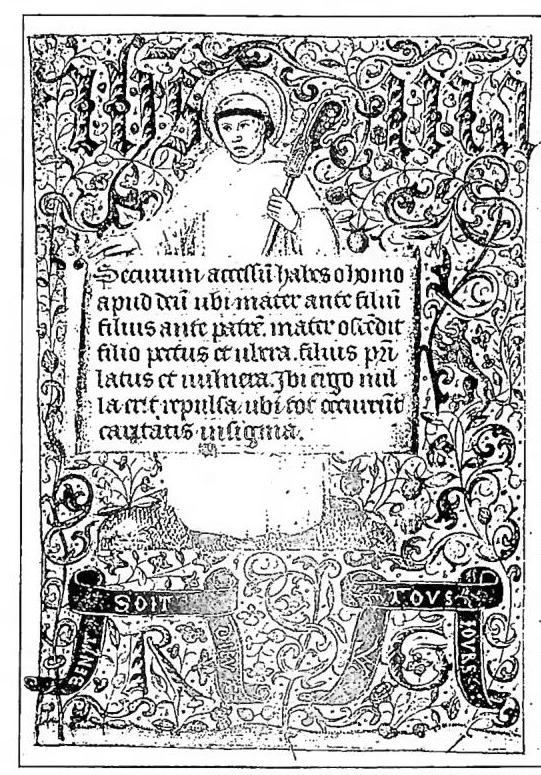
[from V. Lerognini, *Un livre d'heures monastique à l'usage de Mâcon*, Mâcon (1933)]
Bernard of Clairvaux, Saint – Miniature depicting St Bernard – Book of Hours in use at Mâcon (late 15th century). The text in the scroll, once attributed to St Bernard, is now claimed for Arnold of Bonneval, his friend.

Scarcely three years after his entry into the monastery, he was entrusted with founding at Absinthe, on the left bank of the Aube (Champagne), a new religious colony placed under the patronage of the Blessed Virgin Mary, later called Clairvaux (Clairvaux), which he governed for 38 years as abbot, dividing his prodigious activity between his abbey and the other foundations that followed, the Church of Rome, and all Christendom. For about ten years, Bernard devoted himself almost exclusively to the organization of his Order: he interpreted the Rule of St Benedict with austerity; demanded rigorous mortifications, poverty, absolute separation from the world, and perfect obedience, leaving much time for manual labor. In 1118 the *Charter of Charity* was drawn up, the fundamental statute of the Cistercian Order, officially confirmed in 1119 by Pope Callistus II. Bernard had to defend its austerity against the criticisms of the Cluniacs (cf. *Apologia ad Guillelmum*, abbot of St-Thierry): thus arose the famous literary controversy between the “white” and “black” monks, embodied in St Bernard and Peter the Venerable, abbot of Cluny (cf. *Epist.*, I, 28: PL 182, 112 sqq.), which ended in mutual understanding. Bernard vigorously exhorted his monks not to stop at externalities; Peter the Venerable, for his part, carried out a wise reform in his monasteries (cf. St. Hilpisch, *Geschichte des Benediktinischen Mönchtums*, Freiburg in Br. 1929, pp. 213-26). Bernard also concerned himself with the religious and monastic life of many other Orders (v. *infra*), and maintained friendly relations with a great number of eminent figures for holiness and learning, such as St Hildegard of Bingen, St Malachy, archbishop of Armagh in Ireland, and the celebrated theological schools of the time, especially that of Paris. He was often traveling as legate, mediator, advisor among emperors and kings, popes and bishops; three times he undertook the journey to Italy on behalf of Innocent II, fought for the Pope and the cause of the Church, enduring anxieties, oppositions, combating various heresies and errors; he preached the Second Crusade. He was present wherever his counsel or intervention was needed, or the good of the Church and the State required it; he seemed tireless. In the last years of his life, Bernard suffered greatly, especially after the failure of the Crusade, due to the discord of the leaders and the lack of organization. Grieved by the death of dear friends (Hugh of Auxerre; the faithful Suger, who died in 1151; Theobald, who died in 1152; and other bishops and abbots); by the loss of Hugh, abbot of the Three Fountains, detained in Rome and created cardinal; by the abuses and grave failings of his secretary and confidant Nicholas (cf. Epist. 284); by the disagreements with Eugene III, once his disciple, and above all by the weight of the labors he had borne, he was forced to rest (late 1152). He still found the strength to go to Lorraine as mediator between the bishop of Metz and Matthew, duke of Lorraine, finally succeeding, after violent struggles and bloodshed, in securing peace: his last work with which he crowned a prodigious activity for his Order and for the whole Church and its purpose. He died at Clairvaux on 20 August 1153, leaving in that abbey no fewer than 700 persons and 165 monasteries of his Order, of which 68 he had founded himself, scattered throughout Europe. Odo, abbot of Morimond, has left us an incomparable document on the common sorrow at the loss of this man of God (cf. Hüffer, pp. 21-24). Dante (Par., XXI, 33), choosing him as his final guide in the paradisal journey and putting into his mouth the sublime prayer to the Virgin, has made of Bernard the highest and most fitting eulogy. Countless are the praises of the Popes, among which notable is that of Pius XI in the Constitution *Unigenitus Dei Filius* (AAS, 16 [1924], p. 142), which concerns the spiritual formation of religious; Mabillon called him *ultimus inter Patres, primis certe non impar*.

Cult. — Alexander III canonized Bernard in 1174, and Pius VIII on 23 July 1830, in consideration of the depth and purity of his doctrine, gave him the title of Doctor of the Church. His relics were transferred to Ville-sous-la-Ferté in 1790; his head has been in the cathedral of Troyes since 1813 (cf. Ch. Lalore, *Reliques des trois tombeaux saints de Clairvaux*, Troyes 1877-78). The cult of St Bernard is very popular, not only within his Order, which had long venerated him as a Doctor, but throughout the universal Church: he is the patron of Gibraltar and Liguria, of cereals and bees; he is invoked against evil spirits, harmful beasts, and, in a fifteenth-century blessing, even against storms (cf. H. Bächhold-Stäubli, *Handbuch des deutschen Aberglaubens*, I, Berlin 1934, pp. 1087-91).

II. WRITINGS

The writings of St Bernard constitute a true sum of spirituality, whence their wide diffusion.

1. *Epistolae* (PL 182, 67-66): a first corpus of letters was edited by Geoffrey, his secretary and later abbot of Clairvaux, containing 243 letters (cf. PL 185, 526); others have been discovered and added: currently about 540 are known, which, by the variety of their content, recipients, and their length, constitute one of the most interesting collections of documents for ecclesiastical history from 1120 to 1153, for pastoral theology, ethics, and ascetics (cf. E. Vacandard, s.V. in DThC, II, cols. 737 ff.; chronological list in E. Vacandard-M. Sierp, II, pp. 611-16; P. Rassow, *Die Kanzlei St. Bernhards von Clairvaux*, in *Studien und Mitteilungen aus dem Benediktinerorden*, Salzburg 1913; G. Hüffer, pp. 184 ff.). The principal manuscripts are nos. 18.119 and 17.463 of the Bibliothèque Nationale in Paris, no. 242 of Grenoble, no. 1852 of Troyes, and no. 154 of Dijon.

2. **Sermons**: All were delivered to religious communities; they constitute an extremely rich source for the spiritual life: *PL* 183; new edition: B. Gsell and L. Janauschek, *Xenia Bernardina* (2 vols., Vienna 1891); the principal manuscript is no. 12,323 in the Bibliothèque Nationale in Paris; they were translated into several languages. They include: 86 *De tempore*, with expositions on the liturgical character of feasts, among which the famous sermons *Super missus est* for Advent stand out; 17 on Psalm 99 for Lent; 43 *De Sanctis*, including no. 11 on Mary with the jewel *De aquaeductu* and 6 for the anniversary of the dedication; 125 *De diversis*, generally on biblical texts, including 8 purely moral ones; 86 *In Cantica Canticorum*, an allegorical-mystical exposition of Canticles 1–2, the principal source for its mysticism, with some allusions to contemporary events (25, 1; 64–66; 80) and to the claustral life at Clairvaux (3, 2; 26, 3–14).

3. **Tracts**:
a) **Ascetical-mystical**: *De gradibus humilitatis et superbiae* (*PL* 182, 941 ff.), addresses on chapter 7 of the Rule of St Benedict, composed around 1121, in which he contrasts the twelve degrees of humility with twelve degrees of pride. *De diligendo Deo* (*PL* 182, 973 ff.), ca. 1126, answers the question: why and how one loves God; a masterpiece of great importance. *De conversatione ad Clericos* (*PL* 182, 833–56), a sermon delivered in Paris in 1140 against the corrupt morals of students and their consequences (chaps. 2–9), describes the requirements and happiness of conversion (chaps. 10–18), the responsibility of the priesthood (19–20), and ends with an exhortation to leave the world and become a monk. *De moribus et officiis episcoporum* (*PL* 182, 809 ff. = *Epist.*, 42), ca. 1127, addressed to Henry, archbishop of Sens, clearly sets forth the duties of bishops, even in relation to secular authorities, and alludes to some abuses among abbots. *De consideratione* (5 books), his most mature work (*PL* 182, 727 ff.; O. Malfranci, Brescia 1932), composed between 1149–53, dedicated to Eugenius III, a manual for a perfect Pontiff, touching on various dogmatic truths, treating of the manner of contemplation and the sanctification of the Pontiff, and laying out a broad plan for reform of the Roman clergy and ecclesiastical discipline.

b) **Monastic**: *Apologia ad Guallemum*, abbot of St-Thierry (*PL* 182, 895 ff.), ca. 1126, defends the right of diverse forms of monastic life, especially the Cistercians and Cluniacs. *De laude novae militiae ad milites Templi* (*PL* 182, 921 ff.), ca. 1132–36, dedicated to Hugh of Payns, master of the Templars, expounds his ideas on the legitimate warfare of Christians against the infidels and establishes the rules, directives, and theological principles of the Templars, who united the duties of the religious state with those of the military.

c) **Liturgical**: *Epistola seu dialogus super Antiphonarium Cisterciense* (*PL* 182, 1121 ff.), relating to the edition of the Antiphonary and Gradual of the Cistercians that he prepared at the behest of the General Chapter of 1132 (cf. H. Kienle, in *Gregoriusblatt*, 26 [1901], pp. 2 ff.; E. Vacandard, *S. B. et la réforme cistercienne du chant Grégorien*, in *Compte rendu du Congrès scientif. cathol.*, II sect., Brussels 1894–95, pp. 305–309). *De correctione Antiphonarii*, ca. 1132, establishes the laws of liturgical chant in the Cistercian Order (cf. *Isagoge in musicam mellifluam Doctoris s. B.*, Leipzig 1517; Hommey, *Supplementum Parum*). *Officium de S. Victore* (*PL* 183, 371 ff.), the time of composition uncertain; in the letter of presentation to Abbot Guido of Montiéramey, St Bernard sets forth his principles regarding liturgy.

d) **Dogmatic, apologetical**: *De gratia et libero arbitrio* (*PL* 182, 1001 ff.), ca. 1127, expounds the relationship between grace and free will. *Tractatus ad Hugonem de S. Victore de Baptismo aliisque quaestionibus* (*PL* 182, 1031 ff. = *Epist.*, 77), between 1136–40, probably directed against the innovations and assertions of Abelard. *Contra quaedam capitula errorum Abaelardi* (*PL* 182, 1049 ff.), dedicated to Pope Innocent II (*Epist.*, 190), ca. 1140, especially against the Trinitarian and reconciling doctrine and the concept of faith of Abelard; a profound and often excellent exposition, aimed at securing the condemnation of the innovator.

e) **Hagiographical**: *Liber de vita et rebus gestis S. Malachiae Hiberniae Episcopi* (*PL* 182, 1073 ff.), after 1148, the only historical work, accurate and a precious source for the conditions of Ulster in 12th-century Ireland, with a certain credulity regarding strange miracles; also a source for some antiphons in the Office of St Bernard.

###

III. Thought

7. Religious Life

In his spirituality, St. B. appears as the perfect disciple of St. Benedict, who undertakes the task of leading souls, by the path of humility, to the highest degree of love of God (cf. Reg. s. Bened., chap. 7 at the end). Humility was truly the fundamental virtue of St. B., a virtue which he constantly spread through example and word. He sought to preserve it through the austerity of life and through love of Christ, who, by his sovereignty, sweetens the weight of austerities and makes one more generous in bearing, indeed in seeking, the crosses which are a participation in his passion and glorification. The supreme degree of humility is at the same time the first degree of truth: the individual, knowing his own misery, attains knowledge of the misery of his neighbor with the desire to help him; he then ascends to a third degree, namely to a love in which he loves God in every person and thing (cf. De grad. humil., 4-6). With singular clarity, St. B. sets forth the true relationship between grace, will, and personal merits: free will is necessary, but grace is also necessary: *tolle liberum arbitrium, non est quod salvetur; tolle gratiam, non est quo salvetur*. With the fall of the first parents, man did not lose his freedom (*libertas a necessitate* or *arbitrii*), but is capable of choosing either beatitude or misery; however, the lost *libertas consilii* or freedom from sin is restored to him only through grace, and only by cooperating with grace does man obtain freedom from misery (cf. *De gratia et lib. arb.*). The affections and passions, whose manifestations and struggles he describes with powerful psychological depth, follow the vicissitudes of the will. Merits, possible only with antecedent and concomitant grace, are gifts of God, and God wills to reward their use (cf. *In Cant. Serm.*, 67, 10; *De grat. et lib. arb.*, 13 and at the end); grace descends into the souls of the faithful through the Sacraments, and especially by means of the Eucharist, and, in a certain sense, makes them like Christ. The spiritual exercises that assist the soul in ascending the steps of divine love are principally meditation and prayer: the former shows us what we lack, the latter obtains it from God (cf. *Serm. I in festo s. Andreae*, n. 10). Famous is the mysticism of the Saint: the degrees that form the mystical ladder by which one ascends in the love of God are set forth in chap. 8 of *De diligendo Deo* (PL 182, 973); here is the list: love of self or *carnalis*, the lowest degree; love of God for the many benefits which man receives from God; love of God for himself, *propter Deum*; pure love that forgets itself and loves all and everything in God (ibid., 2-11). Love of self is “before all else man loves himself *propter se ipsum*” (ibid., 8); in its principle it is legitimate because natural, but too easily exceeds its limits and turns to pleasures, from which man must withdraw by returning to his own conscience, by restraining curiosity, and by humility; self-love must, in order to be just, divest itself of its selfish character and become common and social. The highest degree of love, mystical union, is a divine operation that elevates the soul already established in perfect charity, destroying what is proper to fallen man, and frees it from every cupidity and fear, and illumines the spirit through a more perfect understanding of Holy Scripture: *adhaerens Deo anima unus spiritus est cum eo* (cf. E. Gilson, *La théologie mystique de s. B.*, Paris 1934). Characteristic of the spiritual life of St. B. is the *Credo ut experiar* and the alternation between action and contemplation (cf. J. Ries, *Das geistliche Leben nach der Lehre des hl. B.*, Freiburg in Br. 1906).

8. Theology

Man is created in the image and likeness of God. To arrive, after the fall, at sanctification, he therefore needs a restoration of the likeness to God, and this is the work of the Divine Redeemer and Mediator between God and men, Jesus Christ. Before Christ, only a few had a clear prophetic knowledge of the Son of God and of his redemptive work; meditation on the mysteries of the earthly life of the Incarnate Word is a most powerful means of kindling love and at the same time offers the model to which one should conform. Characteristic of Bernardine Christology is therefore devotion to the Christ-child in the manger and to the victim on Calvary.

In his Mariology, the Abbot of Clairvaux first celebrates the divine motherhood, the reason for her other prerogatives (cf. *Sermo in Assumpt.*, *in Don. infra Assumpt.*, *In vigilia Nativ. Dom.*, *LII de diversis*); the principal virtues by which she attracted the complacency of God are humility (cf. *Sermo 3 in Annunciat.*, n. 9; 4 in *Assumpt.*, n. 7) and virginity (cf. *Sermo 3 in Assumpt.*, *Sermo. 2 in Adventu*, n. 4). The union of divine motherhood with virginity is extolled repeatedly with the words of the liturgy taken from Sedulius (PL 19, 599): “Having the joys of a mother with the honor of virginity, she is seen to have neither a predecessor like her nor a successor.” He also enunciates the universal mediation of the Virgin, which is theologically founded on the fact that Mary gave to the world in Jesus the source of every grace; Mary serves as a channel, an aqueduct, and it is the will of God that all things come to us through Mary, an idea which the Cistercian Office “B. M. V. in sabato” was later to impress anew (*De aquaeductu*, n. 7; cf. P. Aubron, *La Mariologie de s. B.*, in *Recherches de science relig.*, 24 [1934], pp. 543-77; D. Nogues, *La Mariologie de s. B.*, Paris 1934). Though yielding to the doctrinal prejudice of many of his time, and not accepting the doctrine of the Immaculate Conception (cf. E. Campana, *Maria nel dogma cattolico*, 3rd ed., Turin 1928, pp. 437 ff.), St. B. is the knight and the singer of Mary; indeed, the liturgical lessons of Marian feasts are drawn in part from his sermons in honor of the Madonna.

In the doctrine of the Sacraments, St. B. defends the theory that children of Christian parents, like unbaptized adults who nevertheless believe, can be saved even without Baptism and outside of martyrdom: only the contempt of the Sacrament is worthy of punishment. Moreover, he holds that sinful actions committed without awareness of sinning are equally culpable (cf. *De Bapt.* [1, 2: PL 183, 1032-38]; cf. E. Vacandard, s.V. in *DThC*, II, cols. 745 and 774).

The Church is also a mediator between God and man: hence in him the cult of ecclesiastical tradition, zeal for the communion of saints, and faith in the mission of the angels. The union of the soul with the Divine Word is effected only through the Church. She, with her order and her hierarchy, is a figure of the kingdom of God.

Papacy and empire must draw near and support one another.

Affection for his Order was characteristic of him. With his noble spirit, in which were intertwined virginal chastity, generosity, manliness, piety, and clemency, and with the fervor of his love for God and his eloquence, St. B. attracted to himself men of every age, condition, and profession: from every journey he brought back to Clairvaux a great number of candidates, whom he raised to such monastic perfection that the fame of his monastery seemed to surpass that of Cluny. In this way he contributed greatly to the renewal of the religious-ecclesiastical spirit.

In 1116, for example, he carried out a fruitful preaching mission at Châlons-sur-Marne, recruiting many novices, among whom were also religious and secular priests; in 1140 he was invited by the bishop of Paris to preach to students, and about twenty of his hearers immediately entered the novitiate. Indeed, after his crusade preaching in the Rhineland, he brought back to Clairvaux about 350 young aspirants. It is therefore no wonder that Clairvaux, usually overpopulated, could accept numerous requests for foundations: the 68 abbeys founded by St. B. soon became new centers of light and important hearths of spiritual life in France, Italy, Portugal, Spain, Belgium, England, Ireland, Germany, Austria, Sweden, Denmark, etc.; in 1153, the year of St. B.’s death, his monks reached the most distant and still barbarous lands. The influence of St. B. was alive everywhere, both because of his annual visits and his presidency at abbatial elections, and because of his letters and delegates.

St. B. also contributed greatly to improving the religious life of other Orders; from all sides requests for his advice or intervention were made to him: from the Carthusians (his influence on the Order of St. Bruno is known from his visit to the Grande Chartreuse [cf. PL 185, 305] and from his correspondence, especially Epist. 11); from the Premonstratensians, to whom he ceded land (Epist. 253; cf. 56, 178, 355); from the Augustinian Canons; from the Benedictines (e.g., at Cluny he helped to eradicate certain disorders); in 1137 he settled the affairs of Monte Cassino. Finally, he is found in Italy, in England, in the Rhineland, introducing salutary reforms into monasteries; he promoted with all his strength the expansion of the ideals of the Augustinian Canons of St. Victor in Paris and of Arrouaise and personally intervened among the Canons of St. Stephen in Dijon. On the occasion of the Council of Troyes (1128), he gave the Templars the Rule of St. Benedict adapted to the exigencies of the military life; he was also a wise legislator for the Order of Calatrava. Various monasteries sought to affiliate themselves, if not by the Rule, at least in spirit, to the reform of Cîteaux: St. Mary’s in York, England, St. Denis in Paris, Argenteuil, Compiègne, Ste-Geneviève, the Holy Sepulchre in Cambrai, Ponchières, and others. Other military orders that arose in the following century were more or less closely connected with Cîteaux: those of Alcántara (1156), of Aviz (1162), of St. Michael or de l’Aile (1205), of Montesa (1314), the Order of Christ (1319), of St. George of Alfama, and several others. On his third journey to Italy, St. B. also founded the Third Order of the Humiliati in Lombardy.

Article illustration

His advice or intervention, not only in spiritual matters but also, very often, in political, diplomatic, and ecclesiastical affairs, was eagerly sought by bishops and popes, emperors, and lay nobles (cf. J. Thiel, *Die politische Tätigkeit des Abtes Bernhard V. Cl.*, Königsberg 1885). A considerable number of his letters were addressed to bishops: he wished the episcopate to be imbued with sacred learning, steeped in science, humility, chastity, and charity, so that, thus purified, it might continue the reform of Gregory VII; he desired true shepherds of souls, and therefore often intervened in the election of worthy bishops: at Langres (1138), and shortly afterward at Reims, he urged Bishop Henry of Verdun to abdicate because of serious accusations (cf. MGH, *Scriptores*, X, pp. 506 ff.); in 1128 he intervened on behalf of the bishop of Paris before Pope Honorius II and King Louis VI of France; in 1145 he secured the election of the bishop of York against the opposition of the bishop of Winchester; he exercised great and beneficial influence in the election of Alan, bishop of Auxerre; in 1133 he decided the double archiepiscopal election at Tours in favor of Hugh; he reconciled the bishop of Beauvais with Louis the Young; he acted as peacemaker between the bishop of Metz and Matthew, duke of Lorraine, etc.

He also sought successfully to improve discipline, and especially chastity, among the lower clergy: his famous sermon *De conversione ad clericos* provides an eloquent example of this. He intervened at a great number of chapters, synods, and councils, always exercising a great influence on their decisions: at Troyes (1128), Châlons (1129), Étampes (1130), Reims (1131), Jouarre (1133), Pisa (1135), Sens (1140), Paris (1147), Reims (1148), to name only the principal ones. He refused the episcopate, which was offered to him on several occasions (at Genoa in 1130; at Milan in 1135; at Reims in 1138, etc.), and even the cardinalate.

9. Political Influence

With Theobald, Count of Champagne, in whose domains lay the lands of his Order, and in general with the nobility of the time, he always displayed a prudent firmness that often enabled him to intervene in favor of the oppressed weak. In 1131 he reproved Emperor Lothair for arrogating to himself the right to invest bishops; in 1140 he intervened in the struggle against Louis the Young and the Count of Champagne over the investitures in Aquitaine (cf. J. M. Canivez, s.V. in DHG, VIII, cols. 624–26). As a peacemaker among the great of the world, he reconciled Louis the Young of France with the Count of Anjou and the Duke of Normandy; Emperor Lothair of Germany with Conrad of Swabia and Roger of Sicily with the Pope and the Emperor; William of Poitiers with his king, as well as the cities of Pisa and Genoa, of Milan, etc. Wherever the apostolate of St. B. went, it sought indiscriminately among the great and the small the observance of the laws of God and the Church. Above all, B. sought with all his strength to confirm and propagate the authority of the Holy See. At the Council of Étampes (1130), where it was debated which of the two popes simultaneously elected in Rome was legitimate, Innocent II or Anacletus II, the intervention of B. was decisive in favor of the former: his arguments, though open to criticism, convinced the king of France, then those of England and Germany-Italy, and these with their countries recognized Innocent, in favor of whom B. twice moved King Lothair to a military expedition into Italy (cf. ibid., cols. 626–30; and especially the work by P. F. Palumbo, *Lo scisma del MCXXX*, Rome 1942). B. often stirred the masses with his eloquent enthusiasm (cf. E. Vacandard, *S. B. orateur*, Rouen 1877; E. Gérouzez, *Essai sur l'éloquence et la philosophie de s. B.*, Paris 1839); he undertook arduous journeys, struggled amid anxieties and opposition, to support the Pope and the Church, until, on May 29, 1138, amid the joy of the Roman people, who proclaimed B. father of their country, the saint received the solemn submission of Antipope Victor IV, successor of Anacletus (cf. E. Amélineau, *S. B. et le schisme d’Anaclet II*, in *Revue des Questions Historiques*, 30 [1881], pp. 47 ff.). His expertise in canon law, and even more his ecclesiastical sense and his great labors for the extirpation of the schism, had made him an influential adviser to the Pope.

### Defender of the Faith

Fired by zeal for the purity of the faith and unrelenting in the defense of the Church’s doctrinal and moral principles, he returned to France and there, along the Rhine, opposed the neo-Manichaeans who denied the Church any authority over matters of faith and morals, suppressed the priesthood and other sacraments, and propagated the free interpretation of Holy Scripture. B. forced their leaders, Henry of Lausanne and Peter of Bruys, to submit; at the Council of Sens (1140) he also secured the condemnation of fourteen propositions of Abelard (cf. Hochland, 5 [1908], pp. 527-45; P. Lasserre, Un conflit religieux au XIIe siècle, Paris 1930), and in 1148 at Reims the condemnation of Gilbert de la Porrée (v.). He won over the sects of the Apostolics and the Petrobrusians more by gentleness than by severity, preaching and bringing back in droves the seduced, at Toulouse, Bergerac, Périgueux, Sarlat, Cahors, Albi, etc. At Maguelone his intervention put an end to the bloody persecution of the Jews; he was less fortunate, however, at Cologne, Worms, Speyer, Strasbourg, and elsewhere. While recognizing the need for an interior renewal of ecclesiastical society—his strictures against avaricious priests are especially well known—B. held that the Church’s political rights and its property were inviolable against lay encroachment. He therefore Brescia (v.) and his reform, as well as against those who usurped the goods of the Church and the papacy, a struggle marred by bloody revolts, especially in Rome in 1144.

He also directed his energies to defending the Church against the Muslims. Commissioned by Eugenius III, he preached the crusade for the liberation of the Holy Places in 1146-47 with such zeal and success in France and western Germany that about 200,000 men, led by Conrad III and Louis VII the Younger, took up arms (cf. G. Hüffer, Die Anfänge des zweiten Kreuzzuges, in Histor. Jahrbuch, 8 [1887], pp. 391 ff.; K. Neumann, B. V. Cl. und die Anfänge des zweiten Kreuzzuges, diss., Heidelberg 1882). He wished the entire Christian world to take part in this enterprise—he saw it as a realization of the moral unity of Christendom through the military cooperation of individual states—and therefore sought to bring England, Bohemia, Bavaria, Poland, Sweden, Norway, and Denmark into the movement. When the first attempt failed, he began to preach a second crusade; indeed, he had already been chosen as leader of the new expedition when the other Cistercian abbots forbade its execution. The extraordinary success of his preaching owed much, as it often did on other occasions, to the reputation of miracles worked by him (cf. G. Hüffer, Die Wunder des hl. B. und ihre Kritiker, in Histor. Jahrbuch, 10 [1889], pp. 23-46, 748-806).

### Theological Influence

In the intellectual renewal of the 12th century, B., together with Hugh and Richard of Saint-Victor, essentially represents the ascetic mysticism characteristic of medieval piety. He was not a theologian in the technical sense of the word; rather, he was a magnificent champion of the Church’s traditional values and a great orator. A man of profound feeling, St. B. was dissatisfied neither with Aristotle nor with the dialectical-speculative method.