
EUGENIO III, POPE. — In the world Pietro Bernardo, born in the environs of Pisa, died at Tivoli on 8 July 1153. He was a canon of the cathedral of his city and then, at Chiaravalle, a monk and disciple of S. Bernardo, from there passing as abbot to the monastery of SS. Vincenzo ed Anastasio in Rome. Upon the death of Lucius II, he was unanimously elected pope on 15 February 1145, but because of the opposition of the Senate he had to flee to Farfa, where he was consecrated on the following 18th. Of a gentle disposition, he had to confront the popular uprisings stirred up by Arnaldo da Brescia, who inflamed the Romans in support of the restoration of the Republic. His first thought was to return to Rome.
From Viterbo, where he had taken refuge after his consecration, with the help of the nobles, the countryside, and the city of Tivoli, he succeeded in reaching an agreement with the people while retaining the Senate and the prefect in the city, and at Christmas 1145 he entered Rome amid triumphal acclamation. The city’s dissensions, however, began again, and in March 1146 E. was once more forced to leave; passing through Sutri, Viterbo, and Lombardy, he went to France. During his absence Arnaldo, who had already once obtained pardon, began again to incite the people against papal authority; the Republic was proclaimed, while the houses of the nobles and cardinals, as well as the churches, were plundered. In France E. presided over several synods, devoting himself to ecclesiastical reform; he condemned the errors of Gilberto de la Porrée and Sudo di Sicilia and promoted the Second Crusade, whose preaching was entrusted to S. Bernardo. Toward the end of 1149, with the support of Ruggero II, king of Sicily, he was able to return to Rome, but had to leave it again in May 1150, wandering through the cities of Latium. While under the very burdensome protection of Ruggero, he sought to draw closer to Corrado III of Germany, who was preparing an expedition to Italy, but his death prevented any agreement. In December 1152 E. was able to return to Rome, which was still troubled by Arnaldo’s machinations, and in March 1153 he concluded a treaty with Federico Barbarossa, by which the emperor undertook to restore papal authority in Rome, while E. promised him the imperial crown. E., however, died shortly thereafter. He was buried in S. Pietro. Although he lived in difficult times, he always cultivated the religious virtues, drawing admirable strength of endurance from the teachings of his master S. Bernardo, who had dedicated to him the work De consideration, proposing the methods to be followed in the governance of the Church. In 1872 Pio IX approved his cult as a blessed.
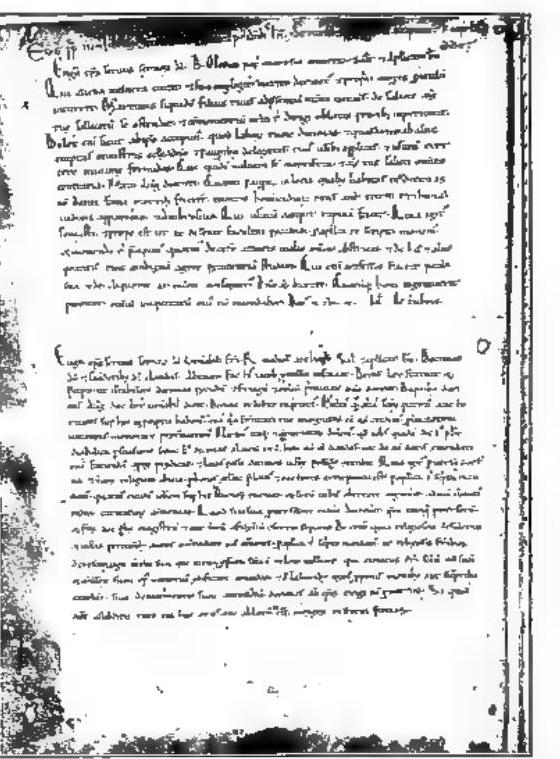
(Int. Vatican Library)
EUGENIO III, PAPA. – Register of the letters of E. III (12th century)
Vatican Library, cod. Vat. lat. 1562, f. 1°.