
VITERBO, DIOCESE of. — Situated in Lazio, in the province of V., TOSCANA (v.), with which it covers an area of 720 sq. km., bounded by the dioceses of Tarquinia, Montefiascone, Bagnoregio, Orte, and Sutri. Its 74,000 inhabitants are distributed among 39 parishes, with 68 secular and 58 regular priests, 12 male and 40 female congregations. It has the major seminary at La Quercia, shared with the other dioceses of upper Lazio, and the minor seminary near the episcopal palace, rebuilt in 1952 because it had been damaged by the war. It is immediately subject to the Holy See, with a court of appeal at the vicariate of Rome (Ann. Pont. 1953, p. 449).
V. rises at the foot of the Monti Cimini, on a gently undulating plateau from which a broad plain extends and gradually rises toward the Monti Volsini. After Rome, it is the most notable city in Lazio. It began its life as an Etruscan centre and later became a modest Roman colony. In the middle of the 8th century it is mentioned as Castrum Viterbii. It has not been proved that its name derives from Vetus urbs, as some believe it was formerly called. In 773 the Lombard king Desiderius fortified it in order to use it as a base for the conquest of Rome, which did not take place; the Franks donated it to the Church. But V.’s importance begins in the 12th century, when the long series of disputes between the Popes and the Romans began. Eugene III took refuge there in 1145, while Frederick Barbarossa established there in 1164 the seat of the antipope Clement III. Otto I and Frederick II were defeated by the people of Viterbo, while the Popes of the 13th century established their residence there while at war with Rome. In 1271, the captain of the people, Raniero Gatti, seeing that the cardinals gathered in Conclave in the Papal Palace could not agree on the election of the new pontiff, shut them in there, also on the advice of s. Bonaventure of Bagnoregio, had the roof removed, and rationed their provisions until Gregory X was elected and regulated the rules of the Conclave. Urban IV had also been elected at V. (1261), and subsequently John XXI (1276), Nicholas III (1277), and Martin IV (1281) were elected there; the people of Viterbo opposed the latter as a foreigner, thereby becoming subject to excommunication and to the absence of the popes for 86 years. During this period the lordship of the Di Vico family prevailed, but in 1345 Cardinal Egidio Albornoz definitively subjected V. Papal States.
It is difficult to determine when evangelical preaching began at V. But there is no lack of indications that it had begun no later than the 4th century, especially if one takes into account the great consular road, the Cassia, which passes through II. In its territory a Christian seal and ring were found, which G. B. De Rossi believed could be dated to the 3rd or 4th century (cf. Bull. d'arch. crist, 2nd series, 2 [1871], pp. 35-
37), as well as some Christian sarcophagi. A Passion (BHL, 8469-70) from the 9th or 10th century relates that a priest named Valentino and a deacon named Ilario, under Maximian, were brought to the castle of V., beheaded outside the walls at the place called « Via Strata » (perhaps the Via Cassia), and buried at a place called « Camillarius » or « Cavillarius » (3 November). An appendix to the Passion adds that in the time of Gregory IV (828-44), the abbot Sicard of Farfa had the martyrs’ relics transferred to his abbey church. In several documents from 824, 817, and 788—that is, before the translation to Farfa—a church or « cella S. Valentini in Silice » (the « Via Strata ») is mentioned. These are the oldest documents concerning the cult of a s. Valentino at V., and it is impossible to say whether he was different from the one of Terni.
In 1172 the people of Viterbo destroyed Ferento, 9 km. from V., the Etrusco-Roman city which, certainly in the time of s. Gregory the Great, was an episcopal see. In the Dialogues (I, 9; III, 38), the Pope mentions the bishops of Ferento: Boniface and Redento. Part of the territory of the ancient diocese passed, in 1192, to that of V. when Celestine III gave the « Castrum Viterbii » the status of a city and made it an episcopal see, uniting with it Tuscania, Civitavecchia, and Bieda (v. TUSCANIA). At that time the bishop of Tuscania was Cardinal Giovanni of the title of S. Clemente, who styled himself bishop of V. TOSCANA, thus demonstrating from the outset the de facto superiority of the Viterbo see; this continued even when the Holy Roman Rota, in 1617, declared the two sees to be united aegue et principaliter. Until the fall of the Papal States, V. S. Peter.
The succession of bishops of V. includes no shortage of men distinguished for learning and administration; it will suffice to recall the two cardinals Brancaccio, Francesco Maria and Stefano, uncle and nephew, of the 17th century. V. is the birthplace of the Augustinian theologian and philosopher Egidio Antonini, called da V. (v. EGIDIO DA V), of s. Rosa (v.), whose venerated remains rest in the church bearing her name, and of b. Venerini (v.). The monastery of S. Bernardino also preserves the body of s. Giacinta Marescotti (v.), who played such an important part in the history of Viterbo society in the 18th century.
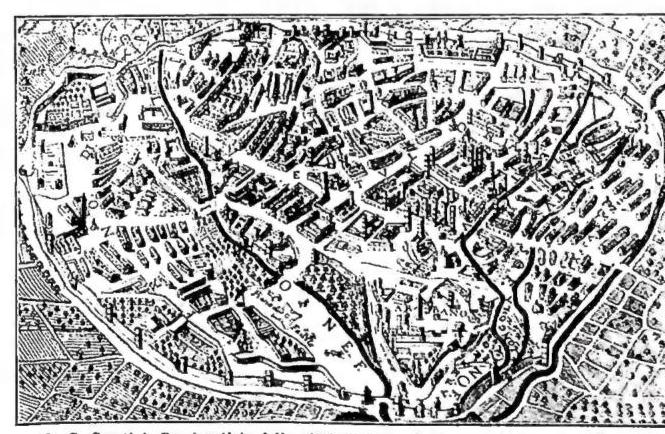
(from G. Coretini, Brevi notizie della città di V. uomini illustri..., Rome 1771) VITERBO, DIOCESE of — Iconographic plan of the city (18th century).
(photo Enit)
The bishop of V. S. Martino al Cimino, from the abbey of that name first mentioned in a bull of Benedict IX (1045).
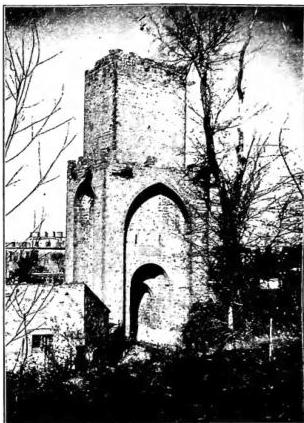
ART. – Few traces of gates and tower foundations, dating from the Etruscan-Roman constructions, are all that remains of the oldest city. Numerous buildings, on the other hand, built of porous tufa and erected between the 10th and 14th centuries, still preserve today, fairly intact, the fascinating appearance of the
(phot. Gab. fot. naz.)
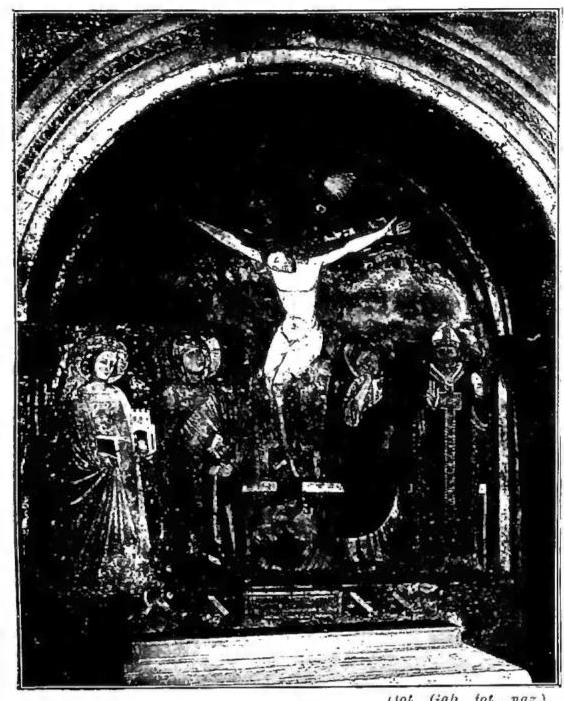
VITERBO, DIOCESI di – The Crucifixion. 14th-century fresco in the church of S. Maria Nuova – Viterbo.
In the churches of the Gesù, formerly S. Silvestro, of S. Maria della Cella, and of S. Giovanni in Zoccoli, the architecture indicates the presence of Lombard craftsmen; the basilican style with colonnades is widespread; roofs are preferably pitched, only rarely vaulted; double-ring arches are frequent. At S. Sisto, the extremely high presbytery shows transalpine influences, as does the crypt of S. Andrea in Piano Scarano; the interior of S. Maria Nuova, with its broad colonnades, is instead related to Pisan constructions (Toesca). The Cathedral was recently restored to its presumed medieval forms: built in a modest form perhaps as early as the 8th century, it underwent many alterations, the fundamental one being that of 1560, which led to the transformation of the main apse, now unfortunately isolated from the rest of the church. The Palazzo Papale and the very elegant loggia are well preserved in their original forms; although mutilated and deprived of its original polychromy, the latter remains one of the most perfect examples of Viterbese Gothic.
This was introduced into Lazio by the Cistercians. Elements derived from their buildings are found in the cloisters of S. Maria in Gradi and of the former convent of Paradiso, and in the façade of S. Francesco. The “flowery Gothic” appears on one side of the cloister of S. Maria della Verità (from 1912 until the Second World War, the seat of the Museo civico). The 13th and 14th centuries also produced several towers and numerous fountains, among which those with spindle-shaped shafts (Fontana Grande) give the city a distinctive character. Interesting examples of civil architecture are Casa Poscia and Casa di Valentino della Pagnotta.
The main façade of the Palazzo Farnese marks the transition from Gothic to the Renaissance. The Palazzo Comunale, the austere Palazzo Chigi, the church of S. Maria delle Fortezze (designed by Battista di Giuliano da Cortona), and that of S. Maria della Quercia are the noblest monuments of Renaissance Viterbo. The Baroque does not assume in V. forms of particular interest in comparison with Rome (Porta Romana, the church of the Gonfalone [1665], and S. Agostino), whereas the 18th century produced one work of extraordinary interest: the rebuilding of S. Maria in Gradi, carried out by Niccolò Salvi (1738).
Although less rich in works of sculpture, V. nevertheless offers interesting artistic material in this field as well: the Museo civico preserves numerous statue and column bases, cippi, and funerary urns from the Etruscan-Roman period. In the church of S. Sisto, the baptismal font is a Roman urn transformed in the Christian period; also Roman in date is the sarcophagus set against the façade of the church of S. Angelo in Spata. In the Romanesque period, Roman marble-workers worked in V. on rare forms as well, such as the sphinxes and dolphins on the capitals of the Cathedral; of great plastic power in its study of antiquity is the sphinx, now in the Museo civico and formerly in S. Maria in Gradi, dated 1286.
But, as in Rome and throughout Lazio, particularly in the Viterbese area, with the advance of the 14th century the classicizing tradition gradually declined, and no especially notable works by local artists are encountered; in the most valuable ones, influences from the Sienese masters may be observed. In S. Francesco, the tomb known as that of Gerardo Landriani remains faithful to the models of the canopy tomb; on columns stands the mausoleum of Clemente IV (1274) by Pietro d'Oderisio, which has affinities with the art of Arnolfo, traces of whom are still visible in the figures of the acolytes on the tomb of Cardinal fra' Marco, from the second half of the 14th century. The tomb of Adriano V is thought probably to be the work of Arnolfo himself. A Viterbese sculptor of the 16th century was Bernardino di Giovanni, to whom the main portal in the façade of the church of S. Maria della Quercia is attributed (1506); there are also an aedicule by Andrea Bregno (1490) and delicate terracottas by Andrea della Robbia.
Viterbese painting maintained constant relations with Roman, Sienese, and Umbrian painting, which were reflected in it in various ways: the remains of frescoes in the crypt of S. Andrea at Piano Scarano are in the distant manner of Cavallini, while the miniatures beneath crystal in the form of disks, found in the mausoleum of Pope Clemente IV in S. Francesco, are also Roman in their draughtsmanship. A small triptych in S. Maria Nuova displays the most strictly Byzantine tendency characteristic of the 13th century.
(phot. Alinari)
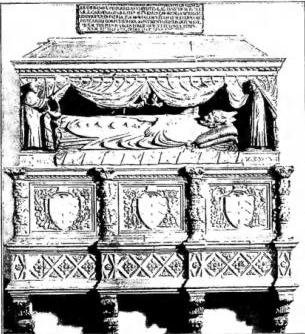
VITERBO, DIOCESI di – Funerary monument to Cardinal fra' Marco [Parentezza] da V. (2nd half of the 14th century) – Viterbo, church of S. Francesco.
Viterbese masters worked at Avignon in the papal palace: Pietro da Viterbo is the foremost local master of the 14th century, together with Matteo Giovannetti. Ilario da Viterbo left an altarpiece in the Porziuncola at Assisi (1393), close to the manner of Simone Martini; paintings in S. Francesco and S. Maria Nuova repeat Sienese models. In the Renaissance, the most important work is certainly the cycle of frescoes painted by Gozzoli in S. Rosa in 1453, destroyed in the 17th century. Gozzoli and Piero della Francesca find a singular accord in local painting in the splendid frescoes by Lorenzo da Viterbo (almost destroyed in 1944) in the Mezzatosta Chapel of S. Maria della Verità (1469). Other masters of the 15th century are Antonio di Francesco da Viterbo, Francesco di Antonio known as il Balletta, Gabriele Francesco da Viterbo, Carolino da Viterbo, Giovanni Francesco da Avanzano, known as il Fantastico, Antonio del Massaro known as il Pastura, Costantino Zelli, and Maestro Monaldo.
Among the works by non-local masters, the splendid Pietà by Sebastiano del Piombo in the Museo civico, formerly in S. Francesco, surpasses all the others; and of the highest quality is the masterpiece by Gerolamo da Cremona, with the Savior and saints in a chapel of the Cathedral (1472), which introduced unusual Paduan Squarcionesque modes into local painting. A Viterbese artist active at the end of the 16th century was Tarquinio Ligustri (Sala Regia of the Palazzo comunale); Giacomo Cordelli was responsible for the frescoes in the cloister of S. Maria in Gradi (1620). Caravaggism, too, had a vigorous representative in Viterbo in Bartolomeo Cavarozzi (Visitation, Museo civico; S. Isidoro, church of S. Angelo; Madonna, church of the Seminary). Angelo Pucciati is Guercinesque, while the brothers Antonio and Giovanni Francesco Bonifazi belong to the orbit of Pietro da Cortona. The greatest local glory of the 17th century, however, is G. Francesco Romanelli, who also went to Paris for Luigi XIV. Until a few years ago, the fresco on the vault of the Cathedral by his son Urbano was preserved there; the apse, detached from the present church, is decorated with the important frescoes of Passeri. The 18th century produced Anton Angelo Falaschi, Domenico Corvi, and Vincenzo Stringelli, who decorated the vault of the church of the Confalone (1756–60), whose perspective paintings are the work of Mazzett