
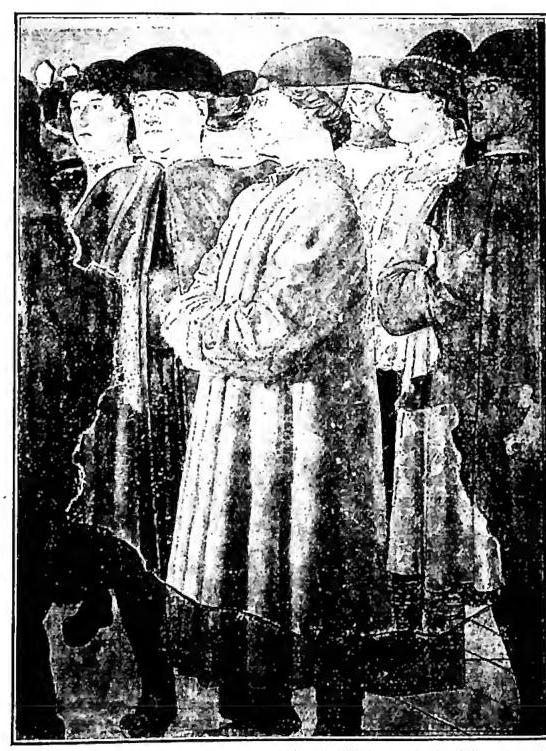
LORENZO da VITERBO. - Properly L. di Jacopo di Pietro Paolo da V., painter b. ca. 1437 at Viterbo and d. after 1476. The only dates referable to his activity are those of 1469 and 1472.
The frescoes of the Mazzatosta Chapel in S. M. della Verità at Viterbo suffered considerable damage in the bombing of 1944 and were reassembled by a new method by the Central Institute of Restoration of Rome (v. RESTAURO). On the vault, in each web, are the figures of a Prophet, an Evangelist, a Father and a Doctor of the Church: on the back wall, the Assumption; on the right wall the Annunciation and the Adoration of the Child, and on the left the Presentation of the Virgin in the Temple and the Marriage, beneath which appears the date 1469 with the monogram L. V. The Saints on the entrance arch, however, are by a different artist. What immediately strikes one in these frescoes is the clear derivation from Benozzo Gozzoli, who must have introduced him into the new Renaissance milieu, dominated by the greatest Florentines active toward the middle of the century, so that even for L. da V. there was soon talk of an adherence to the vision of Piero della Francesca. The evident influence of Benozzo induced R. Longhi to seek the painter's first fruits in the frescoes of Palazzo Orsini at Tagliacozzo, datable to shortly after 1464; and C. Brandi to ascribe to him, albeit doubtfully, some frescoes on the Bisentina island of Lake Bolsena, later than 1462. The contacts with Piero della Francesca led instead to the attribution to L. of the Evangelists (of which, unfortunately, very little remains) frescoed on the vault of the ancient chapel of S. Michele in S. Maria Maggiore at Rome, for which many insist on the attribution to Piero himself. The fortunate discovery of the panel, found again at Cerveteri, can finally add a useful contribution toward determining L.'s further stylistic evolution. It represents the Virgin enthroned with the Child and two saints and bears the artist's signature and the date 1472; this is the only panel painting known to date by this painter, who has revealed himself, in the progress of studies, as one of the most important in the history of the art of central Italy.
Bibliography6 works
Gilberto Ronchi