
BOLSENA. - An ancient episcopal see of Latium, in the province of Viterbo, along the Via Cassia, north-east of the lake of the same name. It still retains the characteristic appearance of a medieval town, dominated by the four-towered Castle (12th century). The Etruscans called it
In 1880-81, excavations were carried out in B. in the ancient Christian cemetery of S. Cristina, from which many inscriptions were brought to light (CIL, XI, 2, nn. 2834-2900), some with consular dates, the oldest of which dates to 37 AD (n. 2845). Alongside these was found an opisthographic marble slab (n. 2777) that in the Middle Ages had been used to close a sarcophagus inside which, in the aforementioned epoch, the relics of a s. Cristina (v.) are said to have been placed. Archaeological data tend to show that in B., in the 4th century, there was a sanctuary with a martyr's tomb, around which an important Christian necropolis developed. This necropolis consists of a main gallery and various secondary ones branching off to the right and left, with large loculi excavated without regularity, closed with tiles bearing inscriptions painted in red, though scratched examples are also not lacking. As for inscriptions on marble, only a single example has been found thus far. The main gallery measures 7 meters in height by 1.50-2.00 meters in width, with 9 and even 11 tiers of loculi. Such a monumental complex places the origin of Christianity in B. in the 4th century, and the tomb of a venerated martyr dates it back at least to the last great Diocletianic persecution.
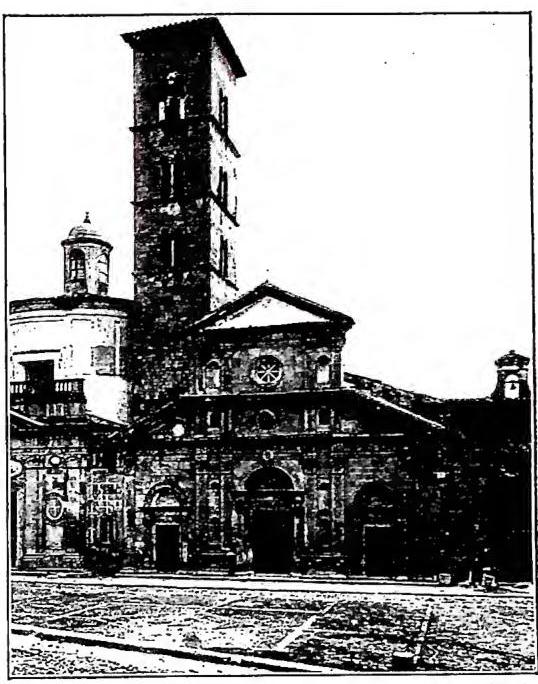
In the 11th century, alongside the sanctuary of S. Cristina, the three-aisled Romanesque church was built, which in 1490
Card. Giovanni de' Medici (later Leo X) had embellished with an elegant facade.
B. is known principally for the Eucharistic miracle that occurred in 1263, known under the name of the "Miracle of Bolsena". A German priest who was making a pilgrimage to Rome, celebrating at the altar of the martyr Christina and held back by doubt regarding the transubstantiation of the bread and wine, at the moment of breaking the Holy Host, saw blood emerge and wet the corporal. The venerable relic was taken to Orvieto where Pope Urban IV was staying, who resolved to institute the feast of "Corpus Domini", and the people of Orvieto, to celebrate such a prodigy, very soon began the work on their marvelous cathedral (v. ORVIETO).
Even without taking into account the attempts of local writers to trace the origin of the episcopal see of B. back to the apostolic age, we must say that we know very little about II. Among the bishops who gathered at the Roman Synod of 313 there is also an Evandro "ab Ursino", whom L. Duchesne doubts whether it should be read "Vulsinio", or rather "Urbino", and Lanzoni, while also leaning toward "Vulsinio", lists Evandro as doubtful for both sees.
The same must be said for Gaudenzio, whose signature at the Roman Synod of 465 is reported by the codices as episcopus veconensis and interpreted by some as vulsinensis, by others as veronensis, though it should more likely be read as vettonensis (v. BETTONA). The first bishop of unquestioned historicity is Secondino, to whom Gelasius I (492-96) addressed a letter (A. Thiel, Epp. Rom. Pont. genuine et quae ad eos scriptae sunt a s. Hilario usque ad Pelagium II, I, Braunsberg 1867, p. 492). We also know of Gaudenzio, who took part in the Roman Synod of 499, and Candido, who took part in that of 595; on the other hand, the existence of an Agnello for the year 680 and of a Claudio contemporary with St. Gregory the Great has no solid foundation. The episcopal see of B. must have disappeared with the decline of the city in the Lombard era, and its territory forms part of the diocese of Orvieto.