
URBINO, ARCIDIOCESI di. — City and archdiocese in the province of Pesaro, in the Marches. It has an area of 465 sq km and a population of 47,000, all Catholics; it comprises 97 parishes served by 113 diocesan priests and 8 religious priests; it has 2 male and 12 female religious communities (Ann. Pont. 1953, p. 438).
The origin of this diocese is unknown: it may date back to the fourth century. It is doubtful whether an Evander, who was present at the Roman Council of 313, can be assigned to U. (cf. Lanzoni, I, p. 503). A Leontius, perhaps already mentioned by Pelagius I, was certainly sent by St. Gregory the Great as visitor and administrator to Rimini (593–96), and Sebastian received the same commission from him in 599. A bishop Esilaratus is mentioned in 680. At the beginning of the eleventh century a Theodoric and then a Teuzo are mentioned; the latter was distinguished for his piety and was succeeded by Mainard, who is said either to have been given or to have taken from Città di Castello the relics of a martyr named Crescentian (Lanzoni, I, p. 483). St. Peter Damian addressed his De eleemosyna (opusc. IX) to him; he is venerated as a blessed. On 4 June 1563, when the bishop was Cardinal Giulio della Rovere, Pius IV made U. an archbishopric, assigning to it as suffragans the bishoprics of Cagli, Senigallia, Pesaro, Fossombrone, Montefeltro, and Gubbio. In 1635 Urban VIII added Urbania and S. Angelo in Vado.
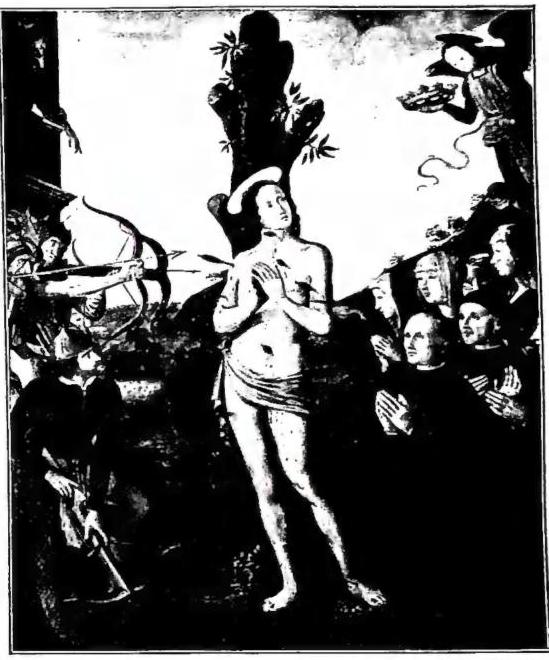
The first certain information concerning the cathedral Chapter dates back to 21 January 1069, when Bishop Mainard confirmed to the canons, then numbering 12, the properties of the chapter mensa. The metropolitan church of Urbino, distinguished for its privileges and artistic treasures, has a notable musical chapel, established by Duke Guidobaldo I in 1507 and endowed with a substantial patrimony. The ancient Cathedral was the church of S. Sergio Martire; in 1021 Bishop Theodoric transferred it, together with the Chapter, to its present location. In 1474, under Duke Federico, work began on the new Duomo. On 12 January 1789 the dome collapsed, plunging into the grotto oratory below and burying in its ruins valuable works by various painters, as well as the precious high altar, a gift of Clement XI. The new Duomo was immediately rebuilt through the efforts of Archbishop Berioli, to designs by Valadier; it was inaugurated and consecrated on 8 September 1801. The church is divided into three majestic naves; the two chapels of the Most Blessed Sacrament and of the Immaculate Conception are what remains of the ancient building. The façade is the work of Camillo Morigi of Ravenna. In the Oratory of the grotto one admires the famous Christ by Bandini. The oratory of S. Croce is the seat of the venerable Confraternity of the Disciplinati of S. Croce, which is said to have been founded in 1318. Two frescoes are admired there: one representing S. Sebastiano, attributed to Giovanni Santi, the other the Madonna col Bambino, a work by Ottaviano Nelli. The relics of the Passion are preserved in a valuable ciborium. The oratory of S. Giovanni Battista dates from 1365, as shown by a bull in the Archive of the Chancellery. The interior of the Oratory was frescoed by the brothers Salimbeni of Sanseverino (1416). The rear wall depicts the Crocifissione, while the side walls depict the life of St. John the Baptist. In the church of S. Domenico (fourteenth century), the marvelous portal is the work of Tommaso di Bartolomeo, known as Masaccio, a Florentine (1406–56); the terracottas are by Luca della Robbia (1400–81). There is no precise record concerning the foundation of the church of S. Francesco (thirteenth century), in which the magnificent portico of the façade and the bell tower are the only surviving parts of the ancient construction, built in the second half of the fourteenth century. The most important painting is that by Federico Barocci above the high altar. It represents the Pardon of Assisi. Construction of the church of S. Bernardino (fifteenth century) and of the convent was begun by Count Guidantonio Feltrio in 1425, continued by his son Oddantonio, and completed by Duke Federico; the tombs of Duke Federico, Guidobaldo I, and Elisabetta Gonzaga are there. Monastic life also flourished in the Middle Ages in the Urbino territory, in the three monasteries of S. Silvestro at Secchieto, mentioned by St. Peter Damian: in 1258 Alexander IV replaced the Benedictines there with the Poor Clares; S. Angelo di Gaifa, which in 1480 was assigned to the Olivetans; and S. Vincenzo at Pietra Pertusa (Badia del Furlo), mentioned as early as the tenth century. St. Peter Damian speaks of it in the life of St. Romuald: the bishop of U. affiliated it to the monastery of Fonte Avellana (P. F. Kehr, Italia Pontificia, IV, Berlin 1909, p. 219).
(fot. Alinari)
URBINO, ARCIDIOCESI di — Martyrdom of St. Sebastian, a painting by G. Santi (fifteenth century) — Urbino, Palazzo Ducale, Galleria nazionale delle Marche.
Albani; Cardinal Alessandro Albani; Cardinal Benedetto Veterani; Cardinal Giovanni Battista de Praetis; Cardinal Gianfrancesco Albani; Cardinal Giuseppe Albani; Cardinal Castruccio Castracane degli Antelminelli.
For holiness, the following should be remembered as blessed: the Franciscan tertiaries Giovanni Pelingotto (1240–1304); Antonio (1336–1421); Giovanni (1337–1439); Pietro Spagnoli (d. 1415); Pietro da U. (d. 1438); Donato (d. 1505); and Gaspare Dondi (d. 1506). In addition, Blessed Sante Brancorsini (1343–94), Blessed Serafina Sforza (1434–78), and Blessed Benedetto Passionei, a Capuchin (1560–1625).
Among mathematicians, Federico Comandino should be remembered; among men of letters, Bernardino Baldi, Raffaello Fabretti, and Polidoro Virgili. Urbino artists hold particular importance in the history of Italian art. In painting, it is enough to recall Raffaello, Coradini known as Fra Carnevale, Giovanni Santi, Timoteo Viti, and Federico Barocci. In architecture: Donato Bramante and Girolamo Genga.
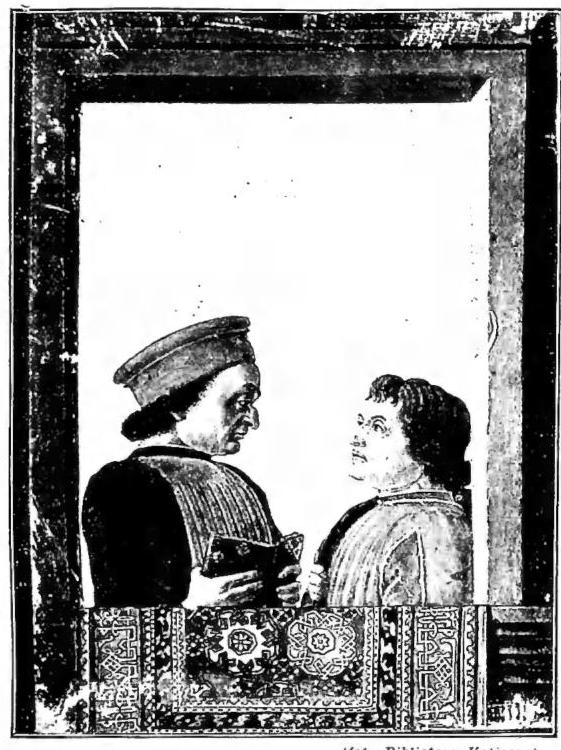
THE DUCHY OF U. — A papal fief, already in the 8th century it was in the possession of the Church and was occupied by Desiderius, who thus intended to avenge the execution of Afiarta, ordered by the archbishop of Ravenna.
It was organized as a free commune and subsequently came into the possession of the Montefeltro family, who held the title of counts there from the end of the 12th century. Buonconte was recognized as lord of U. by Frederick II in 1213, but encountered opposition from the citizens. He was succeeded by Montefeltro Novello and Guido. The latter, a Ghibelline and excommunicated by Martin IV, was forced temporarily to abandon U.; in April 1282 he succeeded in returning after bloody battles and, following his return, was able to come to terms with the Pope (1283). Subsequently he was again forced to leave the city and only in 1292 did he regain the lordship of U. There then followed a period of alternating fortunes, in which the Montefeltro lost and regained U. several times. They were exiled by Albornoz (1359), and finally, in 1443, Oddantonio succeeded in establishing himself there. The town reached its greatest splendor under the rule of Federico da Montefeltro ([v.] 1444-82). He enlarged the territory of the Duchy, obtaining the cession of Fossombrone in 1445, for which he was excommunicated by Eugenius IV and subsequently absolved in 1450 by Nicholas V. Federico fought on behalf of the Pope against the Malatesta, defeating him on the Cesano, near Senigallia, in 1462; following this victory, he further extended his dominion by conquering Fano (1463). In 1474 he was recognized as duke of U. by Sixtus IV. During his rule Federico welcomed men of letters and artists to his court in U., founded a library, and had the Ducal Palace built by Luciano Laurana. He was succeeded by his son Guidobaldo (1482-1508). The latter took part in the operations against the Orsini, serving under the Pontiff. He was forced by Cesare Borgia to leave U., to which he later returned following the conspiracy of Magione. He was expelled from it once again and could return definitively only in August 1503, after the death of Alexander VI. He was on excellent terms with Alexander’s successor, Julius II, who was his guest in U. in September 1506, on the occasion of the submission of Perugia to the Pope; Guidobaldo escorted him to Bologna when, after driving Giovanni Bentivoglio from the city and preventing it from being sacked, he went there in November 1506. He welcomed him again in U. in March 1507, when Julius II was traveling to return to Rome. Guidobaldo died without direct heirs, and the Duchy passed to his nephew Francesco Maria della Rovere (1508-38), who, after much fighting, had to relinquish it from 1516 to 1521 to Leo X, who gave it to Lorenzo II de’ Medici, his nephew. The Duchy again enjoyed a period of splendor under Francesco’s son, Guidobaldo II (1538-74), who lived in Pesaro, surrounding himself with a sumptuous court, but in order to meet its expenses he had to increase taxation, provoking discontent and revolts.
The last duke was his son Francesco Maria II, who was compelled by Urban VIII to accept the devolution of the Duchy to the Church. This devolution took place upon his death (1631), but as early as 1625 he had almost entirely ceded power to a prelate, who governed in his stead. Thereafter, except for a brief interlude during the French Revolution, U. followed the fortunes of the papal territories, until, in 1860, it was annexed to the Kingdom of Italy. — Vedi tav. LXXXVI.