
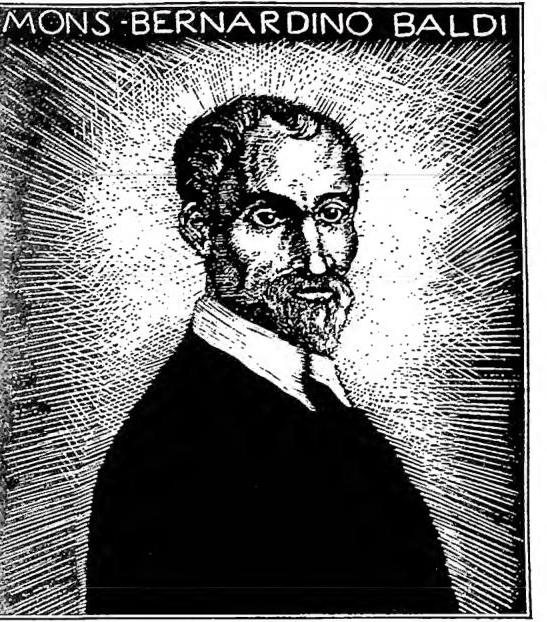
BALDI, BERNARDINO. – First abbot of Guastalla, poet, scientist, historian, and philologist, born in Urbino on 5 June 1553, died there on 10 October 1617. He received an excellent education in the humanities in his native city and studied mathematics under the guidance of the celebrated Federico Commandino. While still very young, he translated and commented on Aratus’s Phenomena. In 1573 his family sent him to the University of Padua to study medicine, but he devoted himself with greater ardor to philosophy and the classical languages, and, with the help of foreign students, to the modern ones. The plague of 1575 compelled him to return to his native city, where he wrote the life of his recently deceased teacher F. Commandino and resumed his mathematical studies under Guidobaldo del Monte.
Having acquired a reputation as a scientist, Don Ferrante II Gonzaga, duke of Guastalla, wishing to have him with him also on the advice of St. Carlo Borromeo, engaged him as a teacher of mathematics (1580), and then as a traveling companion to Spain. But B., having fallen ill, remained in Milan, where he was received by St. Carlo. In 1584 he was in Urbino and, for his sister Eleonora, a Benedictine nun, wrote the spiritual dialogue Comparazione de lo stato monastico e secolare, with a sonnet (manuscript in the Albani Library).
Upon returning from Spain, Don Ferrante II Gonzaga considered elevating the vacant archpriesthood of Guastalla to the rank of an abbey and appointing B. to II. During the lengthy negotiations, B. was ordained a priest and celebrated his first Mass at Easter 1585. He then devoted himself to the study of the sacred sciences and Oriental languages in order to gain a better understanding of the Holy Scriptures. For this purpose he stayed in Rome, where he was appointed apostolic protonotary. In 1609, because of disputes that had arisen, he resigned the abbacy and returned to Urbino to serve Duke Francesco Maria II della Rovere. Family bereavements embittered the final years of his life. He was buried in the church of St. Francis, clothed in the Franciscan habit.
According to Crescimbeni, he knew sixteen languages, which Mazzucchelli lists: “Latin, Greek, Italian, Spanish, French, Old Provençal, Old Sicilian, German, Hungarian, Slavonic (Croatian), Hebrew, Chaldean (Aramaic), Arabic, Persian, Turkish, and Etruscan.”
His poetic works were numerous, including La Nautica, a didactic poem celebrated as his masterpiece, and Il Diluvio Universale (Pavia 1604), famous in the history of Italian versification. He translated Gli automati, ovvero macchine
Very many works remained in manuscript; his friend Marco Velfero, who was supposed to oversee their publication, was prevented from doing so by death. Several others were subsequently lost in a fire in the Guastalla archives. Among them were works dealing with biblical subjects, legal matters, ecclesiastical culture, sermons, etc. There were also grammars of Oriental languages.