PASQUA. - The major feast of the Israelites and of Christians. It was instituted by Moses to commemorate the exodus of Israel from Egyptian oppression; among Christians, it designates the solemnity commemorating the Passion and Resurrection of Jesus.
I. LA P. EBRAICA. - 1. Istituzione, prescrizioni legali. - La parola P. è il greco πᾶγχ dei Settanta, dall'ebraico
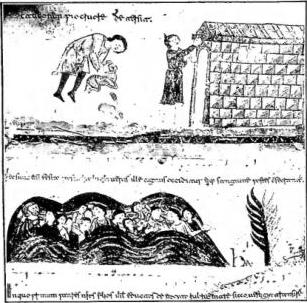
PASQUA - Killing of the lamb, anointing of the doors, crossing of the Red Sea: the Jews stand between the two waves. 12th-century miniature - Troyes, Cathedral, Archive. Emolet. 3.
pēsāh "passage", an allusion to the passage of Yahweh in Egypt to smite the firstborn of the Egyptians, while sparing the dwellings of the Israelites. "This day shall be for you a memorial day, and you shall keep it as a feast to the Lord; throughout your generations, as an ordinance forever, you shall keep it" (Ex. 12, 11-14).
The first time the Passover was celebrated was when Israel was delivered from Egypt (Ex. 12). The rite observed then was always observed, save for a few details. The feast comprised two parts: the first was the eating of the paschal lamb on the evening of the 14th or 15th of Nīsān; the second was the feast of unleavened bread, which lasted seven days. Every Israelite family procured a lamb (or a kid: ibid. 12, 5) around the 10th of the month of Nīsān, kept it until the 14th or 15th of Nīsān, and slaughtered it in the evening. That same evening it was to be roasted and eaten with bitter herbs and unleavened bread.
The bread was unleavened because the fathers had not had time to let it ferment at that time (ibid. 12, 39; Deut. 16, 3), and the bitter herbs were in memory of the bitterness of their life in Egypt (Pēsāhīm, X, 5). It was to be eaten in haste (Ex. 12, 11; Deut. 16, 3), with loins girded, sandals on feet, staff in hand, in the posture of one about to depart. The lintel and the two doorposts were to be marked with the blood of the lamb (Ex. 12, 23). It appears that this custom was not preserved: in Deut. 16, where the legislation concerning the Passover is renewed, no mention is made of it, and it no longer had any reason to exist. Later, the immolation of the lamb took place only in the temple (ibid. 16, 2.5-6; II Chron. 35, 5-6.11), and the blood was sprinkled at the foot of the altar. G. Felten rightly supposes that after this the lamb was carried away and roasted in each family. In the solemn paschal feast that followed Josiah's reform, the Levites themselves took charge of this (II Chron. 35, 13). The other victims that were immolated, sheep and oxen (cf. II Chron. 35, 7-9), were permitted to increase the joy of the feast and in case the lamb was not enough to satisfy all the guests.
According to other secondary prescriptions, men were obliged to participate under pain of being cut off from the people (Num. 9, 13). Women were not obliged, but participated especially when the family was small
(Pēsāhīm, VIII, 1). In this case, friends and neighbors were also invited to be able to consume the lamb: in the time of Flavius Josephus, the guests had to be more than 10 and not more than 20 (Bell. Iud., VI, 9, 3). Pilgrims formed a family, as in the case of Jesus and the Apostles (Matt. 26, 17-19), and a room was offered to them by acquaintances. Only the circumcised could take part in the paschal banquet (Ex. 12, 43-49). Those who were hindered by legal impurity were to celebrate the Passover the following month (Num. 19, 10-12). Nothing of the paschal lamb was to remain until the following day: any leftovers were to be burned (Ex. 12, 10). Not a single bone of it was to be broken (ibid. 12, 46; Num. 9, 12). During the banquet, the head of the family was to explain the meaning of the feast to his household (Ex. 12, 26-27; cf. 13, 8, and Pēsāhīm, X, 4-5).
2. The Paschal Supper
Certain details of the paschal celebration also appear from the account of the supper celebrated by Jesus in his last Passover and from the description of the supper in Talmudic writings.After the washing of the hands (or before, according to other rabbinic schools), a cup of wine mixed with water was poured. The first cup seems to be referred to by the words reported in Lk. 22, 17: "Take this and divide it among yourselves." After the infusion of water into the wine, the blessing of the wine followed and then that of the feast, according to the school of Hillel; whereas, according to the school of Shammai, the blessing of the feast came first and then that of the wine: perhaps this blessing is indicated in the words of Lk. 22, 17: "he gave thanks." After the blessing, the cup was passed and all drank from it (ordinarily, however, each had his own cup: F. Nötscher, p. 337, note 1).
The paschal lamb was then brought to the table. Before this, it seems that the dispute among the Apostles should be placed at the Last Supper, originating from the places they occupied on the couches arranged in the form of a triclinium around Jesus (the paschal supper was no longer eaten in the clothing and posture of pilgrims; everyone, even the poorest, had the right to recline like lords). The other event that took place before the legal supper was the washing of the feet, perhaps to replace the purification of the hands usually performed at the beginning.
After the first cup, the paschal foods were brought to the table: unleavened bread, bitter herbs (lettuce, radishes, and the like), the roasted lamb, salt water, and finally the ḥārōseth (v.), a thick jam of dates, figs, and other fruits boiled with vinegar. The head of the family, having washed his hands again, took some bitter herbs, dipped them in the ḥārōseth, and, giving thanks for the fruits of the earth, ate them. The guests did likewise at his invitation. Then one of them (the youngest, a boy) questioned the father about the meaning of the feast, and the father then explained its symbolism (cf. Ex. 12, 26-27). This was followed by the first part of the hymn called Hallēl (v.): Psalms 113-114 (112-113, 1-8) were sung; this was the thanksgiving for the deliverance from Egypt, which had just been recalled. The second cup was then drunk, and the actual meal began. Everyone washed their hands again, and the head of the family, breaking the unleavened bread and placing bitter herbs upon it, offered it to the guests after pronouncing a blessing over the bread and the herbs. All then ate of the bread and the herbs, and only after this of the other festive victims (called ḥaghīghāh, from the verb ḥāghagh "to celebrate a feast") and of the paschal lamb: this had to be eaten entirely, as prescribed in Ex. 12, 9-10. A cheerful banquet then took place. Although it is not expressly stated, it is very likely that Jesus adhered to the customary ceremonial. Of the conversations that took place during the supper, nothing remains except the announcement of the traitor, who left the room during the legal supper. Saint John notes that the occasion for this was the morsel of bread dipped in the ḥārōseth and given to him by Jesus (Jn. 13, 30). To the rites of the legal supper, Jesus added the rites by which he instituted the Eucharist. It does not appear at what precise point he consecrated the bread. Of the consecration of the cup, it is expressly said that it was "after supper" (Lk. 22, 30; I Cor. 11, 25). Perhaps the consecration of the bread replaced the last morsel of the paschal lamb with which the banquet ended; in that case, it immediately preceded the consecra-
cration of the chalice. This apparently coincided with the third cup which, after the meal was finished and hands washed, was mixed along with the prayer of thanksgiving after food: it was therefore called the "cup of blessing" (by calling it thus, St. Paul confirms the hypothesis that the consecrated chalice was the third: I Cor. 10, 16). Jesus added to the consecration of the chalice the words: "I will not drink henceforth of this fruit of the vine, until that day when I drink it new with you in my Father's kingdom" (Mt. 26, 29). From this it appears that the fourth cup was not poured at that supper, as was ordinarily done. Once the fourth cup was poured, the second part of the Hallél was recited, namely Psalms 115-118 (113, 9-117). This was also done by Jesus and his disciples ("and after they had sung a hymn": Mt. 26, 30). When the Hallél was finished, the fourth cup was drunk. Thus the four cups (which altogether were not to exceed half a liter, and perhaps even less) marked the four high points of the Paschal banquet: the first blessing, the explanation of the meaning of the feast, the thanksgiving after the meal, and the final praise.
The wine used was red; white wine was not esteemed. The banquet was not to be prolonged past midnight, in observance of the law that nothing of the Paschal victim was to remain by morning (Ex. 34, 25).
3. The Feast of Unleavened Bread and the Offering of the First Sheaf. — Closely united with the feast of P. was the feast of Unleavened Bread, which began on the 15th of nísán: "Seven days you shall eat unleavened bread; from the very first day you shall remove leaven from your houses, for whoever eats anything leavened from the first day until the seventh shall be cut off from Israel" (Ex. 12, 15; 16-20; Lev. 23, 4-8). One began to eat unleavened bread at the banquet of the lamb (ibid. 8). On the first and seventh days, holy convocations were held and work was forbidden (ibid. 16; Lev. 23, 7-8). Victims were offered daily, as specified in Num. 28, 19-22.
Regarding the offering of the first sheaf that was to be made in the Temple after P., "on the day after the Sabbath" or "on the day after the Sabbath" (Lev. 23, 11), there was a difference of opinion between the Pharisees and the Sadducees. The Pharisees unhesitatingly saw that "Sabbath" as referring to the solemnity of the 15th of nísán and offered the sheaf on the 16th of nísán, regardless of which day of the week it fell on. The Sadducees, with more reason, understood that "Sabbath" as a true Sabbath and always offered the sheaf on the following day, whatever day of the month it happened to fall on. This practice was supplanted by that of the Pharisees. But this led the Boethusians to fraudulently procure that the 16th of nísán should fall on the first day of the week. The sheaf was from the first harvest, that is, of barley, which in Palestine, on the coast and in the plain along the Jordan, is usually in April. The offering signified the consecration of the harvest to God. Pentecost (v.) the fruits of the already finished harvest, namely the two loaves, would be offered.
4. Sacrificial Character; P. in the New Testament. — The immolation of the Paschal lamb, besides being commemorative, also had a sacrificial character: "And when your children say to you: What is this rite of yours?", you shall say: It is the sacrifice of P. to the Lord" (Ex. 12, 26 sq.).
In this passage, as also ibid. 34, 25 (cf. 23, 18), the word zábhāh is used, which indicates a true sacrifice. Also in Num. 9, 7-13 a sacrificial offering is spoken of: the word qorbān and the verb qārabh in the hiph'il form (hiqribh) are used. Wisd. 18, 9, alluding to the Paschal lamb, says that "the good men's sons did sacrifice secretly." Slaughtering the victim fell to the fathers of families (Ex. 12, 3-6); only when they were not pure did the Levites substitute for them in this (II Chron. 30, 17) (cf. also for the oblation of other victims, in which slaughtering them was an act not reserved to priests, Ex. 29, 22). But the strictly sacrificial act, that is, splashing the blood of the victim around the altar, was reserved to the priests (II Chron. 29, 22; Lev. 1, 11; 3, 2-8). Now for the Paschal lamb in the celebration of P.
under Hezekiah the priests "sprinkled the blood, receiving it from the hand of the Levites" (II Chron. 30, 16). The same occurred in the celebration of P. under Josiah (ibid. 35, 11). There is reason to believe that this was the ordinary rite: thus it is described in the Mishnah.
On the sacrificial character of the immolation of the Paschal lamb is founded the typology of the lamb itself (v.), noted by St. Paul (I Cor. 5, 7). In the sacrifice of the Cross, which was not followed by the breaking of the legs, St. Giovanni saw fulfilled what had been prescribed (Ex. 12, 46): "Nor shall you break any bone of it" (Jn. 19, 36).
Besides the symbolism of the lamb, another figurative aspect of P. has often been noted, namely the Exodus of the Jews as a figure of the Christian exodus, that is, of liberation from sin (cf. La vie spirituelle, March 1951, entirely dedicated to Pâques, Exode des Chrétiens).
In the New Testament, wāqīx mostly means the Jewish Paschal feast: Mt. 26, 2 and parallels Mk. 14, 1; Lk. 22, 1; cf. Lk. 2, 41; Jn. 2, 13-23; 6, 4; 11, 55; 12, 1; 18, 39; 19, 14; Acts 12, 4; Hebr. 11, 28). However, it sometimes has the meaning of the Paschal supper, as in Mt. 26, 18 sq.; Mk. 14, 16; Lk. 22, 8-9, 13. With the meaning of Paschal supper, or rather Paschal lamb, it is found in the expression: "To eat P." (Mt. 26, 17; Mk. 14, 12-14; Lk. 22, 11-15; Jn. 18, 28). The meaning of Paschal lamb is exclusive in the expression "to sacrifice P."; thus Mk. 14, 12: "On the first day of unleavened bread, when they sacrificed P." (cf. Lk. 22, 7) and in the text of St. Paul on Christ-the-lamb (I Cor. 5, 7).
In the life of Jesus, the feast of P. is mentioned: once in his life in Nazareth (his relatives went to Jerusalem every year for the feast of P.: Lk. 2, 41); three times by St. Giovanni in his public life: Jn. 2, 13 is the first P.; ibid. 6, 4 is the second P. (it remains uncertain whether the "feast" of 5, 1 is P., even if the article were critically certain); finally, the third and last P. is mentioned ibid. 11, 55; 12, 1. The significance of the last P. was liberation from the slavery of sin by means of the blood of the lamb, which forever replaced and abolished the rite of the Judaic P. Christians celebrated the new P. on the day of Christ's Resurrection, with which the mystery of their Redemption was accomplished, that is, of their acquisition by God as His people, just as the people in the liberation from Egypt had been made His own by God (cf. Ex. 19, 5).
II. CHRISTIAN EASTER
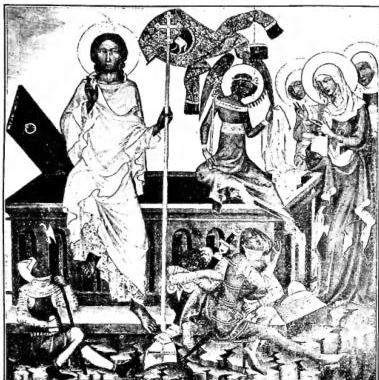
1. Meaning. — Easter, the commemoration of the Resurrection of Jesus Christ, is the oldest and most solemn feast of Christians, the beginning and center of the ecclesiastical year. It is a movable feast, celebrated on the first Sunday after the full moon of the vernal equinox, that is, no earlier than March 22 and no later than April 25. This date determines the ecclesiastical year: the beginning of Septuagesima and Lent, the other movable feasts (Ascension, Pentecost, etc.), and the number of Sundays after Epiphany and after Pentecost; in ancient times and in the Middle Ages, this calendar was recorded on a parchment affixed to the paschal candle.2. Origin of Easter. — Christian Easter has its roots in apostolic tradition; it does not perpetuate the Jewish feast, but fulfills it with its purely Christian content
3. The meaning of the mystery in East and West
Two different phases of the mystery celebrated at Easter can be distinguished: the theoretical-theological phase of the first three Christian centuries and the more historical-real phase from the 4th century onward. The former, the theoretical-theological, celebrated the redemption accomplished by Christ through His Passion, death, and Resurrection; the Passion and death in the sadness and mourning of the fast, the Resurrection in the glory of the Eucharistic celebration. In the nocturnal vigil before the first light of day, the "Transit" (the Passover) took place, that is, the fast ended and the Eucharist was celebrated. The Asian Church celebrated this "transit," the Passover, on the evening of Nisan 14, regardless of which day of the week it fell on, just like the Jews, thereby opposing the Christian fulfillment to the Jewish type and accentuating the Lord's death more as a transit to the Resurrection—that is, celebrating together with His death also the mystery of Christ's Resurrection in a common solemnity. The Western Church, on the other hand, celebrated the Passion and death of the Lord, also in the mourning of the fast, but ended the fast on Sunday, the day of the Kyrios (the Lord elevated in glory), to celebrate Easter, placing a stronger emphasis on Christ's Resurrection. Since the 4th century, the individual days of Holy Week were given names corresponding to the course of historical events according to the custom of the Church of Jerusalem, as described by Egeria in her itinerary: on Thursday the Eucharist was commemorated, on Friday the Passion. Easterwas celebrated in the night following the aliturgical Saturday; it was the only Saturday of the year on which fasting was observed in the East. The following Sunday became the solemnity of the Resurrection.
The early Fathers gave the name of Easter only to the day of the Lord's Passion and death, and the preceding fast was called "paschal," deriving from the Greek πάσχειν = to suffer. However, St. Cyprian began to call the day of the Resurrection Easter as well, a name that has since remained attached to the feast of the Resurrection. From this feast, the word Easter became synonymous with a major feast and solemnity (e.g., Pascha Epiphaniae, Pascha Pentecostes, in Spain Pascha floridum for Palm Sunday), and even the "Easter" of a saint. Therefore, it is called Pascha magnum or Pascha Resurrectionis to distinguish it from the other paschal feasts. The Greeks still speak today of Good Friday as the Easter of the Crucifixion (πάσχα σταυρώσιον) and of the following Sunday as the Easter of the Resurrection (πάσχα δυνατόσιον).
A particular feature of Easter was the vigil, "Mother of all Christian vigils" (St. Augustine, Serm. 219: PL 5, 1088). The paschal night was most holy and solemn; churches and homes were illuminated and, by order of the Emperor Constantine (Eusebius, Vita Constant., IV, 22, 2), the streets as well. It was a pannychis; already in the time of Tertullian, the entire night was spent in sacred readings and prayers. On that holy night, the neophytes received Baptism and Confirmation, and for the first time attended the celebration of the Eucharist with the faithful; the holy oils were blessed (Hippolytus, Traditio Apostolica, 21, ed. B. Botte, Paris 1946, p. 49). This most solemn night, preserved until today in the Eastern Church and shifted in the Western Church, from the 9th century onward, toward morning, was restored in 1951. It begins with the blessing of the fire, of the new light of the paschal candle, amid the cry of the Lumen Christi (v.) and the singing of the Exultet (v.), the lucernarium of the Holy Font; this is followed by the reading of the prophecies—12, 6, or 4, as now in the new Ordo—with their respective canticles. After the white of the Lumen Christi and the Exultet, the violet of paschal mourning returns; then the blessing of the Font and the administration of Baptism; in the restored new rite there is the renewal of baptismal promises; followed by the paschal Mass, in white vestments, with the transition from mourning to joy in the threefold singing of the Alleluia. Originally this was the only Mass of the great solemnity at the close of the pannychis. But when the vigil began on Saturday evening, in the time of St. Gregory I, the Mass of the day was introduced with the Gospel of St. Mark, in which the beautiful sequence Victimae is sung, attributed to Wipo (d. c. 1050). Another particular feature of Easter is the octave, which closes with the hour of None on Saturday in Albis. Each day of this octave has its own proper formulary with its proper station; the prayers and readings make mention of both the Resurrection and Baptism; the neophytes attended in their white garments; after vespers there was a solemn procession. There were 7 feast days, but after the 10th century only the first two days following Sunday remained such; under Pius X these were also suppressed, remaining festive only in the liturgical office.
A further particularity of the paschal feast is the 50 days following it, called Quinquagesima paschalis, until Pentecost, which falls precisely on the fiftieth day after Easter; in ancient times they formed the feast of the Resurrection, which began immediately after the Easter of the vigil. During this time the entire Office is pervaded by a sentiment of joy; the Alleluia is added to all responsories, versicles, and antiphons of the Office; it is repeated over and over again in the Mass. As a sign of joy, kneeling was avoided during prayers. In the Sacramentaries and in all the Capitularies of the 7th-8th centuries, the Pascha annotinum is noted, a feast celebrated on the Monday after Low Sunday (Sunday in Albis) to remind the baptized of the previous year's Easter of their initiation into the Faith.