RISURREZIONE DI GESÙ CRISTO

RESURRECTION OF JESUS CHRIST

Article illustration

The historical fact of the Resurrection of Christ and the related dogmatic treatment are discussed under the entry "GESÙ CRISTO." The liturgical commemoration of the Resurrection is treated under "PASQUA." Here, the discussion concerns only the iconographic aspect.

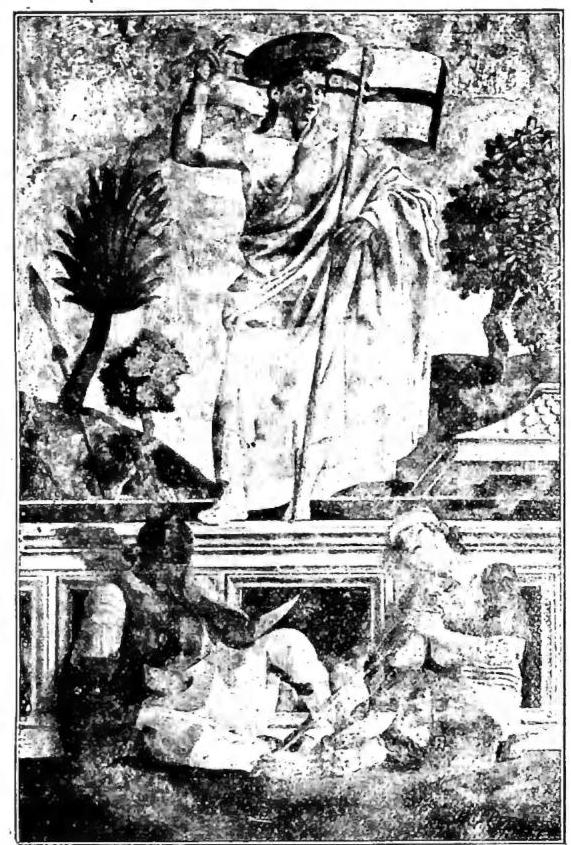
The Resurrection of Christ was already depicted in early Christian art, as evidenced by several carved sarcophagi adorned with scenes of the Passion. At that time, however, the Resurrection was represented symbolically, by means of a Cross (Crux nuda) surmounted by the monogram "Pax," beneath which two guards sleep; birds singing God’s glory are placed around the Cross, alluding to the paradisiacal atmosphere of the sacred scene (v. ANASTASI). Excellent examples of this primitive symbolic depiction of the Resurrection are provided by two marble sarcophagi from the 4th century in the Museo Cristiano Lateranense in Rome (nos. 164 and 171). It is noteworthy that in early Christian sarcophagi, such a symbolic representation of the Resurrection always occupied the central position among the other scenes of Our Lord’s Passion.

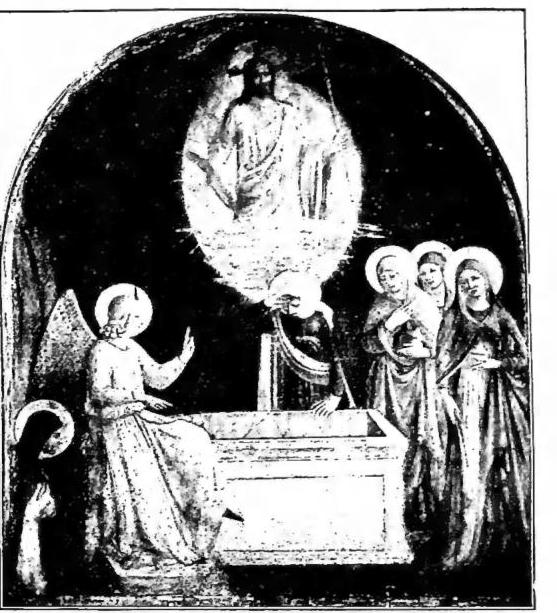
The Middle Ages adopted a very different visual concept: namely, an open tomb, beside which are seen two or three pious women on one side and one or two angels on the other.

Until around 1300, the figure of the risen Christ was not depicted at all in representations of the Resurrection; all such depictions therefore showed a moment subsequent to the Lord’s emergence from the empty tomb. One of the earliest examples of this iconographic concept is a 9th-century fresco in the lower church of S. Clemente in Rome; another appears in the frescoes of S. Angelo in Formis (11th century). According to the same concept, the Resurrection was depicted among the scenes of the Passion cycle adorning the side panels of painted and shaped crosses—for example, the cross of Enrico di Tedice in S. Martino in Pisa. The same visual scheme was used by Duccio in the Maestà of the Siena Cathedral. A similar representation, showing the pious women at the empty tomb guarded by an angel, appears in the Resurrection of Christ by Lorenzo Maitani on the piers of the façade of Orvieto Cathedral. Even Giotto, in his Resurrection fresco painted shortly after 1305 on the walls of the Scrovegni Chapel in Padua, largely adhered to the traditional medieval iconographic scheme, depicting the sacred scene with an empty tomb guarded by two angels and surrounded by sleeping guards. However, he also wove into this depiction of the Resurrection the image of the risen Christ holding the banner of salvation in His hands, appearing to Mary Magdalene.

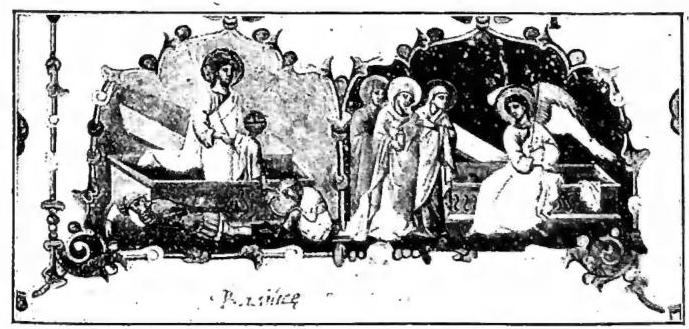
An important general shift in the iconography of the Resurrection occurred around 1300, when the first examples appear of the depiction of Christ’s figure within the scene itself. This change in iconographic concept is well illustrated by a Roman miniature from the circle of Pietro Cavallini, datable to about 1303, which adorns the Exultet in codex 78 B of the Archivio di S. Pietro in Rome. There, the Resurrection is depicted in two successive scenes, grouped together: the first presents a new concept, showing Christ emerging from the open sarcophagus, while the guards sleep.

Article illustration

**Resurrection of Jesus Christ** – The Risen Christ and the Pious Women at the Tomb. Miniature from the Exultet B 78 of S. Pietro. Work of a Roman miniaturist, follower of Pietro Cavallini (1303–1305). Rome, Archivio della Basilica di S. Pietro, cod. 78 B.

Article illustration
(Courtesy of Signorina Ida Bertagna)

**Resurrection of Jesus Christ** – The Risen Christ and the Pious Women at the Tomb. Miniature from the Exultet B 78 of S. Pietro. Work of a Roman miniaturist, follower of Pietro Cavallini (1303–1305). Rome, Archivio della Basilica di S. Pietro, cod. 78 B.

RESURRECTION OF JESUS CHRIST – RESUSCITATION AND REVIVISCENCE

Mt. 27:52–53; Jn. 11:1–45), the beloved friend Lazarus, dead for four days (Jn. 11:1–45). At the moment of Jesus’ death, many bodies of saints who had previously died rose again, appearing to many in Jerusalem (Mt. 27:52–53). Above all, crowning and irrefutable proof of His divinity is His own glorious Resurrection at dawn on the third day after His crucifixion.

In apostolic times, Peter restored life to the deceased Tabitha at Joppa (Acts 9:36–42), and Paul raised the young man Eutychus at Troas, who had fallen from the third-story window while asleep on the window ledge during the Apostle’s long discourse (Acts 20:6–12).

Resurrections from death also recur throughout the history of the Church. A common expedient of those who deny the reality of resurrection miracles is to refuse to acknowledge their historical existence; if the fact is admitted historically, criticism attempts naturalistic explanations, judging them to be cases of awakening from states of lethargy (v.) or apparent death (v.), or of reviviscence (v.). Thus, cases of resurrection are assimilated to phenomena well studied and known to biology and medicine, which, however, are quite different from true resurrection.

Article illustration

Lethargy is a phenomenon found only in lower mammals or in even more primitive animal species, in the form of estivation or hibernation. It consists in an appearance of deep sleep, but is fundamentally different from sleep in its essence, being marked by a reduction to a minimum of the principal functions of vegetative life (respiration, circulation, basal metabolism) and an almost complete abolition of those of relational life. Its characteristic is that it is tied to environmental conditions and represents a means of enabling the individual to survive in circumstances in which normal life would not be possible; in such a state, reserves—particularly of fat—accumulated in the animal’s body are slowly consumed (v. DIGIUNO). True lethargy does not occur in man; only exceptionally, under particular environmental conditions and with maximum fat reserves, may there be phenomena of minimal life in which the subject reduces all forms of relational activity and energy expenditure to the maximum degree. Examples of this kind may be observed during long periods of starvation to which man may be exposed during famines or confinement in concentration camps. Under such conditions, the periods of daily sleep may be greatly prolonged, during which the economy of internal metabolism is maximized; but the conditions proper to lethargy are never established, either from the point of view of vegetative life or that of relational life. It has been said that, due to extreme scarcity of food, Russian peasants and Eskimos may fall into a particular lethargic sleep, with vital manifestations reduced almost to a latent form (O. Polimanti, *Il letargo*, Rome 1913).

Other things, however, are the conditions, peculiar to man, ACATALESSIA (v.) and lethargy. Here we are dealing with true morbid forms, always indicative of neuropsychic abnormality, in subjects suffering from either organic diseases of the nervous system (encephalitis) or hysteria (v.) or certain forms of nervous disorders (v.). In such forms, the functions of the life of relation are mainly affected, the subject assuming the appearance of a person deeply asleep; the pulse and respiration are slow, and in some cases these may even come to a standstill, prolonged for several hours, thus giving the appearance of death; an appearance only, since a careful examination of the other functions (circulation, nervous reactivity) shows that the individual is still alive. Some authors speak of cases of lethargy lasting even 32 days (Krauss), with regard to the appearance of sleep, while the functions of circulation and respiration remain present. In a case reported by Pfendler (cited by Binswanger), there was an arrest of respiration for 48 hours, while cardiac activity remained intact. It is therefore never a question of death in the absolute sense of the word, since the cardinal functions of vegetative life always persist, albeit reduced to a minimum that is almost imperceptible to a cursory examination. In cases where the last manifestations of life are reduced to cardiac activity, revival is possible only through the timely, skilled, and prolonged intervention of a physician; spontaneous return to life of an individual in a state of so-called apparent death, in which only cardiac activity persists, is excluded.

Medical literature describes cases of revival obtained by extraordinary means of resuscitation even several minutes after complete cardiac arrest. In such cases, when all vital functions have ceased, it might seem a question of true revival from death. Here, too, however, the vitality of the muscular and ganglionic cells of the heart persists, albeit in a state of temporary functional inhibition; but this lasts only for a very brief time, after which even the most resistant cells succumb to death due to asphyxia (anoxia) and the accumulation of toxic catabolic products.

Even more rapidly do the higher functional elements of the nervous system, those proper to the cortical and subcortical zones, die. After a certain period of time—truly very brief—following the suspension of respiration and circulation, even if extraordinary means succeed in reactivating and restoring these functions to automaticity for a time, the individual remains irretrievably dead in his sensory-conscious and voluntary-motor activity. All ties of intelligence, affectivity, and will with the environment are destroyed in him: what was once a man is reduced to the condition of an experimental animal whose cerebral hemispheres have been destroyed (Goltz’s dog). Among the most recent cases, well-demonstrating the limited hope of full revival, see the one reported and illustrated by E. Scavo, “La riviviscenza,” a lecture delivered on May 5, 1952, at the Università Internazionale G. Marconi in Rome.

The nervous system, the indispensable instrument of all internal coordination of the organism and of relation with the external world, falls into absolute death very rapidly. Ricche found that after only three minutes the spinal cord of a dog, exsanguinated, dies irretrievably; Stewart sets the maximum term at seven minutes, while Weinberger and colleagues have affirmed that life cannot be restored if circulatory arrest lasts more than 8 minutes and 45 seconds (v. BIBLICA). The various elements of the nervous system resist prolonged lack of oxygenation (anoxia) in inverse relation to their degree of functional dignity, and absolute death inevitably progresses from the highest to the most elementary structures. Anoxia produces loss of consciousness in 10 seconds, arrest of the electrical waves of the electroencephalogram in 20–30 seconds; in 3–5 minutes the higher nervous structures (beginning with cortical neurons, followed by the basal nuclei, particularly the lenticular nucleus, and the cerebellum) undergo irreversible destructive alterations. More resistant, though still within limits, are the bulbar cardiocirculatory centers (15–20 minutes) and the respiratory centers (30–60 minutes). Resistance is greater in young individuals (greatest in asphyxiated newborns) than in adults with a brain in full activity (v. BIBLICA). For these reasons, attempts at resuscitation of an individual suffering from simple respiratory arrest followed shortly by cardiac arrest, or from simultaneous cardiocirculatory arrest, may offer a hope of revival that is all the greater the more rapidly and energetically resuscitation measures are applied: artificial respiration, manual or mechanical; rhythmic electrical stimulation of the phrenic nerve; cardiac excitation with intracardiac injections (adrenaline, barium chloride, etc.); mechanical irritation of the pericardium; direct cardiac massage; intravenous injections or perfusions of medications or artificial physiological solutions or donor blood or plasma; artificial circulation with external mechanical devices for circulation and oxygenation, directly connected to the circulatory system of the subject to be resuscitated.

It must therefore be clearly emphasized that in an individual suffering from respiratory arrest and cardiac syncope, revival always represents a complex and difficult task, requiring first-class technical organization, skilled operators, the utmost promptness of action, and is always uncertain in its final outcome—both with regard to the lasting restoration of automatic respiration and cardiac activity and, even more so, with regard to a full recovery of the activity of the higher nervous system. In all cases, even the most recent ones, in which revival was obtained by extraordinary means after cardiac arrest lasting more than a few minutes (three and a half), real death followed within a few hours or days, and in every case, during such a period of survival, the individual showed no recovery of higher neuropsychic faculties.

A particular form of suspension and return to vital activity is that spoken of with regard to the fakirs (v.), who are said to be able to appear dead, remain buried for a certain time, and then return to life through appropriate maneuvers. Such facts might be invented to provide a rationalistic explanation of the miracle of revival, but in fact, the descriptions of these phenomena by eyewitnesses (C. Godard, op. cit. in bibl., p. 46; J. De Boninot, op. cit. in bibl., pp. 172–74) are incomplete and contradictory, so that they cannot serve as evidence of scientific value and lend themselves to denial and accusations of trickery. If one wishes to accept some more seriously documented cases, in which the fact of such complete and prolonged suspension of every vital manifestation is in glaring contrast with the biological characteristics of living tissues and occurs in the course of magical rituals, it is necessary to admit that we are here on the borders of nature and must consider the intervention of a preternatural cause.

From what has been said, it is clear, therefore, that there is a very distinct difference between true death and its mere appearance; even when the life of the individual is reduced to an intensity that is almost imperceptible, at the level of the major organic functions of respiration, circulation, irritability, and reflex activity of the nervous system. On the other hand, biological experiment and clinical observation clearly demonstrate how the nervous system is endowed with extreme fragility and is affected in the most absolutely lethal manner by the lack of oxygen (anoxia): a few minutes of asphyxia are sufficient to irreparably destroy not only the organ of the most human faculties (cortical and subcortical areas), but also those bulbo-spinal nerve centers essential for life to be preserved and maintained in the consensus partium (Hippocrates) of the structures and functions of our organism. Thus, the step between apparent death and definitive real death is brief and fatal, all the more so as the two states become more indistinguishable from each other. Conversely, an insurmountable barrier absolutely separates the phenomenon of reviviscence from that of resurrection; while the former is the awakening and revitalization of functions that have been dormant and weakened to the point of extinction, the latter represents a new creation of a life that has been completely annihilated. Practically speaking, from the standpoint of the causality of these two events, in the first we observe the complex equipment, the multiplicity and variety of means, the urgency of the maneuvers involved in attempting to bring the subject back from the threshold of death to life once again, fully and enduringly; in the second, the simplicity of the means and the power of the results proper to the recreative act of resurrection!

Examined objectively, with the gaze of unprejudiced criticism, the resurrections of the Old and New Testaments clearly present a twofold characteristic: the certainty of an absolutely accomplished death, and the wonderful simplicity and human inadequacy of the means employed to recall the dead to life.

The son of the widow of Zarephath, dead from a very serious illness, and that of the Shunammite woman, from a violent cerebral congestion, were certainly dead, if they succeeded in destroying every last human hope, every foolish illusion from the anxious hearts of their respective mothers. The son of the widow of Nain was so certainly dead in the estimation of all that he was already being taken for burial; the daughter of Jairus, whose illness had progressively worsened to the point of laying low at the feet of Jesus the pride of a synagogue leader, was certainly not sleeping amid the tumult of weeping and lamentation, but appeared to all present as dead, scientes quod mortua esset (Lk. 8:53); Lazarus, dead and entombed for four days, was already a corpse in full state of putrefaction (iam foetet: ibid. 11:39).

Such growing certainty of death reaches its highest point in that of Jesus. He, in fulfillment of His Passion, undergoes an execution, the torment of the Cross (q.v.), which both historical experience of crucifixion cases and experimental scientific investigations conducted by scholars of the Passion and the Holy Shroud (q.v.) demonstrate to be certainly mortal. The fact, of course, has been explained in various ways from the standpoint of pathogenic mechanism. Thus, various authors have admitted as the determining cause of death: hunger, thirst, exposure to the sun, the obstruction of respiratory movements due to the stretching of the crucified arms, cardiac arrest from reflex syncope, hypercalcemia with muscular tetany and asphyxia (Hynek), and various other causes besides. Experimental research (suspensions of persons by the arms, with or without support for the legs) conducted by U. Modder (communication to the International Congress of Studies on the Holy Shroud, Rome 1950) would indicate as the cause of death in the crucified the "orthostatic collapse," i.e., the drop in arterial pressure with progressive acceleration of the pulse due to blood stasis in the lower parts of the body and the emptying of the upper parts, rendering the return of blood to the right chambers of the heart impossible.

Whatever the mechanism may be, it is certain, however, that crucifixion must be considered a certainly mortal execution. In the case of Christ, in particular, although we must hold as certain that His death occurred by an act of His own will at the predestined moment, in the mechanism of natural causes contributing to the effect of the final execution were the severe moral and physical sufferings that accompanied Jesus from the Last Supper to Calvary. Thus: the agony of prayer in the Garden of Olives, the external and internal injuries produced by scourging, the excruciating pains of the crowning with thorns, the exhausting fatigue, the repeated hemorrhages (cf. G. Judica-Cordiglia, Cristo: l'Uomo, in Perfice Munus, Medicina e Morale, Turin 15 Sept. 1951, no. 18, pp. 164-69). Moreover, the lance thrust of the centurion, piercing through the right intercostal space and the corresponding atrium of the heart, while it was the legal proof of death having occurred, would by itself alone have been sufficient to cause II.
Unless one were to deny the entire historical reality of the Gospels and the demonstrated objectivity of their narrative, no honest and intelligent criticism could maintain that the death of Christ was a case of lethargy or apparent death.

Turning our attention to the other characteristic note of the resurrections in the Old and New Testaments, the simplicity and human inadequacy of the means used to recall the dead to life, the most striking disparity is evident between human effort at reviviscence and the divine act of resurrection. This note is particularly evident in the resurrection of Christ, which occurs by His own power, He who "ipse se suscitavit occisum" (St. Augustine, In Johannis evangelium tract., XII, nn. 10-11; PL 35, 1489).

BIBL.: J. De Bonniet, Le miracle et ses contrefaçons, Paris 1845; C. Richet, La mort du coeur dans l'asphyxie, in Arch. de physiol., 26 (1894), p. 653; C. Godard, Le fakirisme, Paris 1900; G. N. Stewart et al., The Resuscitation of the Central Nervous System of Mammals, in J. Exner, Med., 8 (1906), p. 280; M. Wilke, Hatayoga, Dreda 1926; M. D. Mercier Fautes, Cardiac Resuscitation, in The Journal of Thoracic Surgery, vol. XVI, no. 6, Dec. 1947, St. Louis U.S.A.; G. Ricciotti, Vita di Cristo, Milano 1941; L. Seremin, Diz. di morale professionale, 4th ed., Roma 1949; id., La sopravvivenza artificiale, in Scienza e vita, anno I, no. 5, Roma June 1949; Sidney C. Wiggins-P. Saunders-G. A. Small, Resuscitation, in The New England Journal of Medicine, vol. 241, nos. 10-11, 8-15 Sept. 1949, Boston U.S.A. (q.V. extensive bibliography); A. Alliney, La r. di Gesù, in Orizzonte medico, anno VII, nos. 4-5, Roma Apr.-May 1952; q.V. also FACHIRIO; LETARGIA; SINDONE.